Current issue
Archive
Manuscripts accepted
About the Journal
Editorial office
Editorial board
Section Editors
Abstracting and indexing
Subscription
Contact
Ethical standards and procedures
Most read articles
Instructions for authors
Article Processing Charge (APC)
Regulations of paying article processing charge (APC)


RESEARCH PAPER
Lipoprotein(a) levels and recorded post-test changes in lipid-lowering therapy in a large real-world Polish cohort
1
2nd Department of Cardiology, Jagiellonian University Medical College, Poland
2
Collegium Medicum, Jan Kochanowski University, Kielce, Poland, Poland
3
Department of Internal Medicine and Cardiology, Medical University of Warsaw, Warsaw, Poland, Poland
Submission date: 2026-05-31
Final revision date: 2026-07-19
Acceptance date: 2026-08-25
Online publication date: 2026-09-28
Corresponding author
Artur Dziewierz
2nd Department of Cardiology, Jagiellonian University Medical College, Kopernika 17, 31-501, Krakow, Poland
2nd Department of Cardiology, Jagiellonian University Medical College, Kopernika 17, 31-501, Krakow, Poland
KEYWORDS
TOPICS
ABSTRACT
Introduction:
Elevated lipoprotein(a) [Lp(a)] is a recognized cardiovascular risk factor, but its association with subsequent lipid-lowering treatment (LLT) patterns is unclear. We assessed whether higher Lp(a) levels were associated with recorded post-test changes in lipid-lowering therapy (LLT).
Material and methods:
This retrospective observational study included 23,654 adults tested for Lp(a) within LUX MED, a nationwide private healthcare network in Poland (April 2025-February 2026). Patients were categorized as Lp(a) <62, 62 to <105, or ≥105 nmol/L. Recorded statin initiation, escalation, ezetimibe initiation, and any LLT intensification recorded after Lp(a) testing were compared across categories. Multivariable logistic regression evaluated associations between Lp(a) and LLT initiation and intensification, adjusting for age, sex, body mass index, atherosclerotic cardiovascular disease (ASCVD), current LDL-C, HDL-C, and triglycerides; intensification models additionally adjusted for baseline statin and ezetimibe use.
Results:
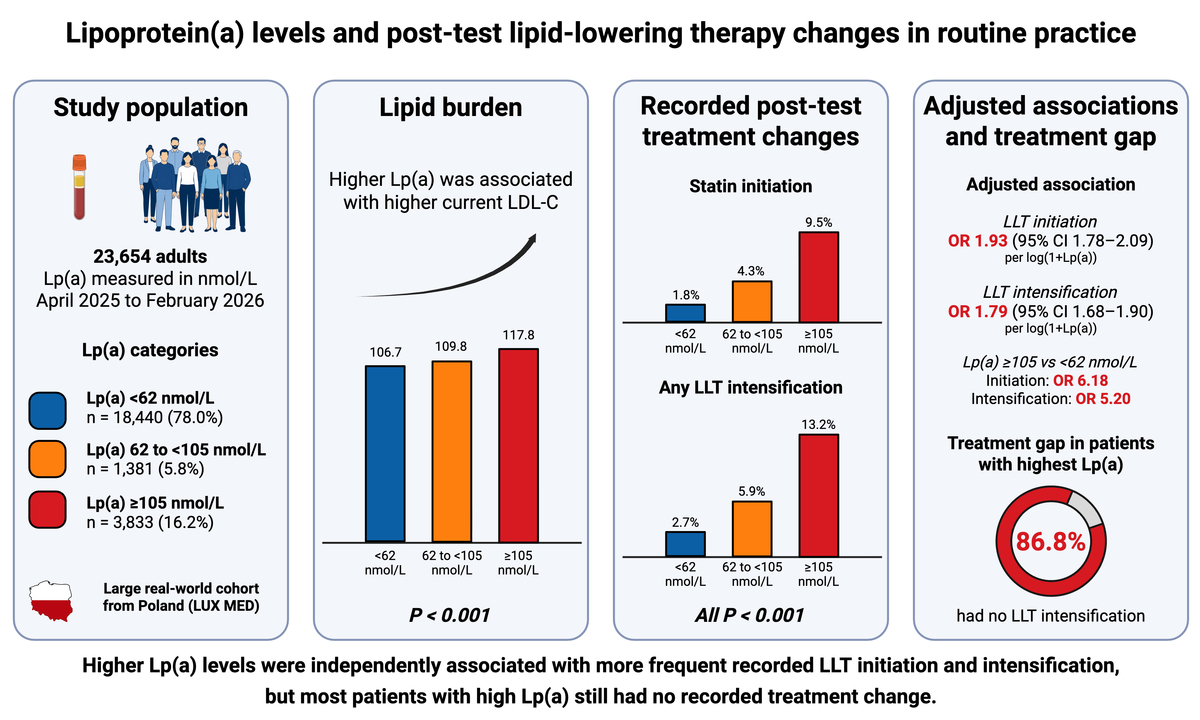
Current LDL-C increased across categories (P<0.001). Statin initiation was 1.8%, 4.3%, and 9.5%, while any LLT intensification was 2.7%, 5.9%, and 13.2% across increasing Lp(a) categories (both P<0.001). Higher Lp(a) remained associated with LLT initiation (OR 1.93, 95% CI 1.78–2.09) and intensification (OR 1.79, 95% CI 1.68–1.90; both P <0.001) per 1-unit increase in ln[1+Lp(a)]. Associations were stronger in younger patients and, for intensification, in women and patients without ASCVD. However, 86.8% of patients with Lp(a) ≥105 nmol/L had no recorded intensification.
Conclusions:
Higher Lp(a) was associated with more frequent recorded post-test LLT initiation and intensification, but absolute rates remained low. These findings suggest an implementation gap but cannot establish that Lp(a) testing itself prompted treatment change.
Elevated lipoprotein(a) [Lp(a)] is a recognized cardiovascular risk factor, but its association with subsequent lipid-lowering treatment (LLT) patterns is unclear. We assessed whether higher Lp(a) levels were associated with recorded post-test changes in lipid-lowering therapy (LLT).
Material and methods:
This retrospective observational study included 23,654 adults tested for Lp(a) within LUX MED, a nationwide private healthcare network in Poland (April 2025-February 2026). Patients were categorized as Lp(a) <62, 62 to <105, or ≥105 nmol/L. Recorded statin initiation, escalation, ezetimibe initiation, and any LLT intensification recorded after Lp(a) testing were compared across categories. Multivariable logistic regression evaluated associations between Lp(a) and LLT initiation and intensification, adjusting for age, sex, body mass index, atherosclerotic cardiovascular disease (ASCVD), current LDL-C, HDL-C, and triglycerides; intensification models additionally adjusted for baseline statin and ezetimibe use.
Results:
Current LDL-C increased across categories (P<0.001). Statin initiation was 1.8%, 4.3%, and 9.5%, while any LLT intensification was 2.7%, 5.9%, and 13.2% across increasing Lp(a) categories (both P<0.001). Higher Lp(a) remained associated with LLT initiation (OR 1.93, 95% CI 1.78–2.09) and intensification (OR 1.79, 95% CI 1.68–1.90; both P <0.001) per 1-unit increase in ln[1+Lp(a)]. Associations were stronger in younger patients and, for intensification, in women and patients without ASCVD. However, 86.8% of patients with Lp(a) ≥105 nmol/L had no recorded intensification.
Conclusions:
Higher Lp(a) was associated with more frequent recorded post-test LLT initiation and intensification, but absolute rates remained low. These findings suggest an implementation gap but cannot establish that Lp(a) testing itself prompted treatment change.
REFERENCES (44)
1.
Bennet A, Di Angelantonio E, Erqou S, et al. Lipoprotein(a) levels and risk of future coronary heart disease: large-scale prospective data. Arch Intern Med. 2008;168:598-608.
2.
Erqou S, Kaptoge S, Perry PL, et al. Lipoprotein(a) concentration and the risk of coronary heart disease, stroke, and nonvascular mortality. JAMA. 2009;302:412-423.
3.
Clarke R, Peden JF, Hopewell JC, et al. Genetic variants associated with Lp(a) lipoprotein level and coronary disease. N Engl J Med. 2009;361:2518-2528.
4.
Berman AN, Biery DW, Singh A, et al. Atherosclerotic cardiovascular disease risk and elevated lipoprotein(a) among young adults with myocardial infarction: the Partners YOUNG-MI Registry. Eur J Prev Cardiol. 2021;28:e12-e14.
5.
Wilson DP, Jacobson TA, Jones PH, et al. Use of lipoprotein(a) in clinical practice: a biomarker whose time has come. A scientific statement from the National Lipid Association. J Clin Lipidol. 2022;16:e77-e95.
6.
Kronenberg F, Mora S, Stroes ESG, et al. Lipoprotein(a) in atherosclerotic cardiovascular disease and aortic stenosis: a European Atherosclerosis Society consensus statement. Eur Heart J. 2022;43:3925-3946.
7.
Mavilakandy AK, Gu T, Lip GYH. Lipoprotein(a) and body mass index in new-onset atrial fibrillation: synergistic in risk? Pol Arch Intern Med. 2025;135:17166.
8.
Guo W, Shi H, You X, et al. Joint association of body mass index and lipoprotein(a) with atrial fibrillation prevalence: an observational and Mendelian randomization study. Pol Arch Intern Med. 2025;135:17123.
9.
Konieczyńska M, Natorska J, Ząbczyk M, Undas A. Lipoprotein(a) and thromboembolism: current state of knowledge and unsolved issues. Arch Med Sci. 2024;20:1770-1783.
10.
Patel AP, Wang M, Pirruccello JP, et al. Lp(a) (lipoprotein[a]) concentrations and incident atherosclerotic cardiovascular disease: new insights from a large national biobank. Arterioscler Thromb Vasc Biol. 2021;41:465-474.
11.
Berman AN, Biery DW, Besser SA, et al. Lipoprotein(a) and major adverse cardiovascular events in patients with or without baseline atherosclerotic cardiovascular disease. J Am Coll Cardiol. 2024;83:873-886.
12.
Sosnowska B, Stepinska J, Mitkowski P, et al. Recommendations of the Experts of the Polish Cardiac Society (PCS) and the Polish Lipid Association (PoLA) on the diagnosis and management of elevated lipoprotein(a) levels. Arch Med Sci. 2024;20:8-27.
13.
Mach F, Koskinas KC, Roeters van Lennep JE, et al. 2025 focused update of the 2019 ESC/EAS guidelines for the management of dyslipidaemias. Atherosclerosis. 2025;409:120479.
14.
Pearson GJ, Thanassoulis G, Anderson TJ, et al. 2021 Canadian Cardiovascular Society guidelines for the management of dyslipidemia for the prevention of cardiovascular disease in adults. Can J Cardiol. 2021;37:1129-1150.
15.
Koschinsky ML, Bajaj A, Boffa MB, et al. A focused update to the 2019 NLA scientific statement on use of lipoprotein(a) in clinical practice. J Clin Lipidol. 2024;18:e308-e319.
16.
Sosnowska B, Toth PP, Razavi AC, et al. 2024: The year in cardiovascular disease - the year of lipoprotein(a). Research advances and new findings. Arch Med Sci. 2025;21:355-373.
17.
Khera AV, Everett BM, Caulfield MP, et al. Lipoprotein(a) concentrations, rosuvastatin therapy, and residual vascular risk: an analysis from the JUPITER trial. Circulation. 2014;129:635-642.
18.
Ruscica M, Greco MF, Ferri N, et al. Lipoprotein(a) and PCSK9 inhibition: clinical evidence. Eur Heart J Suppl. 2020;22:L53-L56.
19.
Telyuk P, Austin D, Luvai A, et al. Lipoprotein(a): insights for the practicing clinician. J Clin Med. 2022;11:3673.
20.
de Boer LM, Oorthuys AOJ, Wiegman A, et al. Statin therapy and lipoprotein(a) levels: a systematic review and meta-analysis. Eur J Prev Cardiol. 2022;29:779-792.
21.
Dyrbuś K, Banach M, Gil R, et al. Interdisciplinary expert team statement on the treatment of multi-bed atherosclerotic disease - endorsed by Polish Cardiac Society, Polish Lipid Association, Polish Society of Diabetology, Polish Neurological Society, Polish Society of Nephrology. Kardiol Pol. 2025;83:531-539.
22.
Kış M, Aydın S, Ekici B, Oktay Ç. Treatment and lifestyle change recommendations by cardiologist for patients attending cardiology outpatient clinics: a TLC study. Adv Interv Cardiol. 2025;21:73-79.
23.
Willeit P, Ridker PM, Nestel PJ, et al. Baseline and on-statin treatment lipoprotein(a) levels for prediction of cardiovascular events: individual patient-data meta-analysis of statin outcome trials. Lancet. 2018;392:1311-1320.
24.
Tomlinson B, Law CF. Lipoprotein(a): treatments in development. Expert Opin Pharmacother. 2025;26:1831-1839.
25.
Nicholls SJ, Nelson AJ. Current perspectives on Lp(a)-lowering therapies: who may benefit? Kardiol Pol. 2025;83:688-694.
26.
Bahit MC, Gibson M, Kuleta M, et al. Vision impairment following glucagon-like peptide-1 receptor agonist use: is it harmful? Pol Arch Intern Med. 2025;135:16987.
27.
Dziewierz A, Nowak K, Rajtar-Salwa R, et al. Underutilization of GLP-1 receptor agonists for non-diabetic weight management by cardiologists in Poland. Kardiol Pol. 2026;84:250-253.
28.
Bobrowska B, Dziewierz A, Domienik-Karłowicz J, et al. Distribution of lipoprotein(a) and its association with atherosclerotic cardiovascular disease in a large real-world Polish cohort. J Clin Lipidol. 2026; in press.
29.
Burzyńska M, Jankowski P, Babicki M, et al. Prevalence of hyperlipoproteinemia(a) in individuals of European ancestry treated at outpatient cardiology clinics: results from a cross-sectional STAR-Lp(a) study. Pol Arch Intern Med. 2024;134:16860.
30.
Konieczyńska M, Nowak K, Pudło J, et al. Elevated lipoprotein(a) in the middle-aged Polish population: preliminary data on the genetic background. Kardiol Pol. 2023;81:1279-1281.
31.
Suk Danik J, Rifai N, Buring JE, et al. Lipoprotein(a), measured with an assay independent of apolipoprotein(a) isoform size, and risk of future cardiovascular events among initially healthy women. JAMA. 2006;296:1363-1370.
32.
Waldeyer C, Makarova N, Zeller T, et al. Lipoprotein(a) and the risk of cardiovascular disease in the European population: results from the BiomarCaRE consortium. Eur Heart J. 2017;38:2490-2498.
33.
Arnold N, Blaum C, Goßling A, et al. Impact of lipoprotein(a) level on low-density lipoprotein cholesterol- or apolipoprotein B-related risk of coronary heart disease. J Am Coll Cardiol. 2024;84:165-177.
34.
Nissen SE, Wolski K, Cho L, et al. Lipoprotein(a) levels in a global population with established atherosclerotic cardiovascular disease. Open Heart. 2022;9:e002060.
35.
Hoogeveen RC, Diffenderfer MR, Lim E, et al. Lipoprotein(a) and risk of incident atherosclerotic cardiovascular disease: impact of high-sensitivity C-reactive protein and risk variability among human clinical subgroups. Nutrients. 2025;17:1324.
36.
Stürzebecher PE, Schorr JJ, Klebs SHG, et al. Trends and consequences of lipoprotein(a) testing: cross-sectional and longitudinal health insurance claims database analyses. Atherosclerosis. 2023;367:24-33.
37.
Parsa S, Shah P, Furst A, et al. Association between lipoprotein(a) testing, lipid-lowering therapy intensification, and low-density lipoprotein cholesterol goal attainment: findings from the Veterans Affairs Health System. J Am Heart Assoc. 2026;e046519.
38.
Mangla M, Bimal T, Akhabue E, et al. Trends in lipoprotein(a) testing and impact on clinical care: a contemporary systemwide analysis. Am J Prev Cardiol. 2025;25:101402.
39.
Kelly MS, Jeminiwa RN, Gohar F, et al. Evaluation of lipid-lowering therapy in patients with elevated lipoprotein(a) levels. J Clin Lipidol. 2025;19:819-826.
40.
Nowowiejska-Wiewióra A, Wita K, Mędrala Z, et al. Dyslipidemia treatment and attainment of LDL-cholesterol treatment goals in patients participating in the Managed Care for Acute Myocardial Infarction Survivors program. Kardiol Pol. 2023;81:359-365.
41.
Ryczkowska K, Adach W, Janikowski K, et al. Menopause and women's cardiovascular health: is it really an obvious relationship? Arch Med Sci. 2022;19:458-466.
42.
Banach M, Mastalerz-Migas A, Wita K, Myśliwiec M. Poland takes a lead in effective lipid disorders management healthcare programmes in Europe. Am J Prev Cardiol. 2025;24:101346.
43.
Saniewski T, Zimodro JM, Procyk G, et al. Incorporating lipoprotein(a) into patient care: the Polish landscape in light of national recommendations and the updated ESC/EAS guidelines. Arch Med Sci. 2025;21:2246-2257.
44.
Katamesh BE, Mickow AA, Huang L, et al. Overcoming patient reluctance to statin intolerance. Kardiol Pol. 2024;82:485-491.
Share
RELATED ARTICLE
| eISSN: | 1896-9151 |
| ISSN: | 1734-1922 |

We process personal data collected when visiting the website. The function of obtaining information about users and their behavior is carried out by voluntarily entered information in forms and saving cookies in end devices. Data, including cookies, are used to provide services, improve the user experience and to analyze the traffic in accordance with the Privacy policy. Data are also collected and processed by Google Analytics tool (more).
You can change cookies settings in your browser. Restricted use of cookies in the browser configuration may affect some functionalities of the website.
You can change cookies settings in your browser. Restricted use of cookies in the browser configuration may affect some functionalities of the website.