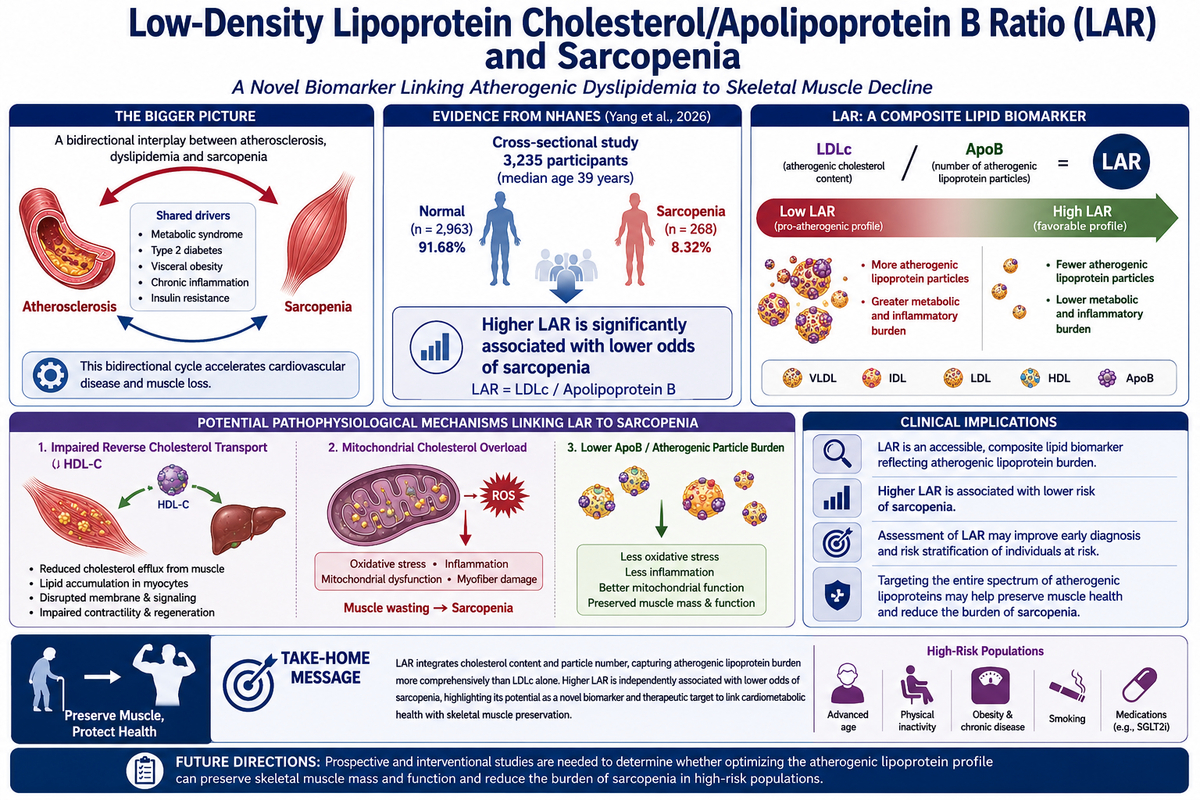
Sarcopenia is a progressive, generalized skeletal muscle disorder involving the loss of muscle mass, strength, and physical performance. The condition is associated with an increased incidence of adverse clinical outcomes, including falls, functional impairment, fractures, and premature mortality. Although sarcopenia is predominantly a condition of older age, it can also manifest earlier in adulthood, particularly in the presence of chronic disease or other predisposing factors [1]. Growing evidence suggests that sarcopenia is linked to an increased risk of cardiovascular disease (CVD), particularly atherosclerosis, independent of conventional CVD risk factors. In turn, atherosclerosis may contribute to the development of sarcopenia by enhancing skeletal muscle loss. Common cardiometabolic conditions, including metabolic syndrome, type 2 diabetes mellitus, and visceral obesity, contribute to both disorders. Together, these conditions create a bidirectional relationship that perpetuates the progression of sarcopenia and cardiovascular disease [2].
Sarcopenia is a multifactorial syndrome resulting from a complex interplay of metabolic abnormalities that contribute to progressive skeletal muscle loss. These metabolic disturbances interact through multiple pathophysiological pathways, creating a self-perpetuating cycle of muscle wasting and functional decline [3]. Among these factors, dyslipidemia has emerged as an important contributor to the development and progression of sarcopenia. Altered lipid metabolism may impair muscle homeostasis by promoting chronic inflammation, oxidative stress, and insulin resistance, thereby accelerating muscle deterioration [2].
Thus, atherosclerosis and dyslipidemia play key roles in the pathophysiology of sarcopenia. Their shared metabolic and inflammatory pathways are increasingly recognized as key drivers of skeletal muscle deterioration [4]. Consequently, growing interest has focused on biomarkers reflecting dyslipidemia and atherosclerotic burden. These biomarkers may provide mechanistic insights into the pathways linking cardiometabolic dysfunction to sarcopenia and may facilitate early diagnosis, risk stratification, and the development of targeted therapeutic strategies [5].
Recent evidence highlights the contribution of fatty acids and other lipid metabolic intermediates to the maintenance of skeletal muscle mass and muscle performance. Dysregulated lipid metabolism promotes the accumulation of lipids and their derivatives within myocytes and the interstitial space, resulting in lipotoxicity and impaired muscle homeostasis. These alterations contribute to oxidative stress, mitochondrial dysfunction, chronic low-grade inflammation, and insulin resistance, all of which are implicated in the pathogenesis of sarcopenia. Consequently, biomarkers of lipid metabolism, including among others, low density lipoprotein cholesterol (LDL-C), non-high density lipoprotein cholesterol (non-HDL-C), HDL-C, triglycerides (TG) or apolipoprotein B (apoB), have attracted increasing interest as potential indicators of muscle health and disease risk. Numerous studies have demonstrated their potential utility as accessible biomarkers for identifying individuals at risk of sarcopenia and monitoring disease progression [6].
In recent years, considerable efforts have been directed toward identifying composite lipid biomarkers that improve the early detection of sarcopenia and facilitate timely clinical intervention. Lipid-derived indices, calculated from combinations of conventional lipid parameters, have emerged as promising tools for risk assessment beyond individual lipid measurements. Among these, the LDL-C/ApoB ratio (LAR) has gained increasing attention as a potential biomarker for muscle health. This ratio may provide additional information regarding metabolic disturbances implicated in the development of sarcopenia.
In this issue of Archives of Medical Science, Yang and Zhang conducted a cross-sectional study that used data from the nationally representative NHANES and included 3,235 participants (48.66% male, median age 39 years), which were divided in normal (91.68%) and sarcopenia (8.32%) groups. The authors revealed that increased LAR is significantly associated with a reduced risk of sarcopenia, highlighting its potential as a novel biomarker of muscle health. The demonstrated association between LAR and sarcopenia may indicate an underlying interaction between atherogenic lipoproteins and the pathophysiological processes contributing to skeletal muscle decline [7].
Several potential mechanisms may account for the pathophysiological processes underlying this association. Mitochondrial cholesterol overload may contribute to skeletal muscle degeneration through disruption of oxidative phosphorylation, resulting in excessive reactive oxygen species (ROS) production, mitochondrial dysfunction, and progressive myofiber damage that accelerates the development of sarcopenia. Conversely, HDL-C plays a critical role in reverse cholesterol transport (RCT) by facilitating the efflux of excess cholesterol from peripheral tissues, including skeletal muscle, to the liver for excretion. Reduced HDL-C concentrations, a characteristic feature of individuals with elevated LAR, may impair this protective pathway, promoting cholesterol accumulation within myocytes. Experimental evidence suggests that defective RCT disrupts membrane fluidity and intracellular signaling, thereby compromising skeletal muscle contractility and regenerative capacity. Collectively, these mechanisms provide a biologically plausible explanation for the association between elevated LAR and the development of sarcopenia [8, 9]. On the other hand, ApoB, a fundamental component of LAR, is widely recognized as a marker of the total number of circulating atherogenic lipoprotein particles. Reduced ApoB levels despite comparable LDL-C concentrations may reflect a lower burden of circulating atherogenic lipoprotein particles, potentially mitigating oxidative stress and subsequent cellular damage [10]. Such a metabolic environment may mitigate oxidative stress, inflammation, and mitochondrial dysfunction within skeletal muscle, processes that have been implicated in the sarcopenia pathogenesis. These mechanisms may partly explain the inverse association between a favorable lipoprotein profile and skeletal muscle deterioration [11, 12].
Thus, the findings of Yang and Zhang highlight the potential importance of addressing the entire spectrum of atherogenic lipoproteins rather than focusing exclusively on LDL-C reduction [7]. Lowering circulating triglyceride-rich lipoproteins (TRLs) and remnant lipoproteins may attenuate lipotoxicity and metabolic disturbances that contribute to skeletal muscle dysfunction. Given the growing prevalence of aging, cardiometabolic disorders, and multimorbidity, preserving skeletal muscle health has become an increasingly important therapeutic objective. This is particularly relevant in individuals exposed to multiple risk factors for sarcopenia, including advanced age, physical inactivity, inadequate protein intake, chronic diseases, sarcopenic obesity, smoking, hormonal alterations, and the potential effects of certain glucose-lowering therapies, such as sodium-glucose cotransporter 2 inhibitors, on lean body mass. In this context, comprehensive management of atherogenic lipoproteins may represent an additional strategy to mitigate the metabolic disturbances contributing to muscle deterioration [13, 14]. Future prospective and interventional studies are needed to determine whether optimizing the atherogenic lipoprotein profile can preserve skeletal muscle mass and function and reduce the burden of sarcopenia in high-risk populations.