Current issue
Archive
Manuscripts accepted
About the Journal
Editorial office
Editorial board
Section Editors
Abstracting and indexing
Subscription
Contact
Ethical standards and procedures
Most read articles
Instructions for authors
Article Processing Charge (APC)
Regulations of paying article processing charge (APC)


CLINICAL RESEARCH
Cardiometabolic multimorbidity and depressive symptom trajectories in middle-aged and older adults with chronic pain: evidence from the CHARLS and ELSA cohorts
1
Ningxia Medical University, China
2
General Hospital of Ningxia Medical University, Yinchuan, Ningxia, China
Submission date: 2026-03-23
Final revision date: 2026-04-20
Acceptance date: 2026-04-29
Online publication date: 2026-07-25
KEYWORDS
TOPICS
ABSTRACT
Introduction:
The co-occurrence of chronic pain and cardiometabolic multimorbidity (CMM) is increasingly prevalent among middle-aged and older adults, yet the extent to which CMM shapes the longitudinal course of depressive symptomatology in this population remains poorly understood.
Material and methods:
Data were drawn from the China Health and Retirement Longitudinal Study (CHARLS; participants aged 45 years and older) and the English Longitudinal Study of Ageing (ELSA; participants aged 50 years and older). Group-based trajectory modeling (GBTM) was applied to identify distinct depressive symptom trajectories, and multinomial logistic regression was used to examine associations between CMM and trajectory group membership, with subgroup analyses conducted to assess potential effect modification.
Results:
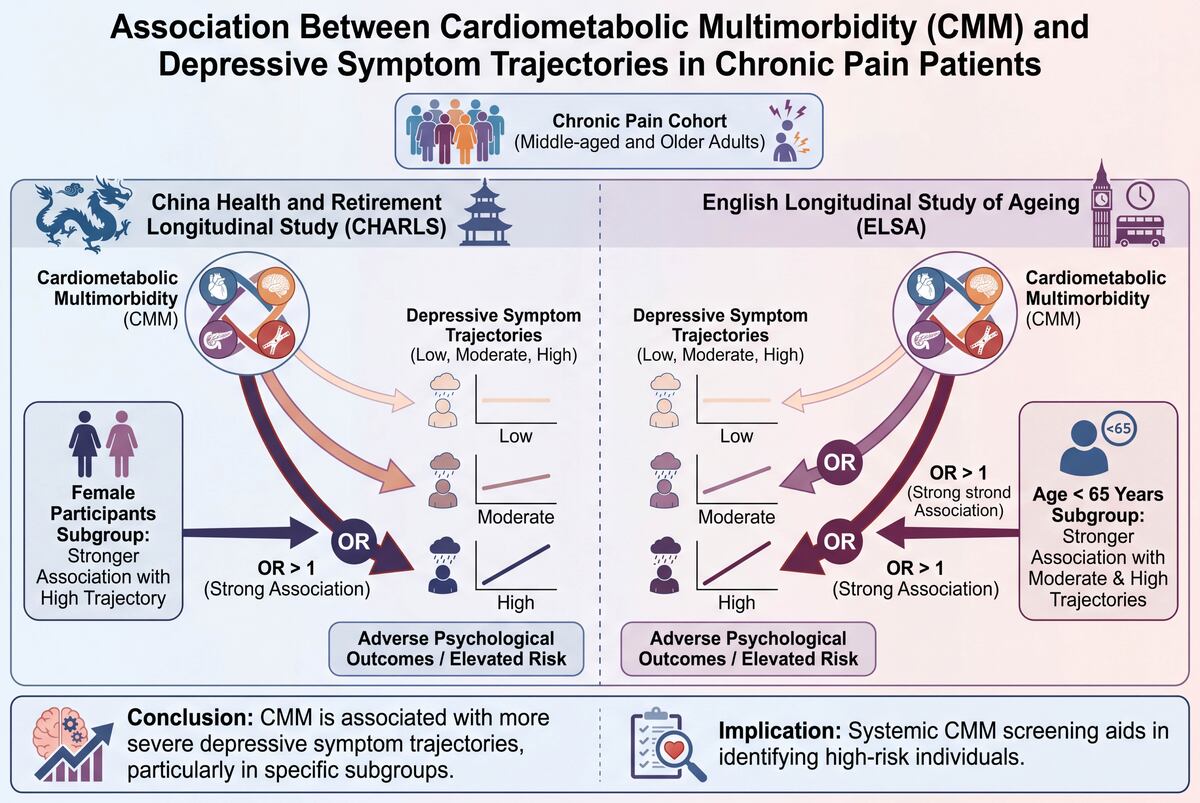
Three stable depressive symptom trajectories were identified in both cohorts: persistently low-, moderate-, and high-symptom groups. In ELSA, CMM was significantly associated with both moderate- (OR = 1.56, 95% CI: 1.24–1.96) and high-symptom trajectories (OR = 2.20, 95% CI: 1.61–3.02) after full covariate adjustment. In CHARLS, the association was confined to the high-symptom trajectory (OR = 1.39, 95% CI: 1.03–1.86). Subgroup analyses indicated a more pronounced association among female participants in CHARLS and among those younger than 65 years in ELSA.
Conclusions:
CMM is significantly associated with more severe depressive symptom trajectories among middle-aged and older adults with chronic pain, with cross-cohort heterogeneity reflecting differences in population characteristics and sociocultural context. These findings suggest that consideration of CMM may be useful in the clinical assessment of individuals with chronic pain and may help identify individuals at elevated risk for adverse psychological outcomes.
The co-occurrence of chronic pain and cardiometabolic multimorbidity (CMM) is increasingly prevalent among middle-aged and older adults, yet the extent to which CMM shapes the longitudinal course of depressive symptomatology in this population remains poorly understood.
Material and methods:
Data were drawn from the China Health and Retirement Longitudinal Study (CHARLS; participants aged 45 years and older) and the English Longitudinal Study of Ageing (ELSA; participants aged 50 years and older). Group-based trajectory modeling (GBTM) was applied to identify distinct depressive symptom trajectories, and multinomial logistic regression was used to examine associations between CMM and trajectory group membership, with subgroup analyses conducted to assess potential effect modification.
Results:
Three stable depressive symptom trajectories were identified in both cohorts: persistently low-, moderate-, and high-symptom groups. In ELSA, CMM was significantly associated with both moderate- (OR = 1.56, 95% CI: 1.24–1.96) and high-symptom trajectories (OR = 2.20, 95% CI: 1.61–3.02) after full covariate adjustment. In CHARLS, the association was confined to the high-symptom trajectory (OR = 1.39, 95% CI: 1.03–1.86). Subgroup analyses indicated a more pronounced association among female participants in CHARLS and among those younger than 65 years in ELSA.
Conclusions:
CMM is significantly associated with more severe depressive symptom trajectories among middle-aged and older adults with chronic pain, with cross-cohort heterogeneity reflecting differences in population characteristics and sociocultural context. These findings suggest that consideration of CMM may be useful in the clinical assessment of individuals with chronic pain and may help identify individuals at elevated risk for adverse psychological outcomes.
REFERENCES (52)
1.
Chen QF, Chao N, Jiang Y, et al. Global burden of disease and its risk factors for adults aged 70 and older across 204 countries and territories: a comprehensive analysis of the Global Burden of Disease Study 2021. BMC Geriatr 2025; 25: 462.
2.
Yang L, Zhang Z, Zhang J, et al. Stage-specific risk factors of cardiometabolic multimorbidity: a systematic review and meta-analysis from incidence to mortality. Ageing Res Rev 2026; 114: 102991.
3.
Lindstrom M, DeCleene N, Dorsey H, et al. Global Burden of Cardiovascular Diseases and Risks Collaboration, 1990-2021. J Am Coll Cardiol 2022; 80: 2372-425.
4.
Chowdhury SR, Chandra Das D, Sunna TC, Beyene J, Hossain A. Global and regional prevalence of multimorbidity in the adult population in community settings: a systematic review and meta-analysis. eClinicalMedicine 2023; 57: 101860.
5.
Asogwa OA, Boateng D, Marza-Florensa A, et al. Multimorbidity of non-communicable diseases in low-income and middle- income countries: a systematic review and meta-analysis. BMJ Open 2022; 12: e049133.
6.
Zhao X. Independent and joint associations of cardiometabolic multimorbidity and depression on cognitive function: findings from multi-regional cohorts and generalisation from community to clinic. Lancet Regional Health Western Pacific 2024; 51: 1041198.
7.
Zhou Y, Kivimäki M, Lim CCW, et al. Bidirectional associations between cardiometabolic multimorbidity and depression and mediation of lifestyles. JACC Asia 2024; 4: 657-71.
8.
Zhao YW, Haregu TN, He L, et al. The effect of multimorbidity on functional limitations and depression amongst middle-aged and older population in China: a nationwide longitudinal study. Age Ageing 2021; 50: 190-197.
9.
Yin X, Chen Y, Zhou L, Yang H, Wang Y. Association between chronic pain and risk of cardiometabolic multimorbidity: a prospective cohort study. Reg Anesth Pain Med 2025; 50: 858-64.
10.
Han Y, Hu Y, Tu C, et al. Duration-dependent impact of cardiometabolic diseases and multimorbidity on all-cause and cause-specific mortality: a prospective cohort study of 0.5 million participants. Cardiovasc Diabetol 2023; 22: 135.
11.
Qiu Y, Li H, Yang Z, et al. The prevalence and economic burden of pain on middle-aged and elderly Chinese people: results from the China health and retirement longitudinal study. BMC Health Serv Res 2020; 20: 600.
12.
Werneck AO, Stubbs B. Bidirectional relationship between chronic pain and depressive symptoms in middle-aged and older adults. General Hospital Psychiatry 2024; 89: 49-54.
13.
Zeng J, Liao Z, Lin A, et al. Chronic pain in multiple sites is associated with depressive symptoms in US adults: a cross-sectional study. J Psych Res 2025; 183: 212-8.
14.
Rydin AO, Milaneschi Y, Lamers F, et al. Trajectories of depressive symptoms, metabolic syndrome, inflammation, and cardiometabolic diseases: a longitudinal Bayesian network approach. Brain Behav Immunity 2025; 130: 106120.
15.
Wray NR, Ripke S, Mattheisen M, et al. Genome-wide association analyses identify 44 risk variants and refine the genetic architecture of major depression. Nat Genet 2018; 50: 668-81.
16.
Zhao Y, Hu Y, Smith JP, Strauss J, Yang G. Cohort profile: the China Health and Retirement Longitudinal Study (CHARLS). Int J Epidemiol 2014; 43: 61-8.
17.
Steptoe A, Breeze E, Banks J, Nazroo J. Cohort profile: the English longitudinal study of ageing. Int J Epidemiol 2012; 42: 1640-8.
18.
Zhao Z, Cheng S, Li S. Dynamic patterns of depression and their association with stroke: insights from CHARLS, ELSA, and HRS. Int J Surg 2026; 112: 2341-50.
19.
Ruiz M, Hu Y, Martikainen P, Bobak M. Life course socioeconomic position and incidence of mid–late life depression in China and England: a comparative analysis of CHARLS and ELSA. J Epidemiol Commun Health 2019; 73: 817-24.
20.
Hamer M, Batty GD, Kivimaki M. Risk of future depression in people who are obese but metabolically healthy: the English longitudinal study of ageing. Mol Psychiatry 2012; 17: 940-5.
21.
Li C, Mils T, Shen L, et al. Early-life exposure to severe famine and subsequent risk of depressive symptoms in late adulthood: the China Health and Retirement Longitudinal Study. Br J Psychiatry 2018; 213: 579-86.
22.
Zhang Y, Zhou Y, Kivimaki M, et al. Cardiometabolic multimorbidity, social activity, and joint trajectories of physical disability, depressive symptom, and cognitive function in mid-to-late life: a multicohort study. BMC Med 2025; 23: 577.
23.
Jiao J, Guo J, Shen J, et al. Long-term trajectories of memory, depression, and mobility independence before death: a multi-cohort study. Transl Psychiatry 2026; 16: 221.
24.
American Diabetes Association. 6. Glycemic Targets: Standards of Medical Care in Diabetes – 2021. Diabetes Care 2021; 44: S73-84.
25.
Joint committee for guideline revision. 2016 Chinese guidelines for the management of dyslipidemia in adults. J Geriatr Cardiol 2018; 15: 1-29.
26.
Lange-Maia BS, Karvonen-Gutierrez CA, Kazlauskaite R, et al. Impact of chronic medical condition development on longitudinal physical function from mid- to early late-life: the Study of Women’s Health Across the Nation. J Gerontol A Biol Sci Med Sci 2020; 75: 1411-7.
27.
Liu L, Li X, Marshall IJ, et al. Trajectories of depressive symptoms 10 years after stroke and associated risk factors: a prospective cohort study. Lancet 2023; 402 Suppl 1: S64.
28.
Shi S, Xue F, Jiang T, Ling L. Association between trajectory of triglyceride-glucose index and all-cause mortality in critically ill patients with atrial fibrillation: a retrospective cohort study. Cardiovasc Diabetol 2025; 24: 278.
29.
Belhassen M, Nolin M, Jacoud F, Marant Micallef C, Van Ganse E. Trajectories of controller therapy use before and after asthma-related hospitalization in children and adults: population-based retrospective cohort study. JMIR Public Health Surveill 2023; 9: e50085.
30.
Li JJ, Liu HH, Li S. Landscape of cardiometabolic risk factors in Chinese population: a narrative review. Cardiovasc Diabetol 2022; 21: 113.
31.
Wang T, Zhao Z, Yu X, et al. Age-specific modifiable risk factor profiles for cardiovascular disease and all-cause mortality: a nationwide, population-based, prospective cohort study. Lancet Regional Health West Pacif 2021; 17: 100277.
32.
Abner S, Gillies CL, Shabnam S, et al. Consultation rates in people with type 2 diabetes with and without vascular complications: a retrospective analysis of 141,328 adults in England. Cardiovasc Diabetol 2022; 21: 8.
33.
Maschke V, Lohner V, Mons U. Linking cardiometabolic multimorbidity to depressive symptoms in the oldest-old: results from a cross-sectional study in Germany. BMC Public Health 2025; 25: 1720.
34.
Huang ZT, Luo Y, Han L, et al. Patterns of cardiometabolic multimorbidity and the risk of depressive symptoms in a longitudinal cohort of middle-aged and older Chinese. J Affect Disord 2022; 301: 1-7.
35.
Ditmars HL, Logue MW, Toomey R, et al. Associations between depression and cardiometabolic health: a 27-year longitudinal study. Psychol Med 2022; 52: 3007-17.
36.
Yang W, Li W, Wang S, et al. Association of cardiometabolic multimorbidity with risk of late-life depression: a nationwide twin study. Eur. Psychiatr 2024; 67: e58.
37.
Vyas A, Pan X, Sambamoorthi U. Chronic condition clusters and polypharmacy among adults. Int J Family Med 2012; 2012: 193168.
38.
Katon WJ. Clinical and health services relationships between major depression, depressive symptoms, and general medical illness. Biol Psychiatry 2003; 54: 216-26.
39.
Asman AG, Hoogendoorn CJ, McKee MD, Gonzalez JS. Assessing the association of depression and anxiety with symptom reporting among individuals with type 2 diabetes. J Behav Med 2020; 43: 57-68.
40.
Scherer M, Hansen H, Gensichen J, et al. Association between multimorbidity patterns and chronic pain in elderly primary care patients: a cross-sectional observational study. BMC Fam Pract 2016; 17: 68.
41.
Tsai SA, Xiao L, Lv N, Liu Y, Ma J. Association of the cardiometabolic staging system with individual engagement and quality of life in the US adult population. Obesity 2017; 25: 1540-8.
42.
Katon WJ. Epidemiology and treatment of depression in patients with chronic medical illness. Dialogues Clin Neurosci 2011; 13: 7-23.
43.
Nadrowski P, Chudek J, Skrzypek M, et al. Associations between cardiovascular disease risk factors and IL-6 and hsCRP levels in the elderly. Exp Gerontol 2016; 85: 112-7.
44.
Kemp AH, Quintana DS, Felmingham KL, Matthews S, Jelinek HF. Depression, comorbid anxiety disorders, and heart rate variability in physically healthy, unmedicated patients: implications for cardiovascular risk. PLoS One 2012; 7: e30777.
45.
Xu S, Ilyas I, Little PJ, et al. Endothelial dysfunction in atherosclerotic cardiovascular diseases and beyond: from mechanism to pharmacotherapies. Pharmacol Rev 2021; 73: 924-67.
47.
Ahrend JN, Jobski K, Bantel C, Hoffmann F. Pain intensity and comorbid depressive symptoms in the general population: an analysis of the German Health Update Study (GEDA 2019/2020‐EHIS). Eur J Pain 2025; 29: e4745.
48.
Stubbs B, Vancampfort D, Veronese N, et al. Depression and pain: primary data and meta-analysis among 237 952 people across 47 low- and middle-income countries. Psychol Med 2017; 47: 2906-17.
49.
Jiang R, Geha P, Rosenblatt M, et al. The inflammatory and genetic mechanisms underlying the cumulative effect of co-occurring pain conditions on depression. Sci Adv 2025; 11: DOI: 10.1126/sciadv.adt1083.
50.
Sălcudean A, Bodo CR, Popovici RA, et al. Neuroinflammation – a crucial factor in the pathophysiology of depression – a comprehensive review. Biomolecules 2025; 15: 502.
51.
Hassamal S. Chronic stress, neuroinflammation, and depression: an overview of pathophysiological mechanisms and emerging anti-inflammatories. Front Psychiatry 2023; 14: 1130989.
52.
Maes M, Almulla AF, You Z,Zhang Y. Neuroimmune, metabolic and oxidative stress pathways in major depressive disorder. Nat Rev Neurol 2025; 21: 473-89.
Share
RELATED ARTICLE
| eISSN: | 1896-9151 |
| ISSN: | 1734-1922 |

We process personal data collected when visiting the website. The function of obtaining information about users and their behavior is carried out by voluntarily entered information in forms and saving cookies in end devices. Data, including cookies, are used to provide services, improve the user experience and to analyze the traffic in accordance with the Privacy policy. Data are also collected and processed by Google Analytics tool (more).
You can change cookies settings in your browser. Restricted use of cookies in the browser configuration may affect some functionalities of the website.
You can change cookies settings in your browser. Restricted use of cookies in the browser configuration may affect some functionalities of the website.