Current issue
Archive
Manuscripts accepted
About the Journal
Editorial office
Editorial board
Section Editors
Abstracting and indexing
Subscription
Contact
Ethical standards and procedures
Most read articles
Instructions for authors
Article Processing Charge (APC)
Regulations of paying article processing charge (APC)


OBSTETRICS AND GYNAECOLOGY / CLINICAL RESEARCH
Immune cells, serum metabolites, and ovarian cancer: a Mendelian randomization mediation study
1
Department of Gynecology and Obstetrics, Beijing Jishuitan Hospital, Capital Medical University, Beijing, China
Submission date: 2025-07-11
Final revision date: 2025-09-25
Acceptance date: 2025-11-02
Online publication date: 2026-02-15
Corresponding author
Wenjing Li
Department of Gynecology and Obstetrics Beijing Jishuitan Hospital Capital Medical University Beijing, China
Department of Gynecology and Obstetrics Beijing Jishuitan Hospital Capital Medical University Beijing, China
Article (PDF)
Supplementary files
References (52)
Immune cells - Supplementary Table SI Screening results of single nucleotide polymorphisms (SNPs) with immune cells phenotype on ovarian cancer .xls
Supplementary Table SII.xlsx
Supplementary Table SIII.xlsx
Supplementary Table SIV.xlsx
Supplementary Table SV.xlsx
Supplementary Table SVI.xlsx
Supplementary Table SVII.xlsx
KEYWORDS
TOPICS
ABSTRACT
Introduction:
Recent studies have highlighted the potential roles of immune cells and serum metabolites in the progression of ovarian cancer (OC). Therefore, this study used Mendelian randomization (MR) methodology to investigate potential causal associations among serum metabolites, immune cells, and OC.
Material and methods:
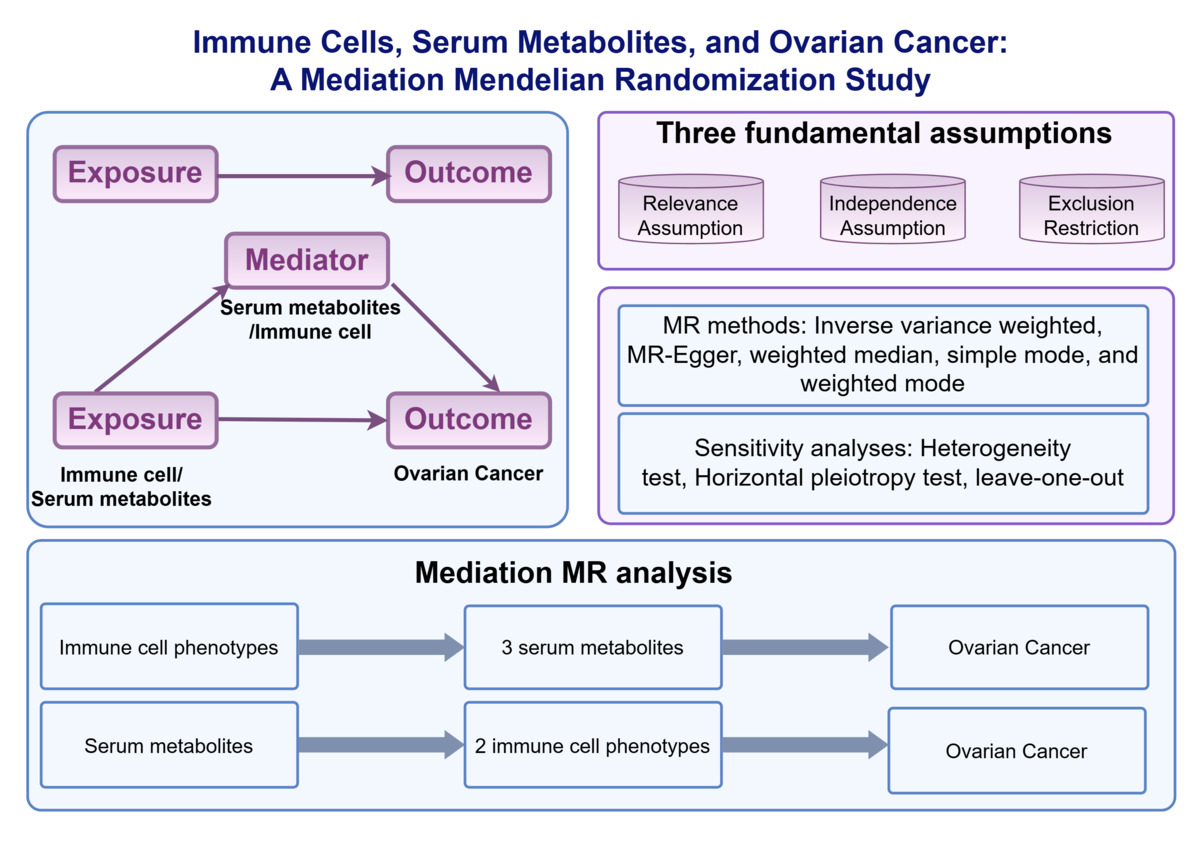
This study used data from multiple sources to obtain genetic data related to immune cell phenotypes, serum metabolites, and OC. Causal effects were estimated using the inverse variance weighted, MR-Egger, weighted median, simple mode, and weighted mode methods to assess potential causal effects. Finally, mediation analysis was conducted to investigate the potential mediating roles of immune cell phenotypes and serum metabolites in OC.
Results:
Thirty-six causal associations between immune cell phenotypes and OC were identified. “Resting CD4 regulatory T cell %CD4 regulatory T cell” (OR = 0.977, p = 0.018) was associated with a lower risk of OC, while “IgD- CD38dim B cell %B cell” (OR = 1.027, p = 0.021) was associated with a higher risk of OC. Additionally, 89 causal associations were identified between serum metabolites and OC. “Gluconate levels” (OR = 0.925, p = 0.047) was associated with a lower risk of OC, while “fructose levels” (OR = 1.097, p = 0.019) was associated with a higher risk of OC. Mediation analysis identified 3 serum metabolites that potentially mediated the influence of immune cell phenotypes on OC, alongside 2 immune cell phenotypes acting as potential mediators between serum metabolites and OC. Notably, sensitivity analysis supported the robustness of these findings.
Conclusions:
This work provides novel insights into the potential causal associations among immune cells, serum metabolites, and OC.
REFERENCES (52)
1.
Siminiak N, Czepczyński, R, Zaborowski MP, Iżycki D. Immunotherapy in ovarian cancer. Arch Immunol Ther Exp 2022; 70: 19.
2.
Auersperg N. The origin of ovarian cancers: hypotheses and controversies. Front Biosci 2013; 5: 709-19.
3.
Chen J, Yang L, Ma Y, Zhang Y. Recent advances in understanding the immune microenvironment in ovarian cancer. Front Immunol 2024; 15: 1412328.
4.
Brown MB, Von Chamier M, Allam AB, Reyes L. M1/M2 macrophage polarity in normal and complicated pregnancy. Front Immunol 2014; 5: 606.
5.
Zhang M, He Y, Sun X, et al. A high M1/M2 ratio of tumor-associated macrophages is associated with extended survival in ovarian cancer patients. J Ovarian Res 2014; 7: 19.
6.
Gasparri ML, Attar R, Palaia I, et al. Tumor infiltrating lymphocytes in ovarian cancer. Asian Pac J Cancer Prev 2015; 16: 3635-8.
7.
Toker A, Nguyen LT, Stone SC, et al. Regulatory T cells in ovarian cancer are characterized by a highly activated phenotype distinct from that in melanoma. Clin Cancer Res 2018; 24: 5685-696.
8.
Cao X, Cai SF, Fehniger TA, et al. Granzyme B and perforin are important for regulatory T cell-mediated suppression of tumor clearance. Immunity 2007; 27: 635-46.
9.
Fillatreau S, Sweenie CH, McGeachy MJ, Gray D, Anderton SM. B cells regulate autoimmunity by provision of IL-10. Nat Immunol 2002; 3: 944-50.
10.
Zhang Y, Morgan R, Podack ER, Rosenblatt J. B cell regulation of anti-tumor immune response. Immunol Res 2013; 57: 115-24.
11.
Ha JH, Jayaraman M, Nadhan R, et al. Unraveling autocrine signaling pathways through metabolic fingerprinting in serous ovarian cancer cells. Biomedicines 2021; 9: 1927.
12.
Garg G, Yilmaz A, Kumar P, et al. Targeted metabolomic profiling of low and high grade serous epithelial ovarian cancer tissues: a pilot study. Metabolomics 2018; 14: 154.
13.
Cao Z, Long X, Yuan L. Associations between serum metabolites and female cancers: a bidirectional two-sample mendelian randomization study. J Steroid Biochem Mol Biol 2024; 243: 106584.
14.
Ke C, Hou Y, Zhang H, et al. Large-scale profiling of metabolic dysregulation in ovarian cancer. Int J Cancer 2015; 136: 516-26.
15.
Ahn HS, Yeom J, Yu J, Kwon YI, Kim JH, Kim K. Convergence of plasma metabolomics and proteomics analysis to discover signatures of high-grade serous ovarian cancer. Cancers 2020; 12: 3447..
16.
Liang G, Miao D, Du C. Causal associations between blood metabolites and breast cancer. Arch Med Sci 2024; 21: 206-14.
17.
Luo M, Li M, Zhou M, Wang L, Yang X. Investigating causal relationships between coffee consumption and gynecological diseases: a mendelian randomization study. Arch Med Sci 2025; doi:10.5114/aoms/200788.
18.
Orrù V, Steri M, Sidore C, et al. Complex genetic signatures in immune cells underlie autoimmunity and inform therapy. Nat Genet 2020; 52: 1036-45.
19.
Zhao G, Cai Y, Wang Y, Fang Y, Wang S, Li N. Genetically predicted blood metabolites mediate the association between circulating immune cells and pancreatic cancer: a mendelian randomization study. J Gene Med 2024; 26: e3691.
20.
Liang X, Fan Y. Bidirectional two-sample mendelian randomization analysis reveals a causal effect of interleukin-18 levels on postherpetic neuralgia risk. Front Immunol 2023; 14: 1183378.
21.
Wootton RE, Lawn RB, Millard LAC, et al. Evaluation of the causal effects between subjective wellbeing and cardiometabolic health: mendelian randomisation study. BMJ 2018; 362: k3788.
22.
Fan JC, Lu Y, Gan JH, Lu H. Identification of potential novel targets for treating inflammatory bowel disease using mendelian randomization analysis. Int J Colorectal Dis 2024; 39: 165.
23.
Skrivankova VW, Richmond RC, Woolf BAR, et al. Strengthening the reporting of observational studies in epidemiology using mendelian randomization: the STROBE-MR statement. JAMA 2021; 326: 1614.
24.
Ding M, Zhang Z, Chen Z, Song J, Wang B, Jin F. Association between periodontitis and breast cancer: two-sample mendelian randomization study. Clin Oral Investig 2023; 27: 2843-49.
25.
Burgess S, Butterworth A, Thompson SG. Mendelian randomization analysis with multiple genetic variants using summarized data. Genet Epidemiol 2013; 37: 658-65.
26.
Burgess S, Thompson SG. Interpreting findings from mendelian randomization using the MR-Egger method. Eur J Epidemiol 2017; 32: 377-89.
27.
Bowden J, Davey Smith G, Haycock PC, Burgess S. Consistent estimation in mendelian randomization with some invalid instruments using a weighted median estimator. Genet Epidemiol 2016; 40: 304-14.
28.
Zeng Y, Cao S, Yang H. Roles of gut microbiome in epilepsy risk: a mendelian randomization study. Front Microbiol 2023; 14: 1115014.
29.
Hemani G, Zheng J, Elsworth B, et al. The MR-base platform supports systematic causal inference across the human phenome. eLife 2018; 7: e34408.
30.
Zhu S, Hu X, Fan Y. Association of triglyceride levels and prostate cancer: a mendelian randomization study. BMC Urol 2022; 22: 167.
31.
Carter AR, Gill D, Davies NM, et al. Understanding the consequences of education inequality on cardiovascular disease: mendelian randomisation study. BMJ 2019; 365: l1855.
32.
Gu X, Li S, DeFalco T. Immune and vascular contributions to organogenesis of the testis and ovary. FEBS J 2022; 289: 2386-408.
33.
Turkoglu O, Zeb A, Graham S, et al. Metabolomics of biomarker discovery in ovarian cancer: a systematic review of the current literature. Metabolomics 2016; 12: 60.
34.
Kim OY, Monsel A, Bertrand M, Coriat P, Cavaillon JM, Adib-Conquy M. Differential down-regulation of HLA-DR on monocyte subpopulations during systemic inflammation. Crit Care 2010; 14: R61.
35.
Asmussen A, Busch HJ, Helbing T, et al. Monocyte subset distribution and surface expression of HLA-DR and CD14 in patients after cardiopulmonary resuscitation. Sci Rep 2021; 11: 12403.
36.
Lu Y, Yao Y, Zhai S, et al. The role of immune cell signatures in the pathogenesis of ovarian-related diseases: a causal inference based on mendelian randomization. Int J Surg 2024; 110: 6541-50.
37.
Shen HH, Zhang YY, Wang XY, et al. Potential Causal association between plasma metabolites, immunophenotypes, and female reproductive disorders: a two-sample mendelian randomization analysis. Biomolecules 2024; 14: 116.
38.
Peng D, Zhong W, Wang Y, Fu Y, Shang W. The causal relationship between immune cells and infertility: a mendelian randomisation study. Am J Reprod Immunol 2024; 92: e13932.
39.
Johnson CH, Patterson AD, Idle JR, Gonzalez FJ. Xenobiotic metabolomics: major impact on the metabolome. Annu Rev Pharmacol Toxicol 2012; 52: 37-56.
40.
Tarasenko TN, Cusmano-Ozog K, McGuire PJ. Tissue acylcarnitine status in a mouse model of mitochondrial β-oxidation deficiency during metabolic decompensation due to Influenza virus infection. Mol Genet Metab 2018; 125: 144-52.
41.
Turnbull PC, Hughes MC, Perry CGR. The fatty acid derivative palmitoylcarnitine abrogates colorectal cancer cell survival by depleting glutathione. Am J Physiol Cell Physiol 2019; 317: C1278-88.
42.
Wenzel U, Nickel A, Daniel H. Increased carnitine-dependent fatty acid uptake into mitochondria of human colon cancer cells induces apoptosis. J Nutr 2005; 135: 1510-4.
43.
Wang Z, Klipfell E, Bennett BJ, et al. Gut flora metabolism of phosphatidylcholine promotes cardiovascular disease. Nature 2011; 472: 57-63.
44.
Huang J, Liu L, Chen C, Gao Y. PCOS without hyperandrogenism is associated with higher plasma trimethylamine N-oxide levels. BMC Endocr Disord 2020; 20: 3.
45.
Sato E, Olson SH, Ahn J, et al. Intraepithelial CD8+ tumor-infiltrating lymphocytes and a high CD8+/regulatory T cell ratio are associated with favorable prognosis in ovarian cancer. Proc Natl Acad Sci 2005; 102: 18538-43.
46.
Cannioto RA, Sucheston-Campbell LE, Hampras S, et al. The association of peripheral blood regulatory T-cell concentrations with epithelial ovarian cancer: a brief report. Int J Gynecol Cancer 2017; 27: 11-6.
47.
Barnett B, Kryczek I, Cheng P, Zou W, Curiel TJ. Regulatory T cells in ovarian cancer: biology and therapeutic potential. Am J Reprod Immunol 2005; 54: 369-77.
48.
Wu M, Chen X, Lou J, et al. Changes in regulatory T cells in patients with ovarian cancer undergoing surgery: preliminary results. Int Immunopharmacol 2017; 47: 244-50.
49.
Zhang S, Ke X, Zeng S, et al. Analysis of CD8+ Treg cells in patients with ovarian cancer: a possible mechanism for immune impairment. Cell Mol Immunol 2015; 12: 580-91.
50.
Wang C, Li ZY, Gong Y, You R, Ming-Hui Z, Chen M. Increased frequency of IgD-CD27(Hi)CD38(Hi) B cells and its association with the renal involvement in ANCA-associated vasculitis. Arthritis Res Ther 2022; 24: 109.
51.
Xiao S, Li VL, Long JZ. Lac-Phe (N-Lactoyl-Phenylalanine). Trends Endocrinol Metab 2024; 35: 758-9.
52.
Guo J, Wang C, Li H, Ding C. Exploring the causal associations of the gut microbiota and plasma metabolites with ovarian cancer: an approach of mendelian randomization analysis combined with network pharmacology and molecular docking. J Ovarian Res 2025; 18: 27.
Share
RELATED ARTICLE
| eISSN: | 1896-9151 |
| ISSN: | 1734-1922 |

We process personal data collected when visiting the website. The function of obtaining information about users and their behavior is carried out by voluntarily entered information in forms and saving cookies in end devices. Data, including cookies, are used to provide services, improve the user experience and to analyze the traffic in accordance with the Privacy policy. Data are also collected and processed by Google Analytics tool (more).
You can change cookies settings in your browser. Restricted use of cookies in the browser configuration may affect some functionalities of the website.
You can change cookies settings in your browser. Restricted use of cookies in the browser configuration may affect some functionalities of the website.