Current issue
Archive
Manuscripts accepted
About the Journal
Editorial office
Editorial board
Section Editors
Abstracting and indexing
Subscription
Contact
Ethical standards and procedures
Most read articles
Instructions for authors
Article Processing Charge (APC)
Regulations of paying article processing charge (APC)


OBSTETRICS AND GYNAECOLOGY / RESEARCH PAPER
Causal Association Between Circulating Macrophage Inflammatory Protein 1α (MIP-1α) Levels and Eclampsia: A Two-Sample Mendelian Randomization Study
1
Department of Obstetrics and Gynecology, Ankang Central Hospital, China
2
Department of Obstetrics and Gynecology, Ankang Gaoxin Hospital, China
3
Department of Obstetrics, Shaanxi Provincial People's Hospital, China
4
Department of Health Service, Fourth Military Medical University, China
5
Department of Obstetrics and Gynecology, Xijing Hospital, Fourth Military Medical University, China
6
Department of Obstetrics and Gynecology, Xijing 986 Hospital, Fourth Military Medical University, China
Submission date: 2025-08-10
Final revision date: 2026-02-09
Acceptance date: 2026-03-31
Online publication date: 2026-06-04
Corresponding author
Ying Zhang
Department of Obstetrics and Gynecology, Xijing 986 Hospital, Fourth Military Medical University, Xi’an, China
Department of Obstetrics and Gynecology, Xijing 986 Hospital, Fourth Military Medical University, Xi’an, China
KEYWORDS
TOPICS
ABSTRACT
Introduction:
Preeclampsia-eclampsia (PE) poses serious risks to maternal and fetal health. Inflammatory markers—such as WBC counts, macrophage-related factors (e.g., serum clusters, MIF, CSF proteins, and inflammatory proteins), and procalcitonin—are implicated in PE, but their causal roles remain unclear. This study investigates these potential causal relationships.
Material and methods:
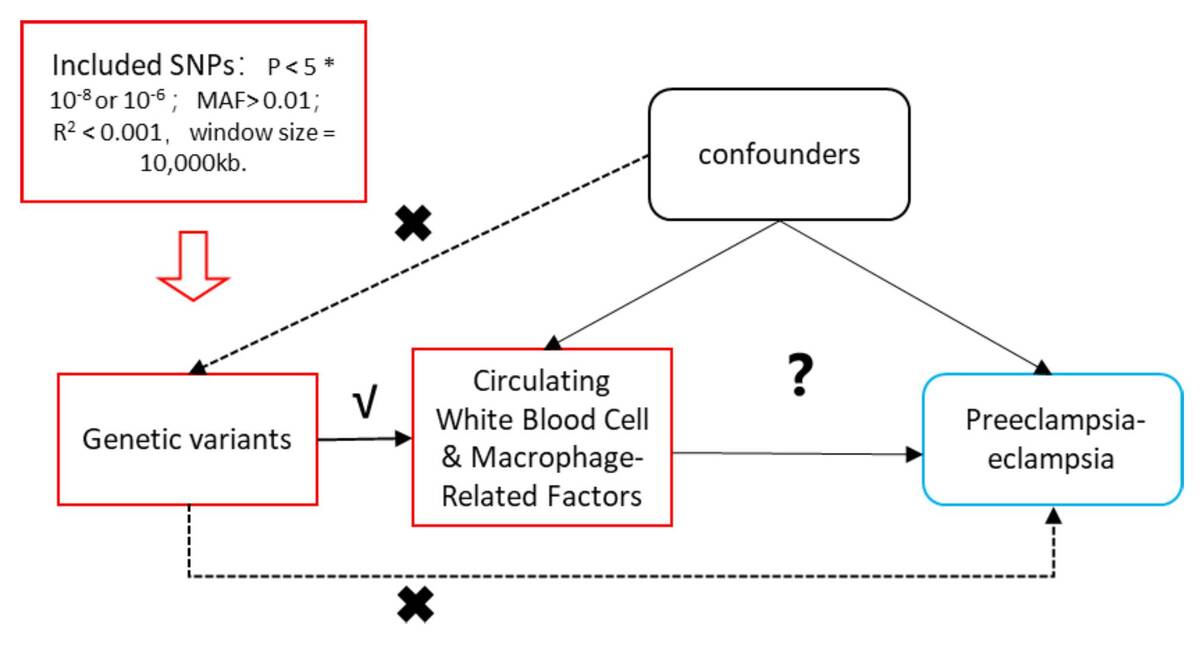
Using summary statistics from the FINNGEN R12 cohort database for outcomes and previously published Genome-wide association studies (GWAS) for a comprehensive panel of circulating inflammatory markers, a two-sample Mendelian randomization (MR) analysis was performed. The primary analytical method was inverse-variance weighted (IVW), supplemented by weighted median, weighted mode, and MR-Egger regression. Sensitivity analyses included MR-Egger, MR-PRESSO, Cochran’s Q test, and leave-one-out analysis to assess pleiotropy, heterogeneity, and the robustness of the findings.
Results:
The IVW method, following rigorous outlier correction and sensitivity analyses, revealed a significant protective causal association between genetically predicted macrophage inflammatory protein-1α (MIP-1α) levels and eclampsia (odds ratio = 0.16, 95% confidence interval 0.05 - 0.46, P<0.001, PFDR=0.024). Conversely, no robust causal associations were observed for other investigated exposures, including circulating white blood cell counts, procalcitonin, other macrophage-related cytokines such as MIP-1β, serum differentiation clusters, MIF, or CSF proteins, with either preeclampsia or eclampsia. After the removal of outliers, no pleiotropic variants were detected. Leave-one-out analysis further confirmed the absence of influential genetic variants, substantiating the robustness of the findings.
Conclusions:
This study supports a significant causal link between MIP-1α levels and Eclampsia, highlighting the role of specific inflammatory pathways in its development.
Preeclampsia-eclampsia (PE) poses serious risks to maternal and fetal health. Inflammatory markers—such as WBC counts, macrophage-related factors (e.g., serum clusters, MIF, CSF proteins, and inflammatory proteins), and procalcitonin—are implicated in PE, but their causal roles remain unclear. This study investigates these potential causal relationships.
Material and methods:
Using summary statistics from the FINNGEN R12 cohort database for outcomes and previously published Genome-wide association studies (GWAS) for a comprehensive panel of circulating inflammatory markers, a two-sample Mendelian randomization (MR) analysis was performed. The primary analytical method was inverse-variance weighted (IVW), supplemented by weighted median, weighted mode, and MR-Egger regression. Sensitivity analyses included MR-Egger, MR-PRESSO, Cochran’s Q test, and leave-one-out analysis to assess pleiotropy, heterogeneity, and the robustness of the findings.
Results:
The IVW method, following rigorous outlier correction and sensitivity analyses, revealed a significant protective causal association between genetically predicted macrophage inflammatory protein-1α (MIP-1α) levels and eclampsia (odds ratio = 0.16, 95% confidence interval 0.05 - 0.46, P<0.001, PFDR=0.024). Conversely, no robust causal associations were observed for other investigated exposures, including circulating white blood cell counts, procalcitonin, other macrophage-related cytokines such as MIP-1β, serum differentiation clusters, MIF, or CSF proteins, with either preeclampsia or eclampsia. After the removal of outliers, no pleiotropic variants were detected. Leave-one-out analysis further confirmed the absence of influential genetic variants, substantiating the robustness of the findings.
Conclusions:
This study supports a significant causal link between MIP-1α levels and Eclampsia, highlighting the role of specific inflammatory pathways in its development.
Share
RELATED ARTICLE
| eISSN: | 1896-9151 |
| ISSN: | 1734-1922 |

We process personal data collected when visiting the website. The function of obtaining information about users and their behavior is carried out by voluntarily entered information in forms and saving cookies in end devices. Data, including cookies, are used to provide services, improve the user experience and to analyze the traffic in accordance with the Privacy policy. Data are also collected and processed by Google Analytics tool (more).
You can change cookies settings in your browser. Restricted use of cookies in the browser configuration may affect some functionalities of the website.
You can change cookies settings in your browser. Restricted use of cookies in the browser configuration may affect some functionalities of the website.