Current issue
Archive
Manuscripts accepted
About the Journal
Editorial office
Editorial board
Section Editors
Abstracting and indexing
Subscription
Contact
Ethical standards and procedures
Most read articles
Instructions for authors
Article Processing Charge (APC)
Regulations of paying article processing charge (APC)


LIPID DISORDERS / CLINICAL RESEARCH
Serum triglycerides, remnant cholesterol, and small dense low-density lipoprotein cholesterol levels: lessons from the NATPOL 2011 survey
1
Department of Clinical Biochemistry, Jagiellonian University Medical College, Krakow, Poland
2
Department of Adult Neurology, Medical University of Gdansk, Poland
3
Department of Preventive Cardiology and Lipidology, Medical University of Lodz, Poland
4
Ciccarone Center for the Prevention of Cardiovascular Disease, Johns Hopkins University School of Medicine, Baltimore, MD, USA
5
1st Department of Cardiology, Medical University of Gdansk, Poland
6
Department of Prevention and Didactics, Medical University of Gdansk, Poland
Submission date: 2026-05-19
Final revision date: 2026-06-11
Acceptance date: 2026-06-23
Online publication date: 2026-06-23
Corresponding author
Bogdan Solnica
Department of Clinical Biochemistry Jagiellonian University Medical College Skawińska 8 31-066 Krakow, Poland
Department of Clinical Biochemistry Jagiellonian University Medical College Skawińska 8 31-066 Krakow, Poland
KEYWORDS
TOPICS
ABSTRACT
Introduction:
The role of triglyceride-rich lipoproteins in atherogenesis is insufficiently recognized and often underestimated. We aimed to evaluate the distribution of serum triglyceride (TG), remnant cholesterol (RC), and small dense LDL cholesterol (sdLDL-C) levels and their interrelationships in participants of the NATPOL 2011 survey.
Material and methods:
In approximately 2,000 NATPOL participants, serum TG was measured, and serum RC and sdLDL-C were calculated and compared between women and men, across age groups, and in relation to overweight/obesity and plasma glucose. RC/sdLDL-C levels were also compared across serum TG intervals (< 100, 100–149, and 150–499 mg/dl), and their percentile distributions were analyzed.
Results:
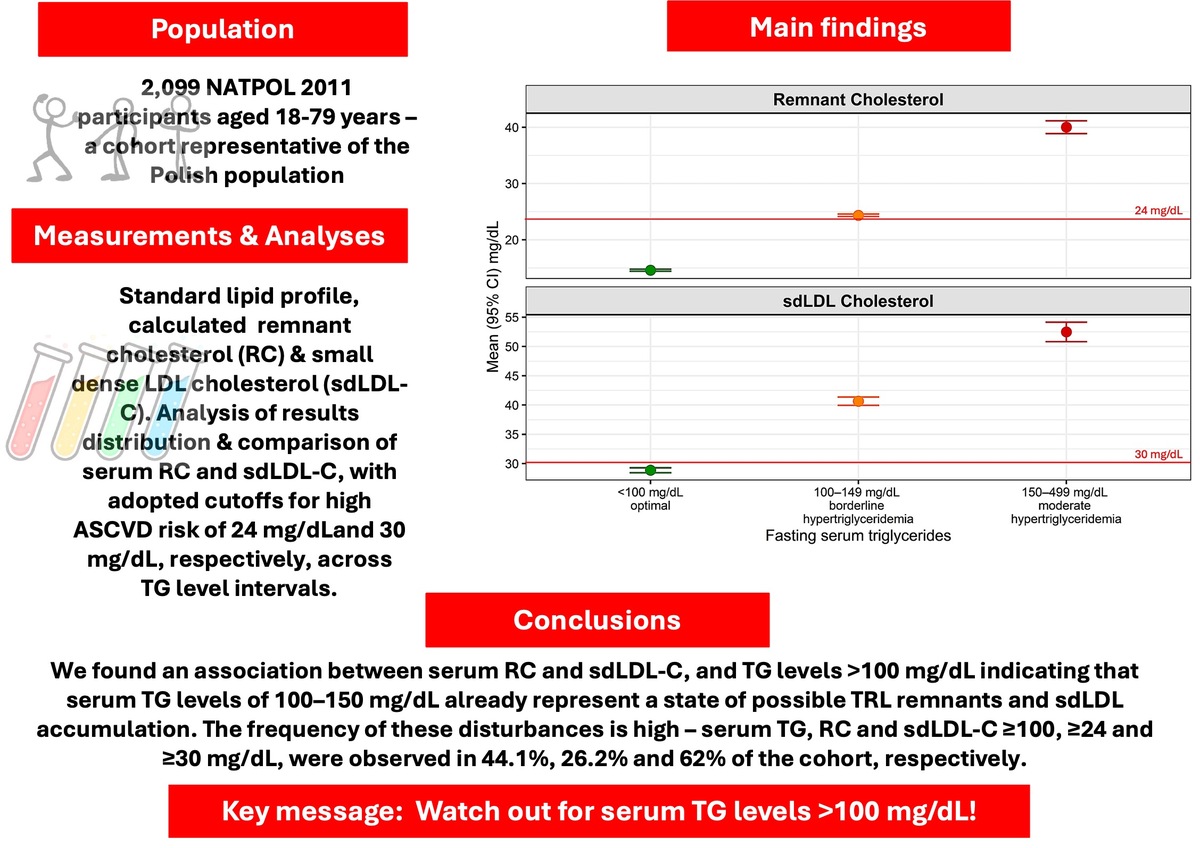
Serum TG, RC and sdLDL-C were higher in overweight/obese participants and in those with prediabetes. In subjects with serum TG levels < 100, 100–149, and 150–499 mg/dl, RC and sdLDL-C levels were successively higher, with values exceeding the cutoffs used to indicate high atherosclerotic cardiovascular disease (ASCVD) risk observed in both TG intervals > 100 mg/dl. Participants with serum RC and sdLDL-C above these cutoffs had higher TG. Serum TG levels of 100 mg/dl and 150 mg/dl corresponded to the 55.9th and 88.2nd percentiles, respectively; serum RC of 24 mg/dl corresponded to the 73.8th percentile; and serum sdLDL-C of 30 mg/dl (adopted cutoff) corresponded to the 38th percentile of the respective distributions.
Conclusions:
We found an association between serum RC and sdLDL-C, and TG levels > 100 mg/dl indicating that serum TG levels of 100–150 mg/dl may already be associated with TRL remnants and sdLDL accumulation. Calculated serum RC and sdLDL-C may be considered useful supplements to the lipid profile.
The role of triglyceride-rich lipoproteins in atherogenesis is insufficiently recognized and often underestimated. We aimed to evaluate the distribution of serum triglyceride (TG), remnant cholesterol (RC), and small dense LDL cholesterol (sdLDL-C) levels and their interrelationships in participants of the NATPOL 2011 survey.
Material and methods:
In approximately 2,000 NATPOL participants, serum TG was measured, and serum RC and sdLDL-C were calculated and compared between women and men, across age groups, and in relation to overweight/obesity and plasma glucose. RC/sdLDL-C levels were also compared across serum TG intervals (< 100, 100–149, and 150–499 mg/dl), and their percentile distributions were analyzed.
Results:
Serum TG, RC and sdLDL-C were higher in overweight/obese participants and in those with prediabetes. In subjects with serum TG levels < 100, 100–149, and 150–499 mg/dl, RC and sdLDL-C levels were successively higher, with values exceeding the cutoffs used to indicate high atherosclerotic cardiovascular disease (ASCVD) risk observed in both TG intervals > 100 mg/dl. Participants with serum RC and sdLDL-C above these cutoffs had higher TG. Serum TG levels of 100 mg/dl and 150 mg/dl corresponded to the 55.9th and 88.2nd percentiles, respectively; serum RC of 24 mg/dl corresponded to the 73.8th percentile; and serum sdLDL-C of 30 mg/dl (adopted cutoff) corresponded to the 38th percentile of the respective distributions.
Conclusions:
We found an association between serum RC and sdLDL-C, and TG levels > 100 mg/dl indicating that serum TG levels of 100–150 mg/dl may already be associated with TRL remnants and sdLDL accumulation. Calculated serum RC and sdLDL-C may be considered useful supplements to the lipid profile.
REFERENCES (40)
1.
Nordestgaard BG. Triglyceride-rich lipoproteins and atherosclerotic cardiovascular disease new insights from epidemiology, genetics, and biology. Circ Res 2016; 118: 547-63.
2.
Xu D, Xie L, Cheng C, et al. Triglyceride-rich lipoproteins and cardiovascular diseases. Front Endocrinol 2024; 15: 1409653.
3.
Ginsberg HN, Packard CJ, Chapman MJ, et al. Triglyceride-rich lipoproteins and their remnants: metabolic insights, role in atherosclerotic cardiovascular disease, and emerging therapeutic strategies – a consensus statement from the European Atherosclerosis Society. Eur Heart J 2021; 42: 4791-806.
4.
Durana EK, Pradhanb AD. Triglyceride-rich lipoprotein remnants and cardiovascular disease. Clin Chem 2021; 67: 183-97.
5.
Balling M, Afzal S, Varbo A, et al. Remnant cholesterol: quantification, concentrations by sex and age, and risk of ischemic heart disease. Clin Chem 2025; 71: 451-62.
6.
Zhao Y, Zhuang Z, Li Y, et al. Elevated blood remnant cholesterol and triglycerides are causally related to the risks of cardiometabolic multimorbidity. Nature Com 2024; 15: 2451.
7.
Baratta F, Cocomello N, Coronati M, et al. Cholesterol remnants, triglyceride-rich lipoproteins and cardiovascular risk. Int J Mol Sci 2023; 24: 4268.
8.
Duran EK, Aday AW, Cook NR, et al. Triglyceride-rich lipoprotein cholesterol, small dense LDL cholesterol, and incident cardiovascular disease. JACC 2020; 75: 122-35.
9.
Krauss RM. Small dense LDL particles: clinically relevant? Cur Opin Lipidol 2022; 33: 160-6.
10.
Vekic J, Zeljkovic A, Cicero AFG, et al. Atherosclerosis development and progression: the role of atherogenic small, dense LDL. Medicina 2022; 58: 299.
11.
Raposeiras-Roubin S, Rossello X, Oliva B, et al. Triglycerides and residual atherosclerotic risk. J Am Coll Cardiol 2021; 77: 3031-41.
12.
Solnica B, Sygitowicz G, Sitkiewicz D, et al. 2024 Guidelines of the Polish Society of Laboratory Diagnostics and the Polish Lipid Association on laboratory diagnostics of lipid metabolism disorders. Arch Med Sci 2024; 20: 357-74.
13.
Sampson M, Wolska A, Warnick R, et al. New equation based on the standard lipid panel for calculating small dense low-density lipoprotein-cholesterol and its use as a risk-enhancer test. Clin Chem 2021; 67: 987-97.
14.
Zdrojewski T, Rutkowski M, Bandosz P, et al. Prevalence and control of cardiovascular risk factors in Poland. Assumptions and objectives of the NATPOL 2011 Survey. Kardiol Pol 2013; 71: 381-92.
15.
Quispe R, Martin SS, Michos ED, et al. Remnant cholesterol predicts cardiovascular disease beyond LDL and ApoB: a primary prevention study. Eur Heart J 2021; 42: 4324-32.
16.
Varbo A, Freiberg JJ, Nordestgaard BG. Remnant cholesterol and myocardial infarction in normal weight, overweight, and obese individuals from the Copenhagen General Population Study. Clin Chem 2018; 64: 1219-30.
17.
Doi T, Langsted A, Nordestgaard BG. Elevated remnant cholesterol reclassifies risk of ischemic heart disease and myocardial infarction. J Am Coll Cardiol 2022; 79: 2383-97.
18.
Ikezaki H, Lim E, Cupples LA, et al. Small dense low-density lipoprotein cholesterol is the most atherogenic lipoprotein parameter in the prospective Framingham Offspring Study. J Am Heart Assoc 2021; 10: e019140.
19.
Inyaku M, Tanaka M, Sato T, et al. Calculated small dense low-density lipoprotein cholesterol level is a predominant predictor for new onset of ischemic heart disease. J Atheroscler Thromb 2024; 31: 232-48.
20.
Koba S, Satoh N, Ito Y, et al. Impact of direct measurement of small dense low-density lipoprotein cholesterol for long-term secondary prevention in patients with stable coronary artery disease. Clin Chem 2024; 70: 957-66.
21.
Toth PP, Banach M. It is time to address the contribution of cholesterol in all apoB-containing lipoproteins to atherosclerotic cardiovascular disease. Eur Heart J Open 2024; 4: oeae057.
22.
Makover ME, Surma S, Banach M, et al. Eliminating atherosclerotic cardiovascular disease residual risk. Eur Heart J 2023; 44: 4731-3.
23.
Wu SA, Kersten S, Qi L. Lipoprotein lipase and its regulators: an unfolding story. Trends Endocrinol Metab 2021; 32: 48-61.
24.
Moulin P, Dufour R, Avernac M, et al. Identification and diagnosis of patients with familial chylomicronaemia syndrome (FCS): expert panel recommendations and proposal of an “FCS score”. Atherosclerosis 2018; 275: 265-72.
25.
Spitler KM, Davies BSJ. Aging and plasma triglyceride metabolism. J Lipid Res 2020; 61: 1161-7.
26.
Feng L, Nian S, Tong Z, et al. Age-related trends in lipid levels: a large-scale cross-sectional study of the general Chinese population. BMJ Open 2020;10: e034226.
27.
ZhangID F, Zhang Y, Zhang J, et al. Small dense low density lipoprotein predominance in patients with type 2 diabetes mellitus using Mendelian randomization. PLoS One 2024; 19: e0298070.
28.
Li B, Liu Y, Zhou X, Chen L, et al. Remnant cholesterol is more positively related to diabetes, prediabetes, and insulin resistance than conventional lipid parameters and lipid ratios: a multicenter, large sample survey. J Diabetes 2024; 16: e13592.
29.
Hirano T. Hypertriglyceridemia contributes significantly to high prevalence of small dense LDL cholesterol in patients with type 2 diabetes, even when LDL C targets are achieved. Diabetol Int 2023; 14: 288-93.
30.
Srisawasdi P, Vanavanan S, Rochanawutanon M, et al. Small-dense LDL/large-buoyant LDL ratio associates with the metabolic syndrome. Clin Biochem 2015; 48: 495-502.
31.
Hirano T, Satoh N, Ito Y. Specific increase in small dense low-density lipoprotein-cholesterol levels beyond triglycerides in patients with diabetes: implications for cardiovascular risk of MAFLD. J Atheroscler Thromb 2024; 31: 36.
32.
Wadstrom BN, Pedersen KM, Wulf AB, et al. Elevated remnant cholesterol in atherosclerotic cardiovascular disease in diabetes: a population-based prospective cohort study. Eur Heart J 2023; 44 (Suppl 2).
33.
Langlois MR, Nordestgaard BG, Langsted A, et al.; European Atherosclerosis Society (EAS) and the European Federation of Clinical Chemistry and Laboratory Medicine (EFLM). Joint Consensus Initiative Quantifying atherogenic lipoproteins for lipid-lowering strategies: consensus-based recommendations from EAS and EFLM. Clin Chem Lab Med 2020; 58: 496-517.
34.
Grant JK, Kaufman HW, Martin SS. Extensive evidence supports the Martin–Hopkins equation as the LDL-C calculation of choice. Clin Chem 2024; 70: 392-8.
35.
Sampson M, Wolska A, Meeusen JW, et al. The Sampson-NIH equation is the preferred calculation method for LDL-C. Clini Chem 2024; 70: 399-402.
36.
Raja V, Aguiar C, Alsayed N, et al. Non-HDL-cholesterol in dyslipidemia: review of the state-of-the-art literature and outlook. Atherosclerosis 2023; 383: 117312.
37.
Zdrojewski T, Solnica B, Cybulska B, et al. Prevalence of lipid abnormalities in land. The NATPOL 2011 survey. Kardiol Pol 2016; 74: 213-23.
38.
NCD Risk Factor Collaboration (NCD-RisC). Repositioning of the global epicenter of non-optimal cholesterol. Nature 2020; 582 (7810): 73-7.
39.
Chen Y, Gue Y, Banach M, et al.; LIPIDOGRAM Investigators. Phenotypes of Polish primary care patients using hierarchical clustering: Exploring the risk of mortality in the LIPIDOGEN2015 study cohort. Eur J Clin Invest 2024; 54: e14261.
40.
Osadnik T, Nowak D, Osadnik K, et al.; LIPIDOGRAM Investigators. Association of body mass index and long-term mortality in patients from nationwide LIPIDOGRAM 2004-2015 cohort studies: no obesity paradox? Cardiovasc Diabetol 2023; 22: 323.
Share
RELATED ARTICLE
| eISSN: | 1896-9151 |
| ISSN: | 1734-1922 |

We process personal data collected when visiting the website. The function of obtaining information about users and their behavior is carried out by voluntarily entered information in forms and saving cookies in end devices. Data, including cookies, are used to provide services, improve the user experience and to analyze the traffic in accordance with the Privacy policy. Data are also collected and processed by Google Analytics tool (more).
You can change cookies settings in your browser. Restricted use of cookies in the browser configuration may affect some functionalities of the website.
You can change cookies settings in your browser. Restricted use of cookies in the browser configuration may affect some functionalities of the website.