Introduction
The enthesis is a specialized fibrocartilaginous structure that serves as the mechanical interface between soft tissues (tendons, ligaments, and joint capsules) and bone [1]. Its primary function is to efficiently transfer biomechanical forces, making it a critical site for load dissipation and adaptation [2]. Enthesitis, defined as inflammation at the enthesis, is a cardinal feature of spondyloarthritis (SpA) [3]. However, enthesopathies – a broader term encompassing both inflammatory and structural changes – are not exclusive to systemic inflammatory diseases. Repetitive microtrauma resulting from chronic mechanical overload, particularly in occupations or activities involving high physical demands, is a well-recognized non-inflammatory cause of entheseal pathology [4].
Elite athletes represent a unique population subjected to highly specific and intense mechanical loading patterns, often exceeding 10 h of training per week over many years. This chronic, repetitive stress can lead to structural remodeling and adaptive changes at the entheses, a process increasingly understood through the lens of mechanoinflammation [5]. Mechanoinflammation posits that excessive biomechanical stress can trigger a localized, non-infectious inflammatory cascade, leading to tissue damage and subsequent repair processes [6]. Differentiating between physiological entheseal adaptation (e.g., thickening, mild enthesophytes) and pathological enthesitis (e.g., active inflammation, erosions) in asymptomatic athletes is a significant clinical and research challenge [7].
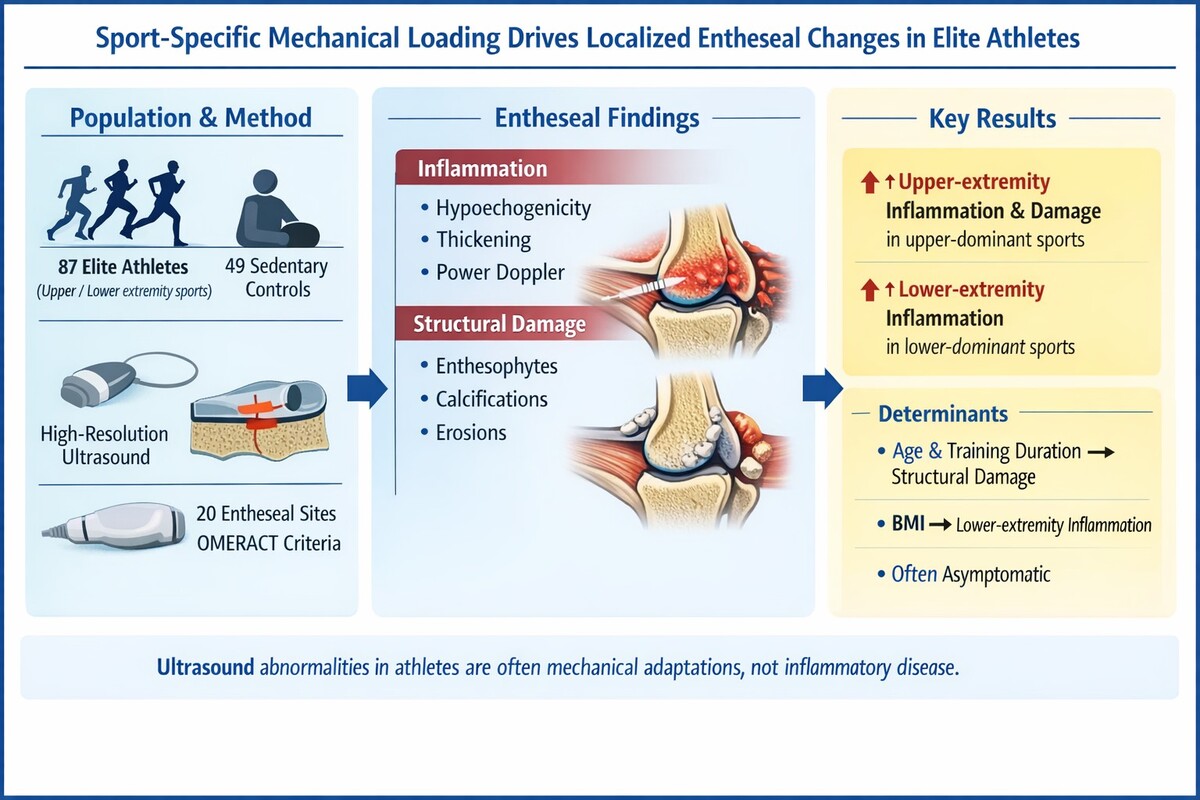
Musculoskeletal ultrasound (US) was chosen as the primary imaging modality for this study due to its unique ability to provide high-resolution, real-time assessment of both inflammatory and structural entheseal changes. Unlike conventional radiography, which detects only late-stage structural damage, US allows visualization of early inflammatory features such as hypoechogenicity and power Doppler signal, as well as structural findings including enthesophytes and calcifications. Compared with magnetic resonance imaging, US offers greater feasibility for the simultaneous evaluation of multiple entheseal sites, enables dynamic and bilateral assessment, does not involve radiation exposure, and is more accessible in routine clinical practice. These characteristics make US particularly suitable for studying sport-related, load-dependent entheseal adaptations in elite athletes [8]. US provides high-resolution, real-time visualization of both inflammatory features (hypoechogenicity, increased thickness, Power Doppler [PD] signal) and structural damage (calcifications, erosions, enthesophytes) [9]. The Outcome Measures in Rheumatology (OMERACT) group has established consensus-based definitions and scoring systems for these elementary lesions, enhancing the reliability of US in this context [10]. Despite this, a global consensus on a single sonographic enthesitis index remains elusive, highlighting the complexity of US assessment in this area [11].
The literature remains limited regarding the differential impact of various sport-specific loading patterns on entheseal pathology. Previous studies have often grouped athletes broadly, obscuring the localized effects of distinct upper-versus lower-extremity dominant sports. Furthermore, the inclusion of non-inflammatory findings in enthesitis scoring indices remains a point of debate, particularly when evaluating athletes [12].
The primary objective of this study was to investigate the impact of sport-specific repetitive mechanical loading on entheseal inflammation and structural damage in elite athletes. We aimed to compare US-detected entheseal changes across different sports and extremity dominance groups relative to sedentary controls, thereby contributing to a better understanding of entheseal adaptation in this highly active population.
Material and methods
Study design and participants
This was a cross-sectional study conducted at a single center. The study included elite athletes aged over 18 years from seven distinct sports disciplines: athletics, basketball, cycling, golf, handball, climbing, and archery. Elite status was strictly defined as training for a minimum of 10 h per week and having at least 5 years of continuous sports experience. Exclusion criteria included a history of rheumatic disease, cancer, recent trauma to any entheseal region, pregnancy, or prior surgery. Participants with any known mental or cognitive dysfunction that could impair the ability to provide informed consent or to adequately cooperate with the study procedures were excluded from the study. The control group consisted of healthy, age- and sex-matched sedentary individuals over 18 years old with no history of regular sports participation.
Demographic data, including age, sex, body mass index (BMI), and smoking status, were collected for all participants. For athletes, weekly training duration and total years of sporting activity were also recorded. The study protocol was approved by the local Non-Interventional Clinical Research Ethics Committee (approval number 220-369/19-14) and was conducted in accordance with the principles of the Declaration of Helsinki. Written informed consent was obtained from all participants prior to inclusion in the study.
Ultrasound protocol and scoring
All participants underwent a standardized US scan on the same day as the clinical assessment. The scans were performed by a single experienced rheumatologist (SB) blinded to the participants’ physical examination findings and specific sport branches. A Logiq-E US machine (General Electric, Wauwatosa, Wisconsin, USA) equipped with a 7–13 MHz linear probe was used. To minimize operator-dependent variability, all US examinations were performed using standardized acquisition settings. A generous amount of coupling gel was applied, and care was taken to allow the transducer to rest lightly on the skin without exerting excessive pressure, in order to avoid artificial compression of the tendon or enthesis. B-mode parameters, including image depth, focal zone placement, and overall gain, were standardized across all examinations. Power Doppler (PD) settings were standardized with a pulse repetition frequency of 500 Hz and low wall filter. The color gain was increased to the highest value where no PD signal was observed below the bony cortex.
A total of 20 bilateral entheseal sites were scanned, including:
Upper extremity: supraspinatus and subscapularis insertions (shoulder), triceps insertions, common flexor and common extensor tendon origins (elbow);
Lower extremity: quadriceps and patellar tendon origin and insertion (knee), Achilles tendon and plantar fascia insertions (heel).
Images were acquired in both longitudinal and transverse planes and anonymized for subsequent scoring. The scoring of the anonymized images was performed after all participants had been enrolled.
Each entheseal area was evaluated for elementary lesions as defined by the OMERACT US Working Group [10]: hypoechogenicity, thickening, entheseal PD signals, erosions, enthesophytes, and calcifications (details provided in Supplementary Table SI, Supplementary Figures S1 and S2).
Thickening and erosions were scored quantitatively.
The remaining features were scored semi-quantitatively (Grade 0: normal; Grade 1: mild; Grade 2: moderate; Grade 3: severe).
Scoring indices (Supplementary Table SII):
Power Doppler settings were standardized across all scans: pulse repetition frequency (PRF) of 500 Hz and a low wall filter. The color gain was set to the highest value at which no PD signal was observed below the bony cortex.
Entheseal thickness cut-off: The cut-off value for entheseal thickness increase in elite athletes was calculated separately for each enthesis area using the mean + 2 standard deviations (SD) method, derived from the control group data, consistent with previous literature (Supplementary Tables SIII, SIV) [13].
Statistical analysis
Statistical analysis was performed using SPSS version 22. Numerical variables were expressed as median (interquartile range [IQR]), and categorical variables as frequency (%).
Grouping: Elite athletes were categorized into four groups based on the extremity predominantly used in their sport:
Upper extremity dominant (Group A): archers, golfers, basketball players, handball players, and climbers;
Upper extremity non-dominant (Group B): track and field athletes, cyclists;
Lower extremity dominant (Group C): track and field athletes, cyclists, basketball players, handball players, and climbers;
Lower extremity non-dominant (Group D): archers and golfers.
The Mann-Whitney U test and the Kruskal-Wallis test were used to compare US scores (inflammation and damage) between groups and the sedentary Control Group. Comparisons of upper and lower extremity scores were performed separately. Upper extremity scores were compared among Group A, Group B, and the sedentary Control Group, whereas lower extremity scores were compared among Group C, Group D, and the sedentary Control Group.
Regression analysis: Linear regression analysis was conducted to evaluate the determinants of US scores. Variables with a p-value below 0.200 in univariate analyses were entered into the multivariate regression model. The frequency of elementary lesions between groups was compared using the χ2 and Fisher’s exact tests.
Results
Participant characteristics
A total of 87 elite athletes (18 athletics, 8 basketball, 12 cycling, 8 golf, 9 handball, 20 climbing, 12 archery) and 49 sedentary controls were recruited. The median (IQR) age of the participants ranged from 19.5 (18.5–22.5) to 39.6 (33.4–49.0) years. Climbers were the oldest group, while archers were the youngest. BMI was comparable across all groups. Weekly training time varied significantly, with archers reporting the highest duration (median 60 h) (Table I).
Table I
Demographic characteristics of groups
Comparison of US scores
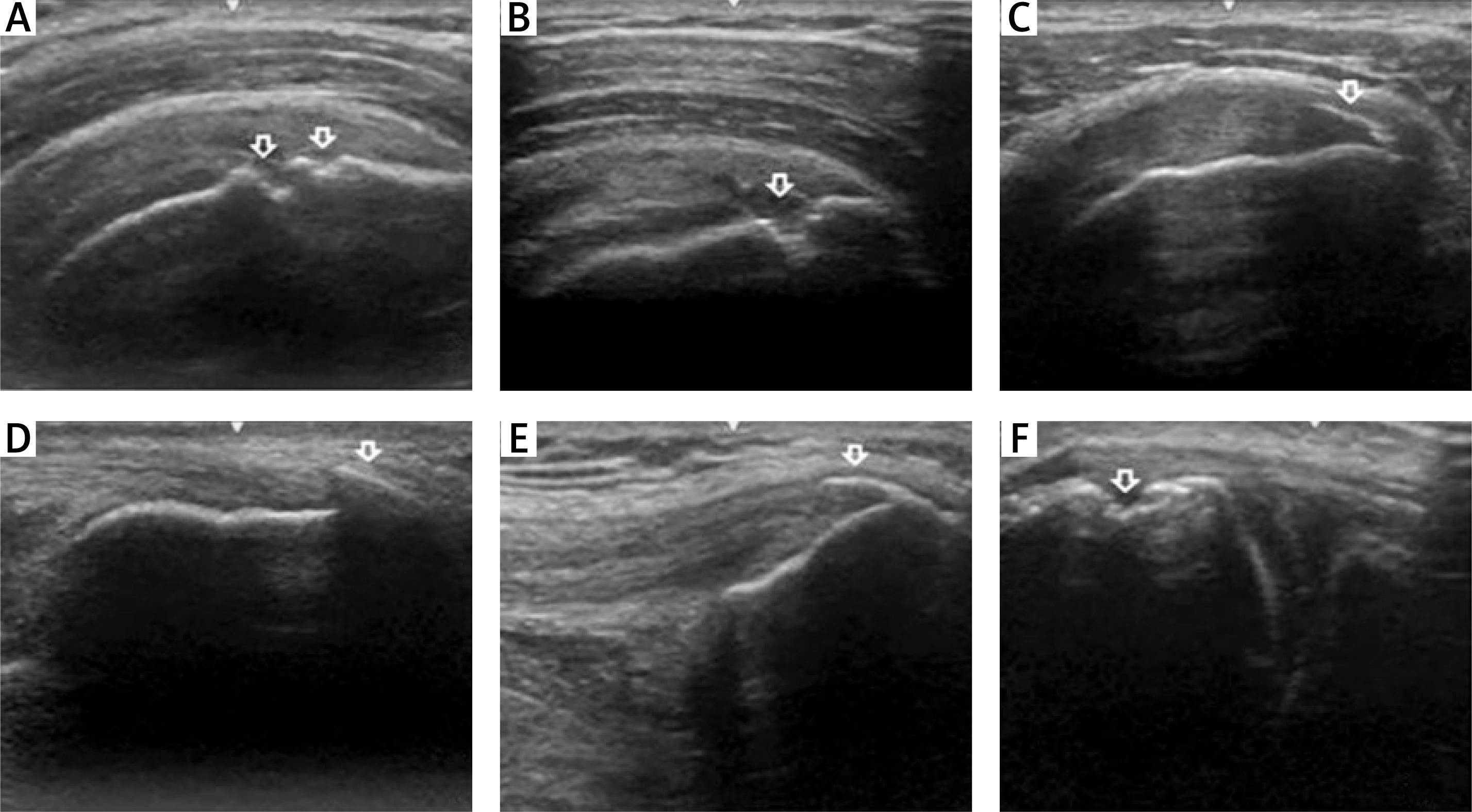
The US scores for entheseal inflammation and damage were compared for the upper extremity among Group A (upper extremity dominant), Group B (upper extremity non-dominant), and the sedentary Control Group, and for the lower extremity among Group C (lower extremity dominant), Group D (lower extremity non-dominant), and the sedentary Control Group (Table II). The frequencies of elementary lesions were compared between each elite athlete group and the sedentary control group, with the results shown in Supplementary Figures S3–S6. Overall, elite athletes exhibited significantly higher entheseal pathology (Figure 1) compared to sedentary controls, with differences varying by extremity and athlete specialization. The results of the regression analyses for lower and upper extremity inflammation and damage scores are presented in Table III.
Table II
Differences in inflammation and damage scores for upper extremity entheses across sports categories
Table III
Determinants of US scores (multivariate linear regression analysis)
Figure 1
Elementary lesions in different enthesis areas: A – erosion on subscapularis enthesis area, B – erosion on supraspinatus enthesis area, C – enthesophyte on supraspinatus enthesis area, D – enthesophyte on Achilles tendon enthesis area, E – enthesophyte on quadriceps tendon enthesis area, F – erosion on lateral epicondyle
Upper extremity scores (Table II, Supplementary Table SV)
Inflammation: Group A (upper dominant) demonstrated the highest median inflammation score (1 [interquartile range (IQR): 0–3]), which was significantly higher than the sedentary Control Group (0 [IQR: 0–1.5]; p = 0.010). No statistically significant differences in inflammation scores were found between Group A and Group B (upper non-dominant), or between Group B and the sedentary Control Group (p = 1.000 and p = 0.587, respectively).
Damage: While the median damage score was 0 for all groups, the distribution of scores revealed significant differences. Group A (0 [IQR: 0–3]) showed significantly higher damage compared to the sedentary Control Group (0 [IQR: 0–0]; p £ 0.001). No statistically significant differences in damage scores were found between Group A and Group B, or between Group B and the sedentary Control Group (p = 0.129 and p = 1.000, respectively).
Lower extremity scores (Table II, Supplementary Table SV)
Inflammation: Group C (lower dominant) exhibited the highest median inflammation score (2 [IQR: 1–4]), which was highly significant compared to the sedentary Control Group (0 [IQR: 0–1]; p < 0.001). Inflammation scores were similar between Group C and Group D (lower non-dominant), and between Group D and the sedentary Control Group (p = 0.137 and p = 0.179, respectively). Damage: No statistically significant differences were observed among groups for lower extremity damage scores (p = 0.055). Although not statistically significant, median damage scores were numerically higher in Group C compared with Group D and the sedentary Control Group.
Determinants of US scores (multivariate analysis)
Multivariate linear regression analysis identified independent factors associated with entheseal US scores, as detailed in Table III.
The analysis showed that age was a significant independent predictor for all damage scores (upper and lower extremity) and upper extremity inflammation. Weekly training duration was uniquely associated with upper extremity inflammation. BMI was the sole independent predictor for lower extremity inflammation and a significant predictor for lower extremity damage.
Climbing athletes demonstrated the highest overall US enthesopathy burden, consistent with the high, sustained mechanical demands of their sport. Despite the high prevalence of imaging abnormalities, a substantial number of athletes remained asymptomatic.
Discussion
This study provides compelling evidence that sport-specific, chronic mechanical loading in elite athletes is associated with a significantly higher burden of entheseal changes – both inflammatory and structural – detectable by US, compared to sedentary controls. Crucially, our findings highlight the differential impact of loading patterns, with upper extremity-dominant sports leading to higher upper limb scores and lower extremity-dominant sports correlating with higher lower limb inflammation.
Our finding of a higher prevalence of entheseal abnormalities in elite athletes compared to sedentary controls is consistent with a growing body of literature. For instance, Lanfranchi et al. [14] conducted a cross-sectional study comparing entheses US findings in axial spondyloarthritis patients, athletes, and healthy controls, similarly reporting a higher frequency of entheseal changes in athletes than in controls. More recently, Perrotta et al. [15] compared entheseal fibrocartilage in psoriatic arthritis patients, athletes, and healthy controls, noting distinct adaptive patterns in athletes, which reinforces the idea that mechanical demand drives structural changes. Our study extends these findings by demonstrating that this increased burden is not uniform but is specifically localized to the most stressed extremity, providing a more granular view of sport-specific adaptation.
The observed effect of limb dominance is a key strength of our study. The significantly higher upper extremity scores in Group A (upper dominant) directly reflect the high-velocity, repetitive, and eccentric loading inherent in sports such as archery and climbing. This localized effect is mirrored in studies focusing on specific joints, such as Benítez-Martínez et al. [16], who found differences in patellar tendon abnormalities based on lower limb dominance in elite basketball players. Our results, which encompass a wider range of entheseal sites, consolidate the principle that the enthesis adapts locally to the specific biomechanical demands placed upon it.
The multivariate analysis provides critical insights into the factors driving entheseal changes.
Age and damage: The strong association between age and all entheseal damage scores (calcifications, enthesophytes) supports the consensus that these structural changes are cumulative, representing a progressive, load-induced remodeling process over an athletic career [1].
BMI and lower extremity: The independent association of BMI with lower extremity inflammation and damage scores aligns perfectly with the understanding that the lower limbs bear the entire axial load. This finding, consistent with general population studies [4], underscores that even in highly conditioned athletes, increased body mass translates to higher compressive and tensile forces at the lower limb entheses.
Training duration and upper extremity inflammation: The unique association of weekly training duration with upper extremity inflammation scores is a novel and important finding. It suggests that the intensity of current training, beyond the cumulative effect of age, drives the more active, inflammatory component (hypoechogenicity, PD signal) in the upper limbs. This may be due to the high-demand, high-strain nature of upper-body dominant sports, where the enthesis is pushed closer to its mechanical limits during peak training periods.
The high prevalence of asymptomatic US abnormalities in our cohort is a crucial finding that necessitates careful clinical interpretation. This finding is at the heart of the debate regarding enthesitis scoring. Mascarenhas et al. (2021) [12] reviewed enthesitis scoring indices and highlighted the challenge of including non-inflammatory findings (such as enthesophytes) when assessing for inflammatory disease. In our athletic population, these findings are likely a manifestation of physiological adaptation or mechanoinflammation – a subclinical, adaptive inflammatory response – rather than systemic inflammatory disease [5]. Clinicians must therefore contextualize US findings within the athlete’s specific sport, training history, and symptom status to avoid misdiagnosis or unnecessary intervention.
An important conceptual consideration in the present study relates to the interpretation of the OMERACT US ‘damage’ domain in an athletic population. While the OMERACT definitions were applied to ensure methodological standardization, structural findings such as enthesophytes and calcifications – classified as ‘damage’ within inflammatory arthritis frameworks – may represent physiological or load-related structural adaptations in elite athletes rather than true pathology. In this context, US features reflecting active inflammation, particularly power Doppler signal and erosions, are likely to be more specific for inflammatory enthesitis when interpreted alongside clinical symptoms and disease probability. Recognizing this distinction is essential to avoid pathologizing adaptive entheseal changes in physically active individuals [10].
This study has several notable strengths. First, entheseal assessment was performed using standardized OMERACT definitions, ensuring methodological consistency and alignment with the current international consensus. Second, a comprehensive US protocol covering multiple bilateral entheseal sites was applied, allowing a detailed evaluation of both inflammatory and structural changes. Third, athletes were analyzed according to sport-specific mechanical loading patterns, providing a more nuanced understanding of localized entheseal adaptations. Finally, the inclusion of largely asymptomatic elite athletes reflects real-world clinical practice, where US abnormalities are often detected in the absence of overt symptoms, thereby enhancing the clinical applicability of our findings.
Several limitations of this study should be acknowledged. First, the cross-sectional design precludes any causal inference regarding the relationship between mechanical loading and entheseal changes. Second, the absence of a spondyloarthritis comparator group limits direct differentiation between mechanically driven entheseal adaptation and inflammatory enthesitis. Third, US assessments were performed by a single experienced examiner, which may limit generalizability despite the use of standardized OMERACT definitions. In addition, although age was included in multivariate analyses, residual confounding related to age differences between certain athlete groups and the control population cannot be entirely excluded. These limitations should be considered when interpreting the results [9]. Although the present study did not include a spondyloarthritis comparator arm, the differentiation between mechanically driven entheseal adaptation and inflammatory enthesitis remains a key clinical challenge. Previous comparative studies have shown that athletes may exhibit a high prevalence of US-detected entheseal abnormalities that overlap with findings seen in inflammatory arthritis, despite the absence of systemic disease or symptoms. In particular, Lanfranchi et al. and Perrotta et al. demonstrated that while structural changes such as enthesophytes and calcifications are common in athletes, features reflecting active inflammation – especially persistent power Doppler signal and erosions – are more suggestive of true inflammatory enthesitis. Our findings should therefore be interpreted within the context of sport-specific mechanical loading, clinical presentation, and disease probability, to avoid misclassification of physiological adaptation as pathological enthesitis [14, 15]. An additional limitation of this study relates to age differences between certain athlete subgroups and the sedentary Control Group. Although age was included as a covariate in the multivariate regression analyses and was identified as an independent predictor of entheseal damage, residual confounding related to age cannot be fully excluded in a cross-sectional design. Structural entheseal changes such as calcifications and enthesophytes are known to accumulate with age and may therefore partially contribute to higher damage scores observed in older athlete groups, particularly climbers, compared with a younger control population. Consequently, the observed differences should be interpreted as associations rather than definitive evidence of sport-related causality
US reliability is a critical methodological consideration in entheseal imaging studies. In the present study, all examinations were performed by a single experienced sonographer using standardized OMERACT definitions; however, formal intra- and inter-observer reliability analyses were not repeated within this dataset, which should be acknowledged as a limitation. Nevertheless, in a previously published study by our group applying the same OMERACT-based US definitions for entheseal assessment, intra- and inter-observer reliability were excellent, with intraclass correlation coefficients exceeding 0.80 across all entheseal sites. These findings support the reproducibility of the applied methodology when performed by trained assessors, although future studies should ideally incorporate reliability testing within the study cohort [2].
Given the cross-sectional design of the present study, causal relationships between sport-related mechanical loading and US-detected entheseal changes cannot be established. The observed associations should therefore be interpreted with caution. An alternative explanation may involve reverse causality or selection bias, whereby individuals with inherently robust musculoskeletal or entheseal characteristics are more likely to engage in and sustain elite-level athletic activity. Consequently, the findings of this study should be understood as associations rather than evidence of direct causation, highlighting the need for longitudinal studies to clarify the temporal relationship between mechanical loading and entheseal adaptation.
The clinical relevance of the present findings lies in their implications for daily rheumatology practice. With the expanding use of musculoskeletal US, entheseal abnormalities are increasingly detected in asymptomatic or minimally symptomatic individuals, particularly among physically active populations. Elite athletes may demonstrate US findings that resemble inflammatory pathology, despite these changes representing biomechanical adaptation rather than disease. Previous studies have highlighted the significant impact of mechanical loading, neuromuscular control, and postural factors on musculoskeletal tissue behavior, underscoring that structural and functional adaptations may occur in the absence of systemic inflammation. Therefore, our results emphasize that US findings in athletes should always be interpreted in conjunction with sport-specific loading patterns, clinical symptoms, and overall disease probability, in order to avoid misdiagnosis and unnecessary therapeutic escalation [17, 18].
The clinical significance of the observed statistically significant differences should be interpreted with caution. In certain comparisons, particularly for upper extremity damage scores, the median value was zero in both athletes and controls, indicating that statistical significance was driven by a subset of individuals with higher scores rather than a uniform group-wide shift. Importantly, a high prevalence of ultrasound-detected entheseal abnormalities was observed in largely asymptomatic elite athletes. These findings should not be automatically interpreted as pathological enthesitis requiring clinical intervention. In physically active populations, many structural entheseal changes likely reflect physiological or load-related adaptation rather than inflammatory disease. Therefore, ultrasound findings in athletes must always be interpreted in conjunction with clinical symptoms, sport-specific mechanical loading patterns, and overall disease probability to avoid misdiagnosis and unnecessary treatment.
Future longitudinal studies are warranted to track the evolution of US-detected entheseal changes over an athlete’s career and to determine which specific US features predict the onset of clinical symptoms. Research incorporating advanced imaging techniques (e.g., MRI) and molecular biomarkers of inflammation could further elucidate the biological distinction between physiological entheseal adaptation and early pathological mechanoinflammation.
Sport-specific mechanical loading is a powerful driver of localized entheseal changes in elite athletes, detectable by high-resolution US. The differential associations of entheseal scores with age, weekly training duration, and BMI underscore the complex interplay of cumulative stress and systemic factors in entheseal remodeling. These findings reinforce the need for a nuanced interpretation of US results in the athletic population, recognizing that many imaging abnormalities represent subclinical adaptation rather than overt disease.