Current issue
Archive
Manuscripts accepted
About the Journal
Editorial office
Editorial board
Section Editors
Abstracting and indexing
Subscription
Contact
Ethical standards and procedures
Most read articles
Instructions for authors
Article Processing Charge (APC)
Regulations of paying article processing charge (APC)


BASIC RESEARCH
Fuzheng Kang’ai decoction suppresses hepatocellular carcinoma via regulation of the KLF4/HIF-1α/CA9 signaling axis
1
Department of Pharmacy, Shaanxi Cancer Hospital, Xi’an, Shaanxi, China
2
Health Science Center, Xi’an Jiaotong University, Xi’an, Shaanxi, China
3
Department of Integrated Traditional Chinese and Western Medicine, Shaanxi Cancer Hospital, Xi’an, Shaanxi, China
4
Third Department of Internal Medicine, Shaanxi Cancer Hospital, Xi’an, Shaanxi, China
5
Department of Thoracic Surgery, Shaanxi Cancer Hospital, Xi’an, Shaanxi, China
6
Department of Scientific Research and Education, Shaanxi Cancer Hospital, Xi’an, Shaanxi, China
7
School of Life Science and Technology, Xi’an Jiaotong University, Xi’an, Shaanxi, China
These authors had equal contribution to this work
Submission date: 2025-11-07
Final revision date: 2025-12-22
Acceptance date: 2026-01-05
Online publication date: 2026-04-01
Corresponding author
Yili Zhang
Third Department of Internal Medicine Shaanxi Provincial Cancer Hospital No. 309 Yanta West Road Xi’an 710061 Shaanxi, China
Third Department of Internal Medicine Shaanxi Provincial Cancer Hospital No. 309 Yanta West Road Xi’an 710061 Shaanxi, China
Peixi Zhao
Department of Pharmacy Shaanxi Provincial Cancer Hospital No. 309 Yanta West Road Xi’an 710061 Shaanxi, China
Department of Pharmacy Shaanxi Provincial Cancer Hospital No. 309 Yanta West Road Xi’an 710061 Shaanxi, China
KEYWORDS
hepatocellular carcinomaFuzheng Kang’ai decoctiontraditional Chinese medicinephytochemicalsbioactive components
TOPICS
ABSTRACT
Introduction:
Clinical studies have established the efficacy of Fuzheng Kang’ai formula (FZKAF) in hepatocellular carcinoma (HCC) management. The molecular basis of FZKAF’s HCC-suppressive effects is not fully characterized. This investigation aimed to mechanistically delineate FZKAF’s therapeutic actions against HCC.
Material and methods:
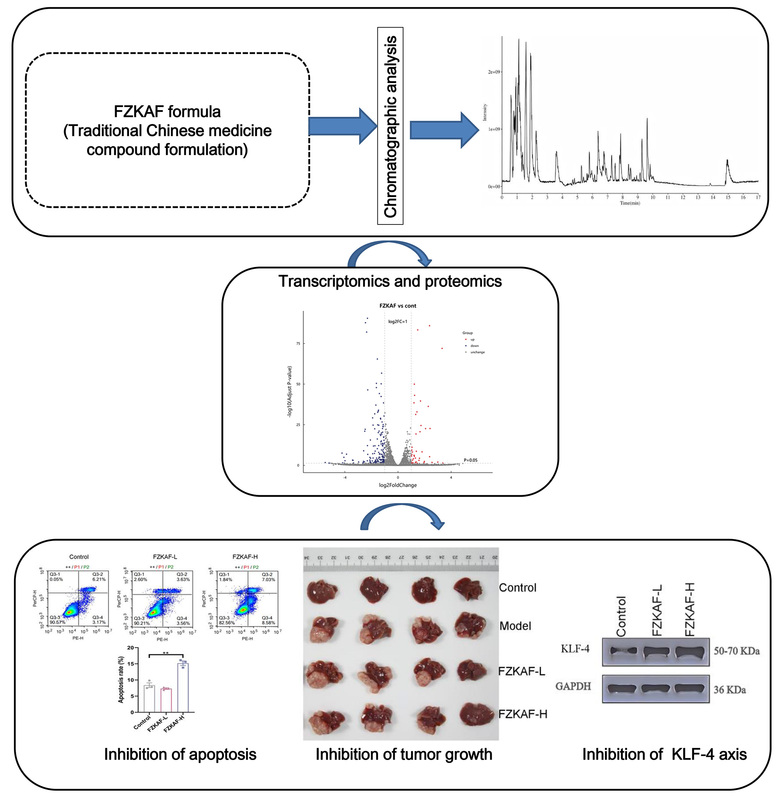
Phytochemical characterization via liquid chromatography-mass spectrometry (LC-MS) established the decoction’s bioactive constituents. CCK-8 assays quantified proliferative suppression and cytotoxicity, while Annexin V-FITC/PI staining and cell cycle analysis mapped apoptosis induction. Integrated proteomic and transcriptomic profiling screened core targets and signaling pathways. Therapeutic efficacy was ultimately confirmed in an orthotopic HCC nude mouse model.
Results:
Phytochemical profiling identified 33 bioactive compounds in serum following FZKAF administration, including 9 established anti-tumor agents such as paeoniflorin, catechin, kaempferol, and quercetin. Functionally, FZKAF demonstrated dual anti-HCC efficacy by suppressing tumor growth in vivo and inhibiting 97H cell proliferation in vitro while promoting apoptosis through mitochondrial dysfunction. Mechanistic interrogation via multi-omics revealed FZKAF coordinately modulates KLF4, HIF-1a, and CA9 targets to disrupt oncogenic signaling.
Conclusions:
FZKAF orchestrates apoptosis induction and growth suppression in HCC, at least partially, by modulating the KLF4/HIF-1a/CA9 signaling axis, revealing a novel druggable pathway that advances precision oncology strategies for HCC patients.
Clinical studies have established the efficacy of Fuzheng Kang’ai formula (FZKAF) in hepatocellular carcinoma (HCC) management. The molecular basis of FZKAF’s HCC-suppressive effects is not fully characterized. This investigation aimed to mechanistically delineate FZKAF’s therapeutic actions against HCC.
Material and methods:
Phytochemical characterization via liquid chromatography-mass spectrometry (LC-MS) established the decoction’s bioactive constituents. CCK-8 assays quantified proliferative suppression and cytotoxicity, while Annexin V-FITC/PI staining and cell cycle analysis mapped apoptosis induction. Integrated proteomic and transcriptomic profiling screened core targets and signaling pathways. Therapeutic efficacy was ultimately confirmed in an orthotopic HCC nude mouse model.
Results:
Phytochemical profiling identified 33 bioactive compounds in serum following FZKAF administration, including 9 established anti-tumor agents such as paeoniflorin, catechin, kaempferol, and quercetin. Functionally, FZKAF demonstrated dual anti-HCC efficacy by suppressing tumor growth in vivo and inhibiting 97H cell proliferation in vitro while promoting apoptosis through mitochondrial dysfunction. Mechanistic interrogation via multi-omics revealed FZKAF coordinately modulates KLF4, HIF-1a, and CA9 targets to disrupt oncogenic signaling.
Conclusions:
FZKAF orchestrates apoptosis induction and growth suppression in HCC, at least partially, by modulating the KLF4/HIF-1a/CA9 signaling axis, revealing a novel druggable pathway that advances precision oncology strategies for HCC patients.
REFERENCES (53)
1.
Bray F, Laversanne M, Sung H, et al. Global cancer statistics 2022: GLOBOCAN estimates of incidence and mortality worldwide for 36 cancers in 185 countries. CA Cancer J Clin 2024; 74: 229-63.
2.
Han B, Zheng R, Zeng H, et al. Cancer incidence and mortality in China, 2022. J Natl Cancer Cent 2024; 4: 47-53.
3.
Devarbhavi H, Asrani SK, Arab JP, Nartey YA, Pose E, Kamath PS. Global burden of liver disease: 2023 update. J Hepatol 2023; 79: 516-37.
4.
Pazgan-Simon M, Szymanek-Pasternal A, Górka-Dynysiewicz J, et al. Serum chemerin level in patients with liver cirrhosis and primary and multifocal hepatocellular carcinoma with consideration of insulin level. Arch Med Sci 2024; 20: 1504-10.
5.
Wei L, Wang Z, Jing N, et al. Frontier progress of the combination of modern medicine and traditional Chinese medicine in the treatment of hepatocellular carcinoma. Chin Med 2022; 17: 90.
6.
Xu L, Wang S, Zhuang L, et al. Jian Pi Li Qi Decoction alleviated postembolization syndrome following transcatheter arterial chemoembolization for hepatocellular carcinoma: a randomized, double-blind, placebo-controlled trial. Integr Cancer Ther 2016; 15: 349-57.
7.
Peng Y, Wu X, Zhang Y, et al. An overview of traditional chinese medicine in the treatment after radical resection of hepatocellular carcinoma. J Hepatocell Carcinoma 2023; 10: 2305-21.
8.
Fan H, Lei S, Zhao Z, et al. Beneficial effects of traditional Chinese medicine fuzheng huayu on the occurrence of hepatocellular carcinoma in patients with compensated chronic hepatitis B cirrhosis receiving entecavir: a multicenter retrospective cohort study. J Clin Transl Hepatol 2024; 12: 505-15.
9.
Lin J, Guo H, Qin H, Zhang X, Sheng J. Integration of meta-analysis and network pharmacology analysis to investigate the pharmacological mechanisms of traditional Chinese medicine in the treatment of hepatocellular carcinoma. Front Pharmacol 2024; 15: 1374988.
10.
Luo J, Zhang H, Jiang D, Li Y, Ye T. Uncovering the role of RPL8 in glutathione synthesis-dependent ferroptosis control in hepatocellular carcinoma. Arch Med Sci 2025; 21: 1513-35.
11.
Ji D, Chen Y, Bi J, et al. Entecavir plus Biejia-Ruangan compound reduces the risk of hepatocellular carcinoma in Chinese patients with chronic hepatitis B. J Hepatol 2022; 77: 1515-24.
12.
Yang X, Feng Y, Liu Y, et al. Fuzheng Jiedu Xiaoji formulation inhibits hepatocellular carcinoma progression in patients by targeting the AKT/CyclinD1/p21/p27 pathway. Phytomedicine 2021; 87: 153575.
13.
Cao J, Huang J, Gui S, Chu X. Preparation, synergism, and biocompatibility of in situ liquid crystals loaded with sinomenine and 5-fluorouracil for treatment of liver cancer. Int J Nanomedicine 2021; 16: 3725-39.
14.
Luo Y, Lin W, Xiang S, et al. Paeoniflorin inhibits chronic restraint stress-induced progression of hepatocellular carcinoma through suppressing norepinephrine-induced activation of hepatic stellate cells via SRC/AKT/ERK pathways. J Ethnopharmacol 2025; 344: 119517.
15.
Jinhua LI, Chunping L, Yueyang Z, et al. Fuzheng Kang’ ai decoction inhibits cell proliferation, migration and invasion by modulating mir-21-5p/human phosphatase and tensin homology deleted on chromosome ten in lung cancer cells. J Tradit Chin Med 2022; 42: 344-52.
16.
Yang XB, Wu WY, Long SQ, Deng H, Pan ZQ. Effect of gefitinib plus Chinese herbal medicine (CHM) in patients with advanced non-small-cell lung cancer: a retrospective case-control study. Complement Ther Med 2014; 22: 1010-8.
17.
Wang S, Peng Z, Li W, Long S, Xiao S, Wu W. Fuzheng Kang-Ai decoction enhances the effect of Gefitinib-induced cell apoptosis in lung cancer through mitochondrial pathway. Cancer Cell Int 2020; 20: 185.
18.
Li L, Wang S, Zheng F, Wu W, Hann SS. Chinese herbal medicine Fuzheng Kang-Ai decoction sensitized the effect of gefitinib on inhibition of human lung cancer cells through inactivating PI3-K/Akt -mediated suppressing MUC1 expression. J Ethnopharmacol 2016; 194: 918-29.
19.
Zheng F, Zhao Y, Li X, et al. The repression and reciprocal interaction of DNA methyltransferase 1 and specificity protein 1 contributes to the inhibition of MET expression by the combination of Chinese herbal medicine FZKA decoction and erlotinib. J Ethnopharmacol 2019; 239: 111928.
20.
Tang Q, Xu M, Long S, et al. FZKA reverses gefitinib resistance by regulating EZH2/Snail/EGFR signaling pathway in lung adenocarcinoma. J Ethnopharmacol 2024; 318: 116646.
21.
Yang Y, Jiang B, Shi L, et al. The potential of natural herbal plants in the treatment and prevention of non-small cell lung cancer: an encounter between ferroptosis and mitophagy. J Ethnopharmacol 2025; 346: 119555.
22.
Zhao YY, Yang YQ, Sheng HH, et al. GPX4 Plays a crucial role in fuzheng kang’ai decoction-induced non-small cell lung cancer cell ferroptosis. Front Pharmacol 2022; 13: 851680.
23.
Huang J, Shi R, Chen F, et al. Exploring the anti-hepatocellular carcinoma effects of Xianglian Pill: integrating network pharmacology and RNA sequencing via in silico and in vitro studies. Phytomedicine 2024; 133: 155905.
24.
Xie YQ, Yan FN, Yu LH, Yan HW, Kong YX, Yang ZY. Mechanism of Shashen-Maidong herb pair in treating hepatocellular carcinoma using network pharmacology and experimental validation. J Ethnopharmacol 2025; 337: 118954.
25.
Qin MY, Huang SQ, Zou XQ, et al. Drug-containing serum of rhubarb-astragalus capsule inhibits the epithelial-mesenchymal transformation of HK-2 by downregulating TGF-b1/p38MAPK/Smad2/3 pathway. J Ethnopharmacol 2021; 280: 114414.
26.
Shi Y, Liu Q, Chen W, et al. Protection of Taohong Siwu Decoction on PC12 cells injured by oxygen glucose deprivation/reperfusion via mitophagy-NLRP3 inflammasome pathway in vitro. J Ethnopharmacol 2023; 301: 115784.
27.
Percie du Sert N, Hurst V, Ahluwalia A, et al. The ARRIVE guidelines 2.0: updated guidelines for reporting animal research. J Cereb Blood Flow Metab 2020; 40: 1769-77.
28.
Chen CT, Chen CF, Lin TY, et al. Traditional Chinese medicine Kuan-Sin-Yin decoction inhibits cell mobility via downregulation of CCL2, CEACAM1 and PIK3R3 in hepatocellular carcinoma cells. J Ethnopharmacol 2023; 317: 116834.
29.
Yang R, Fu X, Wang Z, et al. Unlocking the potential of Traditional Chinese Medicine (TCM): Shipi Xiaoji formula (SPXJF) as a novel ferroptosis inducer in hepatocellular carcinoma. J Ethnopharmacol 2025; 340: 119236.
30.
Zhang Y, Shi K, Li YQ, Liu Y, Feng Y, Wang XB. Efficacy and safety of Fuzheng Jiedu Xiaoji formula combined with conventional western therapy in advanced HBV-HCC: a single-center, randomized controlled trial. Chin J Integr Med 2025; 31: 867-76.
31.
Yin D, Li X, Yang X, et al. Huqi formula suppresses hepatocellular carcinoma growth by modulating the PI3K/AKT/mTOR pathway and promoting T cell infiltration. Chin Med 2025; 20: 25.
32.
Duan ZW, Liu Y, Zhang PP, et al. Da-Chai-Hu-Tang formula inhibits the progression and metastasis in HepG2 cells through modulation of the PI3K/AKT/STAT3-induced cell cycle arrest and apoptosis. J Ethnopharmacol 2024; 331: 118293.
33.
Feng Z, Chan YT, Lu Y, et al. Siwu decoction suppress myeloid-derived suppressor cells through tumour cells necroptosis to inhibit hepatocellular carcinoma. Phytomedicine 2024; 133: 155913.
34.
Chen L, Jiang XD, Liu XP, et al. Mcl-1 is an important target protein for kaempferol from persimmon leaves in sensitizing ABT-199 to induce apoptosis in hepatoma cancer cells. Med Oncol 2025; 42: 146.
35.
Li X, Zhou M, Zhu Z, et al. Kaempferol from Alpinia officinarum hance induces G2/M cell cycle arrest in hepatocellular carcinoma cells by regulating the ATM/CHEK2/KNL1 pathway. J Ethnopharmacol 2024; 333: 118430.
36.
Lin F, Zhou W, Yuan X, Liu S, He Z. Mechanistic study of quercetin in the treatment of hepatocellular carcinoma with diabetes via MEK/ERK pathway. Int Immunopharmacol 2024; 142: 113194.
37.
Chen F. Inhibiting Pink1/Parkin-mediated mitophagy enhances the anticancer effects of quercetin in hepatocellular carcinomaf. Biochem Biophys Res Commun 2024; 712-713: 149899.
38.
Chen W, Li Y, Zhang C, et al. Multi-omics and experimental validation reveal anti-HCC mechanisms of Tibetan Liuwei Muxiang Pill and Quercetin. Pharmaceuticals (Basel) 2025; 18: 900.
39.
Tanigawa S, Fujii M, Hou DX. Action of Nrf2 and Keap1 in ARE-mediated NQO1 expression by quercetin. Free Radic Biol Med 2007; 42: 1690-703.
40.
Wang Z, Bi Z, Bamrah J, et al. Nrf2 drives epigenetic reprogramming and acts as the master regulator of KLF4 expression and activity in arsenic-induced transformation. Adv Sci (Weinh) 2025; 12: e00221.
41.
Zalpoor H, Bakhtiyari M, Liaghat M, Nabi-Afjadi M, Ganjalikhani-Hakemi M. Quercetin potential effects against SARS-CoV-2 infection and COVID-19-associated cancer progression by inhibiting mTOR and hypoxia-inducible factor-1a (HIF-1a). Phytother Res 2022; 36: 2679-82.
42.
Park SJ, Kim DW, Lim SR, et al. Kaempferol blocks the skin fibroblastic interleukin 1b expression and cytotoxicity induced by 12-O-tetradecanoylphorbol-13-acetate by suppressing c-Jun N-terminal kinase. Nutrients 2021; 13: 3079.
43.
Hamid Reza Ghaderi J, Sedigheh S, Abbas Zakeri B. Flavonoids kaempferol (KAE) and quercetine (QUE) inhibited proliferation of human leukemia THP-1 cells by up regulation of pro-apoptotic protein Bax and caspase 3/8 expression and down regulation of anti-apoptotic proteins Bcl-2, Bcl-xl and Mcl-1 expression. Ann Cancer Res Ther 2021; 29: 41-6.
44.
Ma Y, Shi Y, Li W, Sun A, Zang P, Zhang P. Epigallocatechin-3-gallate regulates the expression of Kruppel-like factor 4 through myocyte enhancer factor 2A. Cell Stress Chaperones 2014; 19: 217-26.
45.
Li X, Wu Q, Bu M, et al. Ergosterol peroxide activates Foxo3-mediated cell death signaling by inhibiting AKT and c-Myc in human hepatocellular carcinoma cells. Oncotarget 2016; 7: 33948-59.
46.
Almatroodi SA, Almatroudi A, Alhumaydhi FA, Alsahli MA, Rahmani AH, Khan AA. Potential therapeutic targets of epigallocatechin gallate (EGCG), the most abundant catechin in green tea, and its role in the therapy of various types of cancer. Molecules 2020; 25: 3146.
47.
Nan Y, Wu X, Luo Q, et al. OTUB2 silencing promotes ovarian cancer via mitochondrial metabolic reprogramming and can be synthetically targeted by CA9 inhibition. Proc Natl Acad Sci USA 2024; 121: e2315348121.
48.
White B, Wang Z, Dean M, et al. Acidosis attenuates the hypoxic stabilization of HIF-1a by activating lysosomal degradation. J Cell Biol 2025; 224: e202409103.
49.
Muniyandi A, Hartman GD, Sishtla K, et al. Ref-1 is overexpressed in neovascular eye disease and targetable with a novel inhibitor. Angiogenesis 2025; 28: 11.
50.
Ronca R, Supuran CT. Carbonic anhydrase IX: an atypical target for innovative therapies in cancer. Biochim Biophys Acta Rev Cancer 2024; 1879: 189120.
51.
Tamim YM, Soliman ML, Sayed MM, et al. Acetazolamide suppresses the progression of hepatocellular carcinoma induced by diethylnitrosamine in Wistar albino rats. Fundam Clin Pharmacol 2024; 38: 1045-58.
52.
Li Y, Shi M, Bie B, et al. NRF1-induced lncRNA DDX11-AS1 contributes to the progression of hepatocellular carcinoma via activating CA9 expression and the MEK/ERK pathway. J Hepatocell Carcinoma 2025; 12: 891-908.
53.
Wei T, Lin R, Fu X, et al. Epigenetic regulation of the DNMT1/MT1G/KLF4/CA9 axis synergises the anticancer effects of sorafenib in hepatocellular carcinoma. Pharmacol Res 2022; 180: 106244.
Share
RELATED ARTICLE
| eISSN: | 1896-9151 |
| ISSN: | 1734-1922 |

We process personal data collected when visiting the website. The function of obtaining information about users and their behavior is carried out by voluntarily entered information in forms and saving cookies in end devices. Data, including cookies, are used to provide services, improve the user experience and to analyze the traffic in accordance with the Privacy policy. Data are also collected and processed by Google Analytics tool (more).
You can change cookies settings in your browser. Restricted use of cookies in the browser configuration may affect some functionalities of the website.
You can change cookies settings in your browser. Restricted use of cookies in the browser configuration may affect some functionalities of the website.