Current issue
Archive
Manuscripts accepted
About the Journal
Editorial office
Editorial board
Section Editors
Abstracting and indexing
Subscription
Contact
Ethical standards and procedures
Most read articles
Instructions for authors
Article Processing Charge (APC)
Regulations of paying article processing charge (APC)


CLINICAL RESEARCH
Evaluation of novel prognostic inflammatory markers in pancreatic cancer: a retrospective analysis of a high-volume center
1
Department of Oncology, National Medical Institute of the Ministry of the Interior and Administration, Warsaw, Poland
2
Department of Oncological Propaedeutics, Medical University of Warsaw, Poland
Submission date: 2025-12-30
Final revision date: 2026-01-21
Acceptance date: 2026-02-24
Online publication date: 2026-04-10
Corresponding author
Andrzej Deptała
Department of Oncology National Medical Institute of the Ministry of the Interior and Administration Department of Oncological Propaedeutics Medical University of Warsaw, Poland
Department of Oncology National Medical Institute of the Ministry of the Interior and Administration Department of Oncological Propaedeutics Medical University of Warsaw, Poland
KEYWORDS
pancreatic cancerinflammatory markersprognosisoverall survivalC-reactive protein (CRP)-to-lymphocyte ratio (CLR)CRP-to-bilirubin ratio (CBR)
TOPICS
ABSTRACT
Introduction:
Pancreatic cancer (PC) is one of the leading contributors to global cancer mortality. One direction of research is to evaluate systemic markers of inflammation and their role as predictors of overall survival (OS). The study aimed to assess potential inflammatory markers as prognostic factors for patients with PC.
Material and methods:
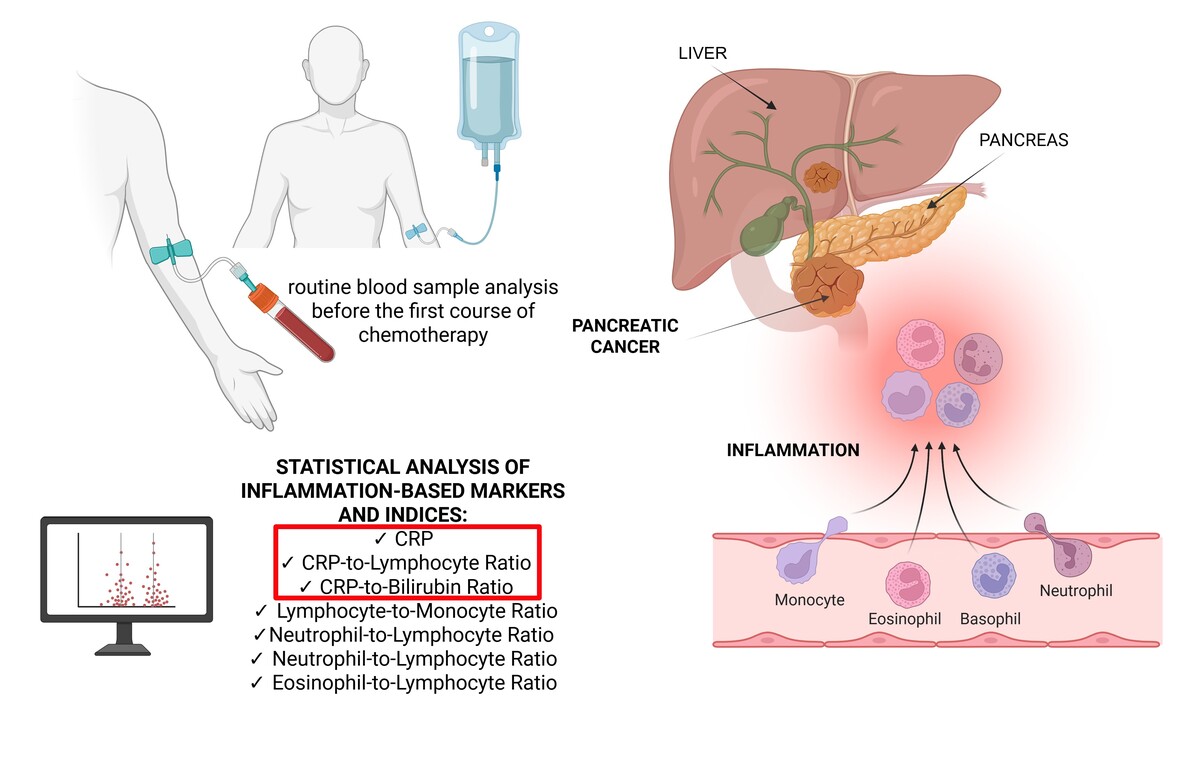
A retrospective analysis of 310 patients with PC was performed. Baseline laboratory characteristics and inflammatory indices were measured before the first course of chemotherapy. Statistical analyses were performed using appropriate tests.
Results:
C-reactive protein (CRP)-to-lymphocyte ratio (CLR) with a cutoff of 10.0 was the strongest OS predictor (AUC = 0.63, HR = 2.29, 95% CI: 1.62–3.22, p < 0.001); however, in further analysis, a value above 10.0 significantly stratified increased mortality risk only in the adjuvant group. CLR was associated with OS in both univariate and multivariate analyses. CRP-to-bilirubin ratio (CBR) with a cutoff of 0.53 (AUC = 0.61, HR = 1.68, 95% CI: 1.23–2.31, p = 0.001) significantly predicted prognosis; however, this association was only observed in the palliative cohort.
Conclusions:
This study identified two markers for predicting OS in PC: CBR and CLR. This was the first study to examine the prognostic im-portance of the CBR in patients with PC, emphasizing its potential as a new and practical biomarker that reflects both systemic in-flammation and liver function. However, the CLR demonstrated slightly better performance than the other indices in our cohort. Both CLR and CBR should be viewed as preliminary markers that need further validation through large-scale, prospective, multi-center research.
Pancreatic cancer (PC) is one of the leading contributors to global cancer mortality. One direction of research is to evaluate systemic markers of inflammation and their role as predictors of overall survival (OS). The study aimed to assess potential inflammatory markers as prognostic factors for patients with PC.
Material and methods:
A retrospective analysis of 310 patients with PC was performed. Baseline laboratory characteristics and inflammatory indices were measured before the first course of chemotherapy. Statistical analyses were performed using appropriate tests.
Results:
C-reactive protein (CRP)-to-lymphocyte ratio (CLR) with a cutoff of 10.0 was the strongest OS predictor (AUC = 0.63, HR = 2.29, 95% CI: 1.62–3.22, p < 0.001); however, in further analysis, a value above 10.0 significantly stratified increased mortality risk only in the adjuvant group. CLR was associated with OS in both univariate and multivariate analyses. CRP-to-bilirubin ratio (CBR) with a cutoff of 0.53 (AUC = 0.61, HR = 1.68, 95% CI: 1.23–2.31, p = 0.001) significantly predicted prognosis; however, this association was only observed in the palliative cohort.
Conclusions:
This study identified two markers for predicting OS in PC: CBR and CLR. This was the first study to examine the prognostic im-portance of the CBR in patients with PC, emphasizing its potential as a new and practical biomarker that reflects both systemic in-flammation and liver function. However, the CLR demonstrated slightly better performance than the other indices in our cohort. Both CLR and CBR should be viewed as preliminary markers that need further validation through large-scale, prospective, multi-center research.
REFERENCES (44)
1.
Siegel RL, Giaquinto AN, Jemal A. Cancer statistics, 2024. CA Cancer J Clin 2024; 74: 12-49.
2.
Rahib L, Smith BD, Aizenberg R, Rosenzweig AB, Fleshman JM, Matrisian LM. Projecting cancer incidence and deaths to 2030: the unex-pected burden of thyroid, liver, and pancreas cancers in the United States. Cancer Res 2014; 74: 2913-21.
3.
Strobel O, Neoptolemos J, Jäger D, Büchler MW. Optimizing the outcomes of pancreatic cancer surgery. Nat Rev Clin Oncol 2019; 16: 11-26.
4.
Conroy T, Pfeiffer P, Vilgrain V, et al. Pancreatic cancer: ESMO Clinical Practice Guideline for diagnosis, treatment and follow-up. Ann Oncol 2023; 34: 987-1002.
5.
Padoan A, Plebani M, Basso D. Inflammation and pancreatic cancer: focus on metabolism, cytokines, and immunity. Int J Mol Sci 2019; 20: 676.
6.
Fan Z, Luo G, Gong Y, et al. Prognostic value of the C-reactive protein/lymphocyte ratio in pancreatic cancer. Ann Surg Oncol 2020; 27: 4017-25.
7.
Worapongpaiboon R, Siranart N, Pajareya P, Phutinart S. Inflammatory markers in predicting survival in pancreatic cancer: a systematic re-view and meta-analysis. Pancreatology 2025; 25: 385-95.
8.
Luo X, Yu B, Jiang N, et al. Chemotherapy-induced reduction of neutrophil-to-lymphocyte ratio is associated with better survival in pancre-atic adenocarcinoma: a meta-analysis. Cancer Control 2020; 27: 1073274820977135.
9.
Iwai N, Okuda T, Sakagami J, et al. Neutrophil to lymphocyte ratio predicts prognosis in unresectable pancreatic cancer. Sci Rep 2020; 10: 18758.
10.
Neumann CCM, Schneider F, Hilfenhaus G, et al. Inflammation-based prognostic scores in pancreatic cancer patients-a single-center analy-sis of 1294 patients within the last decade. Cancers (Basel) 2023; 15: 2367.
11.
Zhou Y, Wei Q, Fan J, Cheng S, Ding W, Hua Z. Prognostic role of the neutrophil-to-lymphocyte ratio in pancreatic cancer: a meta-analysis containing 8252 patients. Clin Chim Acta 2018; 479: 181-9.
12.
Zhou Y, Cheng S, Fathy AH, Qian H, Zhao Y. Prognostic value of platelet-to-lymphocyte ratio in pancreatic cancer: a comprehensive meta-analysis of 17 cohort studies. Onco Targets Ther 2018; 11: 1899-908.
13.
Hu RJ, Ma JY, Hu G. Lymphocyte-to-monocyte ratio in pancreatic cancer: prognostic significance and meta-analysis. Clin Chim Acta 2018; 481: 142-6.
14.
Shimoyama R, Imamura Y, Uryu K et al. Inflammation based prognostic markers of metastatic pancreatic cancer using real world data in Ja-pan: the Tokushukai REAl world Data (TREAD) project. Oncol Lett 2024; 27: 136.
15.
Lee BM, Chung SY, Chang JS, Lee KJ, Seong J. The neutrophil-lymphocyte ratio and platelet-lymphocyte ratio are prognostic factors in pa-tients with locally advanced pancreatic cancer treated with chemoradiotherapy. Gut Liver 2018; 12: 342-52.
16.
Szkandera J, Stotz M, Absenger G, et al. Validation of C-reactive protein levels as a prognostic indicator for survival in a large cohort of pan-creatic cancer patients. Br J Cancer 2014; 110: 183-8.
17.
Badowska-Kozakiewicz A, Fudalej M, Kwaśniewska D, et al. Diabetes mellitus and pancreatic ductal adenocarcinoma-prevalence, clinico-pathological variables, and clinical outcomes. Cancers (Basel) 2022; 14: 2840.
18.
Huang X, Liu Y, Zhou Z, et al. Clinical significance of the C-reactive protein-to-bilirubin ratio in patients with ulcerative colitis. Front Med (Lausanne) 2023; 10: 1227998.
19.
Hart PC, Rajab IM, Alebraheem M, Potempa LA. C-reactive protein and cancer-diagnostic and therapeutic insights. Front Immunol 2020; 11: 595835.
20.
Fudalej M, Krupa K, Badowska-Kozakiewicz A, Deptała A. Inflammation, immunosuppression, and immunotherapy in pancreatic cancer – where are we now? Cancers 2025; 17: 1484.
21.
Shui Y, Li M, Su J, Chen M, Gu X, Guo W. Prognostic and clinicopathological significance of systemic immune-inflammation index in pancre-atic cancer: a meta-analysis of 2,365 patients. Aging (Albany NY) 2021; 13: 20585-97.
22.
Wang Y, Ni Q. Prognostic and clinicopathological significance of Systemic Immune-Inflammation Index in cancer patients receiving im-mune checkpoint inhibitors: a meta-analysis. Ann Med 2023; 55: 808-19.
23.
Chen Y, Yan H, Wang Y, Shi Y, Dai G. Significance of baseline and change in neutrophil-to-lymphocyte ratio in predicting prognosis: a retrospective analysis in advanced pancreatic ductal adenocarcinoma. Sci Rep 2017; 7: 753.
24.
Sun Y, Hu J, Wang R, et al. Meaningful nomograms based on systemic immune inflammation index predicted survival in metastatic pancre-atic cancer patients receiving chemotherapy. Cancer Med 2024; 13: e7453.
25.
Kataoka K, Kawashima H, Ohno E, et al. Comparison of outcomes between secondary fully covered and uncovered self-expandable metal stents in the treatment of recurrent biliary obstruction of pancreatic cancer. Surg Endosc 2022; 36: 5676-83.
26.
Vitek L, Hubacek JA, Pajak A, et al. Association between plasma bilirubin and mortality. Ann Hepatol 2019; 18: 379-85.
27.
Tell G, Gustincich S. Redox state, oxidative stress, and molecular mechanisms of protective and toxic effects of bilirubin on cells. Curr Pharm Des 2009; 15: 2908-14.
28.
Yi F, Tao S, Wu H. Bilirubin metabolism in relation to cancer. Front Oncol 2025; 15: 1570288.
29.
Hwang HJ, Lee SW, Kim SH. Relationship between bilirubin and C-reactive protein. Clin Chem Lab Med 2011; 49: 1823-8.
30.
Imamura T, Okamura Y, Sugiura T, et al. Clinical significance of preoperative albumin-bilirubin grade in pancreatic cancer. Ann Surg Oncol 2021; 28: 6223-35.
31.
Gasparini G, Aleotti F, Palucci M, et al. The role of biliary events in treatment and survival of patients with advanced pancreatic ductal ade-nocarcinoma. Dig Liver Dis 2023; 55: 1750-6.
32.
Han R, Tian Z, Jiang Y, et al. Prognostic significance of systemic immune-inflammation index and platelet-albumin-bilirubin grade in pa-tients with pancreatic cancer undergoing radical surgery. Gland Surg 2022; 11: 576-87.
34.
Del Giudice M, Gangestad SW. Rethinking IL-6 and CRP: Why they are more than inflammatory biomarkers, and why it matters. Brain Behav Immun 2018; 70: 61-75.
35.
Humphris JL, Chang DK, Johns AL, et al. The prognostic and predictive value of serum CA19.9 in pancreatic cancer. Ann Oncol 2012; 23: 1713-22.
36.
Poiraud C, Lenne X, Bruandet A, et al. Adjuvant chemotherapy omission after pancreatic cancer resection: a French nationwide study. World J Surg Oncol 2024; 22: 123.
37.
Muhammadzai J, Haider K, Moser M, et al. Early discontinuation of adjuvant chemotherapy in patients with early-stage pancreatic cancer correlates with inferior survival: a multicenter population-based cohort study. PLoS One 2022; 17: e0263250.
38.
Strijker M, Chen JW, Mungroop TH, et al. Systematic review of clinical prediction models for survival after surgery for resectable pancreatic cancer. Br J Surg 2019; 106: 342-54.
39.
Valle JW, Palmer D, Jackson R, et al. Optimal duration and timing of adjuvant chemotherapy after definitive surgery for ductal adenocarci-noma of the pancreas: ongoing lessons from the ESPAC-3 study. J Clin Oncol 2014; 32: 504-12.
40.
Aziz MH, Sideras K, Aziz NA, et al. The systemic-immune-inflammation index independently predicts survival and recurrence in resectable pancreatic cancer and its prognostic value depends on bilirubin levels: a retrospective multicenter cohort study. Ann Surg 2019; 270: 139-46.
41.
Lee T, Teng TZJ, Shelat VG. Carbohydrate antigen 19-9 – tumor marker: past, present, and future. World J Gastrointest Surg 2020; 12: 468-90.
42.
Ruan GT, Xie HL, Deng L, et al. A novel systemic inflammation prognostic score to stratify survival in elderly patients with cancer. Front Nutrition 2022; 9: 893753.
43.
Harvey S, Stares M, Scott JA, et al. Biomarkers of systemic inflammation provide additional prognostic stratification in cancers of unknown primary. Cancer Med 2024; 13: e6988.
44.
Kwaśniewska D, Fudalej M, Nurzyński P, et al. How a patient with resectable or borderline resectable pancreatic cancer should be treated-a comprehensive review. Cancers (Basel) 2023; 15: 4275.
Share
RELATED ARTICLE
| eISSN: | 1896-9151 |
| ISSN: | 1734-1922 |

We process personal data collected when visiting the website. The function of obtaining information about users and their behavior is carried out by voluntarily entered information in forms and saving cookies in end devices. Data, including cookies, are used to provide services, improve the user experience and to analyze the traffic in accordance with the Privacy policy. Data are also collected and processed by Google Analytics tool (more).
You can change cookies settings in your browser. Restricted use of cookies in the browser configuration may affect some functionalities of the website.
You can change cookies settings in your browser. Restricted use of cookies in the browser configuration may affect some functionalities of the website.