Current issue
Archive
Manuscripts accepted
About the Journal
Editorial office
Editorial board
Section Editors
Abstracting and indexing
Subscription
Contact
Ethical standards and procedures
Most read articles
Instructions for authors
Article Processing Charge (APC)
Regulations of paying article processing charge (APC)


HEPATOLOGY / RESEARCH PAPER
The C-reactive protein-albumin-lymphocyte (CALLY) index predicts survival in hepatitis B-related hepatocellular carcinoma after radical resection: a propensity score-matched analysis in a Chinese cohort
1
Mengchao Hepatobiliary Hospital of Fujian Medical University, China
Submission date: 2026-01-23
Final revision date: 2026-04-23
Acceptance date: 2026-05-15
Online publication date: 2026-07-25
KEYWORDS
TOPICS
ABSTRACT
Introduction:
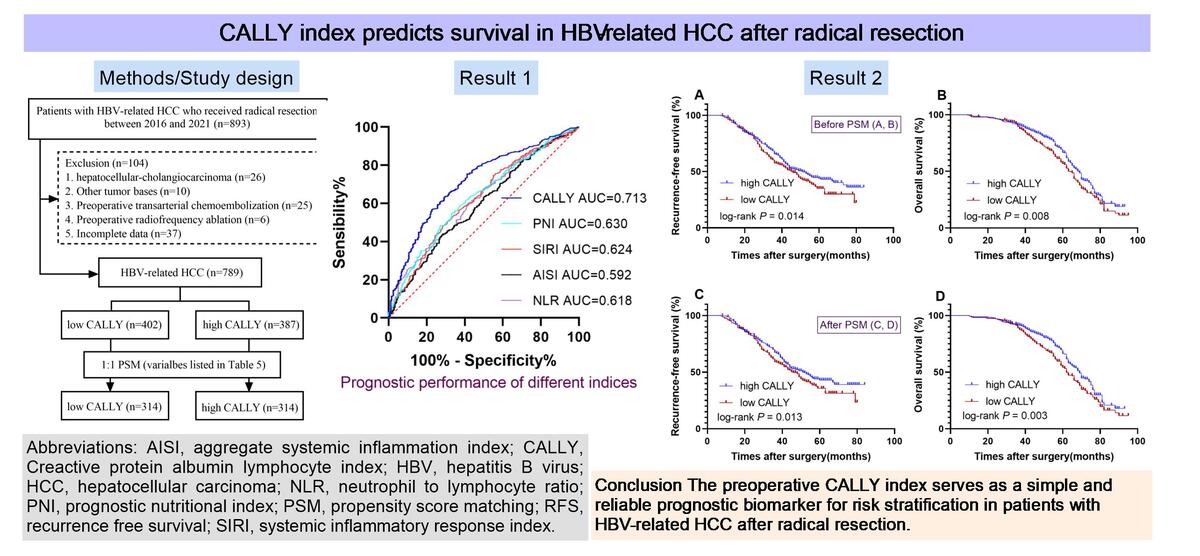
The C-reactive protein–albumin–lymphocyte (CALLY) index has emerged as a promising prognostic tool in various malignancies, yet its role in patients with hepatitis B virus (HBV)-related hepatocellular carcinoma (HCC) remains underexplored. This study aimed to evaluate the association between the preoperative CALLY index and survival outcomes following radical resection in Chinese patients with HBV-related HCC.
Material and methods:
In this retrospective cohort study, we included 789 Chinese patients with HBV-related HCC who underwent radical resection. Recurrence free survival (RFS) and overall survival (OS) were assessed using Kaplan–Meier analysis. Multivariable Cox regression and propensity score matching (PSM) were employed to identify independent prognostic factors and minimize confounding bias.
Results:
The CALLY index was identified as an independent prognostic factor for both RFS and OS. Compared with the low-CALLY group, the high-CALLY group demonstrated significantly superior 1-, 3-, and 5-year RFS (96.3%, 65.7%, and 43.8% vs. 95.3%, 57.6%, and 35.0%, respectively; P = 0.014) and OS (98.5%, 91.0%, and 66.6% vs. 97.9%, 89.4%, and 56.9%; P = 0.008). These survival benefits remained statistically significant following propensity score matching (PSM) adjustment.
Conclusions:
A high preoperative CALLY index is strongly associated with improved survival after radical resection in patients with HBV-related HCC, supporting its utility as an easily accessible prognostic biomarker for clinical risk stratification.
The C-reactive protein–albumin–lymphocyte (CALLY) index has emerged as a promising prognostic tool in various malignancies, yet its role in patients with hepatitis B virus (HBV)-related hepatocellular carcinoma (HCC) remains underexplored. This study aimed to evaluate the association between the preoperative CALLY index and survival outcomes following radical resection in Chinese patients with HBV-related HCC.
Material and methods:
In this retrospective cohort study, we included 789 Chinese patients with HBV-related HCC who underwent radical resection. Recurrence free survival (RFS) and overall survival (OS) were assessed using Kaplan–Meier analysis. Multivariable Cox regression and propensity score matching (PSM) were employed to identify independent prognostic factors and minimize confounding bias.
Results:
The CALLY index was identified as an independent prognostic factor for both RFS and OS. Compared with the low-CALLY group, the high-CALLY group demonstrated significantly superior 1-, 3-, and 5-year RFS (96.3%, 65.7%, and 43.8% vs. 95.3%, 57.6%, and 35.0%, respectively; P = 0.014) and OS (98.5%, 91.0%, and 66.6% vs. 97.9%, 89.4%, and 56.9%; P = 0.008). These survival benefits remained statistically significant following propensity score matching (PSM) adjustment.
Conclusions:
A high preoperative CALLY index is strongly associated with improved survival after radical resection in patients with HBV-related HCC, supporting its utility as an easily accessible prognostic biomarker for clinical risk stratification.
REFERENCES (37)
1.
Bray F, Laversanne M, Sung H, et al. Global cancer statistics 2022: GLOBOCAN estimates of incidence and mortality worldwide for 36 cancers in 185 countries. CA Cancer J Clin. 2024;74(3):229-263.
2.
Xia C, Dong X, Li H, et al. Cancer statistics in China and United States, 2022: profiles, trends, and determinants. Chinese Medical Journal. 2022;135(5):584-590.
3.
Korean Liver Cancer Association (KLCA) and National Cancer Center (NCC) Korea. 2022 KLCA-NCC Korea Practice Guidelines for the Management of Hepatocellular Carcinoma. Korean Journal of Radiology. 2022;23(12):1126-1240.
4.
Nwude VN, Lesi OA, Onyekwere C, et al. Clinical Characteristics of Hepatitis B Virus-Associated Hepatocellular Carcinoma Patients in Southwest Nigeria. Pathogens. 2025;14(2):169.
5.
Lin J, Zhang H, Yu H, et al. Epidemiological Characteristics of Primary Liver Cancer in Mainland China From 2003 to 2020: A Representative Multicenter Study. Frontiers in Oncology. 2022; 12:906778.
6.
Singal A G, Llovet J M, Yarchoan M, et al. AASLD Practice Guidance on prevention, diagnosis, and treatment of hepatocellular carcinoma. Hepatology. 2023,78(6):1922-1965.
7.
Yang F, Ma L, Yang Y, et al. Contribution of Hepatitis B Virus Infection to the Aggressiveness of Primary Liver Cancer: A Clinical Epidemiological Study in Eastern China. Frontiers in Oncology. 2019; 9:370.
8.
Tanemura A, Noguchi D, Shinkai T, et al. Prognostic significance of early and multiple recurrences after curative resection for hepatocellular carcinoma. BMC Surgery. 2024;24(1):339.
9.
Famularo S, Donadon M, Cipriani F, et al. Hepatocellular carcinoma surgical and oncological trends in a national multicentric population: the HERCOLES experience. Updates in Surgery. 2020;72(2):399-411.
10.
Bakrim S, Fessikh ME, Elhrech H, et al. Targeting inflammation in cancer therapy: from mechanistic insights to emerging therapeutic approaches. Journal of Translational Medicine. 2025;23(1):588.
11.
Akkız H, Şimşek H, Balcı D, et al. Inflammation and cancer: molecular mechanisms and clinical consequences. Frontiers in Oncology. 2025; 15:1564572.
12.
Lu J-N, Zhou L-S, Zhang S, et al. Performance of nutritional and inflammatory markers in patients with pancreatic cancer. World Journal of Clinical Oncology. 2024;15(8):1021-1032.
13.
Ding Pa, Yang J, Wu J, et al. Combined systemic inflammatory immune index and prognostic nutrition index as chemosensitivity and prognostic markers for locally advanced gastric cancer receiving neoadjuvant chemotherapy: a retrospective study. BMC Cancer. 2024;24(1):1014.
14.
Liu Q-W, Liu L, Hu J-X, et al. Nomogram based on a novel nutritional immune-inflammatory status score to predict postoperative outcomes in esophageal squamous cell carcinoma. World Journal of Gastroenterology. 2025;31(4):101749.
15.
Zhao H, Wu J, Wu Q, et al. Systemic immune-inflammation index values are associated with non-melanoma skin cancers: evidence from the National Health and Nutrition Examination Survey 2010-2018. Arch Med Sci. 2024;20(4):1128-1137.
16.
Chen D, Ma Y, Li J, et al. Prognostic and clinicopathological significance of C-reactive protein–albumin–lymphocyte (CALLY) in patients with digestive system neoplasms: a systematic review and meta-analysis. World Journal of Surgical Oncology. 2025;23(1):114.
17.
Wu B, Liu J, Shao C, et al. Integrating inflammation, nutrition, and immunity: the CALLY index as a prognostic tool in digestive system cancers - a systematic review and meta-analysis. BMC Cancer. 2025;25(1):672.
18.
Sun Y, Sun Q, Zheng C, et al. C-reactive protein-albumin-lymphocyte (CALLY) index in chronic kidney disease and mortality: insights into inflammation, nutrition, and immune status. Arch Med Sci. 2026;22(3). doi:10.5114/aoms/216398.19. Liu G, Zhao S, Xia M, et al. The CALLY index as a comprehensive inflammation-nutrition-immunity marker for prognosis in gastric cancer surgery. Surg Endosc. 2026 Feb 23. doi: 10.1007/s00464-026-12665-0. Epub ahead of print.
19.
Ishizuka C, Imaizumi K, Ichikawa N, et al. The CALLY index as a predictive biomarker for the prognosis and treatment outcomes of colorectal cancer. Surg Today. 2026 Feb 11. doi: 10.1007/s00595-026-03254-8. Epub ahead of print.
20.
Meng P, Gu T, Xu J, et al. Pretreatment CALLY index as promising novel biomarker in the prediction of surgical and oncological outcomes in esophageal cancer: a multi-center retrospective cohort study. Front Immunol. 2025; 16:1605067.
21.
Zhu L, Kong Y, Xing Y, et al. The Prognostic and Early Efficacy Prediction Value of Baseline C-Reactive Protein-Albumin-Lymphocyte (CALLY) Index in Advanced Pancreatic Cancer. International Journal of General Medicine. 2025; 18:3363-3372.
22.
Xi P, Huang G, Huang K, et al. The Prognostic Significance of the CALLY Index in Ampullary Carcinoma: An Inflammation-Nutrition Retrospective Analysis. Journal of Inflammation Research. 2025; 18:621-635.
23.
Zhang H, Shi J, Xie H, et al. Superiority of CRP-albumin-lymphocyte index as a prognostic biomarker for patients with gastric cancer. Nutrition. 2023; 116:112191.
24.
Jia P, Shen F, Zhao Q, et al. Association between C-reactive protein-albumin-lymphocyte index and overall survival in patients with esophageal cancer. Clin Nutr. 2025; 45:212-222.
25.
Iida H, Tani M, Komeda K, et al. Superiority of CRP-albumin-lymphocyte index (CALLY index) as a non-invasive prognostic biomarker after hepatectomy for hepatocellular carcinoma. Hpb. 2022;24(1):101-115.
26.
Müller L, Hahn F, M Hringer-Kunz A, et al. Immunonutritive Scoring for Patients with Hepatocellular Carcinoma Undergoing Transarterial Chemoembolization: Evaluation of the CALLY Index. Cancers. 2021;13(19):5018.
27.
Zhao H, Yin B, Li X, et al. The CRP-albumin-lymphocyte index provides enhanced prognostic value in liver cancer compared to the TNM staging system. Scientific reports. 2025;15(1):20090.
28.
Kim E-S, Kim SY, Moon A. C-Reactive Protein Signaling Pathways in Tumor Progression. Biomolecules & Therapeutics. 2023;31(5):473-483.
29.
Okumura T, Kimura T, Iwadare T, et al. Prognostic Significance of C-Reactive Protein in Lenvatinib-Treated Unresectable Hepatocellular Carcinoma: A Multi-Institutional Study. Cancers. 2023;15(22):5343.
30.
Lin K-Y, Chen Q-J, Tang S-C, et al. Prognostic implications of alpha-fetoprotein and C-reactive protein elevation in hepatocellular carcinoma following resection (PACE): a large cohort study of 2770 patients. BMC Cancer. 2023;23(1):1190.
31.
Wang X, Xu J, Zhang H, Qu P. The effect of albumin and hemoglobin levels on the prognosis of early-stage cervical cancer: a prospective, single-center–based cohort study. BMC Women's Health. 2023;23(1):553.
32.
Kuhlmann AD, Spies C, Schulte E, et al. Preoperative hypoalbuminaemia in liver surgery: an observational study at a university medical centre. BMJ Open. 2023;13(5): e068405.
33.
Ning J, Wang Y, Tao Z. The complex role of immune cells in antigen presentation and regulation of T-cell responses in hepatocellular carcinoma: progress, challenges, and future directions. Frontiers in Immunology. 2024; 15:1483834.
34.
Liu X, Qiu Z, Ndhlovu E, et al. Establishing and Externally Validating a Hemoglobin, Albumin, Lymphocyte, and Platelet (HALP) Score-Based Nomogram for Predicting Early Recurrence in BCLC Stage 0/A Hepatocellular Carcinoma Patients After Radical Liver Resection: A Multi-Center Study. Journal of Hepatocellular Carcinoma. 2024; 11:1127-1141.
35.
Calder PC, Ortega EF, Meydani SN, et al. Nutrition, Immunosenescence, and Infectious Disease: An Overview of the Scientific Evidence on Micronutrients and on Modulation of the Gut Microbiota. Advances in Nutrition. 2022;13(5): S1-S26.
36.
Zhu D, Lin Y-D, Yao Y-Z, et al. Negative association of C-reactive protein-albumin-lymphocyte index (CALLY index) with all-cause and cause-specific mortality in patients with cancer: results from NHANES 1999–2018. BMC Cancer. 2024;24(1):1499.
37.
Wang S, Liu C, Zheng X, et al. Prognostic value of the C-reactive protein-albumin-lymphocyte index in cancer patients with sarcopenia: A study on overall survival. Nutrition. 2025; 140:112893.
Share
RELATED ARTICLE
| eISSN: | 1896-9151 |
| ISSN: | 1734-1922 |

We process personal data collected when visiting the website. The function of obtaining information about users and their behavior is carried out by voluntarily entered information in forms and saving cookies in end devices. Data, including cookies, are used to provide services, improve the user experience and to analyze the traffic in accordance with the Privacy policy. Data are also collected and processed by Google Analytics tool (more).
You can change cookies settings in your browser. Restricted use of cookies in the browser configuration may affect some functionalities of the website.
You can change cookies settings in your browser. Restricted use of cookies in the browser configuration may affect some functionalities of the website.