Current issue
Archive
Manuscripts accepted
About the Journal
Editorial office
Editorial board
Section Editors
Abstracting and indexing
Subscription
Contact
Ethical standards and procedures
Most read articles
Instructions for authors
Article Processing Charge (APC)
Regulations of paying article processing charge (APC)


CLINICAL RESEARCH
Adverse events related to ligustrazine-containing drugs for cardiovascular and cerebrovascular diseases
1
General Hospital of Ningxia Medical University, Yinchuan, Ningxia Hui Autonomous Region, China
2
The Second Affiliated Hospital of Liaoning University of Traditional Chinese Medicine, Shenyang, Liaoning, China
3
General Hospital of Northern Theater Command, Shenyang, Liaoning, China
4
Yulin Hospital, The First Affiliated Hospital of Xi’an Jiaotong University, Yulin, Shanxi, China
Submission date: 2026-05-09
Final revision date: 2026-07-01
Acceptance date: 2026-07-18
Online publication date: 2026-08-19
KEYWORDS
ligustrazinecardiovascular and cerebrovascular diseasesadverse eventWHO-VigiAccesstraditional Chinese medicine
TOPICS
ABSTRACT
Introduction:
To characterize adverse-event (AE) reporting patterns and disproportionality signals for three ligustrazine-containing injectable formulations used for cardiovascular and cerebrovascular diseases: ligustrazine, Ginkgo biloba with ligustrazine, and Salvia miltiorrhiza with ligustrazine.
Material and methods:
Publicly available WHO-VigiAccess data were searched on November 24, 2024. Reports were summarized by formulation, sex, age group, continent, year, MedDRA System Organ Class (SOC), and Preferred Term (PT). Disproportionality was assessed using the Reporting Odds Ratio (ROR), Proportional Reporting Ratio (PRR), Bayesian Confidence Propagation Neural Network/Information Component (BCPNN/IC), and Empirical Bayes Geometric Mean (EBGM). For each formulation, the comparator consisted of all other medicinal-product reports available through the VigiAccess/VigiBase aggregate counts. Because spontaneous-report data lack exposure denominators, results are interpreted as reporting signals rather than incidence, absolute risk, comparative clinical safety, or causal evidence.
Results:
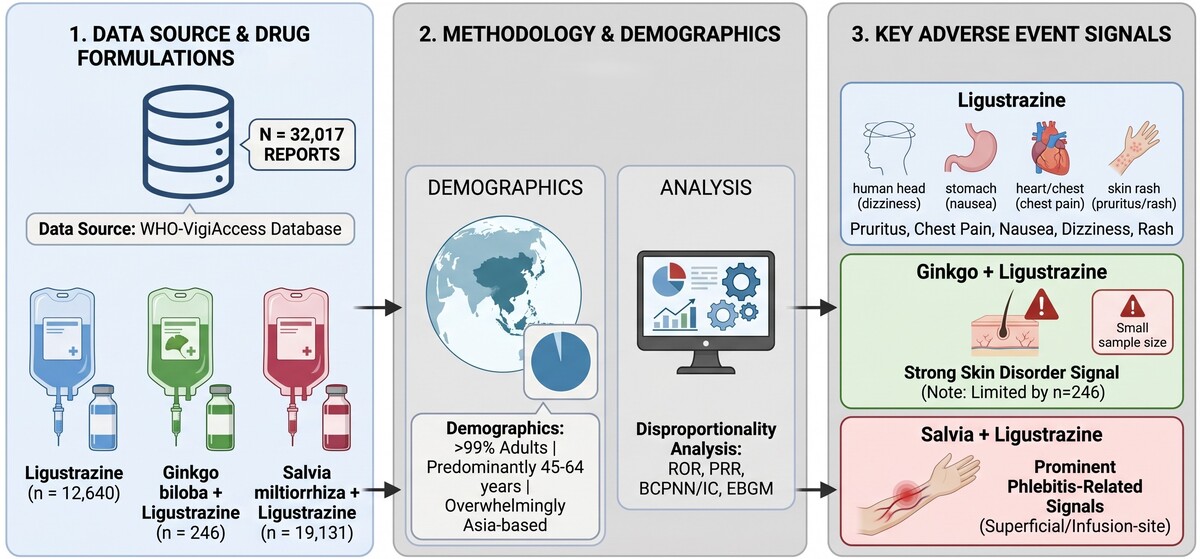
A total of 32,017 reports were retrieved: 12,640 for ligustrazine, 246 for Ginkgo biloba with ligustrazine, and 19,131 for Salvia miltiorrhiza with ligustrazine. Reports were overwhelmingly Asia-based. The 45–64-year age group accounted for the largest reporting proportion across formulations, and adult reports represented more than 99% of reports in each group. General disorders/administration-site conditions, skin and subcutaneous tissue disorders, gastrointestinal disorders, nervous system disorders, and vascular disorders were frequent SOC categories. Ginkgo biloba with ligustrazine showed a relatively stronger skin-disorder signal at the SOC level (ROR = 3.36; PRR = 2.78; IC = 1.48; EBGM = 2.78), but interpretation is limited by the small report volume. Salvia miltiorrhiza with ligustrazine showed prominent phlebitis-related PT signals, including superficial phlebitis (EBGM = 191.09), phlebitis (EBGM = 155.82), and infusion-site phlebitis (EBGM = 125.62). Ligustrazine reports frequently included pruritus, chest pain, nausea, dizziness, and rash. Age and sex patterns were interpreted only as reporting distributions, not as incidence peaks or susceptibility signals.
Conclusions:
The three ligustrazine-containing injectable formulations showed different AE reporting patterns in VigiAccess. These findings should be considered hypothesis-generating pharmacovigilance signals and require validation in denominator-based, clinically annotated, and preferably prospective data sources. Clinical interpretation should account for geography, product utilization, indication, infusion practice, reporting bias, duplicate reporting, and the highly unbalanced number of reports across formulations.
To characterize adverse-event (AE) reporting patterns and disproportionality signals for three ligustrazine-containing injectable formulations used for cardiovascular and cerebrovascular diseases: ligustrazine, Ginkgo biloba with ligustrazine, and Salvia miltiorrhiza with ligustrazine.
Material and methods:
Publicly available WHO-VigiAccess data were searched on November 24, 2024. Reports were summarized by formulation, sex, age group, continent, year, MedDRA System Organ Class (SOC), and Preferred Term (PT). Disproportionality was assessed using the Reporting Odds Ratio (ROR), Proportional Reporting Ratio (PRR), Bayesian Confidence Propagation Neural Network/Information Component (BCPNN/IC), and Empirical Bayes Geometric Mean (EBGM). For each formulation, the comparator consisted of all other medicinal-product reports available through the VigiAccess/VigiBase aggregate counts. Because spontaneous-report data lack exposure denominators, results are interpreted as reporting signals rather than incidence, absolute risk, comparative clinical safety, or causal evidence.
Results:
A total of 32,017 reports were retrieved: 12,640 for ligustrazine, 246 for Ginkgo biloba with ligustrazine, and 19,131 for Salvia miltiorrhiza with ligustrazine. Reports were overwhelmingly Asia-based. The 45–64-year age group accounted for the largest reporting proportion across formulations, and adult reports represented more than 99% of reports in each group. General disorders/administration-site conditions, skin and subcutaneous tissue disorders, gastrointestinal disorders, nervous system disorders, and vascular disorders were frequent SOC categories. Ginkgo biloba with ligustrazine showed a relatively stronger skin-disorder signal at the SOC level (ROR = 3.36; PRR = 2.78; IC = 1.48; EBGM = 2.78), but interpretation is limited by the small report volume. Salvia miltiorrhiza with ligustrazine showed prominent phlebitis-related PT signals, including superficial phlebitis (EBGM = 191.09), phlebitis (EBGM = 155.82), and infusion-site phlebitis (EBGM = 125.62). Ligustrazine reports frequently included pruritus, chest pain, nausea, dizziness, and rash. Age and sex patterns were interpreted only as reporting distributions, not as incidence peaks or susceptibility signals.
Conclusions:
The three ligustrazine-containing injectable formulations showed different AE reporting patterns in VigiAccess. These findings should be considered hypothesis-generating pharmacovigilance signals and require validation in denominator-based, clinically annotated, and preferably prospective data sources. Clinical interpretation should account for geography, product utilization, indication, infusion practice, reporting bias, duplicate reporting, and the highly unbalanced number of reports across formulations.
REFERENCES (27)
1.
Li Y, Cao GY, Jing WZ, Liu J, Liu M. Global trends and regional differences in incidence and mortality of cardiovascular disease, 1990-2019: findings from 2019 Global Burden of Disease study. Eur J Prev Cardiol 2023; 30: 276-86.
2.
Wang MS, Deng JW, Geng WY, et al. Temporal trend and attributable risk factors of cardiovascular diseases burden for adults 55 years and older in 204 countries/territories from 1990 to 2021: an analysis for the Global Burden of Disease Study 2021. Eur J Prev Cardiol 2025; 32: 539-52.
3.
GBD 2021 Causes of Death Collaborators. Global burden of 288 causes of death and life expectancy decomposition in 204 countries and territories and 811 subnational locations, 1990-2021: a systematic analysis for the Global Burden of Disease Study 2021. Lancet 2024; 403: 2100-32.
4.
Santangelo G, Scafuri S, Giugliano G, et al. Imaging approaches in risk stratification of patients with coronary artery disease: a narrative review. Arch Med Sci 2025; 21: 16-31.
5.
Nedeljkovic MI, Ninkovic M, Vucic M, et al. Assessment of patient-reported treatment burden in patients with coronary artery disease. Arch Med Sci 2024; 20: 1006-10.
6.
Ma XH, Chen Y, Huang XY, et al. Characteristics and efficacy of traditional Chinese medicine in the therapeutic strategy of chronic coronary syndrome: a systematic review and meta-analysis. Phytomedicine 2024; 129: 155579.
7.
Shao H, Zhang Y, Xiao X, et al. Ligustrazine injection as an adjunctive therapy for acute cerebral infarction: a systematic review and meta-analysis. Front Pharmacol 2021; 12: 761722.
8.
Zhu T, Fang BY, Meng XB, et al. Folium Ginkgo extract and tetramethylpyrazine sodium chloride injection (Xingxiong injection) protects against focal cerebral ischaemia/reperfusion injury via activating the Akt/Nrf2 pathway and inhibiting NLRP3 inflammasome activation. Pharm Biol 2022; 60: 195-205.
9.
Ma Z, Zhang F, Zhao F, et al. Safety and effectiveness of Salvia miltiorrhiza and ligustrazine injection for acute cerebral infarction in Chinese population: a PRISMA-compliant meta-analysis. Front Pharmacol 2024; 15: 1425053.
10.
Dong P, Huang Y, Pu Y. The therapeutic effects of ligustrazine in combination with other drugs in cardiovascular diseases. Int J Drug Discov Pharmacol 2023; 2: 11-7.
11.
Liu L, Chen W, Zhou H, et al. Chinese Stroke Association guidelines for clinical management of cerebrovascular disorders: executive summary and 2023 update. Stroke Vasc Neurol 2023; 8: e3.
12.
Ni X, Lin H, Luo X, et al. Clinical practice guideline for the prevention and treatment of stroke with integrated traditional Chinese and Western medicine (2023 edition). Chin General Pract 2025; 28: 521-33.
14.
Uppsala Monitoring Centre. Caveat document: statement of restrictions, limitations and conditions relating to data released from VigiBase. 2025.
15.
Fusaroli M, Salvo F, Falconi E, et al. The reporting of a disproportionality analysis for spontaneous reports of suspected adverse drug reactions in pharmacovigilance (READUS-PV): development and statement. Drug Saf 2024; 47: 575-84.
16.
Fusaroli M, Salvo F, Falconi E, et al. The reporting of a disproportionality analysis for spontaneous reports of suspected adverse drug reactions in pharmacovigilance (READUS-PV): explanation and elaboration. Drug Saf 2024; 47: 585-99.
17.
Uppsala Monitoring Centre. Guideline for using VigiBase data in studies. Version 4. 2021.
18.
National Medical Products Administration. Good Pharmacovigilance Practice announcement. 2021.
19.
National Medical Products Administration. Annual report for national adverse drug reaction monitoring. 2019 report; published 2020.
20.
Evans SJW, Waller PC, Davis S. Use of proportional reporting ratios (PRRs) for signal generation from spontaneous adverse drug reaction reports. Pharmacoepidemiol Drug Saf 2001; 10: 483-6.
21.
Rothman KJ, Lanes S, Sacks ST. The reporting odds ratio and its advantages over the proportional reporting ratio. Pharmacoepidemiol Drug Saf 2004; 13: 519-23.
22.
Bate A, Lindquist M, Edwards IR, et al. A Bayesian neural network method for adverse drug reaction signal generation. Eur J Clin Pharmacol 1998; 54: 315-21.
23.
DuMouchel W. Bayesian data mining in large frequency tables, with an application to the FDA spontaneous reporting system. Am Stat 1999; 53: 177-90.
24.
Candore G, Juhlin K, Manlik K, et al. Comparison of statistical signal detection methods within and across spontaneous reporting databases. Drug Saf 2015; 38: 577-87.
25.
Sultana J, Scondotto G, Cutroneo PM, Morgante F, Trifiro G. Intravitreal anti-VEGF drugs and signals of dementia and Parkinson-like events: analysis of the VigiBase database of spontaneous reports. Front Pharmacol 2020; 11: 315.
26.
Watson S, Caster O, Rochon P, den Ruijter H. Reported adverse drug reactions in women and men: aggregated evidence from globally collected individual case reports during half a century. EClinicalMedicine 2019; 17: 100188.
27.
Huang W, Yang Y, Zeng Z, Su M, Gao Q, Zhu B. Effect of Salvia miltiorrhiza and ligustrazine injection on myocardial ischemia/reperfusion and hypoxia/reoxygenation injury. Mol Med Rep 2016; 14: 4537-44.
Share
RELATED ARTICLE
| eISSN: | 1896-9151 |
| ISSN: | 1734-1922 |

We process personal data collected when visiting the website. The function of obtaining information about users and their behavior is carried out by voluntarily entered information in forms and saving cookies in end devices. Data, including cookies, are used to provide services, improve the user experience and to analyze the traffic in accordance with the Privacy policy. Data are also collected and processed by Google Analytics tool (more).
You can change cookies settings in your browser. Restricted use of cookies in the browser configuration may affect some functionalities of the website.
You can change cookies settings in your browser. Restricted use of cookies in the browser configuration may affect some functionalities of the website.