Current issue
Archive
Manuscripts accepted
About the Journal
Editorial office
Editorial board
Section Editors
Abstracting and indexing
Subscription
Contact
Ethical standards and procedures
Most read articles
Instructions for authors
Article Processing Charge (APC)
Regulations of paying article processing charge (APC)


CLINICAL RESEARCH
Association of combined high-sensitivity C-reactive protein and residual cholesterol levels with new-onset metabolic syndrome
1
First Clinical College of Liaoning University of Traditional Chinese Medicine, Shenyang, Liaoning, China
2
Affiliated Hospital of Changchun University of Traditional Chinese Medicine Changchun, Jilin, China
3
Affiliated Hospital of Liaoning University of Traditional Chinese Medicine, Shenyang, Liaoning, China
Submission date: 2026-02-26
Final revision date: 2026-04-28
Acceptance date: 2026-05-11
Online publication date: 2026-07-18
Corresponding author
Bingjiu Lu
Affiliated Hospital of Liaoning University of Traditional Chinese Medicine Shenyang, Liaoning, China
Affiliated Hospital of Liaoning University of Traditional Chinese Medicine Shenyang, Liaoning, China
KEYWORDS
metabolic syndromehigh-sensitivity C-reactive proteinresidual cholesterolChina Health and Retirement Longitudinal Study
TOPICS
ABSTRACT
Introduction:
Metabolic syndrome (MetS) involves dyslipidaemia and inflammation. However, the joint association of high-sensitivity C-reactive protein (hsCRP) and residual cholesterol (RC) with the risk of MetS remains unclear.
Material and methods:
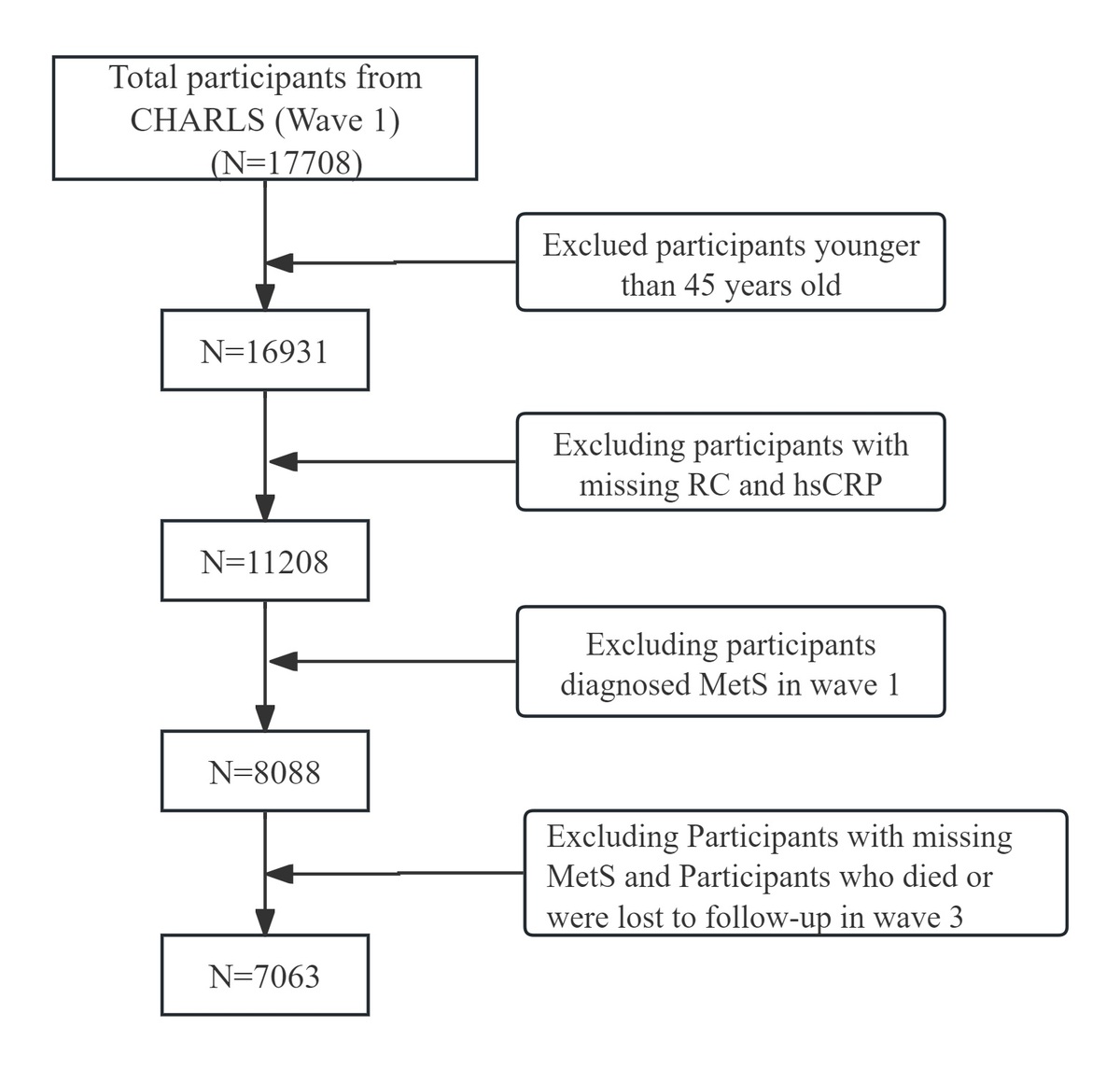
This longitudinal study enrolled 7,063 participants from the China Health and Retirement Longitudinal Study (CHARLS). Participants were grouped by median RC (17 mg/dl) and hsCRP threshold (1 mg/l). Multivariate logistic regression and restricted cubic spline (RCS) analyses were used to evaluate the joint association of RC and hsCRP with the risk of MetS.
Results:
During the 4-year follow-up period, 920 participants (11.5%) developed new-onset MetS. Compared with the group with low RC and low hsCRP, the fully adjusted odds ratio (OR) was 1.43 (p = 0.005) for the high RC only group and 2.56 (p < 0.001) for the group with both elevated levels, with a significant trend (p < 0.001). The residual cholesterol inflammation index (RCII) was positively associated with incident MetS risk. The fully adjusted OR (with 95% confidence interval [CI]) for quartile (Q) 4 vs. Q1 was 2.52 (1.92–3.30, p < 0.001), with a non-linear trend (p < 0.001). This association was consistent across age, sex, and BMI subgroups (all p for interaction > 0.05) and remained robust after excluding participants taking lipid-lowering drugs and using multiple imputation.
Conclusions:
Elevated hsCRP and RC were independently and synergistically associated with a higher MetS risk. Combined evaluation of inflammatory and lipid-related markers may help identify individuals at increased risk of MetS. The findings provide further evidence of the association between these pathways and MetS development.
Metabolic syndrome (MetS) involves dyslipidaemia and inflammation. However, the joint association of high-sensitivity C-reactive protein (hsCRP) and residual cholesterol (RC) with the risk of MetS remains unclear.
Material and methods:
This longitudinal study enrolled 7,063 participants from the China Health and Retirement Longitudinal Study (CHARLS). Participants were grouped by median RC (17 mg/dl) and hsCRP threshold (1 mg/l). Multivariate logistic regression and restricted cubic spline (RCS) analyses were used to evaluate the joint association of RC and hsCRP with the risk of MetS.
Results:
During the 4-year follow-up period, 920 participants (11.5%) developed new-onset MetS. Compared with the group with low RC and low hsCRP, the fully adjusted odds ratio (OR) was 1.43 (p = 0.005) for the high RC only group and 2.56 (p < 0.001) for the group with both elevated levels, with a significant trend (p < 0.001). The residual cholesterol inflammation index (RCII) was positively associated with incident MetS risk. The fully adjusted OR (with 95% confidence interval [CI]) for quartile (Q) 4 vs. Q1 was 2.52 (1.92–3.30, p < 0.001), with a non-linear trend (p < 0.001). This association was consistent across age, sex, and BMI subgroups (all p for interaction > 0.05) and remained robust after excluding participants taking lipid-lowering drugs and using multiple imputation.
Conclusions:
Elevated hsCRP and RC were independently and synergistically associated with a higher MetS risk. Combined evaluation of inflammatory and lipid-related markers may help identify individuals at increased risk of MetS. The findings provide further evidence of the association between these pathways and MetS development.
REFERENCES (35)
1.
Alberti KG, Zimmet P, Shaw J; IDF Epidemiology Task Force Consensus Group. The metabolic syndrome--a new worldwide definition. Lancet 2005; 366: 1059-62.
2.
Liang X, Or B, Tsoi MF, et al. Prevalence of metabolic syndrome in the United States National Health and Nutrition Examination Survey 2011-18. Postgrad Med J 2023; 99: 985-92.
3.
Noubiap JJ, Nansseu JR, Lontchi-Yimagou E, et al. Geographic distribution of metabolic syndrome and its components in the general adult population: a meta-analysis of global data from 28 million individuals. Diabetes Res Clin Pract 2022; 188: 109924.
4.
Valdez Vega RI, Noboa-Velástegui JA, Fletes-Rayas AL ,et al. Predicting metabolic syndrome using supervised machine learning: a multivariate parameter approach. Int J Mol Sci 2025; 26: 9897.
5.
Bhupathiraju SN, Hu FB. Epidemiology of obesity and diabetes and their cardiovascular complications. Circ Res 2016; 118: 1723-35.
6.
Dobrowolski P, Prejbisz A, Kuryłowicz A, et al. Metabolic syndrome – a new definition and management guidelines. Arch Med Sci 2022; 18: 1133-56.
7.
Zheng L, Zeng A, Liu L, et al. Metabolic syndrome: molecular mechanisms and therapeutic interventions. Mol Biomed 2025; 6: 59.
8.
Andersson DP, Arner P. Decreased adipose lipid turnover associates with cardiometabolic risk and the metabolic syndrome. Arterioscler Thromb Vasc Biol 2025; 45: 277-84.
9.
Suren Garg S, Kushwaha K, Dubey R, et al. Association between obesity, inflammation and insulin resistance: insights into signaling pathways and therapeutic interventions. Diabetes Res Clin Pract 2023; 200: 110691.
10.
Lumeng CN, Saltiel AR. Inflammatory links between obesity and metabolic disease. J Clin Invest 2011; 121: 2111-7.
11.
Stürzebecher PE, Katzmann JL, Laufs U. What is “remnant cholesterol”? Eur Heart J 2023; 44: 1446-8.
12.
Quispe R, Martin SS, Michos ED, et al. Remnant cholesterol predicts cardiovascular disease beyond LDL and ApoB: a primary prevention study. Eur Heart J 2021; 42: 4324-32.
13.
Wu Y, Wei Q, Li H, et al. Association of remnant cholesterol with hypertension, type 2 diabetes, and their coexistence: the mediating role of inflammation-related indicators. Lipids Health Dis 2023; 22: 158.
14.
Jin J, Hu X, Francois M, et al. Association between remnant cholesterol, metabolic syndrome, and cardiovascular disease: post hoc analysis of a prospective national cohort study. Eur J Med Res 2023; 28: 420.
15.
Chen J, Wu Q, Liu H, et al. Predictive value of remnant cholesterol inflammatory index for stroke risk: evidence from the China health and Retirement Longitudinal study. J Adv Res 2025; 76: 543-52.
16.
Wang L, Li H, Wang L, et al. Remnant cholesterol inflammatory index and mortality in cardiovascular-kidney-metabolic syndrome: a national study. Arch Med Sci 2026; 22; 672-83.
17.
Shao Y, Li Z, Wu Q, et al. Effects of combined high-sensitivity C-reactive protein and residual cholesterol levels on new-onset diabetes: evidence from two prospective cohort studies. J Transl Med 2025; 24: 57.
18.
Chen X, Crimmins E, Hu P, et al. Venous blood-based biomarkers in the china health and retirement longitudinal study: rationale, design, and results of the 2015 wave. Am J Epidemiol 2019; 188: 1871-7.
19.
Zhao Y, Strauss J. China Health and Retirement Longitudinal Study: 2011-2012 National Baseline User’s Guide, National School of Development, Peking University.
20.
Zhao Y, Hu Y, Smith JP, et al. Cohort profile: the China health and retirement longitudinal study (CHARLS). Int J Epidemiol 2014; 43: 61-8.
21.
Chung G, Jung HS, Kim HJ. Sociodemographic and health characteristics associated with metabolic syndrome in men and women aged ≥ 50 years. Metab Syndr Relat Disord 2021; 19: 159-66.
22.
Maw SS. Prevalence of metabolic syndrome, its risk factors and associated lifestyles in Myanmar adult people: a community based cross-sectional study. Metabol Open 2021; 12: 100135.
23.
Cooke AA, Connaughton RM, Lyons CL, et al. Fatty acids and chronic low grade inflammation associated with obesity and the metabolic syndrome. Eur J Pharmacol 2016; 785: 207-14.
24.
Fahed G, Aoun L, Bou Zerdan M, et al. Metabolic syndrome: updates on pathophysiology and management in 2021. Int J Mol Sci 2022; 23: 786.
25.
Ridker PM, Buring JE, Cook NR, et al. C-reactive protein, the metabolic syndrome, and risk of incident cardiovascular events. Circulation 2003; 107: 391-7.
26.
Festa A, D’Agostino R Jr, Howard G, et al. Chronic subclinical inflammation as part of the insulin resistance syndrome. Circulation 2000; 102: 42-7.
27.
Wang L, Liu C, Zheng X, et al. Association of C-reactive protein to albumin ratio with prevalence and mortality in metabolic syndrome: NHANES 1999-2010. Eur J Med Res 2025; 31: 20.
28.
Varbo A, Benn M, Tybjærg-Hansen A, et al. Remnant cholesterol as a causal risk factor for ischemic heart disease. J Am Coll Cardiol 2013; 61: 427-36.
29.
Drexel H, Mader A, Larcher B, et al. Remnant cholesterol and long-term incidence of death in coronary artery disease patients. Atherosclerosis 2025; 401: 119048.
30.
Castañer O, Pintó X, Subirana I, et al. Remnant cholesterol, not LDL cholesterol, is associated with incident cardiovascular disease. J Am Coll Cardiol 2020; 76: 2712-24.
31.
Yu Y, Zhang Y, Zhu C, et al. Remnant cholesterol inflammatory index, calculated from residual cholesterol to C-reactive protein ratio, and stroke outcomes: a retrospective study using the National institutes of health stroke scale and modified Rankin scale. Lipids Health Dis 2025; 24: 228.
32.
Bernelot Moens SJ, Verweij SL, Schnitzler JG, et al. Remnant cholesterol elicits arterial wall inflammation and a multilevel cellular immune response in humans. Arterioscler Thromb Vasc Biol 2017; 37: 969-75.
33.
Khovidhunkit W, Kim MS, Memon RA, et al. Effects of infection and inflammation on lipid and lipoprotein metabolism: mechanisms and consequences to the host. J Lipid Res 2004; 45: 1169-96.
34.
Björnson E, Packard CJ, Adiels M, et al. Apolipoprotein B48 metabolism in chylomicrons and very low-density lipoproteins and its role in triglyceride transport in normo- and hypertriglyceridemic human subjects. J Intern Med 2020; 288: 422-38.
35.
Hotamisligil GS. Inflammation, metaflammation and immunometabolic disorders. Nature 2017; 542: 177-85.
Share
RELATED ARTICLE
| eISSN: | 1896-9151 |
| ISSN: | 1734-1922 |

We process personal data collected when visiting the website. The function of obtaining information about users and their behavior is carried out by voluntarily entered information in forms and saving cookies in end devices. Data, including cookies, are used to provide services, improve the user experience and to analyze the traffic in accordance with the Privacy policy. Data are also collected and processed by Google Analytics tool (more).
You can change cookies settings in your browser. Restricted use of cookies in the browser configuration may affect some functionalities of the website.
You can change cookies settings in your browser. Restricted use of cookies in the browser configuration may affect some functionalities of the website.