Current issue
Archive
Manuscripts accepted
About the Journal
Editorial office
Editorial board
Section Editors
Abstracting and indexing
Subscription
Contact
Ethical standards and procedures
Most read articles
Instructions for authors
Article Processing Charge (APC)
Regulations of paying article processing charge (APC)


CLINICAL RESEARCH
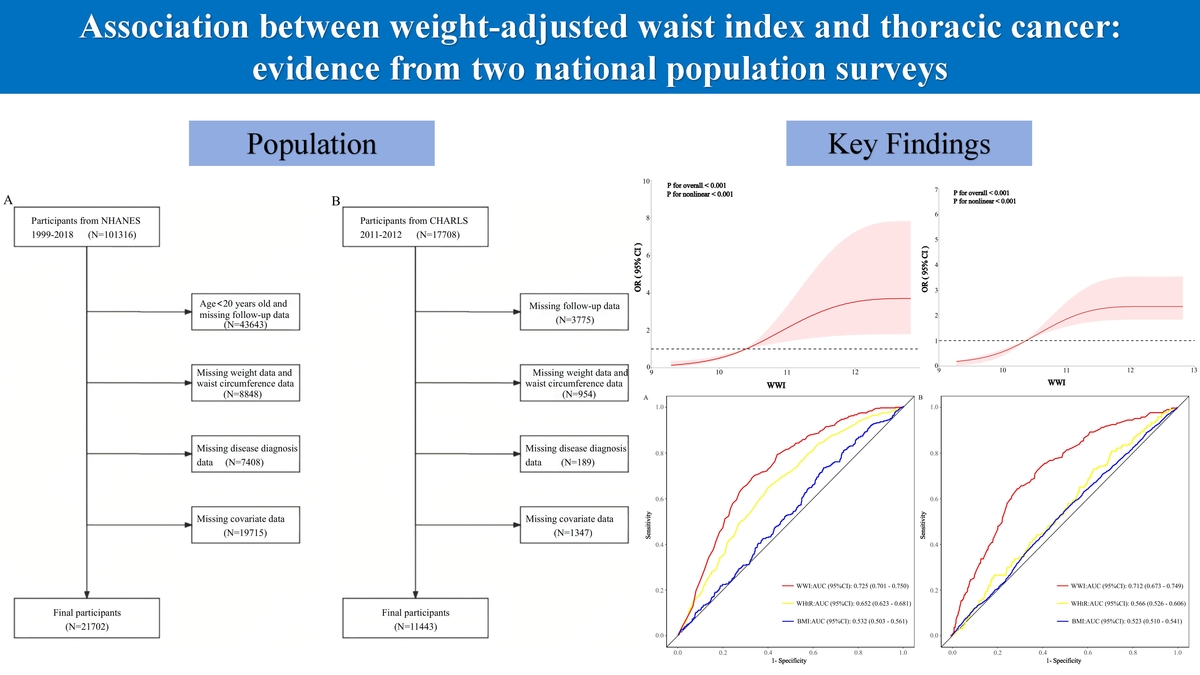
Association between weight-adjusted waist index and thoracic cancer: evidence from two national population surveys
1
Department of Radiation and Medical Oncology, Zhongnan Hospital of Wuhan University, China
2
Hubei Key Laboratory of Tumor Biological Behaviors, Zhongnan Hospital of Wuhan University, China
These authors had equal contribution to this work
Submission date: 2026-01-08
Final revision date: 2026-03-16
Acceptance date: 2026-05-24
Online publication date: 2026-07-21
Corresponding author
Conghua Xie
Department of Radiation and Medical Oncology Hubei Key Laboratory of Tumor Biological Behaviors Zhongnan Hospital of Wuhan University, China
Department of Radiation and Medical Oncology Hubei Key Laboratory of Tumor Biological Behaviors Zhongnan Hospital of Wuhan University, China
KEYWORDS
TOPICS
ABSTRACT
Introduction:
Obesity is closely associated with the risk of cancers. This study analyzed national population surveys from the United States and China to investigate the association between weight-adjusted waist index (WWI) and thoracic cancer.
Material and methods:
Data from two national population surveys were used in the study. Logistic regression analysis was used to analyze the association between WWI and thoracic cancer. Restricted cubic spline (RCS) analysis was used to investigate a potential nonlinear relationship. The stability of this relationship across different subgroups was assessed through subgroup analysis. ROC curve analysis facilitated the evaluation of different obesity indicators in terms of their efficacy in predicting thoracic cancer.
Results:
A relationship between thoracic cancer and WWI was identified. RCS analysis confirmed the nonlinear relationship between thoracic cancer and WWI (p for nonlinear < 0.001). The analysis of subgroups indicated that the association between thoracic cancer and WWI was broadly applicable across different populations, further confirming the robustness of the study findings. ROC analysis showed that WWI possessed satisfactory predictive capability for thoracic cancer.
Conclusions:
The study showed that WWI was independently associated with thoracic cancer prevalence in both the United States and Chinese populations. Furthermore, the accuracy of WWI in predicting thoracic cancer risk surpasses that of conventional obesity indicators.
Obesity is closely associated with the risk of cancers. This study analyzed national population surveys from the United States and China to investigate the association between weight-adjusted waist index (WWI) and thoracic cancer.
Material and methods:
Data from two national population surveys were used in the study. Logistic regression analysis was used to analyze the association between WWI and thoracic cancer. Restricted cubic spline (RCS) analysis was used to investigate a potential nonlinear relationship. The stability of this relationship across different subgroups was assessed through subgroup analysis. ROC curve analysis facilitated the evaluation of different obesity indicators in terms of their efficacy in predicting thoracic cancer.
Results:
A relationship between thoracic cancer and WWI was identified. RCS analysis confirmed the nonlinear relationship between thoracic cancer and WWI (p for nonlinear < 0.001). The analysis of subgroups indicated that the association between thoracic cancer and WWI was broadly applicable across different populations, further confirming the robustness of the study findings. ROC analysis showed that WWI possessed satisfactory predictive capability for thoracic cancer.
Conclusions:
The study showed that WWI was independently associated with thoracic cancer prevalence in both the United States and Chinese populations. Furthermore, the accuracy of WWI in predicting thoracic cancer risk surpasses that of conventional obesity indicators.
REFERENCES (46)
1.
Bray F, Laversanne M, Sung H, et al. Global Cancer Statistics 2022: GLOBOCAN Estimates of Incidence and Mortality Worldwide for 36 Cancers in 185 Countries. CA Cancer J Clin 2024; 74: 229-63.
2.
Thrift AP. Global burden and epidemiology of Barrett oesophagus and oesophageal cancer. Nat Rev Gastroenterol Hepatol 2021; 18: 432-43.
3.
Morgan E, Soerjomataram I, Rumgay H, et al. The global landscape of esophageal squamous cell carcinoma and esophageal adenocarcinoma incidence and mortality in 2020 and projections to 2040: new estimates from GLOBOCAN 2020. Gastroenterology 2022; 163: 649-58.
4.
Malcomson FC, Parra-Soto S, Ho FK, et al. Adherence to the 2018 World Cancer Research Fund (WCRF)/American Institute for Cancer Research (AICR) Cancer Prevention Recommendations and risk of 14 lifestyle-related cancers in the UK Biobank prospective cohort study. BMC Med 2023; 21: 407.
5.
Song C, Lv J, Yu C, et al. Adherence to healthy lifestyle and liver cancer in Chinese: a prospective cohort study of 0.5 million people. Br J Cancer 2022; 126: 815-21.
6.
Bharti JL, Wankhade A, Morey P, Ruikar P. The role of obesity in cancer incidence, treatment, and outcomes. Med Pharm J 2023; 2: 181-92.
7.
Rumgay H, Shield K, Charvat H, et al. Global burden of cancer in 2020 attributable to alcohol consumption: a population-based study. Lancet Oncol 2021; 22: 1071-80.
8.
Aleksandrova K, Reichmann R, Kaaks R, et al. Development and validation of a lifestyle-based model for colorectal cancer risk prediction: the LiFeCRC score. BMC Med 2021; 19: 1.
9.
Joffe L, Mirzaei S, Bhatia S, et al. Body mass index, physical activity, and subsequent neoplasm risk among childhood cancer survivors. JAMA Oncol 2025; 11: 835-45.
10.
Kerr J, Anderson C, Lippman SM. Physical activity, sedentary behaviour, diet, and cancer: an update and emerging new evidence. Lancet Oncol 2017; 18: e457-71.
11.
Lynch BM, Bassett JK, Milne RL, et al. Estimating cancer incidence attributable to physical inactivity in the United States. Cancer 2025; 131: e35725.
12.
Stanley A, Schuna J, Yang S, et al. Distinct phenotypic characteristics of normal-weight adults at risk of developing cardiovascular and metabolic diseases. Am J Clin Nutr 2020; 112: 967-78.
13.
Recalde M, Davila-Batista V, Díaz Y, et al. Body mass index and waist circumference in relation to the risk of 26 types of cancer: a prospective cohort study of 3.5 million adults in Spain. BMC Med 2021; 19: 10.
14.
Rubinstein, MM, Brown KA, Iyengar NM. Targeting obesity-related dysfunction in hormonally driven cancers. Br J Cancer 2021; 125: 495-509.
15.
Leitzmann, MF, Stein MJ, Baurecht H, Freisling H. Excess adiposity and cancer: evaluating a preclinical-clinical obesity framework for risk stratification. EClinicalMedicine 2025; 83: 103247.
16.
Xu M, Li M, Zhang Y, Li L, Shen Y, Hu G. Dynamic phenotypes of preclinical and clinical obesity in relation to new-onset cancer risk: a longitudinal analysis from the UK biobank. Diabetes Obes Metab 2025; 27: 5291-301.
17.
Fontvieille E, Viallon V, Recalde M, et al. Body mass index and cancer risk among adults with and without cardiometabolic diseases: evidence from the EPIC and UK Biobank prospective cohort studies. BMC Med 2023; 21: 418.
18.
Liu EE, Suthahar N, Paniagua SM, et al. Association of cardiometabolic disease with cancer in the community. JACC Cardiooncol 2022; 4: 69-81.
19.
Petrelli F, Cortellini A, Indini A, et al. Association of obesity with survival outcomes in patients with cancer. JAMA Netw Open 2021; 4: e213520.
20.
Sweetland S, Floud S, Gaitskell K, et al. Adiposity and risk of oesophageal cancer subtypes in the Million Women Study. Int J Epidemiol 2023; 52: 1795-804.
21.
Thi, YN, Vu TD, Lan T, Chu DT. Epigenetic contribution to the relationship between obesity and cancer. Int Rev Cell Mol Biol 2024; 387: 195-213.
22.
Lee H. Obesity-associated cancers: evidence from studies in mouse models. Cells 2022; 11: 1472.
23.
Rakib A, Mamun MAA, Mandal M, Sinha P, Singh UP. Obesity–cancer axis crosstalk: molecular insights and therapeutic approaches. Acta Pharm Sinica B 2025; 15: 2930-44.
24.
Lam TK, Daschner P, Ishibe N, et al. Metabolic Dysregulation and Cancer Risk Program (MeDOC): a transdisciplinary approach to obesity-associated cancers. J Natl Cancer Inst 2024; 116: 1555-61.
25.
Pagano C, di Zazzo E, Avilia G, et al. Advances in ‘adiponcosis’: Insights in the inner mechanisms at the base of adipose and tumour tissues interplay. Int J Cancer 2022; 152: 2464-73.
26.
Tang C, Castillon VJ, Waters M, et al. Obesity-dependent selection of driver mutations in cancer. Nat Genet 2024; 56: 2318-21.
27.
Laaksonen MA, Li S, Canfell K, et al. The future burden of oesophageal and stomach cancers attributable to modifiable behaviours in Australia: a pooled cohort study. Br J Cancer 2023; 128: 1052-69.
28.
Kunutsor SK, Jae SY, Laukkanen JA. Association between weight-adjusted waist index and cardiometabolic multimorbidity in older adults: findings from the English Longitudinal Study of Ageing. Geroscience 2025; 47: 6429-6438.
29.
Kim NH, Park Y, Kim NH, Kim SG. Weight-adjusted waist index reflects fat and muscle mass in the opposite direction in older adults. Age Ageing 2021; 50: 780-6.
30.
Li J, Yin Q, Hao J, et al. Association between weight-adjusted-waist index and retinopathy among American adults: a cross-sectional study and mediation analysis. Front Nutr 2025; 12: 1556065.
31.
Renehan AG, Zwahlen M, Egger M. Adiposity and cancer risk: new mechanistic insights from epidemiology. Nat Rev Cancer 2015; 15: 484-98.
32.
Shen S, Brown KA, Green AK, Iyengar NM. Obesity and cancer: a translational science review. JAMA 2026; 335: 1341-50..
33.
Hirano T. IL-6 in inflammation, autoimmunity and cancer. Int Immunol 2020; 33: 127-48.
34.
Gałązka JK, Czeczelewski M, Kucharczyk T, Szklener K, Mańdziuk S. Obesity and lung cancer – is programmed death ligand-1 (PD-L1) expression a connection? Arch Med Sci 2024; 20: 313-6.
35.
Lim JY, Templeton SP. Regulation of lung inflammation by adiponectin. Front Immunol 2023; 14: 1244586.
36.
Shi D, Wu J, Wu Y, Lin X, Xu C, Lian X. High-fat diet-related obesity promotes urethane-induced lung tumorigenesis in C57BL/6J mice. Front Oncol 2021; 11: 620993.
37.
Zhang T, Zhang Z, Wang X, et al. Relationship between weight-adjusted-waist index and all-cause and cardiovascular mortality in individuals with type 2 diabetes. Diabetes Obes Metab 2024; 26: 5621-9.
38.
Guo Y, Song M, Wang C. Weight-adjusted waist circumference index and chronic diseases as predictors of depression risk in U.S. adults: a cross-sectional study with mediation analysis. Front Nutr 2025; 12: 1568193.
39.
Liang X, Chen K, Xia Y, et al. Association between weight-adjusted-waist index and anxiety among adults in the National Health and Nutrition Examination Survey (NHANES), 2007–2012. Front Nutr 2025; 12: 1530028.
40.
Pillay P, Lewington S, Taylor H, Lacey B, Carter J. Adiposity, body fat distribution, and risk of major stroke types among adults in the United Kingdom. JAMA Netw Open 2022; 5: e2246613.
41.
Zhou W, Liu G, Hung RJ, et al. Causal relationships between body mass index, smoking and lung cancer: univariable and multivariable Mendelian randomization. Int J Cancer 2020; 148: 1077-86.
42.
Oswalt C, Liu Y, Pang H, et al. Associations between body mass index, weight loss and overall survival in patients with advanced lung cancer. J Cachexia Sarcopenia Muscle 2022; 13: 2650-60.
43.
Carter P, Yuan S, Kar S, et al. Coffee consumption and cancer risk: a Mendelian randomisation study. Clin Nutr 2022; 41: 2113-23.
44.
Lee S, Jang J, Abe SK, et al. Association between body mass index and oesophageal cancer mortality: a pooled analysis of prospective cohort studies with >800 000 individuals in the Asia Cohort Consortium. Int J Epidemiol 2022; 51: 1190-203.
45.
Gao Q, Lin Z, Zhang Y, Cai J, Li S. The association between waist-to-height index and prostate cancer risk: evidence from the NHANES study. Front Nutr 2025; 12: 1610288.
46.
Fang L, Li X, Fang Y, et al. Association between weight-adjusted-waist index and gynecologic cancers: a population-based study. Front Nutr 2024; 11: 1449643.
Share
RELATED ARTICLE
| eISSN: | 1896-9151 |
| ISSN: | 1734-1922 |

We process personal data collected when visiting the website. The function of obtaining information about users and their behavior is carried out by voluntarily entered information in forms and saving cookies in end devices. Data, including cookies, are used to provide services, improve the user experience and to analyze the traffic in accordance with the Privacy policy. Data are also collected and processed by Google Analytics tool (more).
You can change cookies settings in your browser. Restricted use of cookies in the browser configuration may affect some functionalities of the website.
You can change cookies settings in your browser. Restricted use of cookies in the browser configuration may affect some functionalities of the website.