Current issue
Archive
Manuscripts accepted
About the Journal
Editorial office
Editorial board
Section Editors
Abstracting and indexing
Subscription
Contact
Ethical standards and procedures
Most read articles
Instructions for authors
Article Processing Charge (APC)
Regulations of paying article processing charge (APC)


CLINICAL RESEARCH
Clinical pain phenotypes in breast cancer survivors: the role of neuropathic pain and central sensitization
1
Faculty of Medicine, Health and Sport, Universidad Europea de Madrid, Villaviciosa de Odón, Spain
2
Physical Therapy and Pain Research Group, Phisical Therapy Department, University of Alcalá, Alcalá de Henares, Spain
3
Rehabilitation Research Group, Vrije Universiteit Brussel, Belgium
4
Medical Oncology Department, Universitair Ziekenhuis, Brussel, Belgium
Submission date: 2026-03-21
Final revision date: 2026-04-20
Acceptance date: 2026-06-18
Online publication date: 2026-07-22
KEYWORDS
TOPICS
ABSTRACT
Introduction:
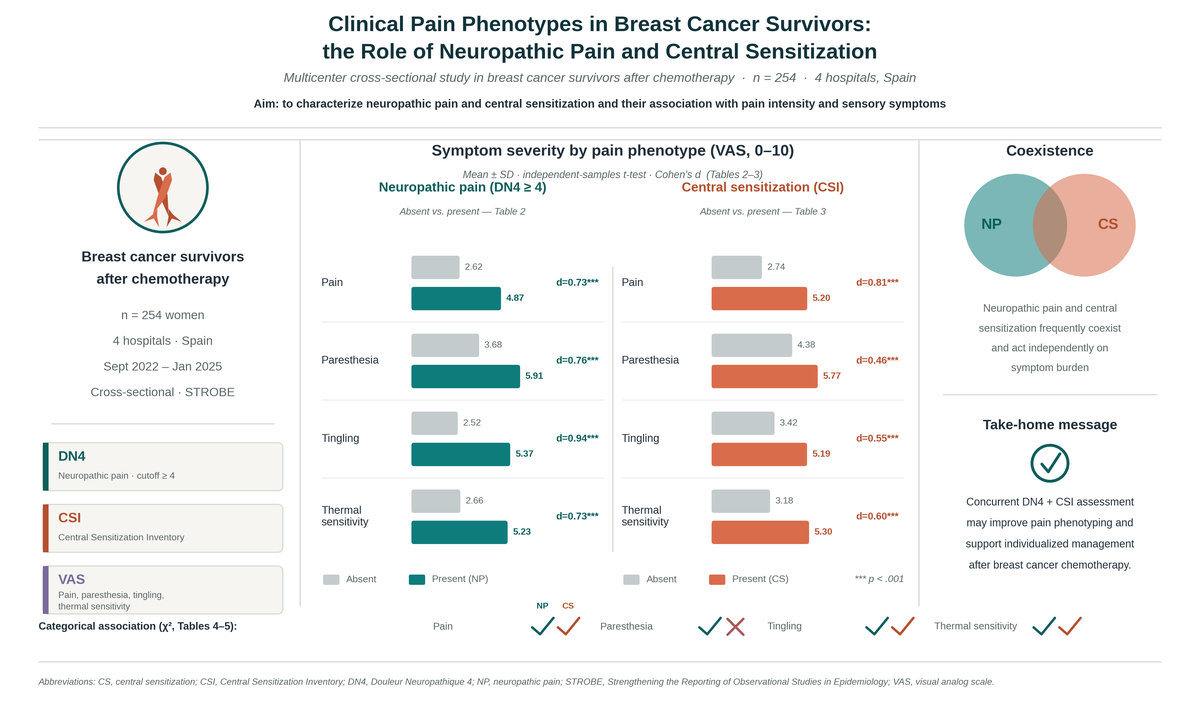
Persistent pain is a common long-term sequela in breast cancer survivors treated with chemotherapy and may involve neuropathic pain and central sensitization (CS). However, few studies have examined these mechanisms together and their association with specific sensory symptoms.
Material and methods:
A multicenter cross-sectional study was conducted in four Spanish hospitals between September 2022 and January 2025. A total of 254 women with surgically treated breast cancer who had completed chemotherapy were included. Neuropathic pain was assessed using the Spanish version of the Douleur Neuropathique 4 (DN4), CS using the Central Sensitization Inventory (CSI), and pain intensity and sensory symptoms (paresthesia, tingling, and thermal sensitivity) using visual analog scales. Between-group comparisons according to the presence of neuropathic pain and central sensitization, as well as analyses of their independent and combined effects on pain intensity and sensory symptoms, were performed.
Results:
Participants reported moderate pain intensity, with clinically relevant neuropathic pain features and CS. Patients with neuropathic pain (DN4 ≥ 4) showed significantly higher pain intensity and greater severity of all sensory symptoms (all p < 0.001). Similarly, participants with CS reported higher pain intensity and greater severity of tingling and thermal sensitivity. Neuropathic pain and CS were independently associated with increased symptom burden and frequently coexisted.
Conclusions:
Neuropathic pain and CS are common and overlapping components of persistent pain in breast cancer survivors treated with chemotherapy and are associated with greater pain intensity and sensory symptom severity. Concurrent assessment of both mechanisms may improve the clinical characterization and management of post-chemotherapy pain.
Persistent pain is a common long-term sequela in breast cancer survivors treated with chemotherapy and may involve neuropathic pain and central sensitization (CS). However, few studies have examined these mechanisms together and their association with specific sensory symptoms.
Material and methods:
A multicenter cross-sectional study was conducted in four Spanish hospitals between September 2022 and January 2025. A total of 254 women with surgically treated breast cancer who had completed chemotherapy were included. Neuropathic pain was assessed using the Spanish version of the Douleur Neuropathique 4 (DN4), CS using the Central Sensitization Inventory (CSI), and pain intensity and sensory symptoms (paresthesia, tingling, and thermal sensitivity) using visual analog scales. Between-group comparisons according to the presence of neuropathic pain and central sensitization, as well as analyses of their independent and combined effects on pain intensity and sensory symptoms, were performed.
Results:
Participants reported moderate pain intensity, with clinically relevant neuropathic pain features and CS. Patients with neuropathic pain (DN4 ≥ 4) showed significantly higher pain intensity and greater severity of all sensory symptoms (all p < 0.001). Similarly, participants with CS reported higher pain intensity and greater severity of tingling and thermal sensitivity. Neuropathic pain and CS were independently associated with increased symptom burden and frequently coexisted.
Conclusions:
Neuropathic pain and CS are common and overlapping components of persistent pain in breast cancer survivors treated with chemotherapy and are associated with greater pain intensity and sensory symptom severity. Concurrent assessment of both mechanisms may improve the clinical characterization and management of post-chemotherapy pain.
REFERENCES (33)
1.
Kalita M, M Devaraja, Saha I, Chakrabarti A. Global burden of cancer pattern in 2020 & prediction to 2040 among older adults. Indian J Med Res 2024; 160: 397-406.
2.
Wagle NS, Nogueira L, Devasia TP, et al. Cancer treatment and survivorship statistics, 2025. CA Cancer J Clin 2025; 75: 308-40.
3.
Sung H, Ferlay J, Siegel RL, et al. Global Cancer Statistics 2020: GLOBOCAN estimates of incidence and mortality worldwide for 36 cancers in 185 countries. CA Cancer J Clin 2021; 71: 209-49.
4.
Yoon SY, Oh J. Neuropathic cancer pain: prevalence, pathophysiology, and management. Korean J Intern Med 2018; 33: 1058-69.
5.
Nishigami T, Manfuku M, Lahousse A. Central sensitization in cancer survivors and its clinical implications: state of the art. J Clin Med 2023; 12: 4606.
6.
Hurth A, Nijzink-Ter Steege J, Scheepbouwer P, et al. Assessment of central sensitization in breast cancer survivors: convergent validity and use of the Central Sensitization Inventory (CSI) and its short-form as a clustering tool. Clin Pract 2021; 11: 607-18.
7.
Mulvey MR, Paley CA, Schuberth A, King N, Page A, Neoh K. Neuropathic pain in cancer: what are the current guidelines? Curr Treat Options Oncol 2024; 25: 1193-202.
8.
Singh S, Dhiraaj S, Shamshery C, et al. Incidence of different characters of neuropathic pain in cancer patients coming to tertiary care centre in north india over a period of 1 year – an observational study. Indian J Palliat Care 2024; 30: 27-33.
9.
Dubin AE, Patapoutian A. Nociceptors: the sensors of the pain pathway. J Clin Invest 2010; 120: 3760-72.
10.
Neblett R, Cohen H, Choi Y, et al. The Central Sensitization Inventory (CSI): establishing clinically significant values for identifying central sensitivity syndromes in an outpatient chronic pain sample. J Pain 2013; 14: 438-45.
11.
Nijs J, Leysen L, Adriaenssens N, et al. Pain following cancer treatment: Guidelines for the clinical classification of predominant neuropathic, nociceptive and central sensitization pain. Acta Oncol 2016; 55: 659-63.
12.
Smart KM, Blake C, Staines A, Thacker M, Doody C. Mechanisms-based classifications of musculoskeletal pain: part 1 of 3: symptoms and signs of central sensitisation in patients with low back (± leg) pain. Man Ther 2012; 17: 336-44.
13.
Woolf CJ. Central sensitization: implications for the diagnosis and treatment of pain. Pain 2011; 152 (3 Suppl): S2-15.
14.
Latremoliere A, Woolf CJ. Central sensitization: a generator of pain hypersensitivity by central neural plasticity. J Pain 2009; 10: 895-926.
15.
Nijs J, Torres-Cueco R, van Wilgen CP, et al. Applying modern pain neuroscience in clinical practice: criteria for the classification of central sensitization pain. Pain Physician 2014; 17: 447-57.
16.
Edwards HL, Mulvey MR, Bennett MI. Cancer-related neuropathic pain. Cancers 2019; 11: 373.
17.
Tofthagen CS, McMillan SC. Pain, neuropathic symptoms, and physical and mental well-being in persons with cancer. Cancer Nurs 2010; 33: 436-44.
19.
Treede RD, Jensen TS, Campbell JN, et al. Neuropathic pain: redefinition and a grading system for clinical and research purposes. Neurology 2008; 70: 1630-5.
21.
Cuesta-Vargas AI, Roldan-Jimenez C, Neblett R, Gatchel RJ. Cross-cultural adaptation and validity of the Spanish central sensitization inventory. Springerplus 2016; 5: 1837.
22.
Mayer TG, Neblett R, Cohen H, et al. The development and psychometric validation of the central sensitization inventory. Pain Pract 2012; 12: 276-85.
23.
Roldán-Jiménez C, Pajares B, Iglesias Campos M, et al. Structural validity and reliability of the Spanish Central Sensitization Inventory in breast cancer survivors. Pain Pract 2021; 21: 740-6.
24.
Perez C, Galvez R, Huelbes S, et al. Validity and reliability of the Spanish version of the DN4 (Douleur Neuropathique 4 questions) questionnaire for differential diagnosis of pain syndromes associated to a neuropathic or somatic component. Health Qual Life Outcomes 2007; 5: 66.
25.
Bouhassira D, Attal N, Alchaar H, et al. Comparison of pain syndromes associated with nervous or somatic lesions and development of a new neuropathic pain diagnostic questionnaire (DN4). Pain 2005; 114: 29-36.
26.
Baek SK, Shin SW, Koh SJ, et al. Significance of descriptive symptoms and signs and clinical parameters as predictors of neuropathic cancer pain. PLoS One 2021; 16: e0252781.
27.
Hawker GA, Mian S, Kendzerska T, French M. Measures of adult pain: Visual Analog Scale for Pain (VAS Pain), Numeric Rating Scale for Pain (NRS Pain), McGill Pain Questionnaire (MPQ), Short-Form McGill Pain Questionnaire (SF-MPQ), Chronic Pain Grade Scale (CPGS), Short Form-36 Bodily Pain Scale (SF-36 BPS), and Measure of Intermittent and Constant Osteoarthritis Pain (ICOAP). Arthritis Care Res 2011; 63 Suppl 11: S240-52.
28.
Cruccu G, Anand P, Attal N, et al. EFNS guidelines on neuropathic pain assessment. Eur J Neurol 2004; 11: 153-62.
29.
Backonja MM, Attal N, Baron R, et al. Value of quantitative sensory testing in neurological and pain disorders: NeuPSIG consensus. Pain 2013; 154: 1807-19.
31.
Oh SY, Shin SW, Koh SJ, et al. Multicenter, cross-sectional observational study of the impact of neuropathic pain on quality of life in cancer patients. Support Care Cancer 2017; 25: 3759-67.
32.
Rayment C, Hjermstad MJ, Aass N, et al.; EPCRC. Neuropathic cancer pain: prevalence, severity, analgesics and impact from the European Palliative Care Research Collaborative-Computerised Symptom Assessment study. Palliat Med 2013; 27: 714-21.
33.
Pineda-Moncusí M, Servitja S, Tusquets I, et al. Assessment of early therapy discontinuation and health-related quality of life in breast cancer patients treated with aromatase inhibitors: B-ABLE cohort study. Breast Cancer Res Treat 2019; 177: 53-60.
Share
RELATED ARTICLE
| eISSN: | 1896-9151 |
| ISSN: | 1734-1922 |

We process personal data collected when visiting the website. The function of obtaining information about users and their behavior is carried out by voluntarily entered information in forms and saving cookies in end devices. Data, including cookies, are used to provide services, improve the user experience and to analyze the traffic in accordance with the Privacy policy. Data are also collected and processed by Google Analytics tool (more).
You can change cookies settings in your browser. Restricted use of cookies in the browser configuration may affect some functionalities of the website.
You can change cookies settings in your browser. Restricted use of cookies in the browser configuration may affect some functionalities of the website.