Current issue
Archive
Manuscripts accepted
About the Journal
Editorial office
Editorial board
Section Editors
Abstracting and indexing
Subscription
Contact
Ethical standards and procedures
Most read articles
Instructions for authors
Article Processing Charge (APC)
Regulations of paying article processing charge (APC)


ONCOLOGY / CLINICAL RESEARCH
Costimulatory molecule-related gene-based prognostic signature and immune characteristics in osteosarcoma
1
Hand Surgery/Wound Reconstruction Surgery, Lishui Hospital of Wenzhou Medical University, The First Affiliated Hospital of Lishui University, Lishui People’s Hospital, Lishui, Zhejiang, China
Submission date: 2026-01-08
Acceptance date: 2026-02-15
Online publication date: 2026-05-01
Corresponding author
Yonghui Shen
Hand Surgery/Wound Reconstruction Surgery Lishui Hospital of Wenzhou Medical University The First Affiliated Hospital of Lishui University Lishui People’s Hospital Lishui, Zhejiang, China
Hand Surgery/Wound Reconstruction Surgery Lishui Hospital of Wenzhou Medical University The First Affiliated Hospital of Lishui University Lishui People’s Hospital Lishui, Zhejiang, China
Zengyong Hu
Hand Surgery/Wound Reconstruction Surgery Lishui Hospital of Wenzhou Medical University The First Affiliated Hospital of Lishui University Lishui People’s Hospital Lishui, Zhejiang, China
Hand Surgery/Wound Reconstruction Surgery Lishui Hospital of Wenzhou Medical University The First Affiliated Hospital of Lishui University Lishui People’s Hospital Lishui, Zhejiang, China
Article (PDF)
Supplementary files
References (61)
Costimulatory molecule-related - Supplementary Figures.pdf
Costimulatory molecule-related - Supplementary Table SI.xlsx
Costimulatory molecule-related - Supplementary Table SII.xlsx
Costimulatory molecule-related - Supplementary Table SIII.xlsx
Costimulatory molecule-related - Supplementary Table SIV.xlsx
KEYWORDS
TOPICS
ABSTRACT
Introduction:
Osteosarcoma (OSA) is a primary malignant bone tumor with a poor prognosis. Costimulatory molecule-related genes (CMRGs) are crucial for T cell-mediated antitumor immunity, yet their prognostic and therapeutic value in OSA remains unclear.
Material and methods:
Non-negative matrix factorization (NMF) clustering was used to define CMRG-based subtypes. Prognostic signature genes were selected using univariate Cox, LASSO, and multivariate regression analyses. The predictive performance of the model was assessed using ROC curves, calibration plots, and decision curve analysis (DCA). Immune infiltration and immune checkpoint differences were evaluated via ssGSEA. Drug sensitivity was predicted using CellMiner, and gene expression was validated by qRT-PCR in OSA cells.
Results:
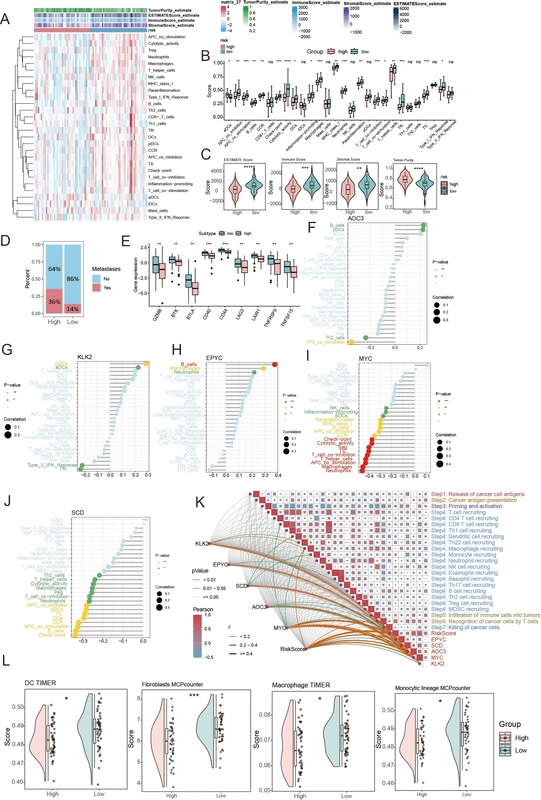
This study identified five characteristic genes related to the prognosis of OSA and constructed a prognostic model. The evaluation results indicated that the model has favorable predictive performance, with calibration curves and DCA indicating good agreement between predicted and observed survival probabilities. Furthermore, immunotherapy response analysis revealed that patients with lower risk scores had more favorable immune responses and lower rates of disease metastasis. Notably, DMAPT, Obatoclax, 8-Chloro-adenosine, and Palbociclib showed a significant positive correlation with MYC. Additionally, qRT-PCR results indicated that EPYC, SCD1, and AOC3 were significantly overexpressed in OSA cells.
Conclusions:
This study integrates CMRG-based subtyping, risk modeling, immune profiling, and experimental validation in OSA. The identified biomarkers may help inform personalized treatment and survival risk stratification in OSA patients.
REFERENCES (61)
1.
Arndt CA, Rose PS, Folpe AL, et al. Common musculoskeletal tumors of childhood and adolescence. Mayo Clin Proc 2012; 87: 475-87.
2.
Huang X, Zhao J, Bai J, et al. Risk and clinicopathological features of osteosarcoma metastasis to the lung: a population-based study. J Bone Oncol 2019; 16: 100230.
3.
Eaton BR, Schwarz R, Vatner R, et al. Osteosarcoma. Pediatr Blood Cancer 2021; 68 Suppl 2: e28352.
4.
Gianferante DM, Mirabello L, Savage SA. Germline and somatic genetics of osteosarcoma – connecting aetiology, biology and therapy. Nat Rev Endocrinol 2017; 13: 480-91.
5.
Li J, Tang X, Du Y, et al. Establishment of an autophagy-related clinical prognosis model for predicting the overall survival of osteosarcoma. Biomed Res Int 2021; 2021: 5428425.
6.
Meltzer PS, Helman LJ. New horizons in the treatment of osteosarcoma. N Engl J Med 2021; 385: 2066-76.
7.
Jamal-Hanjani M, Quezada SA, Larkin J, et al. Translational implications of tumor heterogeneity. Clin Cancer Res 2015; 21: 1258-66.
8.
Wu C, Gong S, Duan Y, et al. A tumor microenvironment-based prognostic index for osteosarcoma. J Biomed Sci 2023; 30: 23.
9.
Momen M, Kohler NL, Binversie EE, et al. Heritability and genetic variance estimation of osteosarcoma (OSA) in Irish Wolfhound, using deep pedigree information. Canine Med Genet 2021; 8: 9.
10.
Wei X, Feng J, Chen L, et al. METTL3-mediated m6A modification of LINC00520 confers glycolysis and chemoresistance in osteosarcoma via suppressing ubiquitination of ENO1. Cancer Lett 2024; 611: 217194.
11.
Jiang M, Jike Y, Liu K, et al. Exosome-mediated miR-144-3p promotes ferroptosis to inhibit osteosarcoma proliferation, migration, and invasion through regulating ZEB1. Mol Cancer 2023; 22: 113.
12.
Cheng X, Bian C, Zhang Y, Gu H, Chen G, Wu L. APOE suppresses osteosarcoma by modulating ferroptosis through the mTOR/Stat3 signaling pathway. Arch Med Sci 2025; 21: 2647-70.
13.
Bilotta MT, Antignani A, Fitzgerald DJ. Managing the TME to improve the efficacy of cancer therapy. Front Immunol 2022; 13: 954992.
14.
Chen C, Xie L, Ren T, et al. Immunotherapy for osteosarcoma: fundamental mechanism, rationale, and recent breakthroughs. Cancer Lett 2021; 500: 1-10.
15.
Singh S, Hassan D, Aldawsari HM, et al. Immune checkpoint inhibitors: a promising anticancer therapy. Drug Discov Today 2020; 25: 223-9.
16.
Sanmamed MF, Chen L. A paradigm shift in cancer immunotherapy: from enhancement to normalization. Cell 2018; 175: 313-26.
17.
Capece D, Verzella D, Fischietti M, et al. Targeting costimulatory molecules to improve antitumor immunity. J Biomed Biotechnol 2012; 2012: 926321.
18.
Fan MK, Qi LL, Zhang Q, et al. The updated status and future direction of immunotherapy targeting B7-H1/PD-1 in osteosarcoma. Cancer Manag Res 2021; 13: 757-64.
19.
Zhang C, Zhang Z, Li F, et al. Large-scale analysis reveals the specific clinical and immune features of B7-H3 in glioma. Oncoimmunology 2018; 7: e1461304.
20.
Janakiram M, Chinai JM, Zhao A, et al. HHLA2 and TMIGD2: new immunotherapeutic targets of the B7 and CD28 families. Oncoimmunology 2015; 4: e1026534.
21.
Ward-Kavanagh LK, Lin WW, Šedý JR, et al. The TNF receptor superfamily in co-stimulating and co-inhibitory responses. Immunity 2016; 44: 1005-19.
22.
Zhang C, Zhang Z, Sun N, et al. Identification of a costimulatory molecule-based signature for predicting prognosis risk and immunotherapy response in patients with lung adenocarcinoma. Oncoimmunology 2020; 9: 1824641.
23.
Li H, Liu S, Li C, et al. TNF family-based signature predicts prognosis, tumor microenvironment, and molecular subtypes in bladder carcinoma. Front Cell Dev Biol 2021; 9: 800967.
24.
Ren Q, Zhang P, Lin H, et al. A novel signature predicts prognosis and immunotherapy in lung adenocarcinoma based on cancer-associated fibroblasts. Front Immunol 2023; 14: 1201573.
25.
Sun D, Guan X, Moran AE, et al. Identifying phenotype-associated subpopulations by integrating bulk and single-cell sequencing data. Nat Biotechnol 2022; 40: 527-38.
26.
Yu S, Yao X. Advances on immunotherapy for osteosarcoma. Mol Cancer 2024; 23: 192.
27.
Bäck M, Weber C, Lutgens E. Regulation of atherosclerotic plaque inflammation. J Intern Med 2015; 278: 462-82.
28.
Zhao Y, Zheng Q, Jin L. The role of B7 family molecules in maternal-fetal immunity. Front Immunol 2020; 11: 458.
29.
Hanada Y, Nakamura Y, Ishida Y, et al. Epiphycan is specifically expressed in cochlear supporting cells and is necessary for normal hearing. Biochem Biophys Res Commun 2017; 492: 379-85.
30.
Yang Z, Li H, Hao J, et al. EPYC functions as a novel prognostic biomarker for pancreatic cancer. Sci Rep 2024; 14: 719.
31.
Liang Y, Lin F, Huang Y. Identification of biomarkers associated with diagnosis of osteoarthritis patients based on bioinformatics and machine learning. J Immunol Res 2022; 2022: 5600190.
32.
Zhang J, Zhang S, Zhou Y, et al. KLF9 and EPYC acting as feature genes for osteoarthritis and their association with immune infiltration. J Orthop Surg Res 2022; 17: 365.
33.
Paton CM, Ntambi JM. Biochemical and physiological function of stearoyl-CoA desaturase. Am J Physiol Endocrinol Metab 2009; 297: E28-37.
34.
Ascenzi F, De Vitis C, Maugeri-Saccà M, et al. SCD1, autophagy and cancer: implications for therapy. J Exp Clin Cancer Res 2021; 40: 265.
35.
Chen H, Qi Q, Wu N, et al. Aspirin promotes RSL3-induced ferroptosis by suppressing mTOR/SREBP-1/SCD1-mediated lipogenesis in PIK3CA-mutant colorectal cancer. Redox Biol 2022; 55: 102426.
36.
Cai F, Liu L, Bo Y, et al. LncRNA RPARP-AS1 promotes the progression of osteosarcoma cells through regulating lipid metabolism. BMC Cancer 2024; 24: 166.
37.
Boyer DS, Rippmann JF, Ehrlich MS, et al. Amine oxidase copper-containing 3 (AOC3) inhibition: a potential novel target for the management of diabetic retinopathy. Int J Retina Vitreous 2021; 7: 30.
38.
Ahmad Zawawi SS, Mohd Azram NAS, Sulong S, et al. Identification of AOC3 and LRRC17 as colonic fibroblast activation markers and their potential roles in colorectal cancer progression. Asian Pac J Cancer Prev 2023; 24: 3099-107.
39.
Ward ST, Weston CJ, Shepherd EL, et al. Evaluation of serum and tissue levels of VAP-1 in colorectal cancer. BMC Cancer 2016; 16: 154.
40.
Lai YC, Chang SJ, Kostoro J, et al. Vascular adhesion protein-1 as indicator of breast cancer tumor aggressiveness and invasiveness. Apmis 2018; 126: 755-61.
41.
Lourenco C, Resetca D, Redel C, et al. MYC protein interactors in gene transcription and cancer. Nat Rev Cancer 2021; 21: 579-91.
42.
Baluapuri A, Wolf E, Eilers M. Target gene-independent functions of MYC oncoproteins. Nat Rev Mol Cell Biol 2020; 21: 255-67.
43.
Duffy MJ, O’Grady S, Tang M, et al. MYC as a target for cancer treatment. Cancer Treat Rev 2021; 94: 102154.
44.
Chen H, Liu H, Qing G. Targeting oncogenic Myc as a strategy for cancer treatment. Signal Transduct Target Ther 2018; 3: 5.
45.
Avgeris M, Mavridis K, Scorilas A. Kallikrein-related peptidase genes as promising biomarkers for prognosis and monitoring of human malignancies. Biol Chem 2010; 391: 505-11.
46.
Paniagua-Herranz L, Moreno I, Nieto-Jiménez C, et al. Genomic and immunologic correlates in prostate cancer with high expression of KLK2. Int J Mol Sci 2024; 25: 2222.
47.
Shang Z, Niu Y, Cai Q, et al. Human kallikrein 2 (KLK2) promotes prostate cancer cell growth via function as a modulator to promote the ARA70-enhanced androgen receptor transactivation. Tumour Biol 2014; 35: 1881-90.
48.
Kohli M, Rothberg PG, Feng C, et al. Exploratory study of a KLK2 polymorphism as a prognostic marker in prostate cancer. Cancer Biomark 2010; 7: 101-8.
49.
Zhang Z, Tan X, Jiang Z, et al. Immune checkpoint inhibitors in osteosarcoma: a hopeful and challenging future. Front Pharmacol 2022; 13: 1031527.
50.
Zheng B, Ren T, Huang Y, et al. PD-1 axis expression in musculoskeletal tumors and antitumor effect of nivolumab in osteosarcoma model of humanized mouse. J Hematol Oncol 2018; 11: 16.
51.
Ratti C, Botti L, Cancila V, et al. Trabectedin overrides osteosarcoma differentiative block and reprograms the tumor immune environment enabling effective combination with immune checkpoint inhibitors. Clin Cancer Res 2017; 23: 5149-61.
52.
Yoshida K, Okamoto M, Sasaki J, et al. Clinical outcome of osteosarcoma and its correlation with programmed death-ligand 1 and T cell activation markers. Onco Targets Ther 2019; 12: 2513-8.
53.
Mendonca MS, Turchan WT, Alpuche ME, et al. DMAPT inhibits NF-B activity and increases sensitivity of prostate cancer cells to X-rays in vitro and in tumor xenografts in vivo. Free Radic Biol Med 2017; 112: 318-26.
54.
Gil da Costa RM, Levesque C, Bianchi-Frias D, et al. Pharmacological NF-B inhibition decreases cisplatin chemoresistance in muscle-invasive bladder cancer and reduces cisplatin-induced toxicities. Mol Oncol 2023; 17: 2709-27.
55.
Champa D, Orlacchio A, Patel B, et al. Obatoclax kills anaplastic thyroid cancer cells by inducing lysosome neutralization and necrosis. Oncotarget 2016; 7: 34453-71.
56.
Buettner R, Nguyen LXT, Morales C, et al. Targeting the metabolic vulnerability of acute myeloid leukemia blasts with a combination of venetoclax and 8-chloro-adenosine. J Hematol Oncol 2021; 14: 70.
57.
Rugo HS, Finn RS, Diéras V, et al. Palbociclib plus letrozole as first-line therapy in estrogen receptor-positive/human epidermal growth factor receptor 2-negative advanced breast cancer with extended follow-up. Breast Cancer Res Treat 2019; 174: 719-29.
58.
Braal CL, Jongbloed EM, Wilting SM, et al. Inhibiting CDK4/6 in breast cancer with palbociclib, ribociclib, and abemaciclib: similarities and differences. Drugs 2021; 81: 317-31.
59.
Zhao T, Li W, Chen J, et al. Genomic variants in Fas-mediated apoptosis pathway predict a poor response to platinum-based chemotherapy for chinese gastric cancer patients. J Cancer 2021; 12: 849-59.
60.
Zhao Q, Lin X, Wang G. Targeting SREBP-1-mediated lipogenesis as potential strategies for cancer. Front Oncol 2022; 12: 952371.
61.
Tracz-Gaszewska Z, Dobrzyn P. Stearoyl-CoA desaturase 1 as a therapeutic target for the treatment of cancer. Cancers 2019; 11: 948.
Share
RELATED ARTICLE
| eISSN: | 1896-9151 |
| ISSN: | 1734-1922 |

We process personal data collected when visiting the website. The function of obtaining information about users and their behavior is carried out by voluntarily entered information in forms and saving cookies in end devices. Data, including cookies, are used to provide services, improve the user experience and to analyze the traffic in accordance with the Privacy policy. Data are also collected and processed by Google Analytics tool (more).
You can change cookies settings in your browser. Restricted use of cookies in the browser configuration may affect some functionalities of the website.
You can change cookies settings in your browser. Restricted use of cookies in the browser configuration may affect some functionalities of the website.