Current issue
Archive
Manuscripts accepted
About the Journal
Editorial office
Editorial board
Section Editors
Abstracting and indexing
Subscription
Contact
Ethical standards and procedures
Most read articles
Instructions for authors
Article Processing Charge (APC)
Regulations of paying article processing charge (APC)


CLINICAL RESEARCH
Early screening of autism spectrum disorder in toddlers
using machine learning
1
Department of Nursing, College of Nursing and Health Sciences, Jazan University,
Jazan, Saudi Arabia
Submission date: 2026-01-09
Final revision date: 2026-02-05
Acceptance date: 2026-02-24
Online publication date: 2026-03-14
Corresponding author
Darin Mansor Mathkor
Department of Nursing College of Nursing and Health Sciences Jazan University Jazan-82911, Saudi Arabia
Department of Nursing College of Nursing and Health Sciences Jazan University Jazan-82911, Saudi Arabia
KEYWORDS
autism spectrum disordermachine learningQ-CHAT-10earlyscreeningpredictive modelingexplainable AItoddlers
TOPICS
ABSTRACT
Introduction:
Autism spectrum disorder (ASD) is a developmental brain condition that causes problems with social interaction and communication, as well as repetitive behaviors. Early ASD screening is vital for prompt ac tions, as existing diagnostic methods suffer from scalability limitations in resource-constrained settings. Herein, a machine learning (ML)-based explain able predictive model was developed and evaluated for early screening of ASD in toddlers using Q-CHAT-10 behavioral, demographic, and clinical features.
Material and methods:
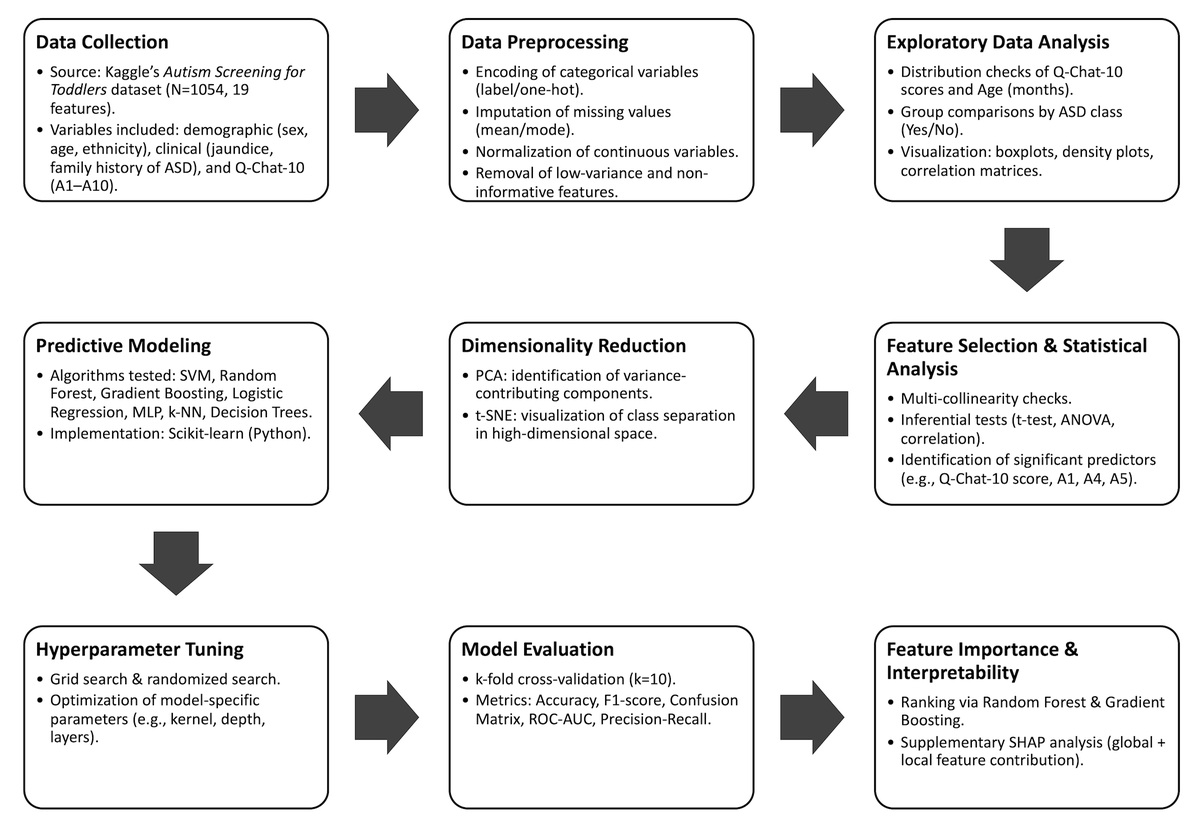
A total of 1054 toddlers’ records sourced from the Autism Screening for Toddlers dataset freely available at Kaggle were ret rospectively analyzed. Data preprocessing, statistical feature selection, and dimensionality reduction were performed. Multiple ensemble models were trained using Q-CHAT-10 behavioral features combined with demographic and clinical variables. Several algorithms were tested, including Logistic Re gression, Random Forest, Gradient Boosting, and Multilayer Perceptron, with k-fold cross-validation for model selection. SHAP analysis was employed to explore the reasons behind individual predictions.
Results:
Model performance was evaluated using ROC-AUC. Feature im portance was checked to identify the most predictive items. The Gradient Boosting classifier achieved the best performance, with an accuracy of 0.98 (95% CI: 0.85–0.93), sensitivity of 0.91, specificity of 0.87, and ROC-AUC of 0.94 on the held-out test set. SHAP analysis revealed total Q-CHAT-10 score, response to name, pointing to share interest, and pretend play as the most influential predictors.
Conclusions:
This ML framework accurately detects ASD traits in toddlers, highlighting the potential of a scalable, low-cost screening tool to enable early ASD detection and improve equitable access to pediatric care. How ever, external validation across diverse populations with larger samples is warranted before clinical application can be recommended.
Autism spectrum disorder (ASD) is a developmental brain condition that causes problems with social interaction and communication, as well as repetitive behaviors. Early ASD screening is vital for prompt ac tions, as existing diagnostic methods suffer from scalability limitations in resource-constrained settings. Herein, a machine learning (ML)-based explain able predictive model was developed and evaluated for early screening of ASD in toddlers using Q-CHAT-10 behavioral, demographic, and clinical features.
Material and methods:
A total of 1054 toddlers’ records sourced from the Autism Screening for Toddlers dataset freely available at Kaggle were ret rospectively analyzed. Data preprocessing, statistical feature selection, and dimensionality reduction were performed. Multiple ensemble models were trained using Q-CHAT-10 behavioral features combined with demographic and clinical variables. Several algorithms were tested, including Logistic Re gression, Random Forest, Gradient Boosting, and Multilayer Perceptron, with k-fold cross-validation for model selection. SHAP analysis was employed to explore the reasons behind individual predictions.
Results:
Model performance was evaluated using ROC-AUC. Feature im portance was checked to identify the most predictive items. The Gradient Boosting classifier achieved the best performance, with an accuracy of 0.98 (95% CI: 0.85–0.93), sensitivity of 0.91, specificity of 0.87, and ROC-AUC of 0.94 on the held-out test set. SHAP analysis revealed total Q-CHAT-10 score, response to name, pointing to share interest, and pretend play as the most influential predictors.
Conclusions:
This ML framework accurately detects ASD traits in toddlers, highlighting the potential of a scalable, low-cost screening tool to enable early ASD detection and improve equitable access to pediatric care. How ever, external validation across diverse populations with larger samples is warranted before clinical application can be recommended.
Share
RELATED ARTICLE
| eISSN: | 1896-9151 |
| ISSN: | 1734-1922 |

We process personal data collected when visiting the website. The function of obtaining information about users and their behavior is carried out by voluntarily entered information in forms and saving cookies in end devices. Data, including cookies, are used to provide services, improve the user experience and to analyze the traffic in accordance with the Privacy policy. Data are also collected and processed by Google Analytics tool (more).
You can change cookies settings in your browser. Restricted use of cookies in the browser configuration may affect some functionalities of the website.
You can change cookies settings in your browser. Restricted use of cookies in the browser configuration may affect some functionalities of the website.