Current issue
Archive
Manuscripts accepted
About the Journal
Editorial office
Editorial board
Section Editors
Abstracting and indexing
Subscription
Contact
Ethical standards and procedures
Most read articles
Instructions for authors
Article Processing Charge (APC)
Regulations of paying article processing charge (APC)


CLINICAL RESEARCH
Higher triglyceride–glucose–albumin index is inversely associated with monoclonal gammopathy of undetermined significance in U.S. adults using NHANES data
1
People's Hospital of Ningxia Hui Autonomous Region, China
2
Yinchuan Center for Disease Control and Prevention, China
3
Guyuan People's Hospital, China
4
Wuzhong People's Hospital, China
5
Ning'an Hospital of Ningxia Hui Autonomous Region, China
These authors had equal contribution to this work
Submission date: 2026-04-07
Final revision date: 2026-06-08
Acceptance date: 2026-06-29
Online publication date: 2026-09-30
KEYWORDS
TOPICS
ABSTRACT
Introduction:
Monoclonal gammopathy of undetermined significance (MGUS) is a premalignant plasma cell disorder with increasing recognition of its metabolic and inflammatory determinants. The triglyceride–glucose–albumin (TyG-ALB) index, a composite marker integrating insulin resistance and nutritional status, has been linked to cardiometabolic and inflammatory conditions; however, its association with MGUS remains unclear.
Material and methods:
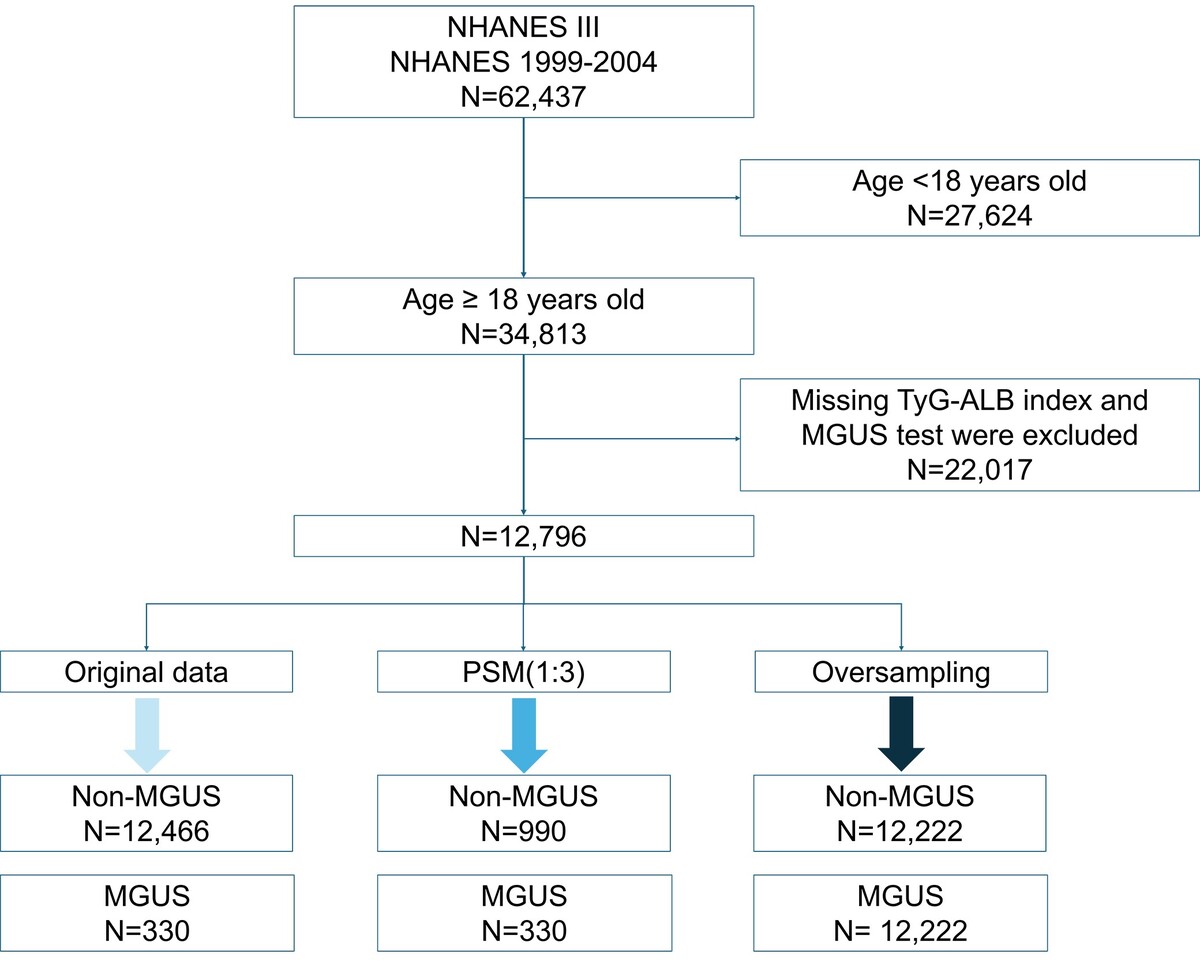
This cross-sectional study included 12,796 adults from the National Health and Nutrition Examination Survey (NHANES) III (1988–1994) and continuous NHANES cycles (1999–2004). The TyG-ALB index was calculated as ln [TG (mg/dl) × fasting blood glucose (mg/dl)/2] × albumin (g/dl). MGUS was assessed using serum protein electrophoresis, immunofixation, and free light chain assays. Survey-weighted logistic regression models were applied to evaluate the association between TyG-ALB and MGUS.
Results:
Among the 12,796 participants, 330 were diagnosed with MGUS. Higher TyG-ALB levels were associated with lower odds of MGUS. In fully adjusted models, participants in the highest tertile of TyG-ALB had lower odds of MGUS compared with those in the lowest tertile [odds ratio (OR) = 0.68, 95% confidence interval (CI): 0.50–0.94]. When analysed as a continuous variable, each one-unit increase in TyG-ALB was associated with 5% lower odds of MGUS (OR = 0.95, 95% CI: 0.92–0.98). Restricted cubic spline analyses revealed a nonlinear inverse association, with an inflection point at a TyG-ALB value of 36.0. Although this inverse association appears counterintuitive because metabolic dysfunction is generally expected to increase MGUS risk, it may be partly explained by the contribution of serum albumin, which reflects better nutritional status and lower systemic inflammation.
Conclusions:
In this cross-sectional NHANES analysis, higher TyG-ALB was associated with lower odds of prevalent MGUS; however, temporality and causality cannot be inferred. These findings should be interpreted as hypothesis-generating rather than confirmatory. Independent prospective cohorts are needed to validate the association, establish temporality, and clarify the underlying mechanisms.
Monoclonal gammopathy of undetermined significance (MGUS) is a premalignant plasma cell disorder with increasing recognition of its metabolic and inflammatory determinants. The triglyceride–glucose–albumin (TyG-ALB) index, a composite marker integrating insulin resistance and nutritional status, has been linked to cardiometabolic and inflammatory conditions; however, its association with MGUS remains unclear.
Material and methods:
This cross-sectional study included 12,796 adults from the National Health and Nutrition Examination Survey (NHANES) III (1988–1994) and continuous NHANES cycles (1999–2004). The TyG-ALB index was calculated as ln [TG (mg/dl) × fasting blood glucose (mg/dl)/2] × albumin (g/dl). MGUS was assessed using serum protein electrophoresis, immunofixation, and free light chain assays. Survey-weighted logistic regression models were applied to evaluate the association between TyG-ALB and MGUS.
Results:
Among the 12,796 participants, 330 were diagnosed with MGUS. Higher TyG-ALB levels were associated with lower odds of MGUS. In fully adjusted models, participants in the highest tertile of TyG-ALB had lower odds of MGUS compared with those in the lowest tertile [odds ratio (OR) = 0.68, 95% confidence interval (CI): 0.50–0.94]. When analysed as a continuous variable, each one-unit increase in TyG-ALB was associated with 5% lower odds of MGUS (OR = 0.95, 95% CI: 0.92–0.98). Restricted cubic spline analyses revealed a nonlinear inverse association, with an inflection point at a TyG-ALB value of 36.0. Although this inverse association appears counterintuitive because metabolic dysfunction is generally expected to increase MGUS risk, it may be partly explained by the contribution of serum albumin, which reflects better nutritional status and lower systemic inflammation.
Conclusions:
In this cross-sectional NHANES analysis, higher TyG-ALB was associated with lower odds of prevalent MGUS; however, temporality and causality cannot be inferred. These findings should be interpreted as hypothesis-generating rather than confirmatory. Independent prospective cohorts are needed to validate the association, establish temporality, and clarify the underlying mechanisms.
REFERENCES (38)
1.
Weiss BM, Abadie J, Verma P, et al. A monoclonal gammopathy precedes multiple myeloma in most patients. Blood 2009; 113: 5418-22.
2.
Landgren O, Kyle RA, Pfeiffer RM, et al. Monoclonal gammopathy of undetermined significance (MGUS) consistently precedes multiple myeloma: a prospective study. Blood 2009; 113: 5412-7.
3.
Mouhieddine TH, Weeks LD, Ghobrial IM. Monoclonal gammopathy of undetermined significance. Blood 2019; 133: 2484-94.
4.
Kyle RA, Larson DR, Therneau TM, et al. Long-term follow-up of monoclonal gammopathy of undetermined significance. N Engl J Med 2018; 378: 241-9.
5.
Tentolouris A, Ntanasis-Stathopoulos I, Gavriatopoulou M, et al. Monoclonal gammopathy of undetermined cardio-vascular significance; current evidence and novel insights. J Cardiovasc Dev Dis 2023; 10: 484.
6.
Laubach J, Richardson P, Anderson K. Multiple myeloma. Annu Rev Med 2011; 62: 249-64.
7.
Landgren O, Graubard BI, Katzmann JA, et al. Racial disparities in the prevalence of monoclonal gammopathies: a population-based study of 12,482 persons from the National Health and Nutritional Examination Survey. Leukemia 2014; 28: 1537-42.
8.
Castaneda-Avila MA, Ulbricht CM, Epstein MM. Risk factors for monoclonal gammopathy of undetermined significance: a systematic review. Ann Hematol 2021; 100: 855-63.
9.
Georgakopoulou R, Andrikopoulou A, Sergentanis TN, et al. Overweight/obesity and monoclonal gammopathy of undetermined significance. Clin Lymphoma Myeloma Leuk 2021; 21: 361-7.
10.
Landgren O, Rajkumar SV, Pfeiffer RM, et al. Obesity is associated with an increased risk of monoclonal gammopathy of undetermined significance among black and white women. Blood 2010; 116: 1056-9.
11.
Schwartz B, Schou M, Ruberg FL, et al. Cardiovascular morbidity in monoclonal gammopathy of undetermined significance: a Danish Nationwide Study. JACC CardioOncol 2022; 4: 313-22.
12.
Kleinstern G, Larson DR, Allmer C, et al. Body mass index associated with monoclonal gammopathy of undetermined significance (MGUS) progression in Olmsted County, Minnesota. Blood Cancer J 2022; 12: 67.
13.
Lee JY, Jung EJ, Kwon S, et al. Metabolic syndrome and risk of monoclonal gammopathy of undetermined significance: a large Korean cohort study. Haematologica 2026; 111: 2417-24.
14.
Chang SH, Wang M, Chen PX, et al. Type 2 diabetes mellitus increases the risk for developing monoclonal gammopathy of undetermined significance in Asian populations. Blood 2024; 144: 6898.
15.
Alejo E, González-Calle V, Blázquez P, et al. Hypoalbuminemia: a new risk factor for progression in patients with monoclonal gammopathy of uncertain significance. Blood Cancer J 2025; 15: 179.
16.
Shi L, Qin X, Wang H, et al. Elevated neutrophil-to-lymphocyte ratio and monocyte-to-lymphocyte ratio and decreased platelet-to-lymphocyte ratio are associated with poor prognosis in multiple myeloma. Oncotarget 2017; 8: 18792-801.
17.
Li HF, Miao X, Li Y. The triglyceride glucose (TyG) index as a sensible marker for identifying insulin resistance and predicting diabetic kidney disease. Med Sci Monit 2023; 29: e939482.
18.
Ding L, Zhang H, Liu Y, et al. Associations between triglyceride-glucose-related indices and all-cause and cardiovascular mortality among individuals with atrial fibrillation and metabolic syndrome: a cohort study of the UK biobank. Cardiovasc Diabetol 2025; 24: 414.
19.
Zhang L, Li S, Liu D, et al. The relationship between C-reactive protein-triglyceride-glucose index and cardiovascular disease: insights from the China health and retirement longitudinal study (CHARLS). Cardiovasc Diabetol 2025; 24: 410.
20.
Ciftel S, Ciftel S, Baykan AR, et al. Cardiometabolic risk in non-diabetic metabolic dysfunction-associated steatotic liver disease (MAFLD) patients: insights from the triglyceride-glucose, plasma atherogenic, and cardiometabolic index. Arch Med Sci 2025; 21: 401-8.
21.
Patel CJ, Pho N, McDuffie M, et al. A database of human exposomes and phenomes from the US National Health and Nutrition Examination Survey. Sci Data 2016; 3: 160096.
22.
Li S, An L, Fu Z, et al. Association between triglyceride-glucose related indices and all-cause and cause-specific mortality in the general population: a cohort study. Cardiovasc Diabetol 2024; 23: 286.
23.
Yao Y, Wang B, Geng T, et al. The association between TyG and all-cause/non-cardiovascular mortality in general patients with type 2 diabetes mellitus is modified by age: results from the cohort study of NHANES 1999-2018. Cardiovasc Diabetol 2024; 23: 43.
24.
Dang K, Wang X, Hu J, et al. The association between triglyceride-glucose index and its combination with obesity indicators and cardiovascular disease: NHANES 2003-2018. Cardiovasc Diabetol 2024; 23: 8.
25.
Zhang Q, Xiao S, Jiao X, et al. The triglyceride-glucose index is a predictor for cardiovascular and all-cause mortality in CVD patients with diabetes or pre-diabetes: evidence from NHANES 2001-2018. Cardiovasc Diabetol 2023; 22: 279.
26.
Liu Y, Zhu B, Zhou W, et al. Triglyceride-glucose index as a marker of adverse cardiovascular prognosis in patients with coronary heart disease and hypertension. Cardiovasc Diabetol 2023; 22: 133.
27.
Mei H, Zhang Z, Lu W, et al. Association between insulin resistance and breast cancer risk in perimenopausal and postmenopausal women: mediating effects of oxidative stress and inflammatory biomarkers. Int J Surg 2025; 112: 10172-91.
28.
Wang D, Li W, Zhou M, et al. Association of the triglyceride-glucose index variability with blood pressure and hypertension: a cohort study. Qjm 2024; 117: 277-82.
29.
Fanali G, di Masi A, Trezza V, et al. Human serum albumin: from bench to bedside. Mol Aspects Med 2012; 33: 209-90.
30.
Belinskaia DA, Voronina PA, Shmurak VI, et al. Serum albumin in health and disease: esterase, antioxidant, transporting and signaling properties. Int J Mol Sci 2021; 22: 10318.
31.
Soeters PB, Wolfe RR, Shenkin A. Hypoalbuminemia: pathogenesis and clinical significance. JPEN J Parenter Enteral Nutr 2019; 43: 181-93.
32.
Gatta A, Verardo A, Bolognesi M. Hypoalbuminemia. Intern Emerg Med 2012; 7 Suppl 3: S193-9.
33.
Akirov A, Masri-Iraqi H, Atamna A, et al. Low albumin levels are associated with mortality risk in hospitalized patients. Am J Med 2017; 130: 1465.e11-9.
34.
Manolis AA, Manolis TA, Melita H, et al. Low serum albumin: a neglected predictor in patients with cardiovascular disease. Eur J Intern Med 2022; 102: 24-39.
35.
Sun Y, Sun Q, Zheng C, et al. C-reactive protein-albumin-lymphocyte (CALLY) index in chronic kidney disease and mortality: insights into inflammation, nutrition, and immune status. Arch Med Sci 2026; 22: 1389-98.
36.
Khan AE, Gallo V, Linseisen J, et al. Diabetes and the risk of non-Hodgkin’s lymphoma and multiple myeloma in the European Prospective Investigation into Cancer and Nutrition. Haematologica 2008; 93: 842-50.
37.
Gini A, Bidoli E, Zanier L, et al. Cancer among patients with type 2 diabetes mellitus: a population-based cohort study in northeastern Italy. Cancer Epidemiol 2016; 41: 80-7.
38.
Zhang C, Sha Y, Liu H, et al. Type 2 diabetes mellitus does not increase the risk of multiple myeloma: a systematic review and meta-analysis. Transl Cancer Res 2020; 9: 2884-94.
Share
RELATED ARTICLE
| eISSN: | 1896-9151 |
| ISSN: | 1734-1922 |

We process personal data collected when visiting the website. The function of obtaining information about users and their behavior is carried out by voluntarily entered information in forms and saving cookies in end devices. Data, including cookies, are used to provide services, improve the user experience and to analyze the traffic in accordance with the Privacy policy. Data are also collected and processed by Google Analytics tool (more).
You can change cookies settings in your browser. Restricted use of cookies in the browser configuration may affect some functionalities of the website.
You can change cookies settings in your browser. Restricted use of cookies in the browser configuration may affect some functionalities of the website.