Current issue
Archive
Manuscripts accepted
About the Journal
Editorial office
Editorial board
Section Editors
Abstracting and indexing
Subscription
Contact
Ethical standards and procedures
Most read articles
Instructions for authors
Article Processing Charge (APC)
Regulations of paying article processing charge (APC)


CLINICAL RESEARCH
Challenges in breast cancer prevention knowledge and training: identifying gaps among medical trainees
1
Maria Sklodowska-Curie National Research Institute of Oncology, Warsaw, Poland
2
Poznan University of Medical Sciences, Poznan, Poland
3
Medical University of Lublin, Lublin, Poland
4
Medical University of Silesia, Katowice, Poland
5
Jagiellonian University Medical College, Krakow, Poland
6
Medical University of Lodz, Lodz, Poland
7
Medical University of Gdansk, Gdansk, Poland
8
Medical Faculty, Collegium Medicum, Cardinal Stefan Wyszynski University in Warsaw, Warsaw, Poland
9
Department of Oncology, Institute of Medical Sciences, University of Opole, Opole, Poland
10
Department of Clinical Oncology, Tadeusz Koszarowski Cancer Centre in Opole, Opole, Poland
11
Wroclaw Medical University, Wroclaw, Poland
12
Jagiellonian University, Medical College Hospital, Krakow, Poland
13
Clinic of Oncology and Radiotherapy, Medical University of Gdansk, Poland
14
Breast Cancer Unit, Maria Skłodowska-Curie National Research Institute of Oncology, Gliwice Branch, Gliwice, Poland
15
Maria Sklodowska-Curie Bialystok Oncology Centre, Bialystok, Poland
16
Department of Breast Cancer and Reconstructive Surgery, Maria Skłodowska-Curie National Research Institute of Oncology, Warsaw, Poland
Submission date: 2025-12-29
Final revision date: 2026-04-29
Acceptance date: 2026-07-14
Online publication date: 2026-10-06
Corresponding author
Paulina Kalman
Maria Sklodowska-Curie National Research Institute of Oncology 5 W.K. Roentgena St. 02-781 Warsaw, Poland
Maria Sklodowska-Curie National Research Institute of Oncology 5 W.K. Roentgena St. 02-781 Warsaw, Poland
KEYWORDS
TOPICS
ABSTRACT
Introduction:
Breast cancer is the most common malignancy among women in Poland, yet participation in the national mammography screening programme remains low (approximately 30%). Medical trainees play a crucial role in promoting prevention, but their preparation in this area is insufficiently explored.
Material and methods:
A cross-sectional online survey was conducted among students from 10 Polish medical universities and doctors-in-training (from November 2024 to February 2025). The questionnaire assessed knowledge of screening guidelines, exposure to curricular training, and self-reported competence in clinical breast examination (CBE). Descriptive statistics and tests were used to analyse associations between categorical variables.
Results:
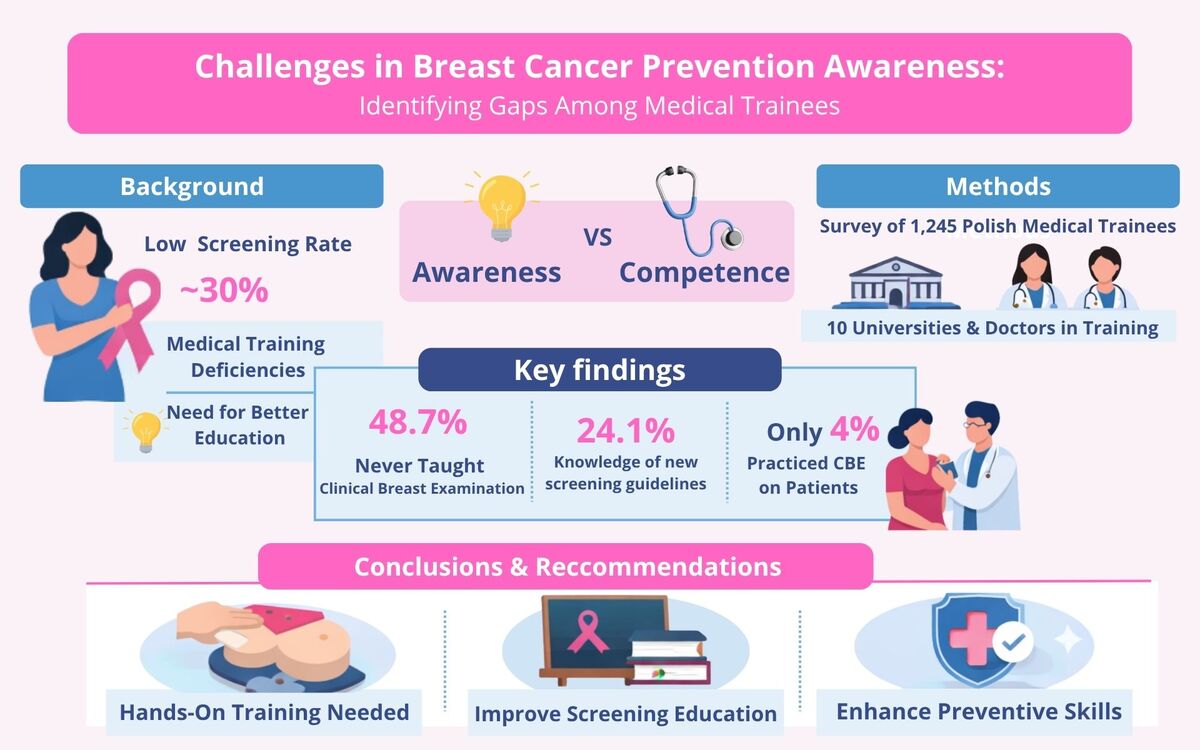
A total of 1,245 participants were included. Nearly half (48.7%) had never been taught CBE, and only 4% had practised with patients. While most respondents recognised mammography as an effective screening tool (96.4%), only 24.1% correctly identified both the screening interval and eligible age group. Attendance at curricular classes was significantly associated with better knowledge, higher confidence in performing CBE independently (p < 0.001), and greater comfort discussing breast self-examination with patients (85% vs. 76%, p < 0.001).
Conclusions:
This nationwide study highlights major gaps in breast cancer prevention education among Polish medical trainees. Although general awareness of mammography is high, understanding of programme details and practical CBE skills remains limited. Structured, competency-based curricula incorporating hands-on and simulation-based training are needed to strengthen preventive oncology education and support efforts to increase screening participation in Poland.
Breast cancer is the most common malignancy among women in Poland, yet participation in the national mammography screening programme remains low (approximately 30%). Medical trainees play a crucial role in promoting prevention, but their preparation in this area is insufficiently explored.
Material and methods:
A cross-sectional online survey was conducted among students from 10 Polish medical universities and doctors-in-training (from November 2024 to February 2025). The questionnaire assessed knowledge of screening guidelines, exposure to curricular training, and self-reported competence in clinical breast examination (CBE). Descriptive statistics and tests were used to analyse associations between categorical variables.
Results:
A total of 1,245 participants were included. Nearly half (48.7%) had never been taught CBE, and only 4% had practised with patients. While most respondents recognised mammography as an effective screening tool (96.4%), only 24.1% correctly identified both the screening interval and eligible age group. Attendance at curricular classes was significantly associated with better knowledge, higher confidence in performing CBE independently (p < 0.001), and greater comfort discussing breast self-examination with patients (85% vs. 76%, p < 0.001).
Conclusions:
This nationwide study highlights major gaps in breast cancer prevention education among Polish medical trainees. Although general awareness of mammography is high, understanding of programme details and practical CBE skills remains limited. Structured, competency-based curricula incorporating hands-on and simulation-based training are needed to strengthen preventive oncology education and support efforts to increase screening participation in Poland.
REFERENCES (30)
1.
Sung H, Ferlay J, Siegel RL, et al. Global Cancer Statistics 2020: GLOBOCAN estimates of incidence and mortality worldwide for 36 cancers in 185 countries. CA Cancer J Clin 2021; 71: 209-49.
3.
Jassem EJ, Krzakowski M, Jassem AJ, et al. Breast cancer. Oncol Clin Pract 2020; 16: 207-60.
4.
Kufel-Grabowska J, Wasąg B. Diagnosis and treatment of patients with breast cancer and mutation in the BRCA1/2 genes. Oncol Clin Pract 2024; 20: 222-8.
5.
Duffy SW, Tabár L, Yen AM, et al. Mammography screening reduces rates of advanced and fatal breast cancers: results in 549,091 women. Cancer 2020; 126: 2971-9.
6.
Narodowy Fundusz Zdrowia; Raport: Realizacja Populacyjnego Programu Wczesnego Wykrywania Raka Piersi. 2025. [cited 2025 Dec 29].
7.
Lagerlund M, Åkesson A, Zackrisson S. Population-based mammography screening attendance in Sweden 2017-2018: A cross-sectional register study to assess the impact of sociodemographic factors. Breast 2021; 59: 16-26.
9.
Kann PE, Lane DS. Breast cancer screening knowledge and skills of students upon entering and exiting a medical school. Acad Med 1998; 73: 904-6.
10.
Tomic M, Vescan ML, Ungureanu MI. Exploring female medical students’ knowledge, attitudes, practices, and perceptions related to breast cancer screening: a scoping review. J Med Life 2023; 16: 1732-9.
11.
Garai S, Törzsökné Márton J, Csima M, Sipos D. Understanding breast cancer: awareness, risk factors, and symptoms among female health science students in Hungary. Healthcare (Basel) 2025; 13: 1512.
12.
Colman R, Kirkman A, Jackson J, Goldburn L, Ozaki A, Kotera Y. Breast cancer understanding among university students: a rapid review of cross-country comparisons. Arch Breast Cancer 2023; 10: 114-23.
13.
Deandrea S, Molina-Barceló A, Uluturk A, et al. Presence, characteristics and equity of access to breast cancer screening programmes in 27 European countries in 2010 and 2014. Results from an international survey. Prev Med 2016; 91: 250-63.
14.
Meani F, Kovacs T, Wandschneider W, Costa A, Pagani O. Multidisciplinary blended learning to build a breast cancer specialist career: survey on the perspective of the first 2 cohorts of the ESO-ULM Certificate of Competence in Breast cancer (CCB). BMC Med Educ 2022; 22: 344.
15.
Özerdoğan N, Şahin BM, Kösgeroğlu N, et al. Educational study to increase breast cancer knowledge level and scanning participation among women working at a university. Eur J Breast Health 2017; 13: 113-6.
16.
Lind DS, Jasra B. Competency-based medical education and breast disease. HCA Healthc J Med 2021; 2: 137-41.
17.
Orsi TD, Valadares ALR, Orsi PME, Orsi IME, Moura AS. Simulation-based training for pelvic and breast physical examination: effect on the anxiety and self-confidence of medical students. Rev Bras Ginecol Obstet 2020; 42: 739-45.
18.
Nassif J, Sleiman AK, Nassar AH, Naamani S, Sharara-Chami R. Hybrid simulation in teaching clinical breast examination to medical students. J Cancer Educ 2019; 34: 194-200.
19.
Sharara-Chami R, Musharrafieh U, Nassar A, Lakissian Z, Nassif J. Hybrid simulation for teaching clinical breast examination (CBE) for physicians in training. Health Edu Care 2019; 4: 1-5.
20.
Bratborska A, Piotrowski I. The impact of yoga practice on cortisol levels in breast cancer patients – a comprehensive review. Oncol Clin Pract 2024; 20: 420-7.
21.
Zhang Y, Maconochie M. A meta-analysis of peer-assisted learning on examination performance in clinical knowledge and skills education. BMC Med Educ 2022; 22: 147.
22.
McCoy CE, Rahman A, Rendon JC, et al. Randomized controlled trial of simulation vs. standard training for teaching medical students high-quality cardiopulmonary resuscitation. West J Emerg Med 2019; 20: 15-22.
23.
European guidelines for quality assurance in breast cancer screening and diagnosis. European Commission; 2023. [cited 2025 Dec 29] https://euref.org/download/eur....
24.
Küçükkaya M, Demirezen E. Using information and communication technologies to improve awareness of early diagnosis of cancers in women. Oncol Clin Pract 2025; 22: e00526073.
25.
Bongaerts THG, Büchner FL, Nierkens V, Crone MR, Guicherit OR, Numans ME. Perceptions and beliefs of general practitioners on their role in the cancer screening programmes in the Netherlands: a mixed-methods study. BMC Prim Care 2024; 25: 129.
26.
Lemmo D, Martino ML, Donizzetti AR, Freda MF, Caso D. The relationship between healthcare providers and preventive practices: narratives on access to cancer screening. Int J Environ Res Public Health 2022; 19: 10942.
27.
Leżanko M, Pilch BA, Czechowska A, Sigorski D, Sobczuk P, Nawrocki S. Knowledge about the European Code Against Cancer, and adherence to the principles of a healthy lifestyle among students in Poland. Nowotwory 2025; 75: 10-8.
28.
Espina C, Yared W, Ritchie D, et al. Sustainability and monitoring of the European Code Against Cancer: recommendations. Cancer Epidemiol 2021; 72: 101933.
29.
Karasiewicz M, Chawłowska E, Lipiak A, Więckowska B. How to improve cancer prevention knowledge? A way to identify gaps and tackle the limited availability of health education services in primary health care using the European Code Against Cancer. Front Public Health 2022; 10: 878703.
30.
Elendu C, Amaechi DC, Okatta AU, et al. The impact of simulation-based training in medical education: a review. Medicine (Baltimore) 2024; 103: e38813.
Share
RELATED ARTICLE
| eISSN: | 1896-9151 |
| ISSN: | 1734-1922 |

We process personal data collected when visiting the website. The function of obtaining information about users and their behavior is carried out by voluntarily entered information in forms and saving cookies in end devices. Data, including cookies, are used to provide services, improve the user experience and to analyze the traffic in accordance with the Privacy policy. Data are also collected and processed by Google Analytics tool (more).
You can change cookies settings in your browser. Restricted use of cookies in the browser configuration may affect some functionalities of the website.
You can change cookies settings in your browser. Restricted use of cookies in the browser configuration may affect some functionalities of the website.