Current issue
Archive
Manuscripts accepted
About the Journal
Editorial office
Editorial board
Section Editors
Abstracting and indexing
Subscription
Contact
Ethical standards and procedures
Most read articles
Instructions for authors
Article Processing Charge (APC)
Regulations of paying article processing charge (APC)


OBSTETRICS AND GYNAECOLOGY / RESEARCH PAPER
Immune Cells, Serum Metabolites, and Ovarian Cancer: A Mediation Mendelian Randomization Study
1
Department of Gynecology and Obstetrics, Beijing Jishuitan Hospital, Capital Medical University, Beijing, China
Submission date: 2025-07-11
Final revision date: 2025-09-25
Acceptance date: 2025-11-02
Online publication date: 2026-02-15
KEYWORDS
TOPICS
ABSTRACT
Introduction:
Recent studies have highlighted the potential functions of immune cells and serum metabolites in the progression of ovarian cancer (OC). Therefore, this study executed Mendelian randomization (MR) methodology to seek out causal links among serum metabolites, immune cells, and OC.
Material and methods:
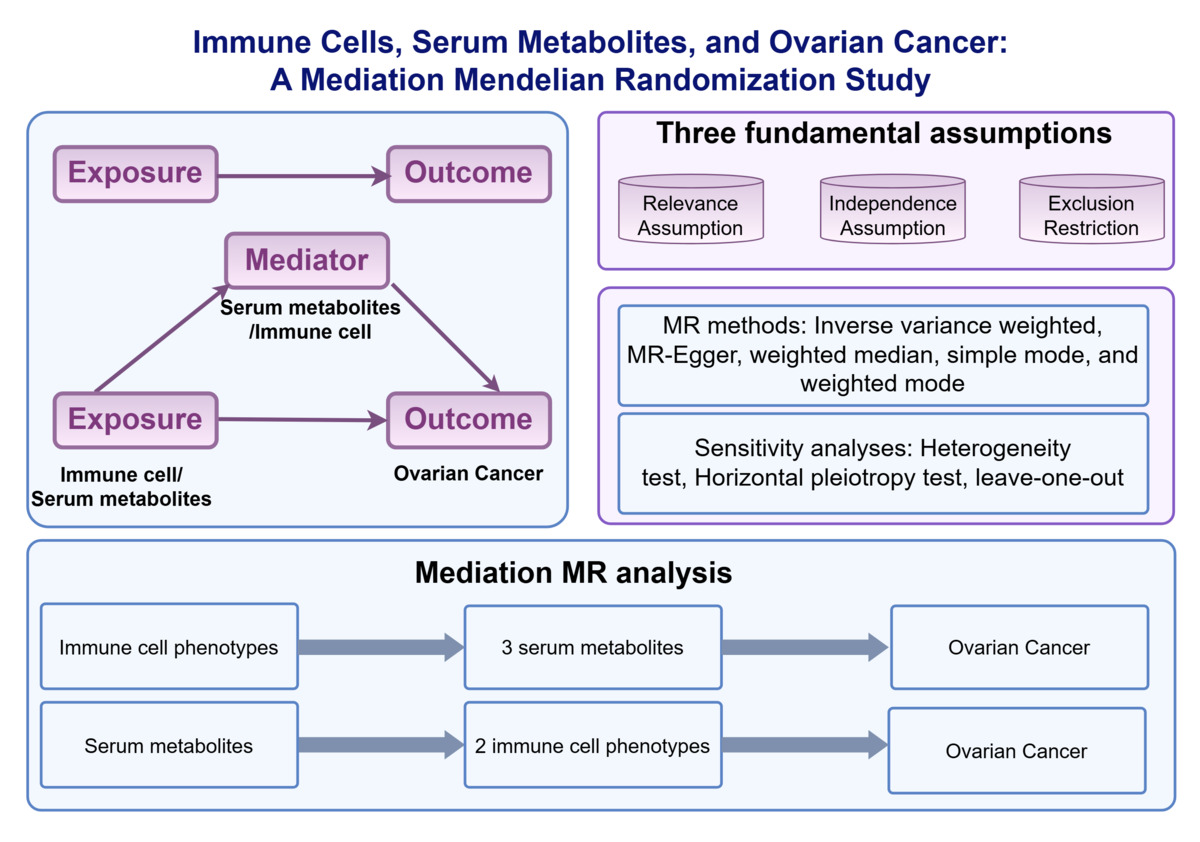
This study wielded data from multiple sources to obtain genetic data related to immune cell phenotypes, serum metabolites, and OC. The causal effects were estimated using the inverse variance weighted, MR-Egger, weighted median, simple mode, and weighted mode to assess potential causal effects. Finally, mediation analysis was conducted to ascertain the potential mediating functions of immune cell phenotypes and serum metabolites in OC.
Results:
36 causal links between immune cell phenotypes and OC were recognized. "Resting CD4 regulatory T cell %CD4 regulatory T cell" (OR = 0.977, p = 0.018) was protective, while "IgD- CD38dim B cell %B cell" (OR = 1.027, p = 0.021) was risk factor. Additionally, 89 causal relationships were identified between serum metabolites and OC. "Gluconate levels" (OR = 0.925, p = 0.047) was protective, while "fructose levels" (OR = 1.097, p = 0.019) was risk factor for OC. Mediation analysis identified 3 serum metabolites that mediated the influence of immune cell phenotypes on OC, alongside 2 immune cell phenotypes acting as mediators between serum metabolites and OC. Notably, sensitivity analysis validated the robustness of these findings.
Conclusions:
This work supplies novel insights into the causal connections among immune cells, serum metabolites, and OC.
Recent studies have highlighted the potential functions of immune cells and serum metabolites in the progression of ovarian cancer (OC). Therefore, this study executed Mendelian randomization (MR) methodology to seek out causal links among serum metabolites, immune cells, and OC.
Material and methods:
This study wielded data from multiple sources to obtain genetic data related to immune cell phenotypes, serum metabolites, and OC. The causal effects were estimated using the inverse variance weighted, MR-Egger, weighted median, simple mode, and weighted mode to assess potential causal effects. Finally, mediation analysis was conducted to ascertain the potential mediating functions of immune cell phenotypes and serum metabolites in OC.
Results:
36 causal links between immune cell phenotypes and OC were recognized. "Resting CD4 regulatory T cell %CD4 regulatory T cell" (OR = 0.977, p = 0.018) was protective, while "IgD- CD38dim B cell %B cell" (OR = 1.027, p = 0.021) was risk factor. Additionally, 89 causal relationships were identified between serum metabolites and OC. "Gluconate levels" (OR = 0.925, p = 0.047) was protective, while "fructose levels" (OR = 1.097, p = 0.019) was risk factor for OC. Mediation analysis identified 3 serum metabolites that mediated the influence of immune cell phenotypes on OC, alongside 2 immune cell phenotypes acting as mediators between serum metabolites and OC. Notably, sensitivity analysis validated the robustness of these findings.
Conclusions:
This work supplies novel insights into the causal connections among immune cells, serum metabolites, and OC.
Share
RELATED ARTICLE
| eISSN: | 1896-9151 |
| ISSN: | 1734-1922 |

We process personal data collected when visiting the website. The function of obtaining information about users and their behavior is carried out by voluntarily entered information in forms and saving cookies in end devices. Data, including cookies, are used to provide services, improve the user experience and to analyze the traffic in accordance with the Privacy policy. Data are also collected and processed by Google Analytics tool (more).
You can change cookies settings in your browser. Restricted use of cookies in the browser configuration may affect some functionalities of the website.
You can change cookies settings in your browser. Restricted use of cookies in the browser configuration may affect some functionalities of the website.