Current issue
Archive
Manuscripts accepted
About the Journal
Editorial office
Editorial board
Section Editors
Abstracting and indexing
Subscription
Contact
Ethical standards and procedures
Most read articles
Instructions for authors
Article Processing Charge (APC)
Regulations of paying article processing charge (APC)


INTERNAL MEDICINE AND GERIATRICS / CLINICAL RESEARCH
Long-term weight patterns and risk of sarcopenia in community-dwelling older adults: a three-year cohort study
1
National Defense Medical University, Taiwan
2
Division of Geriatric Medicine, Department of Family and Community Medicine, Tri-Service General Hospital, Taiwan
Submission date: 2025-12-29
Final revision date: 2026-02-18
Acceptance date: 2026-03-11
Online publication date: 2026-06-04
Corresponding author
Tao-Chun Peng
National Defense Medical University Division of Geriatric Medicine Department of Family and Community Medicine Tri-Service General Hospital, Taiwan
National Defense Medical University Division of Geriatric Medicine Department of Family and Community Medicine Tri-Service General Hospital, Taiwan
KEYWORDS
TOPICS
ABSTRACT
Introduction:
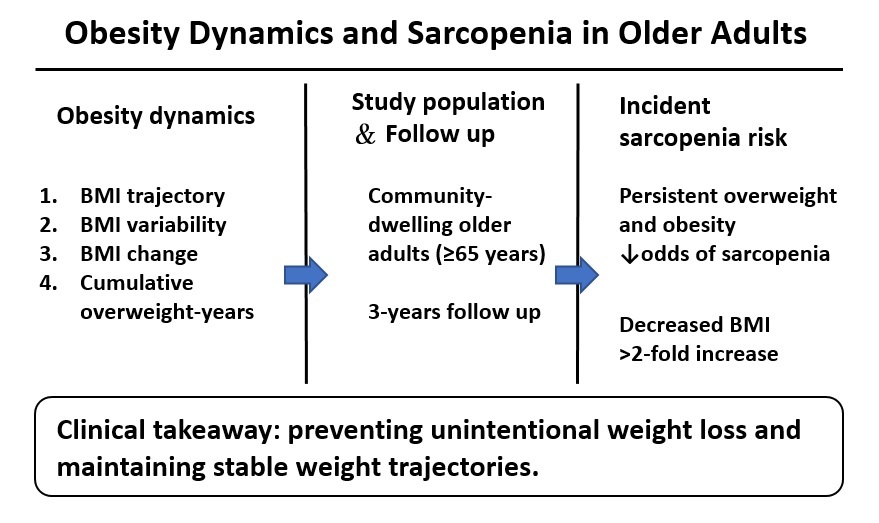
Static body mass index (BMI) measurements fail to capture the clinical implications of body weight fluctuations. Therefore, this study investigated the association between multi-dimensional obesity dynamics and incident sarcopenia in community-dwelling older adults.
Material and methods:
The analytic cohort included 1,091 participants. Of these, 478 completed all assessments at the 3-year follow-up and were analyzed. Despite this attrition, baseline characteristics remained comparable between completers and those lost to follow-up. Obesity dynamics were assessed using BMI trajectories, variability, 3-year change, and cumulative overweight-years. Sarcopenia was defined according to the 2019 Asian Working Group for Sarcopenia (AWGS) criteria. We applied logistic regression models, adjusting for demographics, comorbidities, lifestyle factors, and physical activity.
Results:
Persistent overweight (odds ratio (OR) = 0.31, 95% confidence interval (CI): 0.14–0.67, p = 0.003) and persistent obesity (OR = 0.21, 95% CI: 0.06–0.74, p = 0.016) were associated with significantly lower odds of developing sarcopenia compared with a stable normal BMI, whereas decreased BMI was associated with more than a twofold higher risk (OR = 2.70, 95% CI: 1.17–6.23, p = 0.020). Our analysis of sarcopenia components demonstrated that maintaining an overweight or obese status, along with higher cumulative overweight-years, correlated with a reduced risk of developing low muscle mass (all p < 0.001).
Conclusions:
These findings emphasize the importance of monitoring weight trajectories to prevent unintentional weight loss rather than promoting obesity in later life. Clinicians should prioritize maintaining weight stability to mitigate sarcopenia risk.
REFERENCES (45)
1.
Cruz-Jentoft AJ, Bahat G, Bauer J, et al. Sarcopenia: revised European consensus on definition and diagnosis. Age Ageing 2019; 48: 16-31.
3.
Peng TC, Chiou JM, Chen TF, Chen YC, Chen JH. Grip strength and sarcopenia predict 2-year cognitive impairment in community-dwelling older adults. J Am Med Dir Assoc 2023; 24: 292-8e1.
4.
Benz E, Pinel A, Guillet C, et al. Sarcopenia and sarcopenic obesity and mortality among older people. JAMA Netw Open 2024; 7: e243604.
5.
Hales CM, Fryar CD, Carroll MD, Freedman DS, Ogden CL. Trends in obesity and severe obesity prevalence in US youth and adults by sex and age, 2007-2008 to 2015-2016. JAMA 2018; 319: 1723-5.
6.
Global BMI Mortality Collaboration, Di Angelantonio E, Bhupathiraju SN, Wormser D, et al. Body-mass index and all-cause mortality: individual-participant-data meta-analysis of 239 prospective studies in four continents. Lancet 2016; 388: 776-86.
7.
Tutor AW, Lavie CJ, Kachur S, Milani RV, Ventura HO. Updates on obesity and the obesity paradox in cardiovascular diseases. Prog Cardiovasc Dis 2023; 78: 2-10.
8.
Donini LM, Busetto L, Bischoff SC, et al. Definition and diagnostic criteria for sarcopenic obesity: ESPEN and EASO consensus statement. Clin Nutr 2022; 41: 990-1000.
9.
Prado CM, Batsis JA, Donini LM, Gonzalez MC, Siervo M. Sarcopenic obesity in older adults: a clinical overview. Nat Rev Endocrinol 2024; 20: 261-77.
10.
Jiang M, Ren X, Han L, Zheng X. Associations between sarcopenic obesity and risk of cardiovascular disease: a population-based cohort study among middle-aged and older adults using the CHARLS. Clin Nutr 2024; 43: 796-802.
11.
Peng TC, Chen WL, Chen YY, Chao YP, Wu LW, Kao TW. Associations between different measurements of sarcopenic obesity and health outcomes among non-frail community-dwelling older adults in Taiwan. Br J Nutr 2021; 126: 1749-57.
12.
Xie RZ, Li XS, Zha FD, et al. Relationship between body mass index and low skeletal muscle mass in adults based on NHANES 2011-2018. Sci Rep 2025; 15: 2596.
13.
Yu R, Wong M, Leung J, Lee J, Auyeung TW, Woo J. Incidence, reversibility, risk factors and the protective effect of high body mass index against sarcopenia in community-dwelling older Chinese adults. Geriatr Gerontol Int 2014; 14 Suppl 1: 15-28.
14.
Santos CA, Fraga-Maia H, Pitanga FJG, et al. Anthropometric trajectory in the course of life and occurrence of sarcopenia in men and women: results from the ELSA-Brasil cohort. Br J Nutr 2023; 130: 575-87.
15.
Windham BG, Griswold ME, Wang W, et al. The importance of mid-to-late-life body mass index trajectories on late-life gait speed. J Gerontol A Biol Sci Med Sci 2017; 72: 1130-6.
16.
Cruz-Jentoft AJ, Volkert D. Malnutrition in older adults. N Engl J Med 2025; 392: 2244-55.
17.
Kok RM, Reynolds CF 3rd. Management of Depression in older adults: a review. JAMA 2017; 317: 2114-22.
18.
Luo YX, Zhou XH, Heng T, et al. Bidirectional transitions of sarcopenia states in older adults: the longitudinal evidence from CHARLS. J Cachexia Sarcopenia Muscle 2024; 15: 1915-29.
19.
Bailey KV, Ferro-Luzzi A. Use of body mass index of adults in assessing individual and community nutritional status. Bull World Health Organ 1995; 73: 673-80.
20.
Lennon H, Kelly S, Sperrin M, et al. Framework to construct and interpret latent class trajectory modelling. BMJ Open 2018; 8: e020683.
21.
Bangalore S, Fayyad R, Laskey R, DeMicco DA, Messerli FH, Waters DD. Body-weight fluctuations and outcomes in coronary disease. N Engl J Med 2017; 376: 1332-40.
22.
Hawwash NK, Sperrin M, Martin GP, et al. Excess weight by degree and duration and cancer risk (ABACus2 consortium): a cohort study and individual participant data meta-analysis. EClinicalMedicine 2024; 78: 102921.
24.
Chen LK, Woo J, Assantachai P, et al. Asian Working Group for Sarcopenia: 2019 Consensus Update on sarcopenia diagnosis and treatment. J Am Med Dir Assoc 2020; 21: 300-7 e2.
25.
Liou YM, Jwo CJ, Yao KG, Chiang LC, Huang LH. Selection of appropriate Chinese terms to represent intensity and types of physical activity terms for use in the Taiwan version of IPAQ. J Nurs Res 2008; 16: 252-63.
26.
Uchmanowicz I, Lisiak M, Lomper K, et al. State of the art in measuring frailty in patients with heart failure: from diagnosis to advanced heart failure. Curr Heart Fail Rep 2025; 22: 11.
27.
Uchmanowicz I, Faulkner KM, Iovino P, et al. Integrating frailty interventions into existing care models: a comprehensive approach to enhancing patient outcomes in chronic disease management. Front Public Health 2024; 12: 1518774.
28.
Yoo MC, Won CW, Soh Y. Association of high body mass index, waist circumference, and body fat percentage with sarcopenia in older women. BMC Geriatr 2022; 22: 937.
29.
Trevisan C, Vetrano DL, Calvani R, Picca A, Welmer AK. Twelve-year sarcopenia trajectories in older adults: results from a population-based study. J Cachexia Sarcopenia Muscle 2022; 13: 254-63.
30.
Calcaterra L, Abellan van Kan G, Steinmeyer Z, Angioni D, Proietti M, Sourdet S. Sarcopenia and poor nutritional status in older adults. Clin Nutr 2024; 43: 701-7.
31.
Memel Z, Gold SL, Pearlman M, Muratore A, Martindale R. Impact of GLP- 1 receptor agonist therapy in patients high risk for sarcopenia. Curr Nutr Rep 2025; 14: 63.
32.
Rossi AP, Rubele S, Calugi S, et al. Weight cycling as a risk factor for low muscle mass and strength in a population of males and females with obesity. Obesity (Silver Spring, Md) 2019; 27: 1068-75.
33.
Sui H, Dou J, Shi B, Cheng X. The reciprocity of skeletal muscle and bone: an evolving view from mechanical coupling, secretory crosstalk to stem cell exchange. Front Physiol 2024; 15: 1349253.
34.
Spangenburg EE. Changes in muscle mass with mechanical load: possible cellular mechanisms. Appl Physiol Nutr Metab 2009; 34: 328-35.
35.
Tomlinson DJ, Erskine RM, Morse CI, Winwood K, Onambele-Pearson G. The impact of obesity on skeletal muscle strength and structure through adolescence to old age. Biogerontology 2016; 17: 467-83.
37.
Maimoun L, Bourgeois E, Serrand C, et al. Relationship between lean tissue mass and muscle function in women with obesity. Nutrients 2023; 15: 4517.
38.
Chen LK, Meng LC, Peng LN, et al. Mapping normative muscle health metrics across the aging continuum: a multinational study pooling data from eight cohorts in Japan, Malaysia and Taiwan. J Cachexia Sarcopenia Muscle 2025; 16: e13731.
39.
Curtis M, Swan L, Fox R, Warters A, O’Sullivan M. Associations between body mass index and probable sarcopenia in community-dwelling older adults. Nutrients 2023; 15: 1505.
40.
Kim D, Lee J, Park R, Oh CM, Moon S. Association of low muscle mass and obesity with increased all-cause and cardiovascular disease mortality in US adults. J Cachexia Sarcopenia Muscle 2024; 15: 240-54.
41.
Lynch DH, Petersen CL, Fanous MM, et al. The relationship between multimorbidity, obesity and functional impairment in older adults. J Am Geriatr Soc 2022; 70: 1442-9.
42.
Zhang Z, Yang X. The association between low-density lipoprotein cholesterol to apolipoprotein B ratio (LAR) and sarcopenia: a cross-sectional study. Arch Med Sci DOI: https://doi.org/10.5114/aoms/2....
43.
Yu Z, Liang K, Chen X, Tang H, Chen X. Association of the triglyceride glucose index with computed tomography-based low muscle mass. Arch Med Sci DOI: https://doi.org/10.5114/aoms/2....
44.
Katsiki N, Kolovou G, Vrablik M. Metabolic dysfunction associated-steatotic liver disease (MASLD) and cardiovascular risk: embrace all facets of the disease. Curr Cardiol Rep 2025; 27: 19.
45.
Kokkorakis M, Boutari C, Katsiki N, Mantzoros CS. From non-alcoholic fatty liver disease (NAFLD) to steatotic liver disease (SLD): an ongoing journey towards refining the terminology for this prevalent metabolic condition and unmet clinical need. Metabolism 2023; 147: 155664.
Share
RELATED ARTICLE
| eISSN: | 1896-9151 |
| ISSN: | 1734-1922 |

We process personal data collected when visiting the website. The function of obtaining information about users and their behavior is carried out by voluntarily entered information in forms and saving cookies in end devices. Data, including cookies, are used to provide services, improve the user experience and to analyze the traffic in accordance with the Privacy policy. Data are also collected and processed by Google Analytics tool (more).
You can change cookies settings in your browser. Restricted use of cookies in the browser configuration may affect some functionalities of the website.
You can change cookies settings in your browser. Restricted use of cookies in the browser configuration may affect some functionalities of the website.