Current issue
Archive
Manuscripts accepted
About the Journal
Editorial office
Editorial board
Section Editors
Abstracting and indexing
Subscription
Contact
Ethical standards and procedures
Most read articles
Instructions for authors
Article Processing Charge (APC)
Regulations of paying article processing charge (APC)


SYSTEMATIC REVIEW/META-ANALYSIS
Safety and efficacy of oncolytic virus therapy in malignant brain tumours: a meta-analysis
1
Department of Neuro-oncology, Cancer Center, Beijing Tiantan Hospital, Capital Medical University, China
Submission date: 2026-01-26
Final revision date: 2026-05-29
Acceptance date: 2026-06-08
Online publication date: 2026-08-12
Corresponding author
Wenbin Li
Department of Neuro-oncology Cancer Centre Beijing Tiantan Hospital Capital Medical University 119 Nansihuan West Road Fengtai District Beijing, 100070, China Phone: +86-10-59976611
Department of Neuro-oncology Cancer Centre Beijing Tiantan Hospital Capital Medical University 119 Nansihuan West Road Fengtai District Beijing, 100070, China Phone: +86-10-59976611
KEYWORDS
TOPICS
ABSTRACT
Introduction:
Oncolytic virus (OV) therapy has been investigated as a treatment for malignant brain tumours due to its ability to directly induce tumour cell lysis and stimulate antitumor immunity, especially in malignant gliomas. Nonetheless, clinical evidence is primarily derived from small, early-phase trials. We conducted a meta-analysis to consolidate the safety profile and clinical outcomes of OV therapy in patients with malignant brain tumours.
Methods:
We searched PubMed, Embase, Web of Science, Cochrane Library, and ClinicalTrials.gov up to 31 December 2025. The outcomes assessed were adverse events (AEs), serious adverse events (SAEs), objective response rate (ORR), disease control rate (DCR), 1-year overall survival (OS) rate, median progression-free survival (mPFS), and median overall survival (mOS). Pooled estimates were calculated using random effects models.
Results:
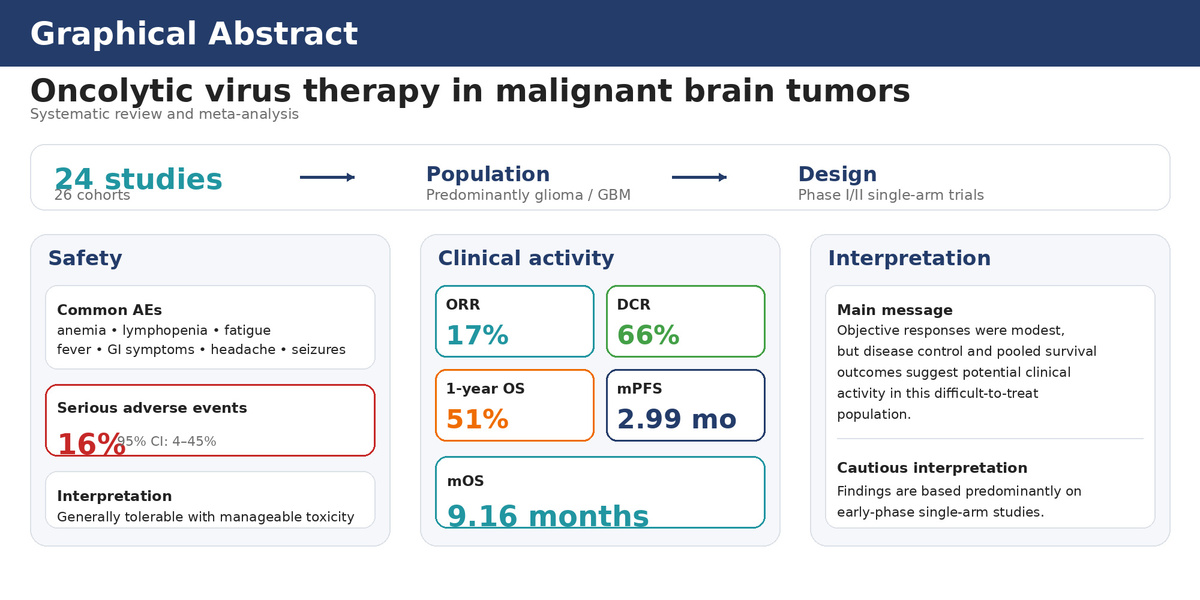
A total of 24 studies comprising 26 cohorts were included, with glioma as the predominant tumour type. All studies were phase I/II single-arm trials. Commonly reported AEs included anaemia, lymphopaenia, fatigue, fever, gastrointestinal symptoms, headache, and seizures. The pooled incidence of SAEs was 16% (95% CI: 4–45%). The pooled ORR was 17% (95% CI: 11–26%), and the DCR was 66% (95% CI: 47–81%). The 1-year OS rate was 51% (95% CI: 33–67%). mPFS and mOS were 2.99 months (95% CI: 1.90–4.08 months) and 9.16 months (95% CI: 7.37–10.96 months), respectively. Leave-one-out analysis confirmed the stability of these estimates.
Conclusions:
OV therapy appears feasible and generally tolerable in patients with malignant brain tumours. Although evidence remains non-confirmatory, pooled outcomes provide descriptive evidence of potential clinical activity, reflected by disease control and survival.
Oncolytic virus (OV) therapy has been investigated as a treatment for malignant brain tumours due to its ability to directly induce tumour cell lysis and stimulate antitumor immunity, especially in malignant gliomas. Nonetheless, clinical evidence is primarily derived from small, early-phase trials. We conducted a meta-analysis to consolidate the safety profile and clinical outcomes of OV therapy in patients with malignant brain tumours.
Methods:
We searched PubMed, Embase, Web of Science, Cochrane Library, and ClinicalTrials.gov up to 31 December 2025. The outcomes assessed were adverse events (AEs), serious adverse events (SAEs), objective response rate (ORR), disease control rate (DCR), 1-year overall survival (OS) rate, median progression-free survival (mPFS), and median overall survival (mOS). Pooled estimates were calculated using random effects models.
Results:
A total of 24 studies comprising 26 cohorts were included, with glioma as the predominant tumour type. All studies were phase I/II single-arm trials. Commonly reported AEs included anaemia, lymphopaenia, fatigue, fever, gastrointestinal symptoms, headache, and seizures. The pooled incidence of SAEs was 16% (95% CI: 4–45%). The pooled ORR was 17% (95% CI: 11–26%), and the DCR was 66% (95% CI: 47–81%). The 1-year OS rate was 51% (95% CI: 33–67%). mPFS and mOS were 2.99 months (95% CI: 1.90–4.08 months) and 9.16 months (95% CI: 7.37–10.96 months), respectively. Leave-one-out analysis confirmed the stability of these estimates.
Conclusions:
OV therapy appears feasible and generally tolerable in patients with malignant brain tumours. Although evidence remains non-confirmatory, pooled outcomes provide descriptive evidence of potential clinical activity, reflected by disease control and survival.
REFERENCES (52)
1.
Perry A, Wesseling P. Histologic classification of gliomas. Handb Clin Neurol 2016; 134: 71-95.
3.
Price M, Ballard C, Benedetti J, et al. CBTRUS statistical report: primary brain and other central nervous system tumors diagnosed in the united states in 2017-2021. Neuro Oncol 2024; 26 (Suppl_6): vi1-85.
4.
Stupp R, Mason WP, van den Bent MJ, et al. Radiotherapy plus concomitant and adjuvant temozolomide for glioblastoma. N Engl J Med 2005; 352: 987-96.
5.
Bao XN, Wang SW, Li Y. Downregulated expression of lncRNA TUBA4B predicts unfavorable prognosis and suppresses glioma progression by sponging miR-183 to regulate SMAD4 expression. Arch Med Sci 2024; 20: 863-75.
6.
Horbinski C, Nabors LB, Portnow J, et al. NCCN guidelines(R) insights: central nervous system cancers, version 2.2022. J Natl Compr Canc Netw 2023; 21: 12-20.
7.
Weller M, van den Bent M, Preusser M, et al. EANO guidelines on the diagnosis and treatment of diffuse gliomas of adulthood. Nat Rev Clin Oncol 2021; 18: 170-86.
8.
Maccari M, Baek C, Caccese M, et al. Present and future of immunotherapy in patients with glioblastoma: limitations and opportunities. Oncologist 2024; 29: 289-302.
9.
Medikonda R, Pant A, Lim M. Immunotherapy as a new therapeutic approach for brain and spinal cord tumors. Adv Exp Med Biol 2023; 1394: 73-84.
10.
Woroniecka K, Chongsathidkiet P, Rhodin K, et al. T-cell exhaustion signatures vary with tumor type and are severe in glioblastoma. Clin Cancer Res 2018; 24: 4175-86.
11.
Sener U, Ruff MW, Campian JL. Immunotherapy in glioblastoma: current approaches and future perspectives. Int J Mol Sci 2022; 23: 7046.
12.
Liu Y, Zhou F, Ali H, Lathia JD, Chen P. Immunotherapy for glioblastoma: current state, challenges, and future perspectives. Cell Mol Immunol 2024; 21: 1354-75.
13.
Lin D, Shen Y, Liang T. Oncolytic virotherapy: basic principles, recent advances and future directions. Signal Transduct Target Ther 2023; 8: 156.
14.
Reale A, Gatta A, Shaik AKB, et al. An oncolytic HSV-1 vector induces a therapeutic adaptive immune response against glioblastoma. J Transl Med 2024; 22: 862.
15.
Bommareddy PK, Wakimoto H, Martuza RL, Kaufman HL, Rabkin SD, Saha D. Oncolytic herpes simplex virus expressing IL-2 controls glioblastoma growth and improves survival. J Immunother Cancer 2024; 12: e008880.
16.
Ma R, Li Z, Chiocca EA, Caligiuri MA, Yu J. The emerging field of oncolytic virus-based cancer immunotherapy. Trends Cancer 2023; 9: 122-39.
17.
Piranlioglu R, Chiocca EA. Oncolytic virus-mediated immunomodulation in glioblastoma: insights from clinical trials and challenges. Semin Immunol 2025; 79: 101975.
18.
Hamad A, Yusubalieva GM, Baklaushev VP, Chumakov PM, Lipatova AV. Recent developments in glioblastoma therapy: oncolytic viruses and emerging future strategies. Viruses 2023; 15: 547.
20.
Shalhout SZ, Miller DM, Emerick KS, Kaufman HL. Therapy with oncolytic viruses: progress and challenges. Nat Rev Clin Oncol 2023; 20: 160-77.
21.
Todo T, Ito H, Ino Y, et al. Intratumoral oncolytic herpes virus G47∆ for residual or recurrent glioblastoma: a phase 2 trial. Nat Med 2022; 28: 1630-9.
22.
Qian X, Ning W, Yang J, et al. The oncolytic adenovirus Ad-TD-nsIL12 in primary or progressive pediatric IDH wild-type diffuse intrinsic pontine glioma results of two phase I clinical trials. Nat Commun 2025; 16: 6934.
23.
Fares J, Ahmed AU, Ulasov IV, et al. Neural stem cell delivery of an oncolytic adenovirus in newly diagnosed malignant glioma: a first-in-human, phase 1, dose-escalation trial. Lancet Oncol 2021; 22: 1103-14.
24.
Todo T, Ino Y, Ohtsu H, Shibahara J, Tanaka M. A phase I/II study of triple-mutated oncolytic herpes virus G47∆ in patients with progressive glioblastoma. Nat Commun 2022; 13: 4119.
25.
Forsyth P, Roldán G, George D, et al. A phase I trial of intratumoral administration of reovirus in patients with histologically confirmed recurrent malignant gliomas. Mol Ther 2008; 16: 627-32.
26.
Freeman AI, Zakay-Rones Z, Gomori JM, et al. Phase I/II trial of intravenous NDV-HUJ oncolytic virus in recurrent glioblastoma multiforme. Mol Ther 2006; 13: 221-8.
27.
Kieran MW, Goumnerova L, Manley P, et al. Phase I study of gene-mediated cytotoxic immunotherapy with AdV-tk as adjuvant to surgery and radiation for pediatric malignant glioma and recurrent ependymoma. Neuro Oncol 2019; 21: 537-46.
28.
Chiocca EA, Abbed KM, Tatter S, et al. A phase I open-label, dose-escalation, multi-institutional trial of injection with an E1B-Attenuated adenovirus, ONYX-015, into the peritumoral region of recurrent malignant gliomas, in the adjuvant setting. Mol Ther 2004; 10: 958-66.
29.
Geletneky K, Hajda J, Angelova AL, et al. Oncolytic H-1 parvovirus shows safety and signs of immunogenic activity in a first phase I/IIa glioblastoma trial. Mol Ther 2017; 25: 2620-34.
30.
Kicielinski KP, Chiocca EA, Yu JS, Gill GM, Coffey M, Markert JM. Phase 1 clinical trial of intratumoral reovirus infusion for the treatment of recurrent malignant gliomas in adults. Mol Ther 2014; 22: 1056-62.
31.
Markert JM, Razdan SN, Kuo HC, et al. A phase 1 trial of oncolytic HSV-1, g207, given in combination with radiation for recurrent GBM demonstrates safety and radiographic responses. Mol Ther 2014; 22: 1048-55.
32.
Markert JM, Liechty PG, Wang W, et al. Phase Ib trial of mutant herpes simplex virus G207 inoculated pre-and post-tumor resection for recurrent GBM. Mol Ther 2009; 17: 199-207.
33.
Ning W, Qian X, Dunmall LC, et al. Non-secreting IL12 expressing oncolytic adenovirus Ad-TD-nsIL12 in recurrent high-grade glioma: a phase I trial. Nat Commun 2024; 15: 9299.
34.
Friedman GK, Johnston JM, Bag AK, et al. Oncolytic HSV-1 G207 immunovirotherapy for pediatric high-grade gliomas. N Engl J Med 2021; 384: 1613-22.
35.
Lang FF, Conrad C, Gomez-Manzano C, et al. Phase I study of DNX-2401 (Delta-24-RGD) oncolytic adenovirus: replication and immunotherapeutic effects in recurrent malignant glioma. J Clin Oncol 2018; 36: 1419-27.
36.
van Putten EHP, Kleijn A, van Beusechem VW, et al. Convection enhanced delivery of the oncolytic adenovirus Delta24-RGD in patients with recurrent GBM: a phase I clinical trial including correlative studies. Clin Cancer Res 2022; 28: 1572-85.
37.
Markert JM, Medlock MD, Rabkin SD, et al. Conditionally replicating herpes simplex virus mutant, G207 for the treatment of malignant glioma: results of a phase I trial. Gene Ther 2000; 7: 867-74.
38.
Galanis E, Dooley KE, Keith Anderson S, et al. Carcinoembryonic antigen-expressing oncolytic measles virus derivative in recurrent glioblastoma: a phase 1 trial. Nat Commun 2024; 15: 493.
39.
Gallego Perez-Larraya J, Garcia-Moure M, Labiano S, et al. Oncolytic DNX-2401 virus for pediatric diffuse intrinsic pontine glioma. N Engl J Med 2022; 386: 2471-81.
40.
Schuelke MR, Gundelach JH, Coffey M, et al. Phase I trial of sargramostim/pelareorep therapy in pediatric patients with recurrent or refractory high-grade brain tumors. Neurooncol Adv 2022; 4: vdac085.
41.
Nassiri F, Patil V, Yefet LS, et al. Oncolytic DNX-2401 virotherapy plus pembrolizumab in recurrent glioblastoma: a phase 1/2 trial. Nat Med 2023; 29: 1370-8.
42.
Mokhtarpour K, Akbarzadehmoallemkolaei M, Rezaei N. A viral attack on brain tumors: the potential of oncolytic virus therapy. J Neurovirol 2024; 30: 229-50.
43.
Bernstock JD, Blitz SE, Hoffman SE, Gerstl JVE, Chiocca EA, Friedman GK. Recent oncolytic virotherapy clinical trials outline a roadmap for the treatment of high-grade glioma. Neurooncol Adv 2023; 5: vdad081.
44.
Liu X, Zhao Z, Dai W, et al. The development of immunotherapy for the treatment of recurrent glioblastoma. Cancers 2023; 15: 4308.
45.
Vaz-Salgado MA, Villamayor M, Albarran V, et al. Recurrent glioblastoma: a review of the treatment options. Cancers 2023; 15: 4279.
46.
Lombardi G, De Salvo GL, Brandes AA, et al. Regorafenib compared with lomustine in patients with relapsed glioblastoma (REGOMA): a multicentre, open-label, randomised, controlled, phase 2 trial. Lancet Oncol 2019; 20: 110-9.
47.
Wick W, Gorlia T, Bendszus M, et al. Lomustine and bevacizumab in progressive glioblastoma. N Engl J Med 2017; 377: 1954-63.
48.
Reardon DA, Brandes AA, Omuro A, et al. Effect of nivolumab vs bevacizumab in patients with recurrent glioblastoma: the CheckMate 143 phase 3 randomized clinical trial. JAMA Oncol 2020; 6: 1003-10.
49.
Kreisl TN, Kim L, Moore K, et al. Phase II trial of single-agent bevacizumab followed by bevacizumab plus irinotecan at tumor progression in recurrent glioblastoma. J Clin Oncol 2009; 27: 740-5.
50.
Lin C, Teng W, Tian Y, Li S, Xia N, Huang C. Immune landscape and response to oncolytic virus-based immunotherapy. Front Med 2024; 18: 411-29.
51.
Lau P, Liang L, Chen X, Zhang J, Liu H. Comparative safety and efficacy of oncolytic virotherapy for the treatment of individuals with malignancies: a systematic review, meta-analysis, and Bayesian network meta-analysis. EClinicalMedicine 2025; 86: 103362.
52.
He Y, Li W, Zhang X, Cui Z. Oncolytic virus targeted therapy for glioma via intravenous delivery. Adv Healthc Mater 2025; 14: e2404965.
Share
RELATED ARTICLE
| eISSN: | 1896-9151 |
| ISSN: | 1734-1922 |

We process personal data collected when visiting the website. The function of obtaining information about users and their behavior is carried out by voluntarily entered information in forms and saving cookies in end devices. Data, including cookies, are used to provide services, improve the user experience and to analyze the traffic in accordance with the Privacy policy. Data are also collected and processed by Google Analytics tool (more).
You can change cookies settings in your browser. Restricted use of cookies in the browser configuration may affect some functionalities of the website.
You can change cookies settings in your browser. Restricted use of cookies in the browser configuration may affect some functionalities of the website.