Introduction
Effective communication plays a key role in the healthcare decision-making process [1]. Health-related communication and shared decision-making (SDM) are crucial elements of patient-centered care [2, 3]. The evolution of the SDM concept originated from the work on informed consent that began in the 1980s [4, 5]. Advances in information and data management (collection, analysis, sharing), along with greater access to information, have led to expectations that patients will take a more active role in managing their health. SDM is based on three pillars: two-way exchange of information between the patient and the physician, identifying and acknowledging the patient’s preferences, and engaging both the patient and the physician in the final decision-making process [6]. In 2015, the Agency for Healthcare Research and Quality (AHRQ) released a revised, more practical 5-step model of SDM, replacing the previous 9-step version, called SHARE (Seek, Help, Assess, Reach, Evaluate) [7]. The objective of the first step is to understand the situation and help the patient become aware of the aspects that demand action (“Seek your patient’s participation”). In the second step, the physician should provide the patient with evidence-based information about the available treatment options (“Help your patient explore and compare treatment options”). The next step should take into account the patient’s values and preferences in the context of the suggested treatment options (“Assess your patient’s values and preferences”). Finally, both parties should make a decision together (“Reach a decision with your patient”) and evaluate it (“Evaluate your patient’s decision”) to ensure it balances benefits, risks, and the patient’s preferences, maximizing the likelihood of achieving the desired outcome [8]. In primary care, multiple health-related decisions are made during each visit [9]. Studies have showed that engaging patients in the decision-making process can reduce regret and anxiety related to the chosen option, improve treatment outcomes, satisfaction, and quality of life, and enhance the quality and safety of healthcare [10, 11]. Engaging patients in decision-making conversations about their chronic condition is crucial as regards lifestyle, as it encourages them to adopt necessary changes [12]. This is particularly important for decisions involving long-term actions, such as physiotherapy for chronic pain or changing the diet due to food allergy [13–15]. In addition, SDM significantly improves health literacy and reduces decision-related conflicts [16]. In contrast, poor SDM practices have been linked to worse patient-reported quality outcomes, lower overall quality of care, and increased dependence on healthcare services [11].
Multiple studies have shown that the decision-making process is often far from ideal, where an ideal process involves the patient being active, understanding their treatment options, and expressing preferences clearly, while the physician has sufficient time and willingness to share knowledge and involve the patient in the decision-making process [16]. The debate on SDM has persisted for many years, yet many physicians still perceive shared decision-making as challenging, mainly due to social, cultural (lack of SDM tradition), and organizational reasons (healthcare systems do not recognize SDM as a standard of care) [17–20]. One major barrier to effective SDM implementation in medical practice is the lack of a universal definition and consistent understanding of SDM. There are differing perspectives on the definition of SDM and how it should be implemented in practice [21]. The way SDM is conceptualized influences how its feasibility is assessed. Examples of SDM conceptualizations include: negative right, informed decision-making, and tailored partnership. Conceptualizing SDM as a “negative right” implies that patients have the right to refuse treatment, but do not necessarily take an active role in selecting therapeutic options. Decisions are primarily made by physicians based on professional standards, with patient involvement emerging mainly when they disagree with the proposed course of action. The informed decision-making model assumes that the physician provides the patient with medical knowledge and available options, while the patient independently makes the treatment decision. In this view, the physician acts as an advisor rather than a decision-maker, although in practice physicians often offer recommendations, as patients tend to rely on their expertise and authority. Conceptualizing SDM as a tailored partnership emphasizes a flexible approach that takes into account the individual characteristics of the patient, such as age, health condition, and personal preferences. Decisions are made jointly, but the process may vary – potentially even including a jointly agreed-upon, more paternalistic approach when appropriate [21]. The article is based on Makula’s definition of SDM, where it is defined as an approach in which clinicians and patients collaborate by sharing the best available evidence in making healthcare decisions, while supporting patients in weighing their options to arrive at informed preferences [22]. Communication and interaction between healthcare providers and patients is key for health-literate decision-making [23].
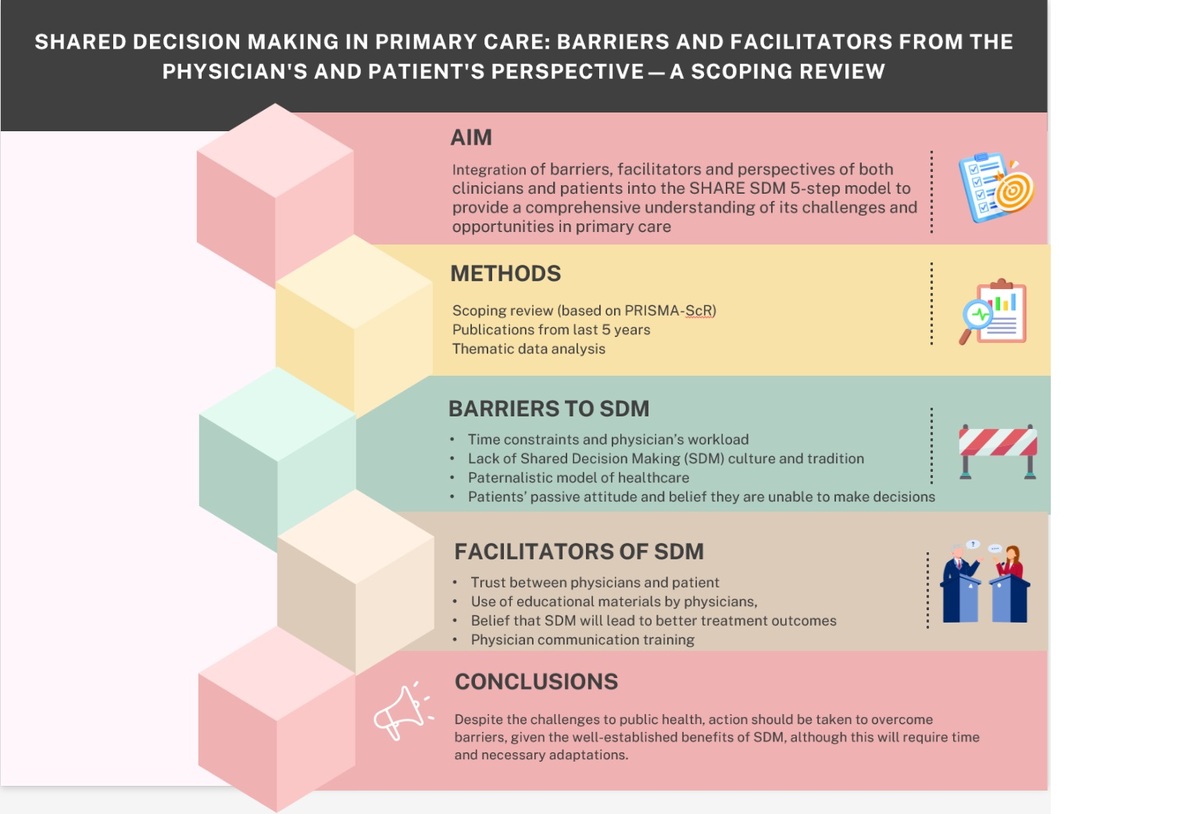
Existing overviews focus on specific elements, such as barriers, facilitators, or either the patient’s or physician’s perspective. This review integrates the barriers, facilitators and both clinician and patient perspectives, framed within the 5-step SHARE model of SDM, to provide a comprehensive understanding of its challenges and opportunities in primary care.
Material and methods
The scoping review was conducted on the basis of the PRISMA- ScR instruction (Figure 1). The framework was applied as follows:
Figure 1
Simplified PRISMA-ScR diagram for literature review process for articles about Shared Decision Making in primary care
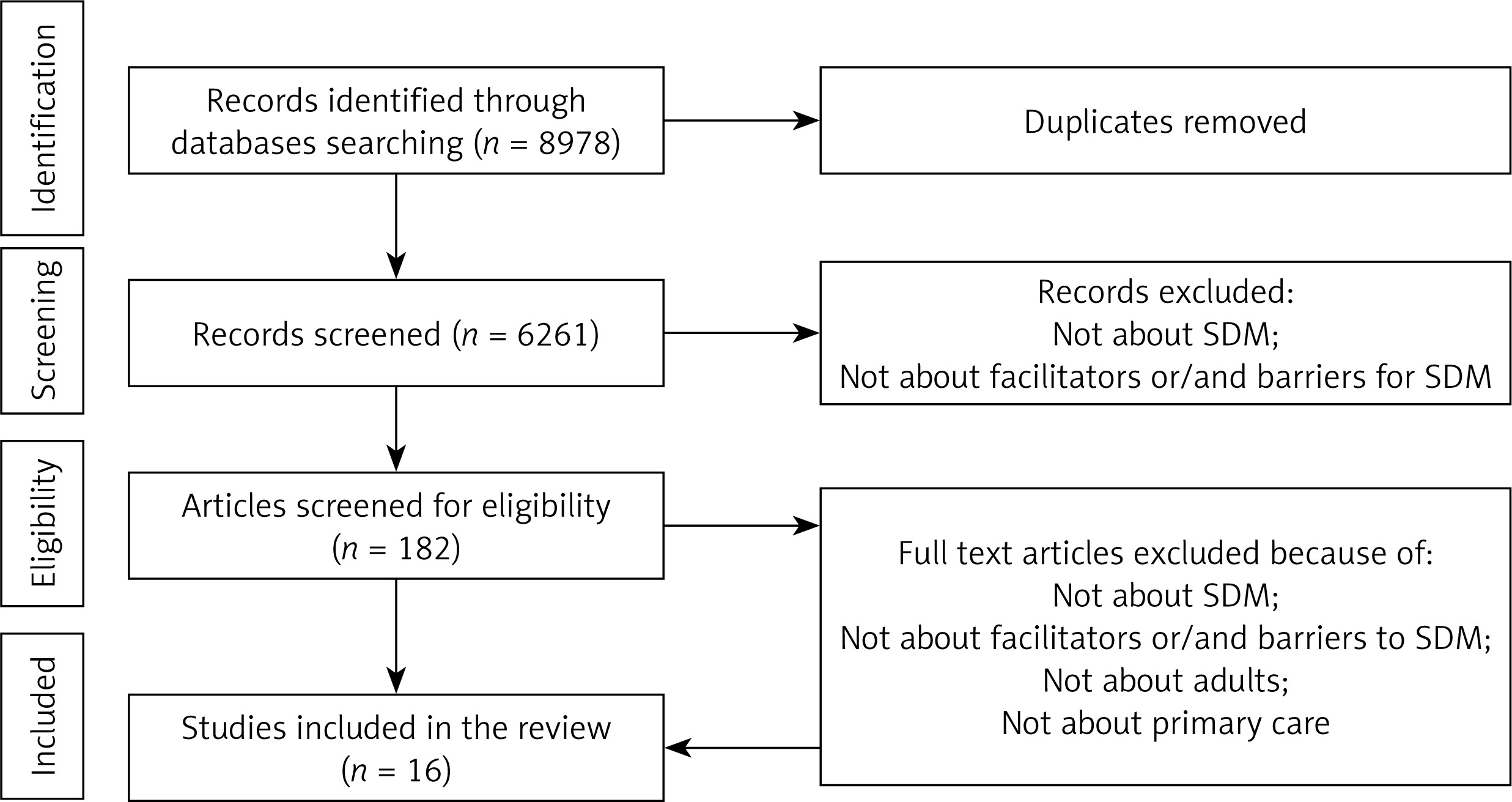
Identification: A comprehensive search strategy was developed based on predefined keywords: barriers, facilitators, shared decision-making, general practice, primary care, patient’s perspective, GP’s perspective. The scoping review was conducted in June 2024 and included the most recent studies conducted over the past 5 years. The following databases were searched: PubMed, Cochrane Library, Wiley Online Library, and Google Scholar.
Screening: After removal of duplicates, all titles and abstracts were independently screened by two reviewers to assess relevance against the eligibility criteria. Studies were included if they: (1) were original data studies, systematic reviews, scoping reviews or meta-analyses; (2) involved an adult population (aged > 19); (3) investigated SDM in primary care; (4) captured SDM barriers and facilitators; (5) the results spanned the last 5 years. They also included guidelines, instructions, and SDM recommendations published on government websites. Studies not meeting the inclusion criteria were excluded at this stage. The exclusion criterion was studies involving hospital settings, pediatric populations, or patients with mental illness or cancer (Supplementary Table SI).
Eligibility: Titles, abstracts, and potentially relevant articles were reviewed independently in full text by the authors (KDŻ and MKP) based on the eligibility criteria. Doubts were resolved through discussion (Figure 1). Due to the scoping nature of this review and in accordance with PRISMA-ScR guidelines, no formal critical appraisal of the quality of the study was conducted. The aim of this review was to map the existing literature and identify key barriers and facilitators to SDM in primary care, rather than to assess the effectiveness or rigor of interventions. Given the methodological heterogeneity of the included studies (e.g. qualitative interviews, surveys, reviews, policy documents), the use of a standardized quality assessment tool was considered inappropriate. However, to ensure the relevance of the included sources, all studies were independently screened by two reviewers using pre-defined inclusion and exclusion criteria, and any disagreements were resolved through discussion.
Inclusion: Studies meeting all criteria were included in the final synthesis.
Data extraction and quality assessment: An inductive thematic analysis was used to group findings into common themes. Results were presented narratively and mapped across the SDM framework from both the physician and patient perspectives.
Data screening – The researchers independently reviewed the full texts of all included studies to gain an in-depth understanding of their content, with a particular focus on reported barriers and facilitators of SDM from both the physician and patient perspectives.
Initial coding – Two researchers (e.g., KDŻ and MKP) independently coded relevant segments of text related to SDM barriers and facilitators. Coding was conducted inductively, with codes assigned to data extracts that described specific factors impeding or supporting SDM.
Search for themes – The identified codes were then grouped into broader categories or themes that reflected common patterns (e.g., time constraints, health literacy, communication style, decision-making roles). Barriers and facilitators were organized within the framework of the 5-step SHARE model of SDM (Seek, Help, Assess, Reach, Evaluate).
Reviewing themes – The initial thematic structure was discussed and refined by the research team to ensure consistency and coherence. Redundant or overlapping themes were merged, and ambiguous codes were clarified.
Defining and naming themes – Final themes were clearly defined, labeled, and classified as either “barriers” or “facilitators”. Each theme was mapped to the corresponding SDM step and perspective (physician or patient), providing a structured thematic matrix.
Data extraction and synthesis – Themes were entered into a standardized extraction table summarizing findings from the original studies. This matrix was used to compare thematic patterns across the five SDM steps and between physician and patient perspectives.
Validation and Consensus – The final thematic framework was reviewed by two independent experts in SDM. Disagreements were resolved through discussion with the principal investigator to ensure the validity and reliability of the thematic interpretation.
Results
Table I shows that barriers were identified for each step of SDM, both from the patient’s and the physician’s perspective. A shared barrier in the first step is the lack of a culture or tradition of SDM [9, 24–26]. In addition, physicians cite time constraints and view consultations involving SDM as burdensome [25–28]. Evidence suggests that this may ultimately result in a default decision-making approach with little or no personalization [29]. Time pressures affect the physician’s intuitive prioritization of which decisions to discuss. In this context, the diversity of patients and their problems also poses a challenge. There is concern that SDM will extend the length of the visit and thus unpredictably affect the physician’s schedule [30, 31]. On the other hand, a passive attitude – stemming from preconceived notions about consultations and socio-demographic factors such as age, education, or gender – is a major barrier to patient engagement in the SDM process. This passive attitude is more commonly observed among elderly patients, males, and less educated individuals [23–39]. SDM facilitators in the first step include trust and recognizing that there are two experts in the clinical encounter [35]. Patients with the following personal traits tend to be more engaged in SDM: kind, self-confident, empowered, proactive [35]. Also, physicians who believe in the beneficial influence of SDM on patient outcomes and have good communication skills find it easier to implement SDM [24].
Table I
Barriers and facilitators from the patient’s and physician’s perspectives in relation to 5 steps of SDM
When treatment options are discussed and compared, SDM may be impeded if the patient feels overloaded by the amount of information, does not understand the information due to overly technical language, is unable to compare different options because only one was presented, or perceives the physician as unwilling to provide explanations [25, 36, 37]. Conversely, the physician may be unable to discuss treatment options with the patient due to time constraints, an overloaded consultation schedule, or a focus on quantity over quality in patient consultations [25, 33].
In the third step, factors impeding the assessment of the patient’s values and preferences include the patient’s hesitation in expressing their preferences or the physician’s unwillingness to listen to and acknowledge the patient’s concerns and opinions. This stage can be supported if the patient is aware of their preferences while the physician is caring, empathic, calm, and open [23, 27, 35].
The most barriers on the patient’s and physician’s sides were identified in the fourth step, where the decision should be made. From the patient’s perspective, the key barriers to making a treatment decision include: insufficient health literacy (difficulty accessing detailed information before the visit), belief that only doctors can make decisions, expectation that visits should provide definitive solutions, uncertainty about the best option, lack of empowerment, financial limitations (only fully or partially state-funded options are affordable), and additional stress from decision-making (acting under time pressure) [24, 25, 28, 34, 36]. On the physician’s side, barriers include: authority-based decision-making style, reluctance to engage patients in the decision-making process (believing they don’t want to participate and it is not necessary), and a lack of communication and interpersonal skills [24, 25]. Supporting factors at this stage include: self-education before the visit, fostering empowerment in self-care and responsibility for own decisions and well-being, health literacy (understanding options, uncertainty in medical evidence, and disease history), viewing the physician as a decision-making partner, having a nurse present during consultations, and involving family members in the treatment process [39, 40]. Also, training for physicians supports SDM [29]. In the last step, the physician should evaluate the decision. A potential limiting factor at this stage is the physician’s fear of facing a higher liability risk [25]. Furthermore, the decision may be difficult to evaluate in the long term if there is no continuity in services – consultations are held by different specialists who give contradictory recommendations, causing confusion. Sometimes, the attending physician changes [25, 35]. The evaluation process is supported when the physician feels responsibility is shared, providing a sense of protection from negative outcomes of the decision, or by maintaining detailed case records, documenting each visit, including concerns, patient preferences, and communication details [25].
Discussion
The shift towards the SDM model of healthcare is driven by the increasing number of treatment options, the growing complexity of the decision-making process, and the rising awareness that the paternalistic model does not translate to better patient outcomes [41]. Therefore, both SDM barriers and facilitators must be identified to enable more effective SDM integration into everyday medical practice. This review offers a wider perspective – that of patients and physicians at each of the five steps of SDM model.
Step 1: Seek your patient’s participation
The barriers identified at this stage include primarily the lack of SDM tradition and culture. For cultural reasons, paternalism dominates in healthcare. On one hand, the physician makes decisions a priori, considering the patient’s best interests, while on the other hand, the patient expects to be offered a ready-made solution, trusting the physician’s knowledge and experience [9]. SDM depends on a number of co-existing factors, including health literacy, patient’s emotional status, patient’s and physician’s personal traits, quality of the patient-physician relationship, and the nature of the decision [42]. Studies have shown that elderly patients or less educated individuals rarely participate in SDM. Potential reasons include difficulties in understanding information and a noticeably low level of engagement. This may discourage physicians from involving these patients in SDM, as they believe the patients are less willing or capable of participating in the decision-making process [43]. Moreover, patients tend to underestimate the value of their contribution to the consultation. Eager to please the physician, patients often feel they should conform and remain passive in the patient-physician relationship, believing they have limited permission to actively participate in the consultation [19, 44]. However, patients’ attitudes and beliefs can be modified through guidance (unlike unmodifiable socio-demographic factors, such as age), helping them accept a more active role [45]. To increase the chances of implementing SDM, physicians should be made aware of the benefits of building high-quality relationships with their patients. Usually, this requires improved communication skills [46]. In this context, personnel training is seen as the most effective intervention, enhancing relationship-building skills and facilitating the implementation of the SDM model as a standard in clinical practice [37]. On the other hand, time constraints have been identified as a significant barrier to introducing SDM. Studies have shown that improved time management could solve the majority of communication-related barriers [47].
Step 2: Help your patient explore and compare treatment options
At step two, where treatment options are discussed, the main barriers are health literacy and comprehension. For patients to effectively use the information in the successive steps of SDM, they must be able to receive and understand it, while physicians need strong communication skills to convey the information clearly [48]. The physician should present alternative treatment options, outlining the risks, benefits, and potential uncertainties, based on up-to-date, evidence-based, and validated data [48]. To improve the effectiveness of communication, physicians may use different techniques and tools enhancing health literacy. Educational aids can help patients make informed decisions [49]. These include: educational materials (brochures, graphics) and option grids, simplified information, no medical jargon, reduced amount of text in educational materials, presenting the most important information first or in isolation, presenting figures logically, use of visual language, examples, and comparisons [23, 50, 51].
Step 3: Assess your patient’s values and preferences
Understanding patients’ values and preferences is a fundamental aspect of patient-centered care. However, eliciting this information can be challenging, since patients represent a heterogeneous group in this regard. In addition, their values and preferences depend on many factors and may change over time [51]. At this step, both parties should seek congruence in the consultation; clinical objectives should align with the patient’s goals and values [51]. A recommended approach may turn out to be ineffective if the patient is not motivated to adhere to the treatment scheme or feels that the benefits do not justify the effort [52]. “Doctors might be experts in clinical matters, but the patient is the expert in their lived experience” [53]. To be able to express personal values and preferences, patients should be equipped with cognitive and social skills. Evidence indicates that these health-related skills can be enhanced through education [48].
Step 4: Reach a decision with your patient
In the 1990s, the practice of engaging patients in the decision-making process was criticized by many. Opponents of the SDM model argued that patients were often unwilling to participate in decision-making, that disclosing medical uncertainties could have negative consequences, that providing complete information on all treatment options was impractical, and that it might lead to an increase in demand for unnecessary and costly procedures [54]. Studies confirm that the paternalistic model can lead to satisfactory outcomes for some patients, while leaving others dissatisfied and with suboptimal results. However, over the past 20 years, there has been an increasing trend in patients preferring to be actively involved in the decision-making process regarding their health [52]. It is a common myth that most patients prefer their doctor to make decisions for them. While it may be true in some situations, researchers emphasize that it is not a reason to abandon SDM, but rather an opportunity to take the initiative. A patient’s unwillingness to make a decision can be a starting point for a deeper discussion about the available options, recommendations, and patient’s expectations. This attitude may benefit the patient-physician relationship, strengthening mutual respect and trust [42, 52].
Step 5: Evaluate your patient’s decision
Ensuring that the patient understands the key aspects of the decision, including its implications for their health, is a crucial final step in the model [42]. However, there is limited evidence in the literature on practical guidelines for assessing whether the patient has correctly understood the information necessary to make an informed health decision [55]. Nonetheless, there are tools to assess a patient’s ability to make health decisions, which can help physicians evaluate the patient’s situation in a structured manner [56]. However, the long-term evaluation process can be impeded by a lack of continuity in services and frequent staff rotations, which may result in a loss of information. The new staff may have no knowledge of the decision-making process from previous visits, which can undermine the patient-physician relationship [57].
The circumstances that limit the adoption of SDM should not be ignored. They include situations where the physician must balance individual wishes and preferences with the safety of the individual and the well-being of the wider population. For example, a patient may pressure the physician to prescribe antibiotics when it is not medically justified, or an individual addicted to psychoactive substances may demand opiates outside the recommended treatment regimen. Another situation arises when specific medical procedures or tests are mandated by the applicable law, such as newborn screening, or when medical evidence is insufficient to compare treatment options. Additionally, there are cases where life-saving actions must be taken or when a patient is deemed incapable of making decisions [58–60].
Based on the findings of Scholl et al. (2018), effectively addressing barriers to shared decision-making (SDM) requires targeted actions at multiple levels. At the policy level, integrating SDM into healthcare regulations and providing financial incentives can promote its adoption. This includes embedding SDM principles into clinical guidelines and quality assessment frameworks to ensure systemic commitment. At the institutional level, fostering an organizational culture that values SDM is critical. This involves providing healthcare professionals with appropriate training, allocating sufficient time and resources for patient engagement, and embedding SDM tools into routine workflows and electronic health records. At the individual level, enhancing communication skills among both clinicians and patients, promoting patient empowerment and health literacy, and cultivating mutual respect and trust are necessary to facilitate effective collaborative decision-making. Addressing barriers through this multi-level approach can help to mitigate structural, cultural, and interpersonal obstacles, thereby supporting more consistent and meaningful implementation of SDM in clinical practice.
The aim of this review was to update the current state of knowledge on the barriers and facilitators of SDM from the physician’s and patient’s perspectives in primary care. To mitigate the risk of imprecision and bias, we used a specific methodology of article screening and data extraction. Nevertheless, the study has several limitations. First, since no precise definition of SDM exists, the authors decided to include studies where SDM matched the definition proposed by Makoul and Clayman [22]. The decision was based on its integrative nature and wide acceptance in the literature, allowing for consistent inclusion criteria across heterogeneous studies. Fundamental studies have included many socio-demographic factors of both healthcare providers and patient populations that may affect SDM, but only within a limited scope. Our search was limited to publications in English, potentially resulting in the omission of relevant studies published in other languages. The restriction to English-language publications may limit the generalizability of the findings, as relevant evidence published in other languages and cultural contexts could have been excluded. This may particularly affect the identification of region-specific barriers to and facilitators of SDM implementation. The search criteria may not have been comprehensive enough to capture all relevant studies reflecting both the physician’s and the patient’s perspectives. Additionally, our approach to data synthesis may have lacked sufficient depth, potentially failing to adequately assign barriers to the five steps of SDM. A more granular, step-by-step synthesis of barriers and facilitators – tailored to specific populations or healthcare systems – was not feasible due to the variability in study design and reporting standards, and the limited level of detail in some of the included sources. The study did not take into account barriers related to factors in the healthcare system (care settings), such as limitations in referral options for tests and specialist consultations, long waiting times for services outside the primary care system, and others. This is a broad area that can affect patient involvement in decision-making. A more in-depth exploration of this issue may be a direction for future research. Finally, the conclusions of this review could be influenced by publication bias, as it is common for studies reporting only significant outcomes to be published.
In conclusion, SDM remains a challenge in primary healthcare but offers well-documented benefits, including improved treatment outcomes, patient satisfaction, and strengthened physician–patient communication. To facilitate its broader implementation, targeted actions are needed to eliminate persistent barriers.
Effective interventions include structured communication training for healthcare professionals, the use of simplified decision aids and educational materials, and promoting continuity of care to strengthen long-term clinical relationships. Programs such as MAGIC in the UK have demonstrated that a supportive institutional culture is essential for successful integration of SDM as a routine component of clinical practice [19].
Future research should investigate the effectiveness of specific interventions across different healthcare settings, assess methods for integrating SDM into electronic medical records, and monitor changes in barriers and facilitators over time. Emphasis should be placed on the role of digital and health literacy in enabling active patient participation. Such evidence will be critical for translating SDM principles into everyday practice in primary care.