Introduction
Respiratory syncytial virus (RSV) is the most common cause of lower respiratory tract infection in infancy and early childhood and, as a consequence, the main reason for hospitalization of children under 5 years old [1]. In turn, bronchopulmonary dysplasia (BPD) is the most frequent chronic lung disease diagnosed among preterm infants. Both the presence of functional and anatomical changes in the respiratory tract and the excessively expressed proinflammatory reactivity characterising this disease contribute to increased lung damage in the course of RSV infection [2, 3]. This is often associated with the necessity of hospitalization of the patient in an intensive care unit. Frequently, either non-invasive or invasive ventilation is required [4]. In infants with BPD who are also infected with RSV, not only respiratory failure occurs, but the infection also contributes to the inhibition of lung development and maturation. Because there is currently no causal treatment for RSV infection and no effective vaccine to avert this disease, the only way to prevent it is to supply a specific monoclonal immunoglobulin – palivizumab [5]. In Poland, the prophylaxis is carried out during the high-risk season, which occurs from October to April. During this period, palivizumab at a dose of 15 mg/kg body weight is administered intramuscularly at monthly intervals. Although BPD is the most frequent chronic lung disease diagnosed among preterm infants, a national registry of BPD has not yet been established in Poland. The mandatory registration of premature infants undergoing prophylaxis creates an opportunity to assess the incidence of BPD in this group of children.
The aim of the study was to assess both the incidence and severity of BPD in infants born before 28 weeks of gestational age (GA). Analysis of data on children born in 2013 and enrolled into the Polish National Program for RSV Prophylaxis (PNPRSVP) was performed. A second goal was to analyse the effectiveness of immunoprophylaxis carried out in accordance with the criteria in force at that time.
Material and methods
Polish National Program for RSV Prophylaxis through palivizumab administration has been carried out in Poland since 2008. However, it was not until 2013 that the criteria for inclusion into the program were expanded to incorporate those children who, at the time of starting immunization, had not yet completed their first year of life, and met one of the following criteria:
GA ≤ 28 weeks, 0 days;
BPD – defined as the necessity to use oxygen therapy for up to 28 days of life.
Children with contraindications for passive immunisation such as hypersensitivity to palivizumab as well as lack of parental or legal guardian consent for participation were not included.
Children born in 2013 were qualified for the program during the seasons 2012–2013 and 2013–2014. Immunoprophylaxis was conducted in 26 neo-natology centres, wherein the patient could be qualified and covered by prophylaxis only during one of the above-mentioned seasons.
A retrospective analysis of the data collected during the prophylaxis program was carried out. Registered data for all children included the neonatal course, the number of palivizumab doses, the inter-dose interval, and tolerance of palivizumab.
The accuracy of extracted data was assessed by the standard data validation and additional verification procedures. Any discrepancies were reported to the main investigator and a physician of the neonatology centre from which the inconsistent data originated. Corrections were performed in line with relevant instructions from the neonatology centre and from the main investigator.
The source of information regarding the number of births and deaths was the data published by the Central Statistical Office (CSO) in Poland.
The analysis included assessment of the following factors: GA, birth weight, small for gestational age (SGA), sex distribution, multiple pregnancy, the need for oxygen therapy for at least 28 days, and the need of oxygen therapy at 36 weeks postmenstrual age (PMA).
Compliance was evaluated comparing the number of received doses with the expected number of doses and the inter-dose interval. The expected number of palivizumab doses was calculated by assuming monthly injections during the season of increased RSV infection risk. It was expected that children who received the first dose of palivizumab from October to December would receive a total of 5 doses, and those who received the first dose in February would be immunized 3 times. When assessing the dosing intervals, 30 ±5-day intervals were considered as recommended. However, between the first and second dose, 16–35 days were considered to be in line with the recommendations.
Statistical analysis
Qualitative variables were expressed as numbers and percentages. Quantitative data were presented as means ± standard deviations (SD). Categorical variables were compared using the χ2 test or the exact Fisher test. Continuous variables were first analysed using the Shapiro-Wilk test. Variables with normal distribution were compared with the Student’s t-test. Otherwise, the Mann-Whitney U test was used. The statistical analysis was carried out using the statistical package R, version 3.6.1. In all analyses, the 0.05 significance level was assumed. Methods for filling in data gaps were not used.
Results
The analysis covered 1621 preterm infants (626 and 995, respectively, in the 2012–2013 and 2013–2014 seasons). Of this group, 1002 children (539 boys [53.8%] and 463 [46.2%] girls) were born in 2013, between 22 and 36 weeks GA.
The final assessment included 603 children born extremely prematurely, who received prophylaxis under the program. According to the CSO’s nativity and mortality data in Poland in 2013, this group accounted for 87.8% of the entire population of infants born before 28 weeks GA (Table I).
Table I
Percentage of infants born extremely prematurely in 2013 enrolled into PNPRSVP
| Gender | CSO | PNPRSVP | % |
|---|---|---|---|
| Male | 369 | 325 | 88.1 |
| Female | 318 | 278 | 87.4 |
| TOTAL | 687 | 603 | 87.8 |
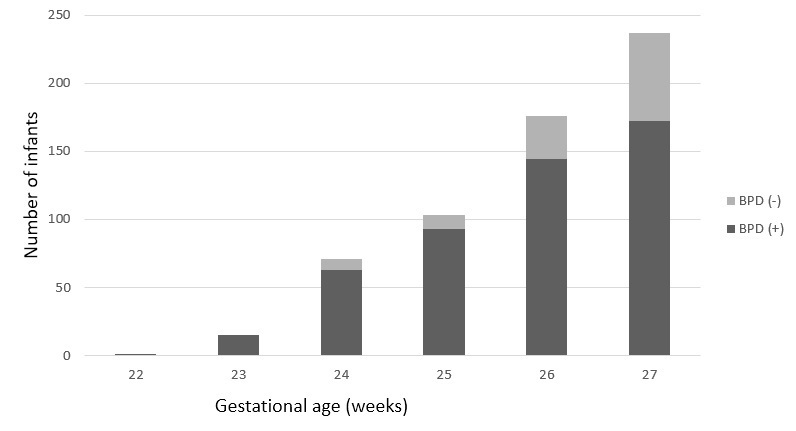
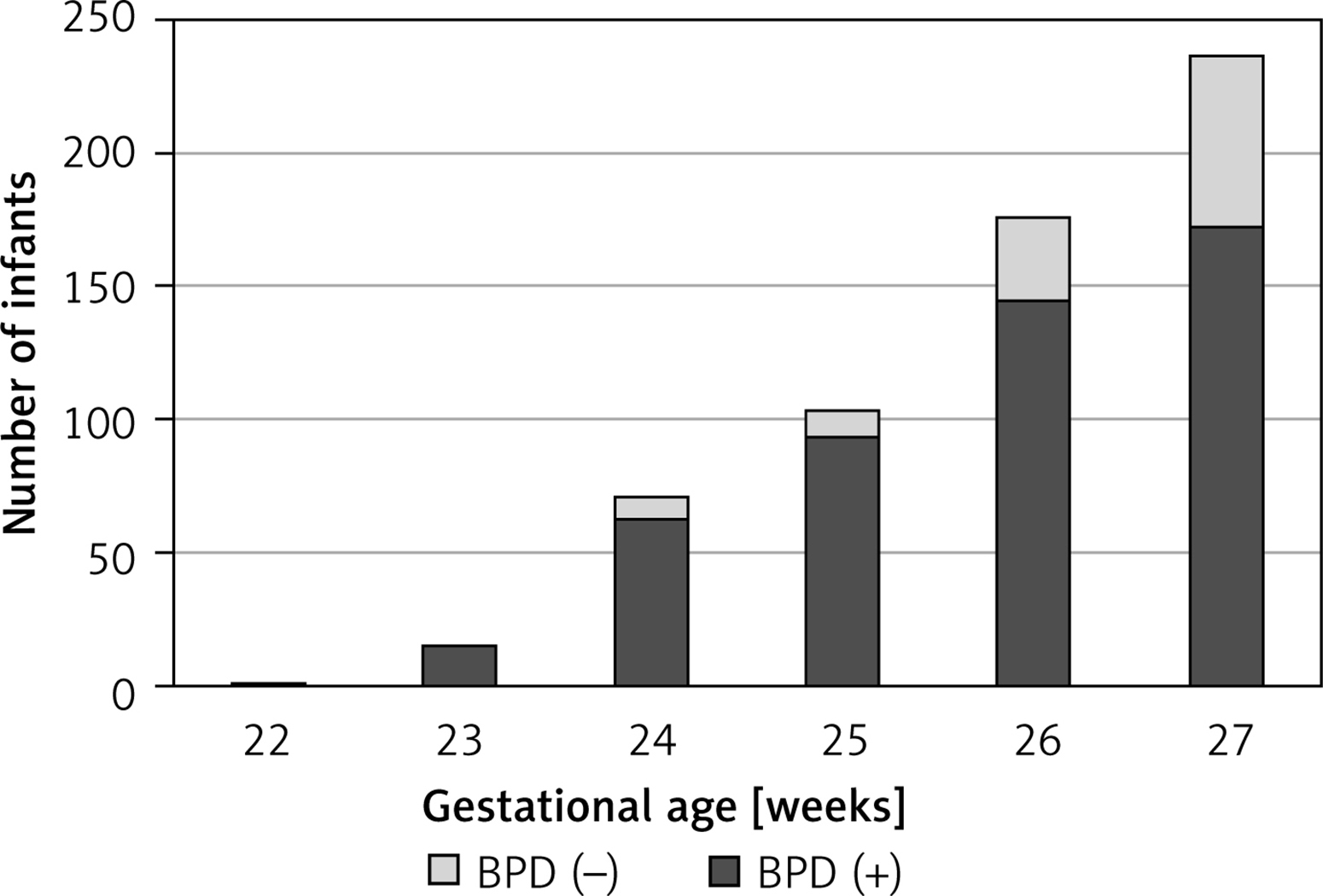
The assessment included infants whose mean birth weight was 886.5 ±211 g and mean GA was 25.9 ±1.1 weeks (Table II). Multiple pregnancy cases resulted in the delivery of 73 (12.1%) children. Of the 603 children born before 28 weeks GA, 488 (80.9%) premature infants were diagnosed with BPD. This group included 271 (83.4%) boys and 217 (78.1%) girls. Given the incidence of BPD in relation to maturity at birth (Figure 1), a decrease in morbidity was observed, from 100% among children born between 22 and 23 weeks GA to 72.6% (75.4% boys and 69.2% girls) in premature infants born at 27 weeks GA.
Table II
Clinical characteristics of the study population
In the analysed group of 488 children, up to 309 (70.7%) developed mild BPD, while 128 (29.3%) infants had moderate or severe BPD (no data for 51 children).
A comparison of selected demographic and clinical features between the group of children who required oxygen therapy for at least 28 days and the group of children who did not require such long oxygen treatment is shown in Table III. Significant BPD risk factors were found to be GA, birth weight, and SGA.
Table III
Risk factors for bronchopulmonary dysplasia
In total, 2495 doses of palivizumab were administered to 603 infants born extremely prematurely. Children received an average of 4.14 ±1.25 injections (ranging from 1 to 5 doses); the median dose received was 5. The group of 82.3% (496/603) children received all required doses, while 59.4% (358/603) children received subsequent doses at appropriate intervals. Adverse reactions occurred after only 53 doses of palivizumab (2.1%). Most often, the parents/guardians reported transiently increased excitability and irritability (0.8%; 20/2,495) to the physician applying immunoprophylaxis. None of the children had any serious adverse reactions.
Discussion
In the assessed neonatal population, 80.9% of infants born before 28 weeks GA required oxygen treatment for at least 28 days. Comparing the obtained results with data on the global incidence of BPD, ranging from 10 to 89%, it should be noted that they are among the higher numbers [6]. However, the evaluation of the obtained results and the possibility of comparing them with the data collected by other researchers significantly depends on the adopted definition of the disease as well as on the homogeneity of the analysed groups of children in terms of GA. In a multicentre observational cohort study published in 2017, Poindexter et al. [7] noted that both the differences in the results and the number of unclassified cases depending on the BPD definition used. In the population analysed by these authors, the incidence of BPD ranged from 33.0 to 58.6%, whereas the percentage of patients who could not be assessed ranged from 2.1 to 16.1% depending on the applied BPD definition.
In our study, we used the definition proposed by Jobe and Bancalari, indicating the need for oxygen therapy for at least 28 days with mild, moderate, and severe forms depending on the oxygen concentration used at 36 weeks PMA. According to this definition, the BPD incidence in the group analysed by Poindexter et al. was 58.6%, whereas in the group of those that could not be assessed it was 2.1%. Considering the fact that in the study group, children born at 28th week GA constituted 24.6% (188 cases out of 765 analysed), we conclude that the results obtained by us in a group homogeneous in terms of pregnancy length are comparable.
According to the data published in the French study EPIPAGE-2, the BPD incidence in the group of children born before 28 weeks GA was 21%, but these data concerned only the severe form of the disease [8].
A similar analysis of BPD incidence in the Polish population of infants born between 23 and 28 weeks GA, based on the definition of Jobe and Bancalari, was carried out at the Mother and Child Institute. Oxygen supply for at least 28 days was used in 76% of cases, with mild disease diagnosed in 67%, moderate in 15%, and severe illness in 18% of cases [9].
Notable data on BPD incidence in a group of infants born with extremely low birth weight was published by Kwinta et al. [10]. Oxygen supply for at least 28 days was required for 70% of neonates, including 48% of infants who required oxygen therapy at 36 weeks PMA. However, this population was significantly different, because the average GA of children was higher (27.3 ±2.2) compared to the data obtained in our group of analysed infants.
Interesting data obtained in the Polish NeoPro study allows us to compare the BPD incidence in 2014–2015 with our results (2013). In this study, the need for oxygen supply for at least 28 days after birth in a group of 239 children born before 28 weeks GA was 79.5%, with mild and moderate disease diagnosed in 83%, and severe illness in 17% of infants (detailed explanations from authors) [11].
Similar to the mentioned studies, infants with BPD in our analysis had a lower GA and birth weight than infants without BPD. On the other hand, when assessing BPD risk related to gender, many authors emphasize a significantly higher incidence in boys [9–11]. However, in the group of patients we evaluated, we did not observe this correlation.
Another important risk factor for the development of BPD, especially in the group of infants born before 28 weeks GA, is the intrauterine growth restriction. According to results published by other authors [12, 13], we also found that SGA is a factor of increased disease development risk.
Respiratory syncytial virus infection prophylaxis is crucial to protect premature infants from developing severe respiratory failure during the course of infection, requiring hospitalization and respiratory support. In our study, we showed that 87.8% of the infant population born in 2013 before 28 weeks GA received immunoprophylaxis, and 82.3% of them received all of the expected doses. The results obtained in our study are similar to data obtained in the French and Canadian studies. In the EPIPAGE-2 study, 93.5% of infants born between 23 and 26 weeks GA and 88.3% of those born between 27 and 28 weeks GA received prophylaxis; respectively, 83% and 77.4% received all required doses [14]. On the other hand, in the Canadian CARESS study, 81% of patients were administered the expected number of doses during the RSV prevention program [15].
The high convergence of our results with the data published in other registers indicates that RSV prevention in our country is carried out effectively. However, considering the fact that compliance with the dosage regimen reduces the rate of hospitalization due to RSV infection, further optimization of the prophylaxis program is advisable [15]. Thus, activities such as starting prevention in a neonatal ward, organising educational programs for parents, or reminding them of the next immunization date should be common [16].
The limitation of our analysis is the lack of available data on the need for oxygen therapy at 36 weeks PMA for 51 children (10.5%). Therefore, we did not compare the selected demographic and clinical features between a group of infants who required oxygen therapy at 36 weeks PMA and a group of neonates who did not require extended oxygen treatment.
Based on the results obtained in our study we conclude that by collecting data during the PNPRSVP, we were able to evaluate the BPD incidence in the group of infants who are eligible for the prevention program. As a national registry of BPD has not yet been established in Poland, we hope that data obtained during PNPRSVP will allow the regular assessment and monitoring of the incidence of BPD.
However, in order to collect data on the BPD incidence and severity in a precise manner, it is necessary to develop a specially dedicated scheme for data collection as a part of the PNPRSVP.
In conclusion, immunoprophylaxis of RSV infections was effectively realised in infants born before 28 weeks GA. The BPD incidence in this group was 80.9%. The widespread implementation of the RSV infection prevention program and reported data allow us to monitor the BPD incidence in premature infants in Poland.