Current issue
Archive
Manuscripts accepted
About the Journal
Editorial office
Editorial board
Section Editors
Abstracting and indexing
Subscription
Contact
Ethical standards and procedures
Most read articles
Instructions for authors
Article Processing Charge (APC)
Regulations of paying article processing charge (APC)


CARDIOLOGY / BASIC RESEARCH
Aging and coronary artery calcification: a Mendelian randomization study
1
Department of Pharmacology, Faculty of Medical Sciences in Zabrze, Medical University of Silesia in Katowice, Poland
2
Department of Family Medicine and Public Health, Faculty of Medicine, University of Opole, Poland
3
Department of Preventive Cardiology and Lipidology, Medical University in Lodz (MUL), Poland
These authors had equal contribution to this work
Submission date: 2026-01-08
Acceptance date: 2026-01-31
Online publication date: 2026-01-31
Publication date: 2026-02-28
Corresponding author
Mateusz Lejawa
Department of Pharmacology Faculty of Medical Sciences in Zabrze Medical University of Silesia in Katowice Poland
Department of Pharmacology Faculty of Medical Sciences in Zabrze Medical University of Silesia in Katowice Poland
Arch Med Sci 2026;22(1):345-354
KEYWORDS
TOPICS
ABSTRACT
Introduction:
Coronary artery calcification (CAC) is a recognized marker of atherosclerosis and cardiovascular disease (CVD) risk. While CAC is closely linked to aging, its potential as a marker of biological aging remains uncertain. Telomere length (TL), epigenetic aging markers, and dental deterioration parameters have been proposed as indicators of biological aging. However, the extent to which these biological aging indicators are associated with CAC remains unclear.
Material and methods:
Two-sample and three-sample Mendelian randomization (MR) analyses were conducted to investigate the potential causal effects of TL, epigenetic aging markers (intrinsic epigenetic age acceleration [IEAA], phenotypic age [PhenoAge]), and dental deterioration traits on CAC. Summary-level statistics from large-scale genome-wide association studies (GWASs) were obtained and analyzed using appropriate MR methods.
Results:
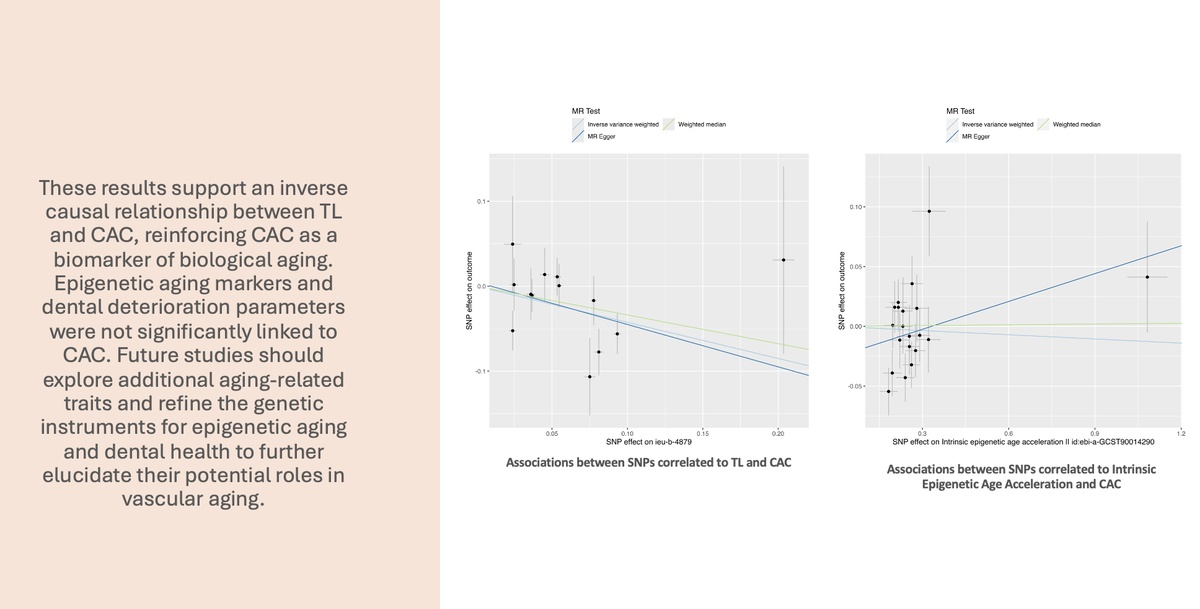
Genetically determined longer TL was significantly associated with lower CAC levels (IVW p < 0.001), supporting TL as a protective factor against atherosclerosis progression (as measured by CAC). Other analyses confirmed the robustness of this finding (MR-Egger p = 0.03, WME p = 0.004). A three-sample MR analysis provided further evidence for this association (IVW p < 0.01). However, neither epigenetic aging markers nor dental deterioration parameters exhibited a significant causal relationship with CAC.
Conclusions:
This study supports an inverse causal relationship between TL and CAC, reinforcing CAC as a biomarker of biological aging. Epigenetic aging markers and dental deterioration parameters were not significantly linked to CAC. Future studies should explore additional aging-related traits and refine the genetic instruments for epigenetic aging and dental health to further elucidate their potential roles in vascular aging.
Coronary artery calcification (CAC) is a recognized marker of atherosclerosis and cardiovascular disease (CVD) risk. While CAC is closely linked to aging, its potential as a marker of biological aging remains uncertain. Telomere length (TL), epigenetic aging markers, and dental deterioration parameters have been proposed as indicators of biological aging. However, the extent to which these biological aging indicators are associated with CAC remains unclear.
Material and methods:
Two-sample and three-sample Mendelian randomization (MR) analyses were conducted to investigate the potential causal effects of TL, epigenetic aging markers (intrinsic epigenetic age acceleration [IEAA], phenotypic age [PhenoAge]), and dental deterioration traits on CAC. Summary-level statistics from large-scale genome-wide association studies (GWASs) were obtained and analyzed using appropriate MR methods.
Results:
Genetically determined longer TL was significantly associated with lower CAC levels (IVW p < 0.001), supporting TL as a protective factor against atherosclerosis progression (as measured by CAC). Other analyses confirmed the robustness of this finding (MR-Egger p = 0.03, WME p = 0.004). A three-sample MR analysis provided further evidence for this association (IVW p < 0.01). However, neither epigenetic aging markers nor dental deterioration parameters exhibited a significant causal relationship with CAC.
Conclusions:
This study supports an inverse causal relationship between TL and CAC, reinforcing CAC as a biomarker of biological aging. Epigenetic aging markers and dental deterioration parameters were not significantly linked to CAC. Future studies should explore additional aging-related traits and refine the genetic instruments for epigenetic aging and dental health to further elucidate their potential roles in vascular aging.
REFERENCES (52)
1.
Obisesan OH, Boakye E, Wang FM, et al. Coronary artery calcium as a marker of healthy and unhealthy aging in adults aged 75 and older: The Atherosclerosis Risk in Communities (ARIC) study. Atherosclerosis 2024; 392: 117475.
2.
Altamura S, Del Pinto R, Pietropaoli D, Ferri C. Oral health as a modifiable risk factor for cardiovascular diseases. Trends Cardiovasc Med 2024; 34: 267-75.
3.
Talmud PJ, Hingorani AD, Cooper JA, et al. Utility of genetic and non-genetic risk factors in prediction of type 2 diabetes: Whitehall II prospective cohort study. BMJ 2010; 340: b4838.
4.
Grandhi GR, Mszar R, Cainzos-Achirica M, et al. Coronary calcium to rule out obstructive coronary artery disease in patients with acute chest pain. JACC Cardiovasc Imaging 2022; 15: 271-80.
5.
Blaha MJ, Mortensen MB, Kianoush S, Tota-Maharaj R, Cainzos-Achirica M. Coronary artery calcium scoring: Is it time for a change in methodology? JACC Cardiovasc Imaging 2017; 10: 923-37.
6.
Handy CE, Desai CS, Dardari ZA, et al. The association of coronary artery calcium with noncardiovascular disease: the Multi-Ethnic Study of Atherosclerosis. JACC Cardiovasc Imaging 2016; 9: 568-76.
7.
Aengevaeren VL, Mosterd A, Sharma S, et al. Exercise and coronary atherosclerosis: observations, explanations, relevance, and clinical management. Circulation 2020; 141: 1338-50.
8.
Pham T, Fujiyoshi A, Hisamatsu T, et al. Smoking habits and progression of coronary and aortic artery calcification: a 5-year follow-up of community-dwelling Japanese men. Int J Cardiol 2020; 314: 89-94.
9.
Orakzai SH, Nasir K, Blaha M, Blumenthal RS, Raggi P. Non-HDL cholesterol is strongly associated with coronary artery calcification in asymptomatic individuals. Atherosclerosis 2009; 202: 289-95.
10.
Won KB, Han D, Lee JH, et al. Evaluation of the impact of glycemic status on the progression of coronary artery calcification in asymptomatic individuals. Cardiovasc Diabetol 2018; 17: 4.
11.
Mori H, Torii S, Kutyna M, Sakamoto A, Finn AV, Virmani R. Coronary artery calcification and its progression: What does it really mean? JACC Cardiovasc Imaging 2018; 11: 127-42.
12.
Otsuka F, Sakakura K, Yahagi K, Joner M, Virmani R. Has our understanding of calcification in human coronary atherosclerosis progressed? Arterioscler Thromb Vasc Biol 2014; 34: 724-36.
13.
Banach M, Mazidi M, Mikhailidis DP, et al. Association between phenotypic familial hypercholesterolaemia and telomere length in US adults: results from a multi-ethnic survey. Eur Heart J 2018; 39: 3635-40.
14.
Mazidi M, Kengne AP, Sahebkar A, Banach M. Telomere length is associated with cardiometabolic factors in US adults. Angiology 2018; 69: 164-9.
15.
Brandt M, Dörschmann H, Khraisat S, et al. Telomere shortening in hypertensive heart disease depends on oxidative DNA damage and predicts impaired recovery of cardiac function in heart failure. Hypertension 2022; 79: 2173-84.
16.
Ogami M, Ikura Y, Ohsawa M, et al. Telomere shortening in human coronary artery diseases. Arterioscler Thromb Vasc Biol 2004; 24: 546-50.
17.
Cheng F, Luk AO, Tam CHT, et al. Shortened relative leukocyte telomere length is associated with prevalent and incident cardiovascular complications in type 2 diabetes: analysis from the Hong Kong diabetes register. Diabetes Care 2020; 43: 2257-65.
18.
Bell CG, Lowe R, Adams PD, et al. DNA methylation aging clocks: challenges and recommendations. Genome Biol 2019; 20: 249.
19.
Zhang Z, Zhao X, Gao S, et al. Biological aging mediates the association between periodontitis and cardiovascular disease: results from a national population study and Mendelian randomization analysis. Clin Epigenetics 2024; 16: 116.
20.
Li S, Wen C, Bai X, Yang D. Association between biological aging and periodontitis using NHANES 2009–2014 and Mendelian randomization. Sci Rep 2024; 14: 10089.
21.
Lawlor DA. Commentary: two-sample Mendelian randomization: opportunities and challenges. Int J Epidemiol 2016; 45: 908-15.
22.
Skrivankova VW, Richmond RC, Woolf BAR, et al. Strengthening the reporting of observational studies in epidemiology using Mendelian randomization: the STROBE-MR statement. JAMA 2021; 326: 1614-21.
23.
Codd V, Wang Q, Allara E, et al. Polygenic basis and biomedical consequences of telomere length variation. Nat Genet 2021; 53: 1425-33.
24.
Elsworth B, Lyon M, Alexander T, et al. The MRC IEU OpenGWAS data infrastructure. bioRxiv 2020; 2020.08.10.244293.
25.
Li C, Stoma S, Lotta LA, et al. Genome-wide association analysis in humans links nucleotide metabolism to leukocyte telomere length. Am J Hum Genet 2020; 106: 389-404.
26.
McCartney DL, Min JL, Richmond RC, et al. Genome-wide association studies identify 137 genetic loci for DNA methylation biomarkers of aging. Genome Biol 2021; 22: 194.
27.
Horvath S. DNA methylation age of human tissues and cell types. Genome Biol 2013; 14: 3156.
28.
Levine ME, Lu AT, Quach A, et al. An epigenetic biomarker of aging for lifespan and healthspan. Aging (Albany NY) 2018; 10: 573-91.
30.
Kavousi M, Bos MM, Barnes HJ, et al. Multi-ancestry genome-wide study identifies effector genes and druggable pathways for coronary artery calcification. Nat Genet 2023; 55: 1651-64.
33.
Burgess S, Thompson SG. Avoiding bias from weak instruments in Mendelian randomization studies. Int J Epidemiol 2011; 40: 755-64.
34.
Cleal K, Norris K, Baird D. Telomere length dynamics and the evolution of cancer genome architecture. Int J Mol Sci 2018; 19: 482.
36.
R Core Team. R: A language and environment for statistical computing. Vienna: R Foundation for Statistical Computing; 2021.
37.
Hemani G, Zheng J, Elsworth B, et al. The MR-Base platform supports systematic causal inference across the human phenome. Elife 2018; 7: e34408.
38.
Verbanck M, Chen CY, Neale B, Do R. Detection of widespread horizontal pleiotropy in causal relationships inferred from Mendelian randomization between complex traits and diseases. Nat Genet 2018; 50: 693-8.
39.
Chen X, Cheng Z, Xu J, Wang Q, Zhao Z, Jiang Q. Causal effects of autoimmune diseases on temporomandibular disorders and the mediating pathways: a Mendelian randomization study. Front Immunol 2024; 15: 1390516.
40.
Kuo CL, Pilling LC, Kuchel GA, Ferrucci L, Melzer D. Telomere length and aging-related outcomes in humans: a Mendelian randomization study in 261,000 older participants. Aging Cell 2019; 18: e13017.
41.
Deng Y, Li Q, Zhou F, et al. Telomere length and the risk of cardiovascular diseases: a Mendelian randomization study. Front Cardiovasc Med 2022; 9: 1012615.
42.
Qin S, Sheng Z, Chen C, Cao Y. Genetic relationship between ageing and coronary heart disease: a Mendelian randomization study. Eur Geriatr Med 2024; 15: 159-67.
43.
Gao H, Li J, Ma Q, Zhang Q, Li M, Hu X. Causal associations of DNA methylation and cardiovascular disease: a two-sample Mendelian randomization study. Glob Heart 2024; 19: 48.
44.
Zhou M, Dong J, Zha L, Liao Y. Causal association between periodontal diseases and cardiovascular diseases. Genes (Basel) 2021; 13: 13.
45.
Liu Y, Qin H, Li T, et al. Denture use and risk for cardiometabolic disease: observational and Mendelian randomization analyses. Eur J Prev Cardiol 2023; 31: 13-20.
46.
Mainous 3rd AG, Codd V, Diaz VA, et al. Leukocyte telomere length and coronary artery calcification. Atherosclerosis 2010; 210: 262-7.
47.
Dzaye O, Dardari ZA, Cainzos-Achirica M, et al. Warranty period of a calcium score of zero: comprehensive analysis from MESA. JACC Cardiovasc Imaging 2021; 14: 990-1002.
48.
Thomas DM, Divakaran S, Villines TC, et al. Management of coronary artery calcium and coronary CTA findings. Curr Cardiovasc Imaging Rep 2015; 8: 18.
49.
Fyhrquist F, Saijonmaa O, Strandberg T. The roles of senescence and telomere shortening in cardiovascular disease. Nat Rev Cardiol 2013; 10: 274-83.
50.
Chen L, Ye X, Li Y, Ran X. Systematic identification of therapeutic targets for coronary artery calcification: an integrated transcriptomic and proteomic Mendelian randomization. Front Cardiovasc Med 2024; 11: 1419440.
51.
Banach M, Surma S, Guzik TJ, et al. Upfront lipid-lowering combination therapy in high cardiovascular risk patients: a route to effective atherosclerotic cardiovascular disease prevention. Cardiovasc Res 2025; 121: 851-9.
52.
Aengevaeren VL, Mosterd A, Braber TL, et al. Relationship between lifelong exercise volume and coronary atherosclerosis in athletes. Circulation 2017; 136: 138-48.
Share
RELATED ARTICLE
| eISSN: | 1896-9151 |
| ISSN: | 1734-1922 |

We process personal data collected when visiting the website. The function of obtaining information about users and their behavior is carried out by voluntarily entered information in forms and saving cookies in end devices. Data, including cookies, are used to provide services, improve the user experience and to analyze the traffic in accordance with the Privacy policy. Data are also collected and processed by Google Analytics tool (more).
You can change cookies settings in your browser. Restricted use of cookies in the browser configuration may affect some functionalities of the website.
You can change cookies settings in your browser. Restricted use of cookies in the browser configuration may affect some functionalities of the website.
