Current issue
Archive
Manuscripts accepted
About the Journal
Editorial office
Editorial board
Section Editors
Abstracting and indexing
Subscription
Contact
Ethical standards and procedures
Most read articles
Instructions for authors
Article Processing Charge (APC)
Regulations of paying article processing charge (APC)


RHEUMATOLOGY / CLINICAL RESEARCH
The synergistic impact of anti-inflammatory and nutrient-rich dietary patterns on long-term prognosis among individuals with osteoarthritis
1
Department of Rheumatology, Chengdu Fifth People’s Hospital, Chengdu, China
2
School of Nursing, Chengdu Medical College, Chengdu, China
3
School of Clinical Medicine, Chengdu Medical College, Chengdu, China
4
Department of Respiratory and Critical Care Medicine, The First Affiliated Hospital
of Chengdu Medical College, Chengdu, China
5
Laboratory of Geriatric Respiratory Diseases of Sichuan Higher Education Institute, Chengdu, China
6
Department of Respiratory and Critical Care Medicine, Deyang People’s Hospital, Deyang, China
These authors had equal contribution to this work
Submission date: 2025-07-27
Final revision date: 2025-08-17
Acceptance date: 2025-09-08
Online publication date: 2025-11-07
Publication date: 2026-08-28
Corresponding author
Wenjing Dai
Department of Respiratory and Critical Care Medicine The First Affiliated Hospital of Chengdu Medical College Chengdu, China
Department of Respiratory and Critical Care Medicine The First Affiliated Hospital of Chengdu Medical College Chengdu, China
Arch Med Sci 2026;22(4):2133-2144
KEYWORDS
TOPICS
ABSTRACT
Introduction:
The aim of the study was to investigate the associations between healthy and anti-inflammatory dietary patterns and mortality risk in osteoarthritis (OA) patients, and to identify key dietary factors influencing long-term outcomes.
Material and methods:
We analyzed data from 3,012 OA patients participating in the National Health and Nutrition Examination Survey (NHANES) between 2007 and 2018. Dietary patterns were assessed using two validated indices: the Healthy Eating Index-2015 (HEI-2015) for overall diet quality and the Dietary Inflammatory Index (DII) for inflammatory potential, both derived from 24-hour dietary recall data. Mortality outcomes were ascertained through linkage with the National Death Index. Weighted Cox proportional hazards regression models were employed to evaluate associations between dietary patterns and all-cause mortality, with adjustments for demographic, lifestyle, and clinical confounders. To identify key dietary predictors, we applied Least Absolute Shrinkage and Selection Operator (LASSO) regression. A prognostic nomogram was developed to assess predictive performance.
Results:
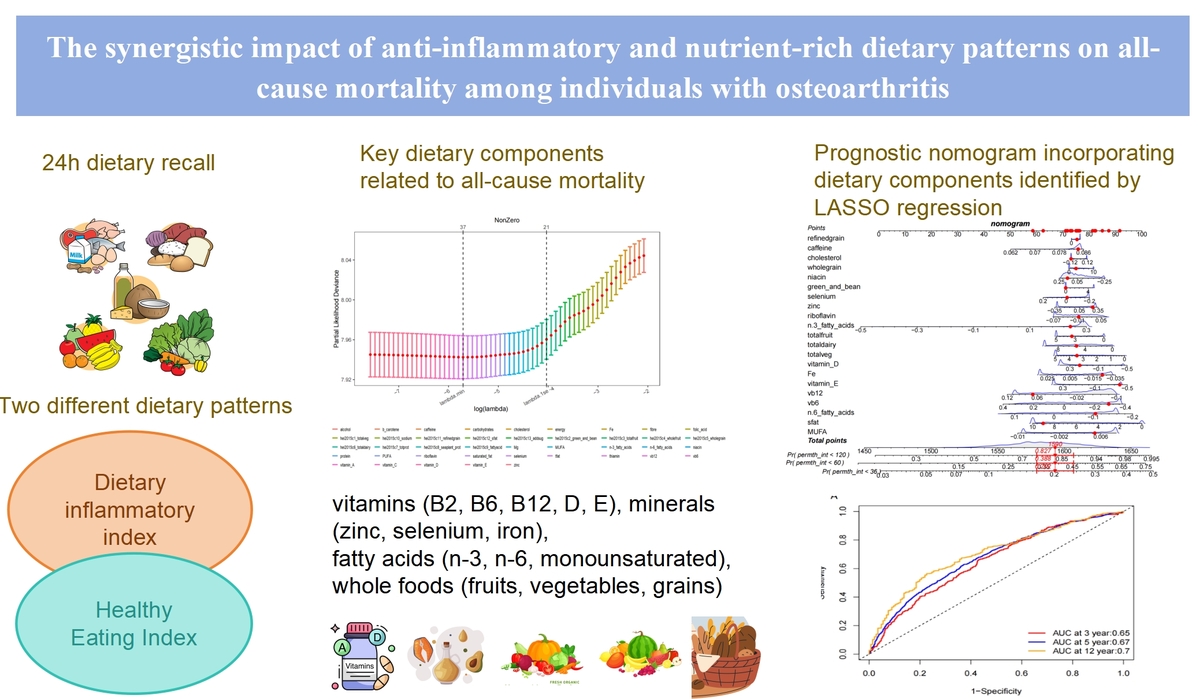
A healthy, anti-inflammatory diet (high HEI-2015, low DII) was associated with a 14% lower mortality risk (HR = 0.86, 95% CI: 0.75–1.00, p-trend = 0.045) compared to an unhealthy, pro-inflammatory diet. LASSO regression highlighted 21 key dietary factors, including vitamins (B2, B6, B12, D, E), minerals (zinc, selenium, iron), fatty acids (n-3, n-6, monounsaturated), and whole foods (fruits, vegetables, grains). The nomogram showed reliable predictive accuracy (AUC: 0.65 at 3 years, 0.70 at 12 years). Subgroup analyses indicated stronger effects in non-smokers (HR = 0.79, 95% CI: 0.65–0.97).
Conclusions:
Adopting a healthy, anti-inflammatory dietary pattern can reduce mortality rates in individuals with arthritis, with specific micronutrients and food groups playing a critical role. Dietary interventions are beneficial for OA management, highlighting the need for further longitudinal and clinical research to establish causal relationships.
The aim of the study was to investigate the associations between healthy and anti-inflammatory dietary patterns and mortality risk in osteoarthritis (OA) patients, and to identify key dietary factors influencing long-term outcomes.
Material and methods:
We analyzed data from 3,012 OA patients participating in the National Health and Nutrition Examination Survey (NHANES) between 2007 and 2018. Dietary patterns were assessed using two validated indices: the Healthy Eating Index-2015 (HEI-2015) for overall diet quality and the Dietary Inflammatory Index (DII) for inflammatory potential, both derived from 24-hour dietary recall data. Mortality outcomes were ascertained through linkage with the National Death Index. Weighted Cox proportional hazards regression models were employed to evaluate associations between dietary patterns and all-cause mortality, with adjustments for demographic, lifestyle, and clinical confounders. To identify key dietary predictors, we applied Least Absolute Shrinkage and Selection Operator (LASSO) regression. A prognostic nomogram was developed to assess predictive performance.
Results:
A healthy, anti-inflammatory diet (high HEI-2015, low DII) was associated with a 14% lower mortality risk (HR = 0.86, 95% CI: 0.75–1.00, p-trend = 0.045) compared to an unhealthy, pro-inflammatory diet. LASSO regression highlighted 21 key dietary factors, including vitamins (B2, B6, B12, D, E), minerals (zinc, selenium, iron), fatty acids (n-3, n-6, monounsaturated), and whole foods (fruits, vegetables, grains). The nomogram showed reliable predictive accuracy (AUC: 0.65 at 3 years, 0.70 at 12 years). Subgroup analyses indicated stronger effects in non-smokers (HR = 0.79, 95% CI: 0.65–0.97).
Conclusions:
Adopting a healthy, anti-inflammatory dietary pattern can reduce mortality rates in individuals with arthritis, with specific micronutrients and food groups playing a critical role. Dietary interventions are beneficial for OA management, highlighting the need for further longitudinal and clinical research to establish causal relationships.
REFERENCES (28)
2.
Liu W, Ma G, Zhu X, Liufu Q, Lai J. Epidemiological trends and burden of osteoarthritis in United States: Insights from the GBD 2021 study. Arch Med Sci 2025. DOI: https://doi.org/10.5114/aoms/2....
3.
Yang S, Zhou L, Gong W, Guo B, Wang L. Global burden of osteoarthritis from 1990 to 2019 attributable to high body mass index. Arch Med Sci 2024; 20: 1841-53.
4.
Safiri S, Kolahi AA, Smith E, et al. Global, regional and national burden of osteoarthritis 1990-2017: a systematic analysis of the Global Burden of Disease Study 2017. Ann Rheum Dis 2020; 79: 819-28.
5.
Cisternas MG, Murphy L, Sacks JJ, Solomon DH, Pasta DJ, Helmick CG. Alternative methods for defining osteoarthritis and the impact on estimating prevalence in a US population-based survey. Arthritis Care Res (Hoboken) 2016; 68: 574-80.
6.
Veronese N, Cereda E, Maggi S, et al. Osteoarthritis and mortality: a prospective cohort study and systematic review with meta-analysis. Semin Arthritis Rheum 2016; 46: 160-7.
7.
Veronese N, Trevisan C, De Rui M, et al. Association of osteoarthritis with increased risk of cardiovascular diseases in the elderly: findings from the Progetto Veneto Anziano Study Cohort. Arthritis Rheumatol 2016; 68: 1136-44.
8.
Xing X, Wang Y, Pan F, Cai G. Osteoarthritis and risk of type 2 diabetes: a two-sample Mendelian randomization analysis. J Diabetes 2023; 15: 987-93.
9.
Wen S, Huang Z, Zhang B, Huang Y. The effect of cheese intake on osteoarthritis: a Mendelian randomization study. Arch Med Sci 2024; 20: 1943-56.
10.
Dai Z, Niu J, Zhang Y, Jacques P, Felson DT. Dietary intake of fibre and risk of knee osteoarthritis in two US prospective cohorts. Ann Rheum Dis 2017; 76: 1411-9.
11.
Tang Y, Xu X, Zhang S, Kong W, Zhang W, Zhu T. Genetic liability for diet-derived circulating antioxidants, oxidative stress, and risk of osteoarthritis: a Mendelian randomization study. Front Nutr 2023; 10: 1233086.
12.
Wei N, Dai Z. The role of nutrition in osteoarthritis: a literature review. Clin Geriatr Med 2022; 38: 303-22.
13.
Veronese N, Koyanagi A, Stubbs B, et al. Mediterranean diet and knee osteoarthritis outcomes: a longitudinal cohort study. Clin Nutr 2019; 38: 2735-9.
14.
Wang YB, Page AJ, Gill TK, Melaku YA. The association between diet quality, plant-based diets, systemic inflammation, and mortality risk: findings from NHANES. Eur J Nutr 2023; 62: 2723-37.
15.
Zahedi H, Djalalinia S, Asayesh H, et al. A higher dietary inflammatory index score is associated with a higher risk of incidence and mortality of cancer: a comprehensive systematic review and meta-analysis. Int J Prev Med 2020; 11: 15.
16.
Namazi N, Larijani B, Azadbakht L. Dietary Inflammatory Index and its association with the risk of cardiovascular diseases, metabolic syndrome, and mortality: a systematic review and meta-analysis. Horm Metab Res 2018; 50: 345-58.
17.
Chen TC, Clark J, Riddles MK, Mohadjer LK, Fakhouri THI. National Health and Nutrition Examination Survey, 2015-2018: sample design and estimation procedures. Vital Health Stat 2 2020; 184: 1-35.
18.
Xiao Q, Cai B, Yin A, et al. L-shaped association of serum 25-hydroxyvitamin D concentrations with cardiovascular and all-cause mortality in individuals with osteoarthritis: results from the NHANES database prospective cohort study. BMC Med 2022; 20: 308.
19.
Krebs-Smith SM, Pannucci TE, Subar AF, et al. Update of the Healthy Eating Index: HEI-2015. J Acad Nutr Diet 2018; 118: 1591-602.
20.
Shivappa N, Steck SE, Hurley TG, Hussey JR, Hébert JR. Designing and developing a literature-derived, population-based dietary inflammatory index. Public Health Nutr 2014; 17: 1689-96.
21.
Levey AS, Stevens LA, Schmid CH, et al. A new equation to estimate glomerular filtration rate. Ann Intern Med 2009; 150: 604-12.
22.
Xu C, Liu T, Driban JB, McAlindon T, Eaton CB, Lu B. Dietary patterns and risk of developing knee osteoarthritis: data from the osteoarthritis initiative. Osteoarthritis Cartilage 2021; 29: 834-40.
23.
Zeng J, Franklin DK, Das A, Hirani V. The effects of dietary patterns and food groups on symptomatic osteoarthritis: a systematic review. Nutr Diet 2023; 80: 21-43.
24.
Buck AN, Vincent HK, Newman CB, et al. Evidence-based dietary practices to improve osteoarthritis symptoms: an umbrella review. Nutrients 2023; 15: 3050.
25.
Asadi S, Grafenauer S, Burley CV, Fitzgerald C, Humburg P, Parmenter BJ. The effectiveness of dietary intervention in osteoarthritis management: a systematic review and meta-analysis of randomized clinical trials. Eur J Clin Nutr 2025; 79: 959-71.
26.
Chen Z, Zhang H, Jin J, Su C, Chen H, Li B. A longitudinal study of dietary inflammatory index and quality of life in people with osteoarthritis: data from the Osteoarthritis Initiative database. Sci Rep 2025; 15: 6024.
27.
Veronese N, Shivappa N, Stubbs B, et al. The relationship between the dietary inflammatory index and prevalence of radiographic symptomatic osteoarthritis: data from the Osteoarthritis Initiative. Eur J Nutr 2019; 58: 253-60.
28.
Arikawa AY, Kurzer MS. Associations between diet quality and anthropometric measures in white postmenopausal women. Nutrients 2021; 13: 1947.
Share
RELATED ARTICLE
| eISSN: | 1896-9151 |
| ISSN: | 1734-1922 |

We process personal data collected when visiting the website. The function of obtaining information about users and their behavior is carried out by voluntarily entered information in forms and saving cookies in end devices. Data, including cookies, are used to provide services, improve the user experience and to analyze the traffic in accordance with the Privacy policy. Data are also collected and processed by Google Analytics tool (more).
You can change cookies settings in your browser. Restricted use of cookies in the browser configuration may affect some functionalities of the website.
You can change cookies settings in your browser. Restricted use of cookies in the browser configuration may affect some functionalities of the website.