Introduction
Oral health during pregnancy is a significant public health concern [1]. Compared to non-pregnant women of the same age, pregnant women are at increased risk for conditions such as gingivitis, periodontitis, tooth erosion, and dental caries [2]. These risks can be considerably reduced through appropriate oral health behaviours [1, 3, 4], which are also critical for instilling good habits in children [5, 6]. Hormonal changes during pregnancy, particularly in oestrogen and progesterone levels, alter saliva composition, pH, and vascular permeability, promoting bacterial colonisation and increasing susceptibility to dental caries and periodontal diseases [7]. Dental caries affects an estimated 51% of pregnant women, and the risk of gingivitis is about 50% higher than in the general population [8]. In Poland, caries prevalence reaches up to 96% in the third trimester [9, 10], while 33% of pregnant women in the U.S. have untreated caries [3, 11]. Similar trends are observed in Asia, with prevalence rates of 81.3% in Sri Lanka, 74.0% in Thailand, and 54.4% in India. Pregnancy-related gingivitis varies widely, from 36% to 100% [2, 12]. European data show 86% caries prevalence and 77.1% periodontal disease among pregnant women in Italy [7], with low rates of dental treatment in countries such as France (44%) and Greece (27.3%) [4]. Untreated oral conditions can lead to pain, infection, anxiety, and reduced quality of life, and may increase the risk of inappropriate self-medication [8]. Moreover, periodontal disease is associated with adverse pregnancy outcomes, including preterm birth and low birth weight [13].
Despite its importance, awareness and preventive behaviours regarding oral health among pregnant women remain insufficient [14]. Many avoid dental visits during pregnancy, with consultation rates reported at 30–36% in Australia, 44.7% in the U.S., and 38.5% in Poland [15]. Toothbrushing, a key preventive practice [16], is often reduced in frequency during pregnancy (reported by 27.0–62.0% of women), while sugary food consumption increases (68.5%) [17, 18]. Only 24% of pregnant women brush their teeth twice daily or more [19]. Barriers to adequate oral care include financial constraints, low awareness, poor hygiene habits, lower socioeconomic status, urban residence, and insufficient collaboration between gynaecologists and dentists [9, 20].
In light of these concerns, a study was undertaken to evaluate oral health-promoting behaviours among pregnant women in Poland and to assess the influence of sociodemographic factors on these behaviours.
Material and methods
The study was conducted between October and November 2022 on a group of 1,000 women aged 18 years and older, who were in their second or third trimester of pregnancy. Data were collected using the computer-assisted telephone interviewing (CATI) method, with participants selected at random. Participants provided informed verbal consent after receiving a full explanation of the study’s purpose, data anonymisation practices, the scientific use of the results and their option to withdraw at any time.
The research tool was a survey questionnaire consisting of two parts: a sociodemographic section (12 questions) and a HU-DBI questionnaire (20 questions), developed using back-translation methodology. The HU-DBI index was calculated based on 12 questions verifying the respondents’ attitudes and oral hygiene health behaviours. Questions 1, 8, 10, 15 and 19 assessed oral health and dental visits; questions 16, 11 and 14 explored attitudes toward oral hygiene health; and questions 4, 9, 12 and 16 examined basic oral hygiene behaviours. One point was awarded for each ‘Yes/Agree’ response for items 4, 9, 11, 12, 16 and 19, and one point for each ‘No/Disagree’ response for items 1, 6, 8, 10, 14 and 15. The respondent could obtain a minimum of 0 and a maximum of 12 points. Higher index values indicate a more supportive attitude and better oral health behaviour. A significance level of 0.05 was adopted, with p-values presented as consecutive significance levels: p < 0.05, p < 0.01 and p < 0.001. All statistical analyses and graph generation were performed using the R software (version 4.0.0) and Microsoft Excel.
Results
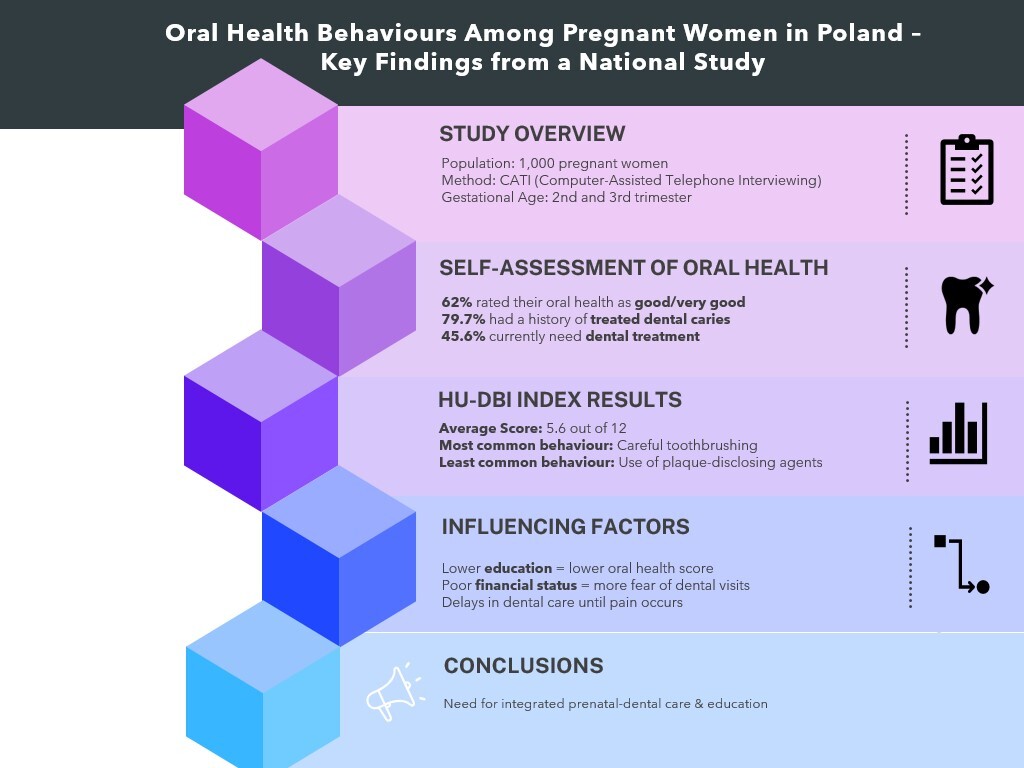
The study involved 1,000 pregnant women in their second or third trimesters. The average age of the participants was 30 years, with ages ranging from 18 to 55 years. The largest age group was 20–29 years. Most participants had a university education, resided in rural areas and reported being economically active and married. The condition of the participants’ oral cavities was assessed as good or very good by 62% of the women. Additionally, 45.6% reported that their dentition currently required treatment due to dental caries, while 79.7% reported a history of past treatments for caries.
The mean HU-DBI index was 5.6 points, with a maximum score of 12 and a minimum score of 1. Among the health behaviours listed in the questionnaire, most frequently reported were: careful oral cavity brushing, assessing teeth after brushing and receiving professional instruction on proper brushing techniques (Table I). The least common behaviours included the belief that the respondents were able to clean their teeth effectively without toothpaste and the use of plaque-disclosing agents to assess oral cleanliness.
Table I
Self-assessment of oral health behaviours of female respondents according to the HU-DBI questionnaire (n = 100; %) (source: own research)
| No. | Statement | Yes/Agree | No/Disagree |
|---|---|---|---|
| 1 | I feel anxious about visiting the dentist. | 41.2 | 58.8* |
| 2 | I have noticed some sticky white deposits on my teeth. | 25.0* | 75.0 |
| 3 | I think I cannot avoid having false teeth in old age. | 43.0 | 57.0* |
| 4 | I think my teeth are deteriorating despite my daily brushing. | 36.8 | 63.2* |
| 5 | I brush each of my teeth carefully. | 79.2* | 20.8 |
| 6 | I have never received professional instructions on proper brushing techniques. | 40.4 | 59.6* |
| 7 | I think I can clean my teeth effectively without toothpaste. | 13.8* | 86.2 |
| 8 | I often check my teeth in a mirror after brushing. | 70.8* | 29.2 |
| 9 | I think that brushing alone cannot prevent gum disease. | 46.6 | 53.4* |
| 10 | I delay going to the dentist until I feel a toothache. | 45.0 | 55.0* |
| 11 | I have used a plaque disclosing agent to assess my oral cleanliness. | 16.1* | 83.9 |
| 12 | I sometimes think I take too much time to brush my teeth. | 22.3* | 77.7 |
Analysis of factors affecting self-assessed oral health behaviours showed significant differences in the index scores based on socioeconomic status (Table II). Women who assessed their financial situation as ‘good’ showed a higher level of oral health behaviour compared to women with an ‘average’ or ‘poor’ financial situation. Women who assessed their financial situation negatively were significantly more likely to believe that they could not prevent future denture use and to feel that their teeth were deteriorating despite daily brushing. They were also more likely to fear dental visits, to delay them until they experienced pain and to brush their oral cavity less thoroughly compared to women who assessed their material situation as ‘average’ or ‘good’.
Table II
Oral health behaviour index in relation to socioeconomic status and having a child (source: own research)
| Statement | Factor | Yes (%) | No (%) | χ2 | P-value | |
|---|---|---|---|---|---|---|
| I feel anxious about visiting the dentist. | Education | Lower or secondary | 46.3 | 53.7* | 9.73 | < 0.01 |
| Higher | 36.4 | 63.6* | ||||
| Financial situation | Poor | 64.6 | 35.4* | 23.223 | < 0.001 | |
| Average | 41.6 | 58.4* | ||||
| Good | 36.0 | 64.0* | ||||
| I have noticed some sticky white deposits on my teeth. | Financial situation | Poor | 41.5* | 58.5 | 9.8613 | < 0.01 |
| Average | 23.6* | 76.4 | ||||
| Good | 23.4 | 76.6 | ||||
| I think I cannot avoid having false teeth in old age. | Financial situation | Poor | 59.8 | 40.2* | 16.401 | < 0.001 |
| Average | 45.1 | 54.9* | ||||
| Good | 36.9 | 63.1* | ||||
| I think my teeth are deteriorating despite my daily brushing. | Education | Lower or secondary | 41.4 | 58.6* | 8.069 | < 0.01 |
| Higher | 32.5 | 67.5* | ||||
| Financial situation | Poor | 56.1 | 43.9* | 27.546 | < 0.001 | |
| Average | 40.2 | 59.8* | ||||
| Good | 28.6 | 71.4* | ||||
| I brush each of my teeth carefully. | Financial situation | Poor | 70.7* | 29.3 | 10.22707 | < 0.01 |
| Average | 77.0* | 23.0 | ||||
| Good | 83.7* | 16.3 | ||||
| I think I can clean my teeth effectively without toothpaste. | Education | Lower or secondary | 16.9* | 83.1 | 7.009 | < 0.01 |
| Higher | 10.9* | 89.1 | ||||
| I delay going to a dentist until I feel a toothache. | Education | Lower or secondary | 50.8 | 49.2* | 12.5 | < 0.001 |
| Higher | 39.5 | 60.5* | ||||
| Financial situation | Poor | 64.6 | 35.4* | 17.706 | < 0.001 | |
| Average | 46.1 | 53.9* | ||||
| Good | 39.7 | 60.3* | ||||
Women with secondary or lower education exhibited lower levels of oral health behaviour, compared to those with higher education. They were significantly more likely than their higher-educated counterparts to fear dental visits, to perceive a worsening dental condition despite regular brushing, to feel incapable of thorough cavity cleaning without toothpaste and to delay visiting the dentist until experiencing a toothache. Other HU-DBI questionnaire items not shown in Table II were also analysed but did not demonstrate statistically significant differences in relation to participants’ socioeconomic status or educational level (p > 0.05). These included, for example, the use of dental floss, frequency of brushing, or beliefs regarding the effectiveness of mouth rinses. Although not significantly different between groups, such behaviours still represent an important area for future health promotion strategies.
Discussion
The aim of this study was to assess oral health-promoting behaviours among pregnant women in Poland. Pregnancy is a physiological state characterised by numerous adaptive changes. In the oral cavity, these changes may include the temporary weakening of the immune system, increased cravings for sweets, hormonal fluctuations, salivary alterations and other physiological changes that may increase the susceptibility to dental caries, subsequently impacting maternal and neonatal health significantly [21]. It is therefore very important for expectant mothers to recognise the importance of maintaining oral health for their own well-being and the healthy progression of pregnancy [22, 23]. The adage “Every child costs the mother a tooth”, regardless of its veracity, should serve as a cautionary principle and foster great awareness among expectant mothers regarding oral hygiene and disease prevention during pregnancy [24].
In our study, the mean score for self-assessed health behaviours was 5.6 points, indicating a fairly average level (maximum score of 12 points). It should be noted that self-assessed oral health behaviours or oral health status may be overly optimistic. For instance, a nationwide study revealed that only 14.7% of female participants rated their oral health status negatively, while dental examinations revealed that merely 15.2% of respondents did not require dental treatment. Furthermore, approximately 70% of women with objectively poor oral health were unaware of their oral condition [25]. A study conducted in Germany found that over 60% of pregnant women surveyed perceived their knowledge of the importance of oral hygiene as insufficient [25]. Additionally, gaps in women’s knowledge and behaviours related to oral disease prevention during pregnancy were also confirmed in a study conducted in the United States [26].
In contrast, the results of other studies highlight the issue of dental check-ups – despite the prevalent belief in the need to receive adequate dental care, only 53% of respondents reported visiting the dentist during pregnancy [27]. The reluctance to use dental services during pregnancy may be attributed to a fear of dental visits, reported by nearly 60% of respondents (58.8%), or the perception that dental procedures could be harmful to women and their fetuses [28, 29].
Another issue highlighted was the lack of professional instruction on oral hygiene. A study conducted in Iran revealed that approximately half of the pregnant women surveyed did not use dental cleaning tools and did not maintain proper oral hygiene [30]. It is essential for dental professionals to implement oral health education and promotion activities targeted at pregnant women as soon as possible to improve their oral health awareness. These activities should encompass topics such as regular oral cavity cleaning, correct brushing techniques and flossing habits [29].
Self-assessment of oral health behaviour among pregnant women is influenced by numerous factors. As our study demonstrated, these can include socioeconomic conditions, educational background, cultural aspects and access to medical services [23]. Women who rated their financial situation as good and possessed a university education exhibited higher levels of oral health behaviour than women with an average or poor financial situation and those with secondary or lower education. In Poland, the National Health Fund guarantees additional dental benefits for women during pregnancy and the postpartum period (up to the 42nd day after giving birth), in addition to the recommended dental check-ups. To access these benefits, it is necessary to possess a pregnancy card. In addition to the services to which all patients are entitled, a pregnant woman is entitled to endodontic treatment of premolar and molar teeth, including root canal filling, removal of dental deposits at a frequency of once every 6 months and check-ups every 3 months [31].
Despite the extensive range of state-guaranteed dental services available to pregnant women and access to modern, painless treatment methods, it was found that participants who assessed their financial situation negatively were significantly more likely to believe that they could not prevent the need for dentures in their old age. They also believed that their teeth were deteriorating despite brushing them daily, expressed fear of visiting the dentist, postponed appointments until they experienced a toothache and brushed their teeth less meticulously compared to women who rated their financial situation as average or good. Our study corroborated the findings of a cross-sectional study conducted in 2022 in Greater Poland Voivodship, which indicated that women with lower economic status demonstrated lower levels of oral health behaviour compared to those in more favourable financial situations. In addition, in the aforementioned study, approximately one-third of respondents (30.2%) expressed the belief that their economic status had impeded their access to dental services at least once [32].
Conversely, the Kamate 2019 study found no correlation between socioeconomic status and oral hygiene practices. The authors suggested that this finding indicates a growing awareness of oral hygiene practices among pregnant women from all socioeconomic backgrounds [33]. In turn, a Spanish survey of pregnant women assessing their levels of self-assessment, hygiene and oral health knowledge during pregnancy revealed, similar to our findings, that respondents with higher education levels exhibited better oral self-assessment compared to those with primary education [34]. An Iranian cross-sectional study showed that the index value reflecting the oral health status of the subjects was influenced by age, place of residence, education level, socioeconomic status, number of pregnancies and chronic conditions such as diabetes, cardiovascular diseases and hypertension. The index value was statistically significantly higher in women living in rural areas, with lower education levels, representing lower socioeconomic status, suffering from chronic diseases and having experienced a higher number of pregnancies [35]. Other identified predictors of pregnant women’s oral health care included social support to increase their commitment, motivation, skills and belief in the efficacy of oral hygiene interventions, as well as overcoming barriers and fears related to dental care before and during pregnancy [36].
According to a recent study, overall oral health worldwide has not significantly improved over the past three decades [37]. Oral health conditions mostly affect people’s quality of life without being fatal, so they impair everyday life and comfort [37]. Due to this fact, the importance of the proper dental hygiene and prophylaxis should be emphasised. Studies show that a significant number of women underestimate the correlation between oral health and the course of pregnancy. This fact highlights the inadequacy of basic oral health prevention targeted at pregnant women. Researchers assert that it is crucial to implement initiatives aimed at increasing pregnant women’s knowledge of maintaining good oral hygiene, as this is beneficial not only for themselves but also for their unborn children [38]. Key factors in enhancing women’s health education include promotion and prevention activities within the community, particularly aimed at women of childbearing age, as well as integrated cooperation among gynaecologists, midwives, dentists and dental hygienists [38].
Early oral health promotion, targeted identification and minimisation of risks, along with comprehensive nutritional counselling and close interdisciplinary cooperation, have been shown to improve the oral health of both pregnant women and their children [24].
The study addresses a significant topic in the realm of public health. Self-assessment of health behaviours and oral health among pregnant women is a crucial factor in the context of a holistic view of the health of future mothers and their newborns. Although the study was conducted on a representative group of female participants, it does have certain limitations.
These include the reliance on self-reported data, as the assessment of oral health was not corroborated by dental examinations. The study primarily considered socioeconomic factors, particularly the education and financial situation of the respondents. The use of the CATI method may have limited access to certain populations, such as women without reliable phone access, potentially introducing selection bias and affecting representativeness. Important health-related variables, such as chronic conditions (e.g., diabetes, hypertension), the number of previous pregnancies, and whether the pregnancy was planned or unplanned, were not assessed. These may significantly influence oral health status and behaviours. The study did not explore whether participants had received information or support regarding oral health from healthcare providers (e.g., gynaecologists, midwives, dentists), which could influence oral hygiene practices. Although rural residence was recorded, the study did not include a detailed geographical analysis. Regional disparities in access to dental services, particularly between urban and rural areas, may have influenced the results. In planning future research, it would be beneficial to expand the range of factors examined to include, for instance, cultural factors, which are increasingly relevant given the rising immigration flows in Poland.
In conclusion, the findings of this study carry important implications for public health policies and clinical practice. Access to dental care should be promoted among all pregnant women, regardless of their socioeconomic status. Measures to safeguard the oral health of future mothers should primarily focus on education, as well as preventive and therapeutic interventions. Currently, the reporting of pregnant women to dental surgeries is inadequate, influenced by sociodemographic factors and primarily determined by the need for treatment of oral diseases. A significant predictor of a visit to the dentist among pregnant women is the occurrence of toothache. Therefore, it is crucial to implement educational initiatives aimed at raising awareness among expectant mothers about the substantial impact of their own oral health behaviours on both their own health and that of their children from the fetal period onward. Greater integration of oral health professionals into prenatal care teams is essential. Cooperation between dentists, gynaecologists, midwives and dental hygienists could enhance awareness and care.