Introduction
Bladder cancer is the 11th most commonly diagnosed cancer worldwide [1]. Approximately 75% of patients present with a malignancy confined to the mucosa (stage Ta, CIS) or submucosa (T1) [1]. Non-muscle-invasive bladder cancer (NMIBC) represents a heterogeneous group of tumours with different risks of recurrence and progression [2, 3]. T1 tumours, high-grade (HG) tumours, carcinoma in situ (CIS) and multiple, recurrent and large (≥ 3 cm) low-grade (LG) tumours are considered to be at high risk of progression to muscle-invasive bladder cancer (MIBC) [1]. Conservative treatment of high-risk NMIBC includes complete transurethral resection of the bladder tumour (TURBT) followed by intravesical Bacillus Calmette-Guérin (BCG) instillations for 1 to 3 years, which constitutes a safe therapeutic standard [4, 5]. However, BCG therapy has been found to be unsuccessful within a certain group of patients due to either severe side effects (approximately 20% experience BCG intolerance) or no response to treatment (BCG failure) [6–9]. Bacillus Calmette-Guérin instillations are associated with local (cystitis, haematuria, frequency, granulomatous prostatitis, epididymo-orchitis, ureteral obstruction, contracted bladder) or systemic side effects (fever, general malaise, sepsis, allergy, arthritis) related to infection or hypersensitivity [10, 11]. The majority of side effects occur at the beginning of the treatment (induction and early maintenance) and further maintenance schedule continuation does not increase the risk of BCG toxicity [9, 10]. Serious side effects occur in < 5% of patients and can be managed effectively in almost all cases [9]. The most common side effects include chemical or bacterial cystitis, which can be treated with analgesics, spasmolytics or alternative therapies (e.g. hyaluronic acid instillations) [10, 12]. Unfortunately, BCG failure is observed in up to 40% of cases [7, 13]. The recommended option for the treatment of these individuals is immediate radical cystectomy (RC). Ongoing trials evaluating the efficacy of immune checkpoint inhibitors in combination with BCG might become an alternative bladder-preserving strategy for patients who failed intravesical BCG [14]. Nonetheless, patients who experience progression to MIBC have worse cancer-specific survival compared with those primarily diagnosed with an invasive malignancy [15, 16]. Predicting disease recurrence and progression is, thus, vital in order to separate the patients most likely to benefit from the BCG therapy from those in whom immediate RC should be indicated. To date several predictive tools to facilitate the risk stratification have been proposed based on standard clinicopathological features [2, 17]. Although Spanish Urological Club for Oncological Treatment (CUETO) scoring model and European Organization for Research and Treatment of Cancer (EORTC) risk tables are now part of routine clinical practice, their implementation in predicting BCG failure is questionable, whereas the accuracy of the novel tools remains insufficient [3]. Recent studies suggest that neutrophil-to-lymphocyte ratio (NLR), systemic inflammatory markers and preoperative anaemia may serve as promising predictors of recurrence and progression in patients with NMIBC [18–20]. The aim of our study was to re-evaluate the blood count-derived inflammatory markers and standard clinicopathological features as BCG failure risk factors.
Material and methods
Study design and inclusion criteria
This is a retrospective, single tertiary centre study. Medical records of 201 consecutive patients with high-risk NMIBC, who underwent TURBT between 2011 and 2018 and were further treated with BCG instillations, were reviewed. Patients with BCG for intermediate-risk NMIBC (n = 9), upfront metastases (n = 1) as well as patients who had not completed the full induction course due to intolerance (n = 8) were excluded.
Treatment
The procedures were carried out according to the protocol recommended by the European Association of Urology (EAU) clinical guidelines [1]. Surgical specimens were reviewed by a genito-urinary pathologist, graded according to the 1973 and 2004 WHO grading system and staged according to the 2009 TNM classification.
Patients with high-risk NMIBC defined as high-grade tumour or T1 stage or CIS or multiple, recurrent and large (≥ 3 cm) low-grade Ta tumours were qualified for BCG in a standard schedule. All patients received an induction course of 6 weekly instillations. The maintenance schedule included 3 instillations of intravesical BCG each week at 3, 6, 12, 18, 24, 30 and 36 months.
Follow-up and endpoint
Follow-up included cystoscopy and urine cytology performed on a regular basis (every 3 months for the first 2 years and every 6 months from the 2nd to the 5th year). Suspicion of recurrence or progression raised based on follow-up was each time verified with TURBT or transurethral bladder biopsy.
The endpoint of the study was defined as histopathologically confirmed BCG failure. Bacillus Calmette-Guérin failure was defined as progression to MIBC or presence of BCG unresponsive disease (BCG refractory or early relapse within 6 months of last BCG exposure) according to the EAU 2019 guidelines [1]. Therefore, patients for whom further BCG re-induction remained a treatment option were not classified as failures. The endpoint defined as described was evaluated retrospectively.
Eight patients were not classified as BCG failures despite high-grade disease presence after the induction course. Out of these, 3 patients experienced CIS and 5 patients TaHG persistence after the induction course. With further BCG maintenance therapy, all of them achieved disease eradication. Consequently, in accordance with current EAU guidelines the above individuals did not meet the criteria for BCG failure [1].
Descriptive variables and statistical analysis
Descriptive variables included clinical, histopathological and laboratory data. Histopathological data included primary staging and grading. Clinical data included tumour size and multifocality, age, gender, previous history of bladder cancer and comorbidities. Laboratory data included pretreatment blood parameters – blood cell counts and haemoglobin level collected from preoperative laboratory evaluation. Derived ratios between different parameters were calculated. The optimal cut-off value for each parameter was determined by the receiver operating characteristic (ROC) curve with J statistic. The systemic inflammatory marker (SIM) score was calculated based on categorized values of NLR, platelet-to-lymphocyte ratio (PLR), and lymphocyte-to-monocyte ratio (LMR), as reported previously [19].
Continuous variables are presented as median values accompanied by values of the lower and upper quartile. For prediction analysis univariable and multivariable logistic regression was implemented. The differences in time to BCG failure were evaluated with the log-rank test and illustrated with Kaplan-Meier curves in the entire cohort and in predefined subgroups. To aid choice of variables for multivariate model development Spearman correlation was implemented. Differences between groups were evaluated with the Mann-Whitney U test for continuous variables and with Fisher’s exact test for categorical variables. For all statistical analyses, a two-sided p- value < 0.05 was considered statistically significant. Statistical analyses were performed with the SAS System (version 9.4).
Results
Among 183 patients with high-risk NMIBC included in the study, 39 individuals (21.3%) developed BCG failure. In total, 15 patients (8.2%) progressed to muscle-invasive disease and 40 patients (21.9%) developed high-grade tumour recurrence, including 8 (4.4%) with high-grade persistent disease after the induction course. In 8 other individuals (4.4%) high-grade recurrence was followed by progression to MIBC. Baseline characteristics of the cohort are presented in Table I.
Table I
Clinicopathologic features of the entire cohort (183 patients)
Overall, 72 patients (39.3%) completed the 1-year BCG maintenance schedule. Median cancer-free follow-up in BCG responders was 11.3 months (range between quartiles 6–19.9 months). Median time to treatment failure in BCG non-responders was 6.5 months (range between quartiles 3–10.5 months).
Uni- and multivariate analysis
Kaplan-Meier analysis for the whole cohort revealed that patients with preoperative NLR > 2.3 (p < 0.05), PLR > 147 (p < 0.01), LMR < 2.55 (p < 0.05) and higher SIM score (p < 0.01) had significantly shorter time to BCG failure (Figure 1).
Figure 1
Bacillus Calmette-Guérin (BCG) failure-free survival stratified by blood count-derived inflammatory markers (A – neutrophil-to-lymphocyte ratio – NLR, B – systemic inflammatory marker score – SIM score, C – plateletto-lymphocyte ratio – PLR, D – lymphocyte-to-monocyte ratio – LMR, E – neutrophil-to-erythrocyte – NER) and F – red blood cell count – entire cohort
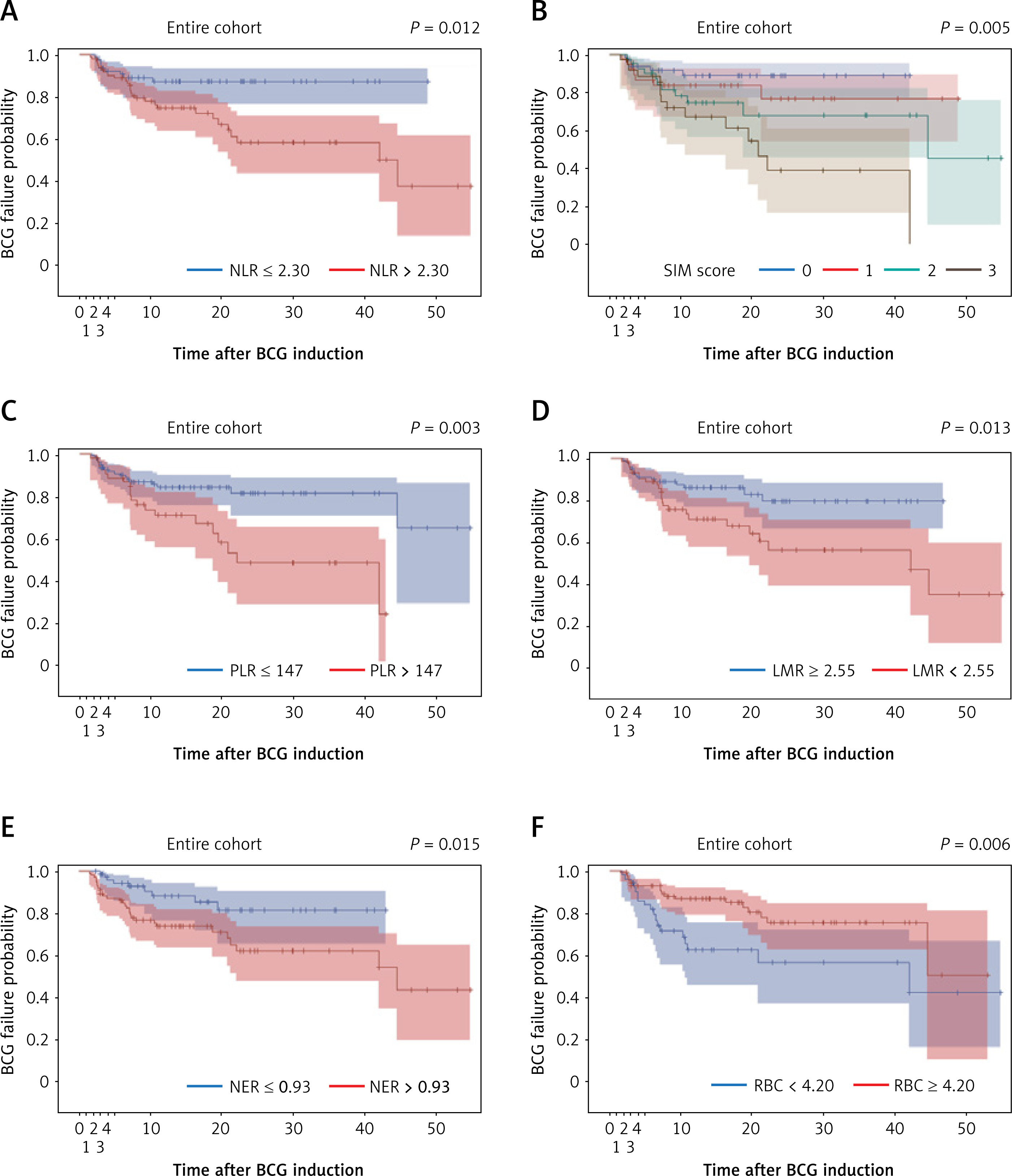
As univariate analysis and Kaplan-Meier curves revealed an association between low red blood cell count (< 4.2 × 10¹²/l) and BCG failure (p < 0.01) (Figure 1), we derived the neutrophil-to-erythrocyte (NER) ratio as a new marker of systemic inflammation. Patients with higher preoperative NER (> 0.93) had shorter time to BCG failure compared to individuals with lower NER (p < 0.05) (Figure 1).
In univariate logistic regression analysis systemic inflammatory markers as well as CUETO recurrence and progression risk scores, tumour multiplicity, and presence of residual tumour on re-TURBT were associated with BCG failure (Table II A). Multivariate models based on the CUETO recurrence risk score are presented in Table II B. The CUETO progression risk score was not utilized to develop a multivariate model as it showed a significant correlation with NLR (r = 0.17, p < 0.05) and SIM score (r = 0.22, p < 0.05).
Table II
Predictors of BCG failure. Univariate (A) and multivariate (B) analysis – logistic regression
A
B
Subgroups with NLR significance
For subgroup analysis validation we chose NLR as the most conservative and extensively analysed previously (Figure 2). Patients with NLR > 2.3 had shorter time to BCG failure in the subgroup of high CUETO progression risk score (10–14) (p < 0.01). Moreover, NLR > 2.3 remained significantly associated with time to BCG failure in patients with papillary tumour (T1 and Ta) (p < 0.05) and in the subgroups of patients with recurrent tumour (p < 0.001), single tumour (p < 0.05) and tumour size < 3 cm (p < 0.001).
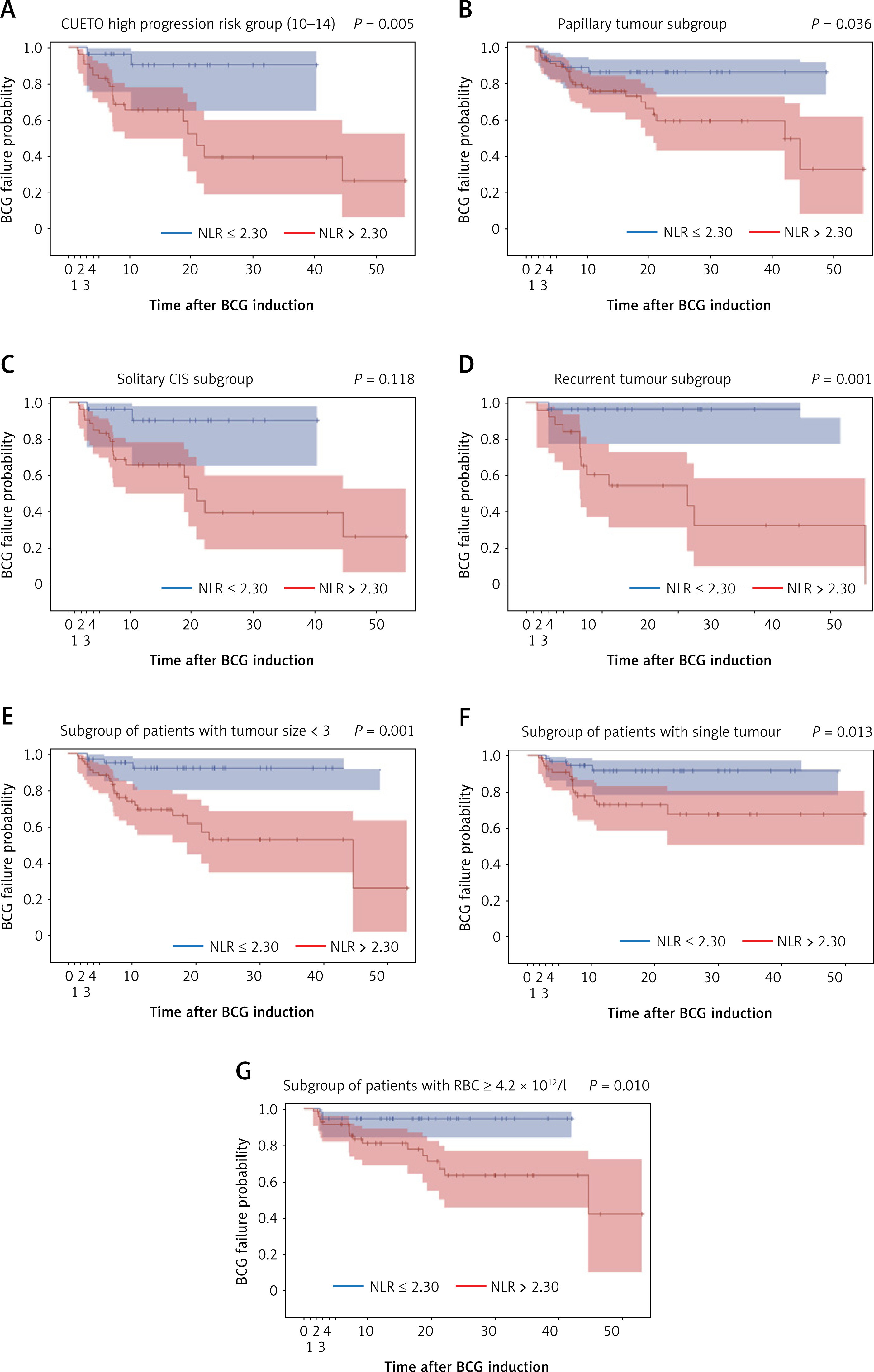
Since red blood cell count revealed a significant association with BCG failure (Figure 1), we also investigated whether stratification based on RBC influences the prognostic value of NLR. Kaplan-Meier analysis demonstrated that patients with NLR > 2.3 had shorter time to BCG failure only in the subgroup with normal RBC (≥ 4.2 × 10¹²/l) (p < 0.01).
Inflammatory markers (including NLR, PLR, LMR, SIM score) remained significant predictors of BCG failure in the subgroup of patients without common systemic diseases such as diabetes mellitus or metabolic syndrome (Supplementary Table SI and Supplementary Figure S1).
To determine potential confounders, patients’ baseline characteristics according to NLR status were evaluated (for details see Supplementary Table SII). There were no significant differences in terms of tumour stage, grade, recurrence rate, multiplicity, tumour size, presence of concomitant CIS, gender or median age between groups with high NLR (> 2.3) and low NLR (≤ 2.3).
Discussion
Development of dedicated BCG failure predictive models remains an unmet clinical necessity [14, 21]. In fact, BCG failure prediction might become even more significant in the light of awaited results of clinical trials evaluating the efficacy of BCG and immune checkpoint inhibitors in high-risk NMIBC [14]. Defining individuals at higher risk of BCG failure provides a possibility to avoid unsuccessful BCG treatment and instead performance of radical cystectomy in the highest-risk patients, reducing unnecessary delay [15, 16].
In this study, we retrospectively evaluated the utility of preoperative NLR and other blood count-derived inflammatory markers in prediction of BCG failure in the population of high-risk NMIBC patients. Unlike in previous studies, retrospective definition of BCG failure as the endpoint was determined based on the updated EAU 2019 guidelines [1, 22, 23]. We hypothesized that a systemic inflammatory response might negatively impact the local response to BCG antigens, which is inevitable to obtain the desired cancer eradication.
Our study demonstrates that high preoperative NLR (> 2.3) and systemic inflammatory marker score are associated with shorter time to BCG failure. Importantly, we identified subgroups in which NLR implementation into risk-stratification tools might be especially relevant. Since high NLR values helped to further sub-stratify patients with the highest CUETO progression score, it might serve as an adjunct to currently used risk scores, especially when immediate radical cystectomy is being considered. Obviously in such scenarios, abnormal values of inflammatory markers must always be contextualized within the patient’s clinical characteristics and histopathologic tumour features and cannot be used as single decisive factor.
Neutrophil-to-lymphocyte ratio marks time to BCG failure in papillary tumours (Ta and T1) and tended to mark it in solitary CIS, which indicates its universal implementation regardless of staging. Furthermore, high preoperative NLR (> 2.3) appeared to be a negative prognostic factor, especially in patients with recurrent tumour, single tumour, when tumour size < 3 cm and when RBC ≥ 4.2 × 10¹²/l. Neutrophil-to-lymphocyte ratio remains a predictor of BCG failure in the subgroup of patients without diabetes mellitus or metabolic syndrome, which indicates that common systemic diseases such as diabetes do not constitute a confounder in the analysis. Identification of specific subgroups in which NLR might be especially efficient requires further studies on a larger cohort of patients.
In the multivariate model, NLR remained a significant adjunct to the CUETO recurrence risk score when predicting BCG failure. Similarly to other studies we propose NLR incorporation into risk stratification tools for high-risk NMIBC to improve their accuracy [18, 24–26]. Importantly, several studies have investigated the prognostic role of high preoperative NLR in the cohort of BCG treated NMIBC, but they focused only on recurrence and progression risk [24, 25, 27, 28]. Only one study focused on its value in BCG failure prediction [22]. Notably, patients without tumour progression to MIBC are also classified as BCG failures when high-grade recurrence is diagnosed [1]. Therefore, prediction of disease progression might not always be the equivalent of BCG failure prediction, which covers wider spectra of clinical situations (high-grade recurrence). Of note, aforementioned studies reporting the value of NLR in recurrence prediction [24, 25, 27, 28] do not discriminate high and low-grade recurrence, which is of utmost significance to diagnose BCG immunotherapy failure and implement a new treatment strategy. Therefore NLR association with tumour recurrence and progression demonstrates only partial utility of this marker. In our study, we focused particularly on BCG failure defined as BCG unresponsive or progression to MIBC. Using such a definition we attempted to denote a group of patients for whom BCG does not provide any benefit. For such patients only radical cystectomy remains a true option [1, 6]. Therefore, we believe that our detailed analysis offers a more precise view of NLR utility in the stratification of patients who are at high risk of not benefiting from BCG immunotherapy.
Association of residual tumour presence in re-TURBT and BCG failure was not significant (p = 0.11) and was not included in the final multivariate model. However, such a potential association underlies the pivotal role of re-TURBT in NMIBC management [17, 21, 29]. It has been recently reported that re-TURBT pathology constitutes an independent prognostic factor for NMIBC recurrence and progression [30]. Further evaluation of the impact of re-TURBT pathology on prognosis in high-risk BCG-treated patients is warranted.
We have also attempted to determine an association between other blood cell count-derived parameters and BCG failure. High PLR (> 147) and low LMR (< 2.55) were associated with shorter time to BCG failure. Recently, it has been shown that PLR and LMR provide additional information to NLR when combined together in the SIM score [19]. Association of high SIM score with recurrence and progression in T1HG NMIBC was reported [19]. In our analysis, SIM score remained a significant predictor of BCG failure in the uni- and multivariable model. Consequently, SIM score constitutes a promising parameter, which mirrors the level of systemic inflammation and has predictive value for time to BCG failure.
We found that patients with a low RBC count (< 4.2 × 10¹²/l) had a shorter time to BCG failure. It can be suspected that the predictive value of erythropoietic parameters is related to their ability to mirror the state of chronic inflammation, which is known to impair erythropoiesis and shorten the erythrocyte half-life [31]. This corresponds with the hypothesis that systemic inflammation is associated with a poorer BCG response. To the best of our knowledge, this is the first report on the association of red blood cell count and neutrophil-to-erythrocyte ratio with BCG failure. Incorporation of erythrocyte and neutrophil counts into one derived index might combine the advantages of both parameters in terms of their predictive values. On the other hand, the impact of preoperative (pre-TURBT) anaemia on cancer-specific and overall survival in NMIBC patients has been previously reported [20, 32, 33].
Study limitations including selection bias result from its retrospective design. Due to methodological issues, the follow-up time was limited to 6 months from the last exposure to BCG. Therapy interruption due to multiple factors (age, comorbidities, intolerance, non-compliance) led to suboptimal maintenance in a significant number of cases. The probability of missing a small tumour during the initial TURBT and its further identification as recurrence during BCG is limited due to re-TURBT performance (71.5% patients) and strict cystoscopic follow-up.
In conclusion, prediction of BCG immunotherapy outcomes remains a challenge, which should be overcome in order to achieve durable cancer control in patients with high-risk NMIBC. We found that simple blood count-derived markers – NLR, PLR, NER, LMR and SIM score – might be utilized to predict BCG immunotherapy failure. Since NLR, PLR, NER and SIM score predict BCG failure independently from the CUETO scoring system, they can be easily implemented in everyday practice and aid clinical decision-making.