Current issue
Archive
Manuscripts accepted
About the Journal
Editorial office
Editorial board
Section Editors
Abstracting and indexing
Subscription
Contact
Ethical standards and procedures
Most read articles
Instructions for authors
Article Processing Charge (APC)
Regulations of paying article processing charge (APC)


NEUROLOGY / RESEARCH PAPER
The causal effect of epigenetic aging on intracerebral hemorrhage is not mediated by frontal network function: A Mendelian randomization study
1
Department of Hematology/Oncology, Children’s Medical Center, Sun Yat-sen Memorial Hospital, Sun Yat-sen University, China
2
Department of Neurosurgery, Zhujiang Hospital, Southern Medical University, The National Key Clinical Specialty, The Engineering Technology Research Center of Education Ministry of China, Guangdong Provincial Key Laboratory on Brain Function Repair and Regeneration, The Neurosurgery Institute of Guangdong Province, China
Submission date: 2025-10-14
Final revision date: 2026-01-08
Acceptance date: 2026-02-05
Online publication date: 2026-05-01
Corresponding author
Jianwei Guan
Department of Neurosurgery, Zhujiang Hospital, Southern Medical University, The National Key Clinical Specialty, The Engineering Technology Research Center of Education Ministry of China, Guangdong Provincial Key Laboratory on Brain Function Repair and Regeneration, The Neurosurgery Institute of Guangdong Province, China
Department of Neurosurgery, Zhujiang Hospital, Southern Medical University, The National Key Clinical Specialty, The Engineering Technology Research Center of Education Ministry of China, Guangdong Provincial Key Laboratory on Brain Function Repair and Regeneration, The Neurosurgery Institute of Guangdong Province, China
KEYWORDS
genome-wide association studiesintracerebral hemorrhageMendelian randomizationepigenetic clocksaging markers
TOPICS
ABSTRACT
Introduction:
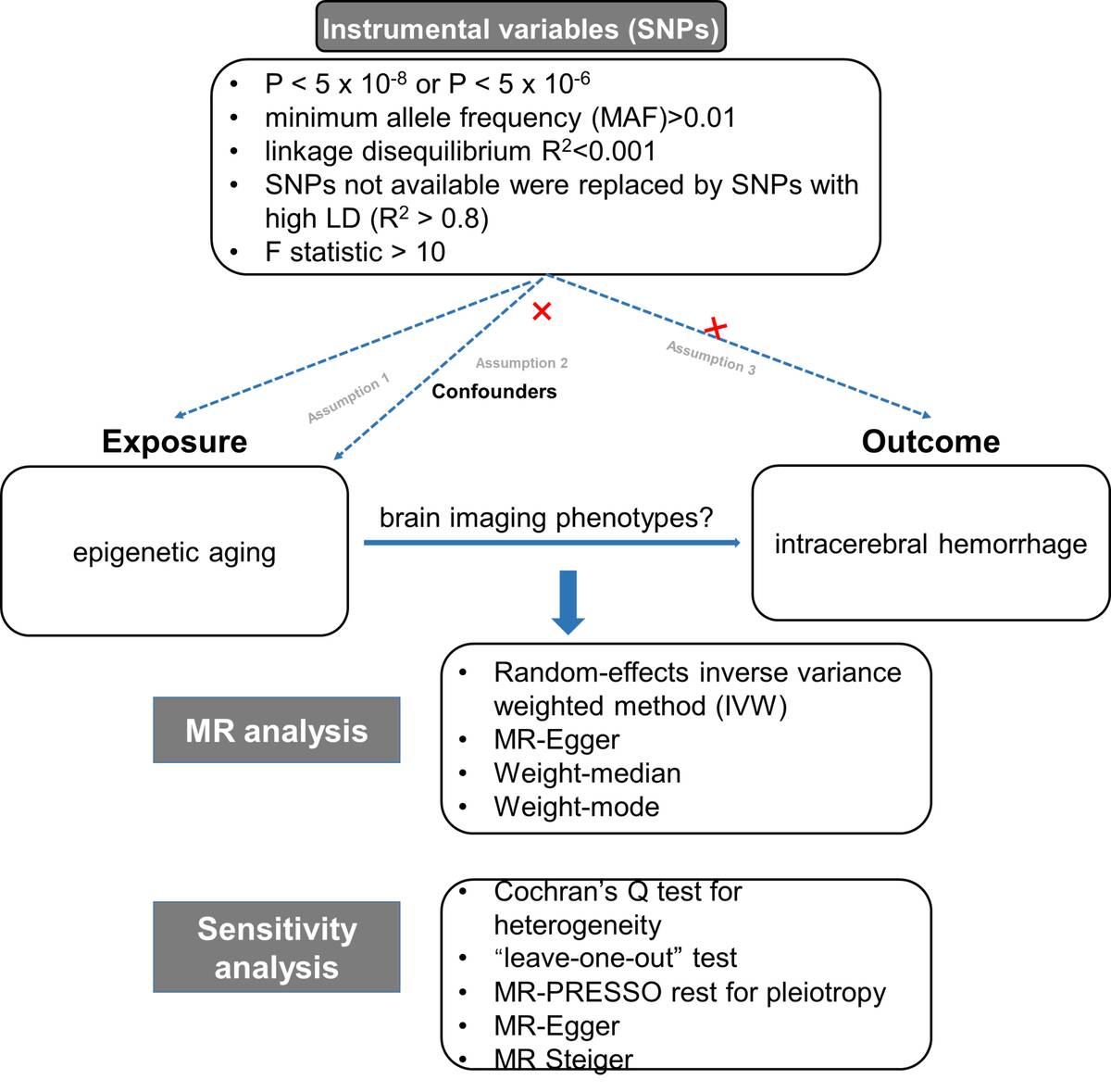
The association between epigenetic clocks and intracerebral hemorrhage (ICH) remains poorly understood. This study investigated whether specific brain imaging phenotypes play a mediating role in the causal pathway from epigenetic aging to ICH.
Material and methods:
We utilized genome-wide association study (GWAS) summary statistics for four epigenetic clocks and two related biomarkers (from a large-scale meta-analysis), 20 brain functional imaging phenotypes, and ICH (FinnGen R12). A two-sample Mendelian randomization (MR) analysis was performed to estimate the total causal effect, followed by a two-step mediation analysis to explore potential neural mediators. The inverse variance weighted (IVW) method was employed as the primary analysis. Comprehensive sensitivity analyses, including MR-Egger, weighted median, and RadialMR, were conducted to ensure result robustness and correct for horizontal pleiotropy.
Results:
Genetically predicted accelerated PhenoAge was causally associated with an increased risk of ICH (OR = 1.08, 95% CI: 1.03–1.13). While an exploratory association was identified between PhenoAge and a frontal network phenotype (pheno16) after outlier removal, pheno16 showed no causal effect on ICH. Consequently, the hypothesized mediating pathway (PhenoAge → frontal network function → ICH) was not supported. Furthermore, a supplementary analysis revealed no causal link between PhenoAge and white matter hyperintensities, a marker of cerebral small vessel disease.
Conclusions:
The study provides genetic evidence that the acceleration of the epigenetic clock PhenoAge may be causally associated with ICH. However, the hypothesized mediating pathway via changes in frontal network function (pheno16) was not supported, suggesting that other biological mechanisms may be involved.
The association between epigenetic clocks and intracerebral hemorrhage (ICH) remains poorly understood. This study investigated whether specific brain imaging phenotypes play a mediating role in the causal pathway from epigenetic aging to ICH.
Material and methods:
We utilized genome-wide association study (GWAS) summary statistics for four epigenetic clocks and two related biomarkers (from a large-scale meta-analysis), 20 brain functional imaging phenotypes, and ICH (FinnGen R12). A two-sample Mendelian randomization (MR) analysis was performed to estimate the total causal effect, followed by a two-step mediation analysis to explore potential neural mediators. The inverse variance weighted (IVW) method was employed as the primary analysis. Comprehensive sensitivity analyses, including MR-Egger, weighted median, and RadialMR, were conducted to ensure result robustness and correct for horizontal pleiotropy.
Results:
Genetically predicted accelerated PhenoAge was causally associated with an increased risk of ICH (OR = 1.08, 95% CI: 1.03–1.13). While an exploratory association was identified between PhenoAge and a frontal network phenotype (pheno16) after outlier removal, pheno16 showed no causal effect on ICH. Consequently, the hypothesized mediating pathway (PhenoAge → frontal network function → ICH) was not supported. Furthermore, a supplementary analysis revealed no causal link between PhenoAge and white matter hyperintensities, a marker of cerebral small vessel disease.
Conclusions:
The study provides genetic evidence that the acceleration of the epigenetic clock PhenoAge may be causally associated with ICH. However, the hypothesized mediating pathway via changes in frontal network function (pheno16) was not supported, suggesting that other biological mechanisms may be involved.
Share
RELATED ARTICLE
| eISSN: | 1896-9151 |
| ISSN: | 1734-1922 |

We process personal data collected when visiting the website. The function of obtaining information about users and their behavior is carried out by voluntarily entered information in forms and saving cookies in end devices. Data, including cookies, are used to provide services, improve the user experience and to analyze the traffic in accordance with the Privacy policy. Data are also collected and processed by Google Analytics tool (more).
You can change cookies settings in your browser. Restricted use of cookies in the browser configuration may affect some functionalities of the website.
You can change cookies settings in your browser. Restricted use of cookies in the browser configuration may affect some functionalities of the website.