Current issue
Archive
Manuscripts accepted
About the Journal
Editorial office
Editorial board
Section Editors
Abstracting and indexing
Subscription
Contact
Ethical standards and procedures
Most read articles
Instructions for authors
Article Processing Charge (APC)
Regulations of paying article processing charge (APC)


OBSTETRICS AND GYNAECOLOGY / RESEARCH PAPER
MicroRNA-Based Machine Learning Classifier Accurately Predicts Molecular Subtypes in Endometrial Carcinoma
1
Department of Gynecology, Shanghai General Hospital, Shanghai Jiao Tong University School of Medicine, China
2
School of Clinical Medicine, Medical College of Yangzhou University, China
Submission date: 2025-11-20
Final revision date: 2026-02-12
Acceptance date: 2026-03-31
Online publication date: 2026-06-04
Corresponding author
Miao Li
Department of Gynecology, Shanghai General Hospital, Shanghai Jiao Tong University School of Medicine, China
Department of Gynecology, Shanghai General Hospital, Shanghai Jiao Tong University School of Medicine, China
KEYWORDS
TOPICS
ABSTRACT
Introduction:
Molecular classification of endometrial carcinoma (EC) has revolutionized prognostic stratification. MicroRNAs (miRNAs) offer a potential cost-effective alternative for molecular subtyping. This study presents a proof-of-concept computational analysis to evaluate the feasibility of a miRNA-based machine learning classifier for discriminating the four distinct EC molecular subtypes.
Material and methods:
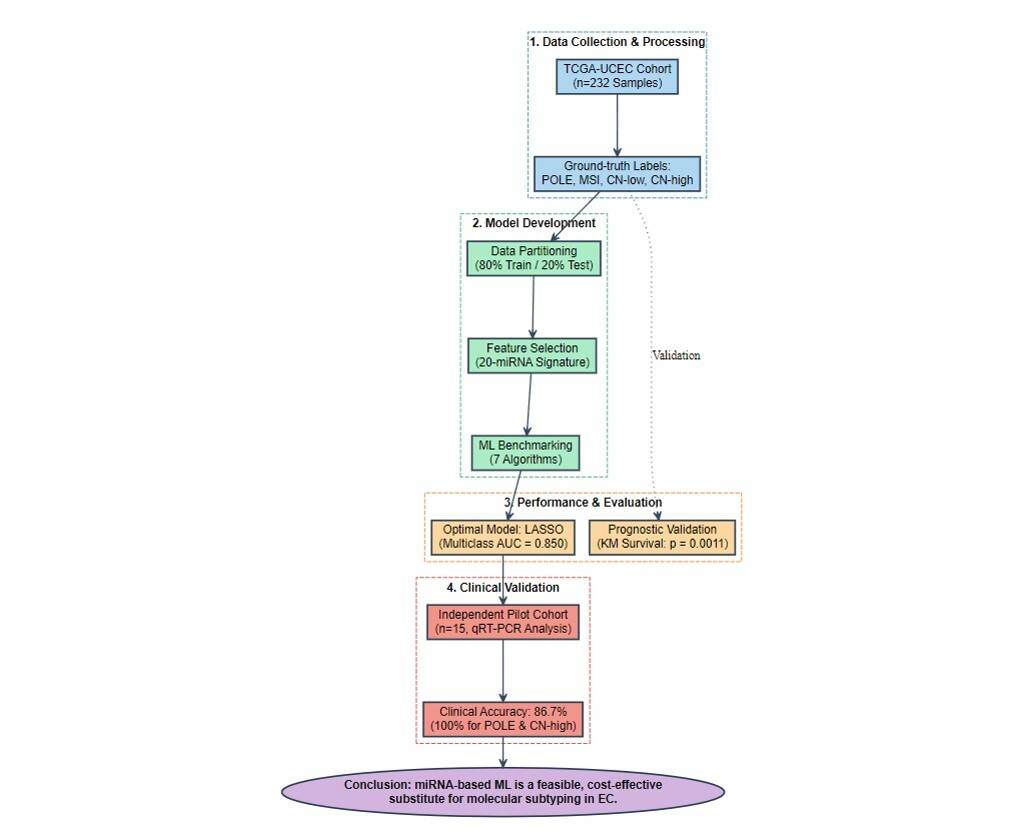
We analyzed 232 EC samples from the TCGA-UCEC cohort with complete molecular annotations. To confirm the clinical relevance of the ground-truth labels used for modeling, survival analyses (Kaplan-Meier and cumulative incidence function) were first performed on the established TCGA subtypes. Feature selection was conducted exclusively on the training set, identifying a signature of 20 differentially expressed miRNAs. A benchmark of seven machine learning algorithms was conducted. A pilot external validation was performed on 15 independent clinical samples using qRT-PCR, with ground-truth subtypes confirmed via POLE sequencing and IHC (ProMisE criteria).
Results:
Survival analysis confirmed that the ground-truth TCGA subtypes exhibited statistically significant prognostic differences (p=0.0011 for OS). In the computational benchmark, the LASSO logistic regression model demonstrated superior performance on the independent test set (multiclass AUC = 0.850). In the pilot external validation cohort, the classifier achieved an accuracy of 86.7% (95% CI: 59.5%–98.3%), correctly identifying all POLE and CN-high cases.
Conclusions:
This study demonstrates the computational feasibility of using a 20-miRNA signature to classify EC molecular subtypes, particularly for the prognostically distinct POLE and CN-high groups. While the survival analysis reaffirms the prognostic value of the molecular subtypes themselves, our findings regarding the classifier represent a preliminary proof-of-concept.
Molecular classification of endometrial carcinoma (EC) has revolutionized prognostic stratification. MicroRNAs (miRNAs) offer a potential cost-effective alternative for molecular subtyping. This study presents a proof-of-concept computational analysis to evaluate the feasibility of a miRNA-based machine learning classifier for discriminating the four distinct EC molecular subtypes.
Material and methods:
We analyzed 232 EC samples from the TCGA-UCEC cohort with complete molecular annotations. To confirm the clinical relevance of the ground-truth labels used for modeling, survival analyses (Kaplan-Meier and cumulative incidence function) were first performed on the established TCGA subtypes. Feature selection was conducted exclusively on the training set, identifying a signature of 20 differentially expressed miRNAs. A benchmark of seven machine learning algorithms was conducted. A pilot external validation was performed on 15 independent clinical samples using qRT-PCR, with ground-truth subtypes confirmed via POLE sequencing and IHC (ProMisE criteria).
Results:
Survival analysis confirmed that the ground-truth TCGA subtypes exhibited statistically significant prognostic differences (p=0.0011 for OS). In the computational benchmark, the LASSO logistic regression model demonstrated superior performance on the independent test set (multiclass AUC = 0.850). In the pilot external validation cohort, the classifier achieved an accuracy of 86.7% (95% CI: 59.5%–98.3%), correctly identifying all POLE and CN-high cases.
Conclusions:
This study demonstrates the computational feasibility of using a 20-miRNA signature to classify EC molecular subtypes, particularly for the prognostically distinct POLE and CN-high groups. While the survival analysis reaffirms the prognostic value of the molecular subtypes themselves, our findings regarding the classifier represent a preliminary proof-of-concept.
Share
RELATED ARTICLE
| eISSN: | 1896-9151 |
| ISSN: | 1734-1922 |

We process personal data collected when visiting the website. The function of obtaining information about users and their behavior is carried out by voluntarily entered information in forms and saving cookies in end devices. Data, including cookies, are used to provide services, improve the user experience and to analyze the traffic in accordance with the Privacy policy. Data are also collected and processed by Google Analytics tool (more).
You can change cookies settings in your browser. Restricted use of cookies in the browser configuration may affect some functionalities of the website.
You can change cookies settings in your browser. Restricted use of cookies in the browser configuration may affect some functionalities of the website.