Introduction
Pregnancy is a period associated with significant physiological changes that are mainly caused by changes in hormone levels [1]. Hormonal changes during pregnancy may affect both glucose metabolism and thyroid function [2].
Gestational diabetes mellitus (GDM) and gestational thyroid dysfunction (GTD) are the two most prevalent endocrinopathies during pregnancy [3]. GDM is a form of hyperglycemia diagnosed for the first time during pregnancy [4]. The International Association of Diabetes and Pregnancy Study Groups (IADPSG) estimates the global prevalence of GDM as 14% of pregnant women, with a significant continuously increasing trend [5]. The main pathogenetic mechanism in the development of GDM is insufficient insulin secretion relative to the physiological insulin resistance (IR) that occurs during pregnancy [4]. Known risk factors for GDM include overweight and obesity [6], advanced maternal age [7], and a family history of glucose intolerance or diabetes [8].
Hypothyroidism is the second most prevalent endocrine disorder during pregnancy, following GDM. Its prevalence ranges from 3% to 5% [9]. The most common causes of hypothyroidism are iodine deficiency and chronic autoimmune thyroiditis, particularly Hashimoto’s disease [10]. Both thyroid dysfunction and GDM can lead to serious maternal and fetal complications if not adequately diagnosed and treated. Uncontrolled hypothyroidism may lead to miscarriage, maternal anemia, pre-eclampsia, and placental abnormalities [2]. GDM increases the risk of preterm birth, macrosomia, and fetal distress. It also increases the risk of diabetes in both the mother and the offspring [11].
In recent years, several studies have reported associations between single nucleotide polymorphisms (SNPs) in various genes and the risk of selected diseases [12–15].
The hexokinase domain containing 1 (HKDC1) gene encodes a protein belonging to the hexokinase family, which plays a crucial role in glucose metabolism [16]. Unlike other hexokinases (e.g., HK1-HK4), which are well-characterized enzymes involved in phosphorylating glucose during glycolysis [17], HKDC1 is less studied, and its precise enzymatic activity remains unclear.
Recent studies have shown that HKDC1 may influence glucose homeostasis, insulin sensitivity, and hepatic glucose regulation [18]. Genetic variants in HKDC1 have been associated with altered glucose tolerance and an increased risk of developing GDM, particularly in late pregnancy [19]. Additionally, HKDC1 expression is elevated in insulin-resistant states, indicating a possible role in metabolic adaptation during pregnancy [18].
Functional studies have demonstrated that reduced HKDC1 expression impairs glucose tolerance and increases hepatic glucose output, while hepatic overexpression improves glucose metabolism in pregnant mouse models [18]. These experimental findings are supported by genome-wide association studies (GWAS), which have identified SNPs in HKDC1 (such as rs4746822 and rs1076224) associated with fasting glucose levels [20].
Despite its structural similarity to classical hexokinases, HKDC1 has low enzymatic activity, suggesting a potential regulatory rather than catalytic role in glucose metabolism [21].
Although HKDC1 has been established as relevant in GDM and related metabolic pathways, there is currently no evidence linking this gene to hypothyroidism. Its potential role in thyroid pathophysiology remains unexplored.
The aim of this study was to investigate the association between HKDC1 SNPs (rs4746822, rs1076224, rs2394529, rs9645501) and the risk of GDM and hypothyroidism in pregnant women, to better understand their potential role in metabolic and hormonal dysregulation during pregnancy.
Material and methods
Subjects
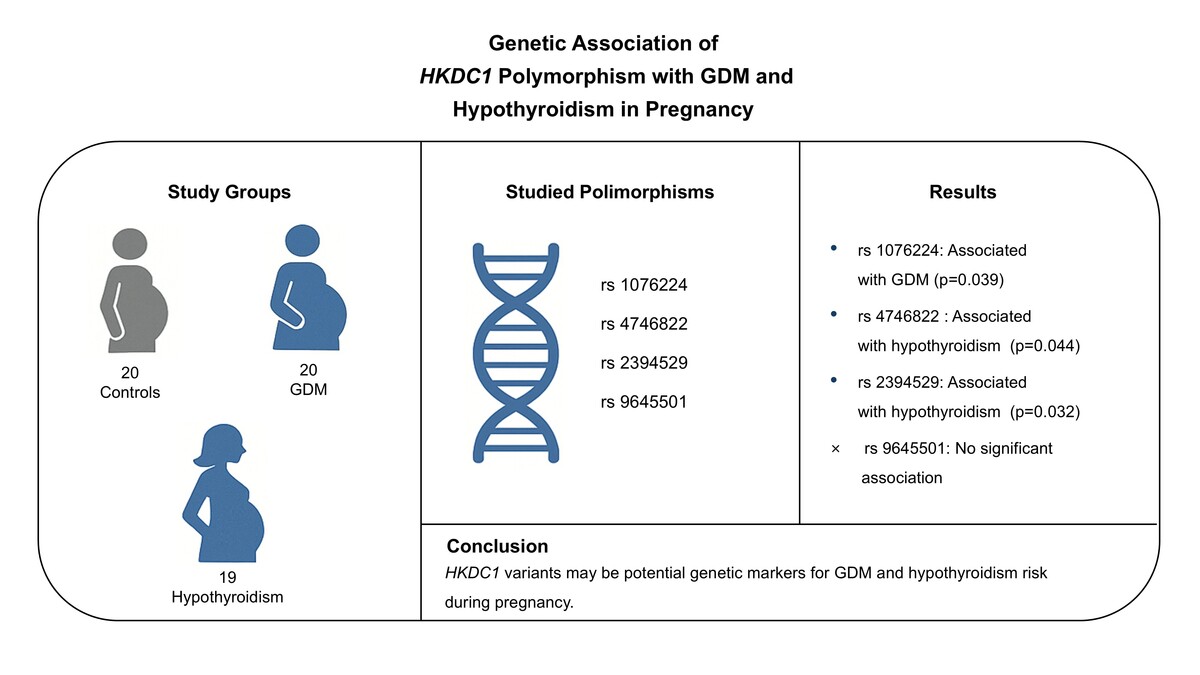
This case-control study included 59 pregnant women in their third trimester (28–36 weeks of gestation). The participants were divided into three groups: 20 healthy pregnant women (without GDM or hypothyroidism), 20 pregnant women diagnosed with GDM, and 19 with hypothyroidism.
The diagnosis of GDM was based on a 75-gram oral glucose tolerance test conducted between 24 and 28 weeks of gestation, according to the IADPSG criteria [22]. GDM was diagnosed if any of the following plasma glucose values were met or exceeded: fasting glucose ≥ 92 mg/dl (≥ 5.1 mmol/l), 1-hour glucose ≥ 180 mg/dl (≥ 10.0 mmol/l), or 2-hour glucose between 153 and 199 mg/dl (8.5–11.0 mmol/l) [13]. Hypothyroidism was diagnosed when TSH levels exceeded 2.5 µU/l in the first trimester of pregnancy [23].
Women with pregestational diabetes (type 1 or type 2), pre-pregnancy hypothyroidism, or autoimmune diseases unrelated to thyroid or glucose metabolism were not included in the study.
Methods
Blood samples were collected from all study participants. Approximately 5 ml of whole blood was collected in EDTA tubes. Genomic DNA was manually isolated using the commercially available QIAamp DNA Blood Mini Kit (Qiagen, Valencia, CA, USA), which is based on silica-membrane spin columns. The quantity and quality of DNA samples were assessed using a NanoDrop ND-1000 spectrophotometer (NanoDrop Technologies, Wilmington, DE, USA) and a Qubit 4 Fluorometer (Thermo Fisher Scientific, USA). Only high-quality DNA was used for genotyping. All eluates were stored at –20°C until genotype analysis. For the analysis, ready-to-order Custom TaqMan SNP Genotyping Assays (Applied Biosystems, USA) were used. Genotyping of selected single nucleotide polymorphisms (SNPs) – rs1076224, rs4746822, rs2394529, and rs9645501 – in the HKDC1 gene was performed using commercially available, ready-to-use TaqMan probe kits, specifically the Sample-to-SNP Kit (Applied Biosystems, USA). The assay kit included a pair of primers and two differently labeled TaqMan minor groove binder (MGB) probes for allele discrimination. The probes were labeled with FAM and VIC dyes at the 5’ end and contained MGB molecules along with a non-fluorescent quencher (NFQ) at the 3’ end. A total of 20 ng of genomic DNA was used for amplification in a 25 µl reaction mix. Polymerase chain reaction (PCR) was performed according to the manufacturer’s instructions provided by Applied Biosystems. The PCR-based amplification followed the thermal cycling conditions: initial denaturation at 95°C for 30 s, followed by 40 cycles of 92°C for 5 s and 60°C for 20 s. Amplicons were then analyzed using an Applied Biosystems ViiA 7 Real-Time PCR System, and genotype calls were determined manually by comparison with no-template controls. Homozygosity for FAM or VIC-specific alleles (X:X or Y:Y) was confirmed by an increase in fluorescence of either FAM or VIC dye. An increase in fluorescence from both dyes indicated heterozygosity (X:Y). The two dyes (FAM and VIC) were detected using the ViiA 7 Real-Time PCR System. Genotype calls were assessed using the Applied Biosystems TaqMan Genotyper Software.
Statistical analysis
The raw fluorescence data generated by PCR amplification were converted into specific alleles and genotypes. The metadata were then correlated with the obtained genotypes. The genotype distribution and allele frequencies of selected SNPs in the HKDC1 gene were compared between the control and study groups using the χ2 test. Bonferroni’s post hoc test was applied to determine differences between the groups. Hardy-Weinberg equilibrium was assessed using a goodness-of-fit χ2 test. The Kruskal-Wallis test was used in R to compare the observed and expected genotype distributions across the groups. Statistical significance was defined as p-values < 0.05.
Statistical analysis was performed using Microsoft Excel 2019 within the R version 3.5.5 statistical environment and the PSPP program.
Results
All SNPs were in Hardy-Weinberg equilibrium (HWE) (p > 0.05) in both the case and control groups.
Genotype and allele frequencies of the HKDC1 rs1076224 variant
In this study, we identified statistically significant differences in the distribution of genotypes in the HKDC1 rs1076224 dominant model (G/G vs. A/G + A/A) between pregnant women with and without GDM, with an odds ratio (OR) of 0.19 (95% CI: 0.04–1.06). The A/G and A/A genotypes were observed more frequently in the group without GDM. Individuals with the G/G genotype did not exhibit a significantly increased or decreased risk for GDM compared to the other groups (Table I).
Genotype and allele frequencies of the HKDC1 rs4746822 variant
This study revealed statistically significant differences in the genotype distribution of the HKDC1 rs4746822 codominant model (T/T, C/T, and C/C) between pregnant women with hypothyroidism and those without (p = 0.044). The T/T genotype was associated with a lower risk of hypothyroidism, whereas the C/T genotype was linked to an increased risk. The risk for individuals with the C/C genotype remained unclear due to the limited data, as only 4 cases were observed. The T allele was associated with a lower risk of hypothyroidism, while the C allele, particularly in the heterozygous C/T configuration, may increase the risk (Table II).
Table II
Evaluation of the relationship between the rs4746822 polymorphism of the HKDC1 gene and the incidence of HT (N = 39)
Significant differences were also observed between pregnant women with and without hypothyroidism in the HKDC1 rs4746822 overdominant model (T/T + C/C- compared to C/T) (p = 0.014). In a separate analysis, the heterozygous C/T genotype was associated with an increased risk of hypothyroidism (OR = 5.5, 95% CI: 1.32–22.86), whereas the homozygous C/C and T/T genotypes appeared to have a neutral effect on risk (Table II).
Genotype and allele frequencies of the HKDC1 rs2394529 variant
This study found statistically significant differences in the genotype distribution of the HKDC1 rs2394529 overdominant model (C/C + G/G vs. C/G) between pregnant women with and without hypothyroidism (p = 0.032). The presence of the C and G alleles in a heterozygous configuration (C/G) was associated with a 4.44-fold higher risk of hypothyroidism. No significant association was found between the homozygous genotypes (C/C and G/G) and disease risk (Table III).
Discussion
This study aimed to evaluate the association between specific regulatory variants of the HKDC1 gene (rs1076224, rs4746822, rs2394529, and rs9645501) and the development of both gestational diabetes mellitus (GDM) and hypothyroidism during pregnancy. While previous research has examined the role of HKDC1 single nucleotide polymorphisms (SNPs) in GDM [19], to our knowledge, this is the first study to explore their potential involvement in pregnancy-related hypothyroidism.
Our findings suggest that specific variants of the HKDC1 gene are associated with GDM and hypothyroidism in pregnant women. In particular, a statistically significant association was observed between the HKDC1 rs1076224 polymorphism and GDM. Additionally, rs4746822 and rs2394529 were significantly associated with hypothyroidism, while rs9645501 showed no differences in genotype or allele frequencies across the study groups. Among all four studied polymorphisms, associations were observed only for three, indicating distinct genetic contributions to different pregnancy-related metabolic and endocrine disorders. These results highlight the potential of HKDC1 variants as biomarkers for such conditions.
In the dominant model (G/G vs. A/G + A/A) for the genotype distribution of HKDC1 rs1076224, we observed that the A/G and A/A genotypes were more prevalent in the group without GDM (p = 0.039). These results suggest that the A allele may play a protective role in maintaining normal glucose metabolism during pregnancy, as women carrying at least one A allele (A/G or A/A) exhibited an 81% lower risk of developing GDM compared to those with the G/G genotype (OR = 0.19).
Currently, there is no clear evidence supporting a protective role of the A allele in HKDC1 rs1076224 against diabetes. Most existing studies have focused on the role of the HKDC1 gene in glucose metabolism and its association with diabetes risk [18, 19]. A study by Kanthimathi et al. reported a significant association between the rs1076224 variant and an increased risk of GDM, with an odds ratio of 1.24 [20]. However, replication studies conducted in Han Chinese [24] and Russian [25] populations did not confirm this association. These inconsistencies may reflect population-specific genetic backgrounds or environmental influences.
Protective roles for specific alleles against diabetes have been observed in other genes, such as CREBRF (rs373863828). A 2020 study demonstrated that the A allele of CREBRF is associated with reduced GDM prevalence in Māori and Pacific populations [26]. Furthermore, a 2021 study emphasized its role in enhancing insulin secretion without affecting insulin sensitivity, suggesting a potential mechanism for lowering type 2 diabetes risk [27]. Our findings raise the possibility that a similar protective mechanism may be involved in carriers of the A allele in HKDC1 rs1076224.
Regarding the associations observed in hypothyroidism, we found significant relationships between the HKDC1 rs4746822 and rs2394529 polymorphisms and thyroid dysfunction. In the codominant model (T/T, C/T, and C/C) for rs4746822, the T/T genotype was more common among healthy pregnant women compared to those with hypothyroidism, suggesting that the C allele may act as a potential risk factor for thyroid dysfunction. These findings may help identify individuals at increased risk of hypothyroidism. However, further studies with larger sample sizes are needed to confirm these findings and to elucidate the relationship between these SNPs and the risk of thyroid disease.
Additionally, in the overdominant model for both rs4746822 and rs2394529, the heterozygous C/T and C/G genotypes were associated with an increased risk of hypothyroidism. In contrast, homozygous genotypes (T/T, C/C, and G/G) appeared to have a neutral effect, suggesting that it is the combination of alleles in the heterozygous configuration, rather than the individual alleles themselves, that contributes to the observed risk.
Although data on HKDC1 variants in thyroid disease are limited, similar heterozygote effects have been reported in other genes associated with autoimmune and endocrine disorders. For example, specific heterozygous combinations of HLA gene variants have been shown to increase susceptibility to autoimmune thyroid disease by disrupting antigen presentation or immune tolerance [28]. The +49A/G polymorphism (rs231775) in the CTLA4 gene is another example, where the heterozygous A/G genotype is associated with an increased risk of autoimmune diseases, such as Hashimoto’s thyroiditis and Graves’ disease [29].
The mechanism behind the observed overdominant effect in HKDC1 is unclear. Allele-specific interactions may disrupt HKDC1 expression or related metabolic pathways in the thyroid. Given the role of HKDC1 in glucose metabolism and energy regulation [16], altered expression could affect thyroid hormone synthesis or immune responses. This hypothesis requires confirmation in functional studies.
Although HKDC1 is primarily involved in glucose metabolism [16], our study is the first to suggest a potential link between HKDC1 polymorphisms and hypothyroidism during pregnancy. Previous studies have identified other SNPs associated with thyroid dysfunction [13, 30], but no data are currently available regarding the role of HKDC1 variants in thyroid disease. This gene is not known to directly regulate thyroid function; however, its role in metabolic processes [31] may indirectly influence thyroid health, particularly during pregnancy when the endocrine and metabolic systems are tightly interlinked [3]. Further research is required to elucidate the molecular mechanisms by which these genetic variants contribute to thyroid dysfunction. Understanding these interactions could improve early detection and management strategies for metabolic and thyroid disorders in pregnant women, potentially reducing the risks for both maternal and fetal health.
In conclusion, the results of this study reveal a significant association between HKDC1 gene polymorphisms (rs1076224, rs4746822, and rs2394529) and both gestational diabetes mellitus and hypothyroidism during pregnancy. These findings suggest a potential genetic link between HKDC1, previously implicated in glucose metabolism, and thyroid dysfunction in pregnancy, providing novel insights into the genetic factors that may contribute to the susceptibility of pregnant women to these conditions.
This preliminary study has several limitations. First, the small sample size limits statistical power and may affect the reliability and generalizability of the findings. Second, the single-center design introduces potential selection bias and may not adequately reflect other demographic or geographic groups. Third, no functional studies were conducted to assess the biological mechanisms behind the associations between HKDC1 variants and the studied conditions, so the molecular relevance of these polymorphisms remains speculative. Fourth, the study did not account for potential confounding factors such as body mass index (BMI), smoking status, dietary habits, or other environmental and lifestyle factors, which may influence both glucose metabolism and thyroid function during pregnancy. Finally, due to the cross-sectional design, no conclusions can be drawn about the temporal relationship between genetic variants and disease onset.
Future studies with larger and more diverse cohorts, comprehensive clinical data, and functional analyses are needed to provide deeper insights into the role of HKDC1 in pregnancy-related endocrine disorders.