Current issue
Archive
Manuscripts accepted
About the Journal
Editorial office
Editorial board
Section Editors
Abstracting and indexing
Subscription
Contact
Ethical standards and procedures
Most read articles
Instructions for authors
Article Processing Charge (APC)
Regulations of paying article processing charge (APC)


ONCOLOGY / BASIC RESEARCH
Mechanism of resistin-induced enhancement of proliferation and migration of ovarian cancer cells
1
Department of Obstetrics and Gynecology, Shengjing Hospital of China Medical University, Shenyang, Liaoning, China
Submission date: 2020-06-15
Final revision date: 2020-09-18
Acceptance date: 2020-10-04
Online publication date: 2020-11-06
Publication date: 2026-11-25
Corresponding author
Li Pang
Department of Obstetrics and Gynecology Shengjing Hospital of China Medical University Shenyang 110004 Liaoning, China Phone: +24 18940252992
Arch Med Sci 2026;22(5):2950-2958
KEYWORDS
TOPICS
ABSTRACT
Introduction:
Resistin, a novel hormone secreted by human adipocytes and mononuclear cells, is associated with obesity, insulin resistance, and inflammation. Recent studies showed that resistin plays a key role in ovarian cancer cells. In this study, we investigated the potential of resistin to regulate the proliferation and migration of ovarian cancer cells.
Material and methods:
A series of in vitro functional experiments were carried out to elucidate the role of resistin in ovarian cancer progression and the molecular mechanisms underlying its role.
Results:
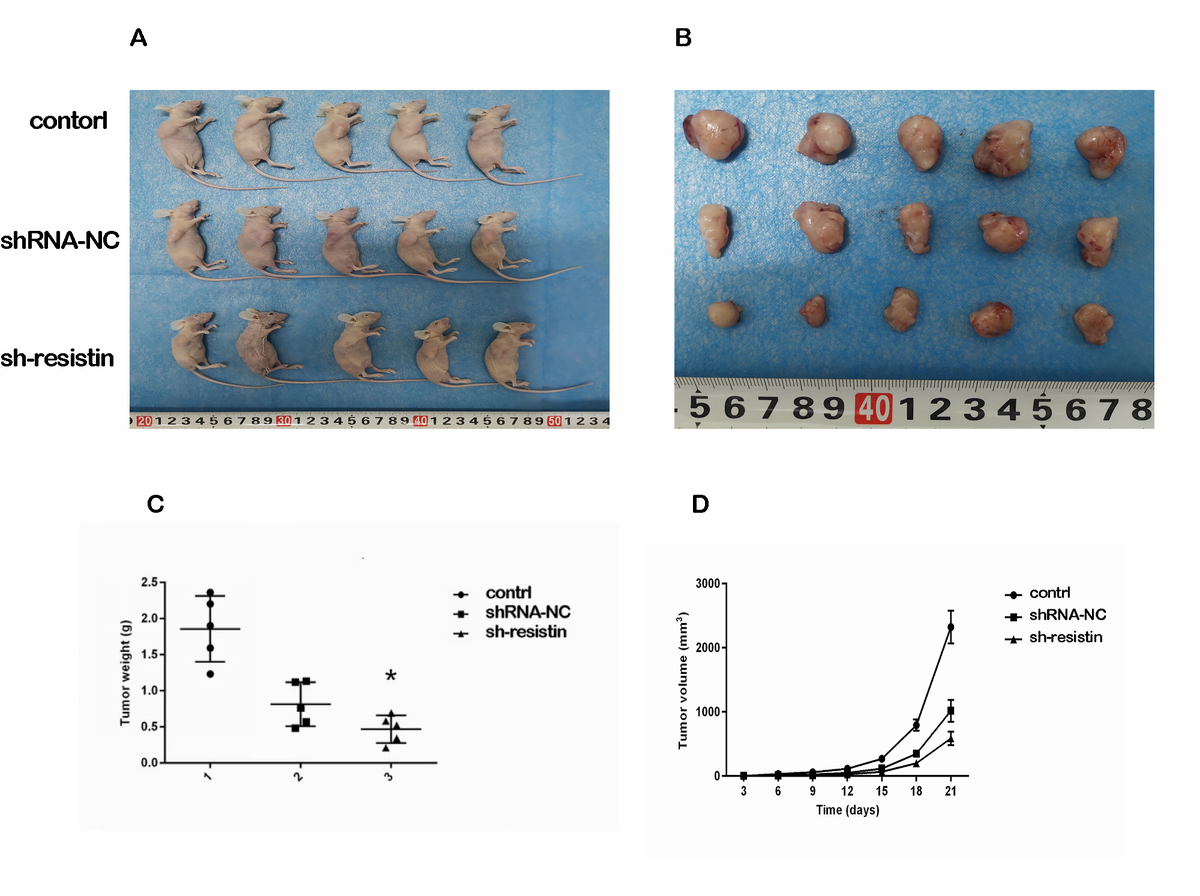
Resistin enhanced the proliferation of human ovarian epithelial carcinoma cells (HO-8910) in a time- and dose-dependent manner (30–100 ng/ml). Furthermore, HO-8910 cells cultured in adipocyte-conditioned medium showed dramatically increased rates of proliferation. Resistin knockout during adipocyte culture attenuated the proliferation of HO-8910 cells treated with adipocyte-conditioned media, indicating that resistin may promote HO-8910 cell proliferation via the mechanistic target of a rapamycin (mTOR)-mediated signaling pathway. Resistin (30–100 ng/ml) also enhanced wound-healing rates in a time- and concentration-dependent manner. Co-culturing HO-8910 cells with adipocytes also increased the wound-healing rates. Resistin expression was inhibited by miR-124-1 transcriptional activity, and resistin-mediated HO-8910 cell migration was also regulated by miR-124-1. Furthermore, we also confirmed the role of resistin in promoting tumor growth in vivo.
Conclusions:
These findings suggest that resistin may serve as an effective therapeutic target for ovarian epithelial carcinoma, especially in patients who are obese.
REFERENCES (19)
1.
Billottet C, Janji B, Thiery JP, Jouanneau J. Rapid tumor development and potent vascularization are independent events in carcinoma producing FGF-1 or FGF-2. Oncogene 2002; 21: 8128-39.
2.
Steppan CM, Bailey ST, Bhat S, et al. The hormone resistin links obesity to diabetes. Nature 2001; 409: 307-12.
3.
Wang CH, Wang PJ, Hsieh YC, et al. Resistin facilitates breast cancer progression via TLR4-mediated induction of mesenchymal phenotypes and stemness properties. Oncogene 2018; 37: 589-600.
4.
Jiang R, Zhao C, Wang X, et al. Resistin-like molecule-beta promotes invasion and migration of gastric carcinoma cells. Med Sci Monit 2016; 22: 937-42.
5.
Huang WS, Yang JT, Lu CC, et al. Fulvic acid attenuates resistin-induced adhesion of HCT-116 colorectal cancer cells to endothelial cells. Int J Mol Sci 2015; 16: 29370-82.
6.
Nakajima TE, Yamada Y, Hamano T, et al. Adipocytokines and squamous cell carcinoma of the esophagus. Cancer Res Clin Oncol 2010; 136: 261-6.
7.
Yang HS, Yoon C, Myung SK, Park SM. Effect of obesity on survival of women with epithelial ovarian cancer: a systematic review and meta-analysis of observational studies. Int J Gynecol Cancer 2011; 21: 1525-32.
8.
Pavelka JC, Brown RS, Karlan BY, et al. Effect of obesity on survival in epithelial ovarian cancer. Cancer 2006; 107: 1520-4.
9.
Yamout R, Ammar W, Tabbara J, Fares S, Assi M, Sibai AM. Waist circumference cutoff points for predicting metabolic abnormalities in Lebanese adults. Arch Med Sci Civil Dis 2019; 4: e64-71.
10.
Mariscalco G, D’Errigo P, Biancari F, et al. Early and late outcomes after transcatheter versus surgical aortic valve replacement in obese patients. Arch Med Sci 2020; 16: 796-801.
11.
McCourt CK, Mutch DG, Gibb RK, et al. Body mass index: relationship to clinical, pathologic and features of microsatellite instability in endometrial cancer. Gyneco Oncol 2007; 104: 535-9.
12.
Harvie M, Hooper L, Howell AH. Central obesity and breast cancer risk: a systematic review. Obes Rev 2003; 4: 157-73.
13.
Nieman KM, Kenny HA, Penicka CV, et al. Adipocytes promote ovarian cancer metastasis and provide energy for rapid tumor growth. Nat Med 2011; 17: 1498-503.
14.
Lee YC, Chen YJ, Wu CC, Lo S, Hou MF, Yuan SS. Resistin expression in breast cancer tissue as a marker of prognosis and hormone therapy stratification. Gynecol Oncol 2012; 125: 742-50.
15.
Patel L, Buckels AC, Kinghorn IJ, et al. Resistin is expressed in human macrophages and directly regulated by PPAR gamma activators. Biochem Biophys Res Comm 2003; 300: 472-6.
16.
Qiu L, Zhang GF, Yu L, Wang HY, Jia XJ, Wang TJ. Novel oncogenic and chemoresistance-inducing functions of resistin in ovarian cancer cells require miRNAs-mediated induction of epithelial-to-mesenchymal transition. Sci Rep 2018; 8: 12522.
17.
Pang L, Zhang Y, Yu Y, Zhang S. Resistin promotes the expression of vascular endothelial growth factor in ovary carcinoma cells. Int J Mol Sci 2013; 14: 9751-66.
18.
Zhao S, Shao L, Wang Y, Meng Q, Yu J. Ketamine exhibits anti-gastric cancer activity via induction of apoptosis and attenuation of PI3K/Akt/mTOR Arch Med Sci 2020; 16: 1140-9.
19.
Hatziapostolou M, Polytarchou C, Aggelidou E, et al. An HNF4alpha-miRNA inflammatory feedback circuit regulates hepatocellular oncogenesis. Cell 2011; 147: 1233-47.
Share
RELATED ARTICLE
| eISSN: | 1896-9151 |
| ISSN: | 1734-1922 |

We process personal data collected when visiting the website. The function of obtaining information about users and their behavior is carried out by voluntarily entered information in forms and saving cookies in end devices. Data, including cookies, are used to provide services, improve the user experience and to analyze the traffic in accordance with the Privacy policy. Data are also collected and processed by Google Analytics tool (more).
You can change cookies settings in your browser. Restricted use of cookies in the browser configuration may affect some functionalities of the website.