Current issue
Archive
Manuscripts accepted
About the Journal
Editorial office
Editorial board
Section Editors
Abstracting and indexing
Subscription
Contact
Ethical standards and procedures
Most read articles
Instructions for authors
Article Processing Charge (APC)
Regulations of paying article processing charge (APC)


CARDIOVASCULAR PREVENTION / CLINICAL RESEARCH
Prevalence and determinants of early acute coronary syndrome in Kosovo: a population-based study of sex-specific differences
1
University of Prishtina, Kosovo
2
Medical Faculty, University of Prishtina, Kosovo
3
Department of Cardiology and Adult Congenital Heart Diseases, Polish Mother’s Memorial Hospital Research Institute, Lodz, Poland
4
Imperial College London, United Kingdom
5
Medical Faculty, University of Pristina, Kosovo; University Clinical Centre of Kosovo, Prishtina, Kosovo
Submission date: 2026-04-16
Final revision date: 2026-04-27
Acceptance date: 2026-04-28
Online publication date: 2026-04-29
Corresponding author
Rozafa Koliqi
Department of Clinical Pharmacy and Biopharmacy Faculty of Medicine University of Prishtina Prishtina, Kosovo
Department of Clinical Pharmacy and Biopharmacy Faculty of Medicine University of Prishtina Prishtina, Kosovo
KEYWORDS
early-onset acute coronary syndromeKosovocardiovascular risk factorsbiochemical indicescross-sectionalretrospective study
TOPICS
ABSTRACT
Introduction:
Acute coronary syndrome (ACS) in younger individuals represents an important and growing clinical challenge, and is associated with substantial long-term morbidity. This study aimed to evaluate the clinical characteristics and predictors of premature ACS, with particular emphasis on sex differences and cardiovascular (CV) risk factors.
Material and methods:
We retrospectively analyzed 2,909 patients with ACS treated at the University Clinical Centre of Kosovo. Of these, 587 (20.2%) had premature ACS (men < 55 years; women < 65 years). Data on CV risk factors, electrocardiographic, echocardiographic, and angiographic findings, and medications were collected from medical records.
Results:
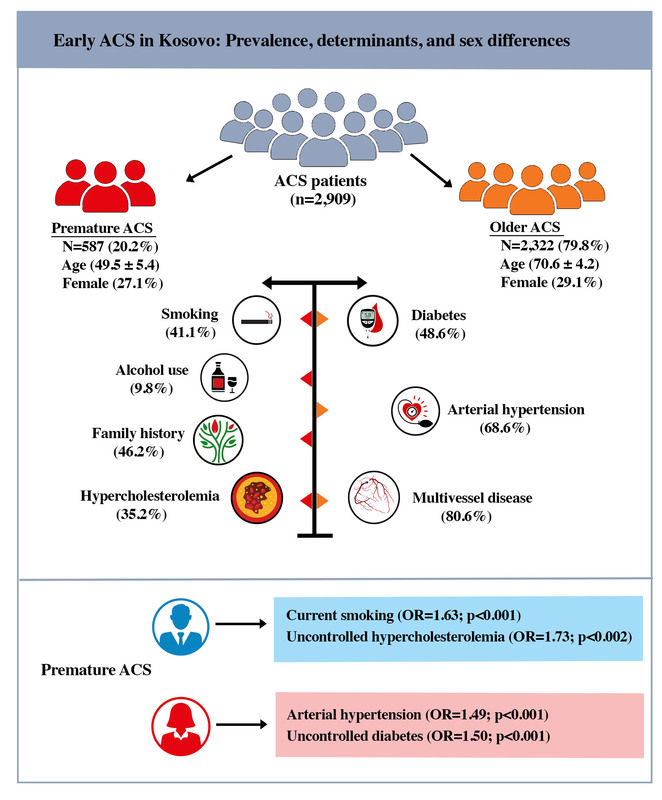
Patients with premature ACS (mean age: 49.5 ±5.4 years, men: 72.9%) had a higher prevalence of hypercholesterolemia (35.2 vs. 25.1%; p < 0.001), uncontrolled hypercholesterolemia (40.4% vs. 26.9%; p < 0.001), current smoking (41.1% vs. 22.9%; p < 0.001) and family history of coronary artery disease (46.2% vs. 32.4%; p < 0.001), but a lower prevalence of diabetes, hypertension, and uncontrolled diabetes (all p < 0.001) compared with older patients. Among patients with premature ACS, women had lower rates of current smoking (35.2% vs. 46.9%; p = 0.01), alcohol consumption (2.9% vs. 14.7%; p < 0.001) and uncontrolled hypercholesterolemia (32.7% vs. 45.5%) but a higher prevalence of diabetes, uncontrolled diabetes, and hypertension compared with premature men. In multivariable analysis, current smoking (OR = 1.59; p < 0.001), uncontrolled hypercholesterolemia (OR = 1.71; p < 0.001), and family history (OR = 1.66; p < 0.001) were independently associated with premature ACS, irrespective of sex. In women, a more pronounced cardiometabolic profile was observed, with uncontrolled diabetes (OR = 1.51; p < 0.001) and hypertension (OR = 1.49; p < 0.001) as independent predictors. However, in men, premature ACS was mainly driven by smoking (OR = 1.63; p < 0.001) and uncontrolled hypercholesterolemia (OR = 1.73; p < 0.001).
Conclusions:
Premature ACS, diagnosed in every fifth patient in Kosovo, is mainly associated with uncontrolled hypercholesterolemia and smoking, while diabetes, hypertension, and hyperglycemia are less common than in older patients. Clear sex differences were observed, with a more cardiometabolic profile in women and predominantly lifestyle-related risk factors in men. These findings highlight the distinct risk factor patterns in premature ACS and emphasize the importance of targeted prevention and early risk factor control in this population.
Acute coronary syndrome (ACS) in younger individuals represents an important and growing clinical challenge, and is associated with substantial long-term morbidity. This study aimed to evaluate the clinical characteristics and predictors of premature ACS, with particular emphasis on sex differences and cardiovascular (CV) risk factors.
Material and methods:
We retrospectively analyzed 2,909 patients with ACS treated at the University Clinical Centre of Kosovo. Of these, 587 (20.2%) had premature ACS (men < 55 years; women < 65 years). Data on CV risk factors, electrocardiographic, echocardiographic, and angiographic findings, and medications were collected from medical records.
Results:
Patients with premature ACS (mean age: 49.5 ±5.4 years, men: 72.9%) had a higher prevalence of hypercholesterolemia (35.2 vs. 25.1%; p < 0.001), uncontrolled hypercholesterolemia (40.4% vs. 26.9%; p < 0.001), current smoking (41.1% vs. 22.9%; p < 0.001) and family history of coronary artery disease (46.2% vs. 32.4%; p < 0.001), but a lower prevalence of diabetes, hypertension, and uncontrolled diabetes (all p < 0.001) compared with older patients. Among patients with premature ACS, women had lower rates of current smoking (35.2% vs. 46.9%; p = 0.01), alcohol consumption (2.9% vs. 14.7%; p < 0.001) and uncontrolled hypercholesterolemia (32.7% vs. 45.5%) but a higher prevalence of diabetes, uncontrolled diabetes, and hypertension compared with premature men. In multivariable analysis, current smoking (OR = 1.59; p < 0.001), uncontrolled hypercholesterolemia (OR = 1.71; p < 0.001), and family history (OR = 1.66; p < 0.001) were independently associated with premature ACS, irrespective of sex. In women, a more pronounced cardiometabolic profile was observed, with uncontrolled diabetes (OR = 1.51; p < 0.001) and hypertension (OR = 1.49; p < 0.001) as independent predictors. However, in men, premature ACS was mainly driven by smoking (OR = 1.63; p < 0.001) and uncontrolled hypercholesterolemia (OR = 1.73; p < 0.001).
Conclusions:
Premature ACS, diagnosed in every fifth patient in Kosovo, is mainly associated with uncontrolled hypercholesterolemia and smoking, while diabetes, hypertension, and hyperglycemia are less common than in older patients. Clear sex differences were observed, with a more cardiometabolic profile in women and predominantly lifestyle-related risk factors in men. These findings highlight the distinct risk factor patterns in premature ACS and emphasize the importance of targeted prevention and early risk factor control in this population.
REFERENCES (29)
1.
Roth GA, Mensah GA, Johnson CO, et al. Global burden of cardiovascular diseases and risk factors, 1990–2019: update from the GBD 2019 study. J Am Coll Cardiol 2020; 76: 2982-3021.
2.
Xu S, Liu Y, Zhu M, et al. Global burden of atherosclerotic cardiovascular disease attributed to lifestyle and metabolic risks. Sci China Life Sci 2025; 68: 2739-54.
3.
Hoxha V, Dragusha E, Morina S, et al. Sex-related differences in predictors of acute coronary syndrome in Kosovo: a cross-sectional study. J Clin Med 2025; 14: 8002.
4.
Yusuf S, Hawken S, Ounpuu S, et al. Effect of potentially modifiable risk factors associated with myocardial infarction in 52 countries (the INTERHEART study). Lancet 2004; 364: 937-52.
5.
Arnett DK, Blumenthal RS, Albert MA, et al. 2019 ACC/AHA guideline on the primary prevention of cardiovascular disease. Circulation 2019; 140: e596-646.
6.
Virani SS, Alonso A, Aparicio HJ, et al. Heart disease and stroke statistics – 2021 update: a report from the American Heart Association. Circulation 2021; 143: e254-743.
7.
Bredehorst M, Müller OJ, Katus HA, et al. Recommendations for the primary prevention of atherosclerotic cardiovascular disease: a systematic guideline review. Front Med 2024; 11: 1494234.
8.
Khot UN, Khot MB, Bajzer CT, et al. Prevalence of conventional risk factors in patients with coronary heart disease. JAMA 2003; 290: 898-904.
9.
Banach M, Surma S. Monitoring of traditional atherosclerosis cardiovascular disease risk factors - is it enough to prevent premature acute coronary syndrome? Lancet Reg Health Eur 2024; 38: 100866.
10.
Bytyci I, Toth P, Bytyqi S, Henein M, Banach M. Worldwide patterns for premature atherosclerotic cardiovascular disease: a meta-analysis. Circulation 2025; 152(25).
11.
Vogel B, Acevedo M, Appelman Y, et al. The Lancet women and cardiovascular disease Commission: reducing the global burden by 2030. Lancet 2021; 397: 2385-438.
12.
Regitz-Zagrosek V, Oertelt-Prigione S, Prescott E, et al. Gender in cardiovascular diseases: impact on clinical manifestations, management, and outcomes. Nat Rev Cardiol 2016; 13: 516-28.
13.
Stringhini S, Carmeli C, Jokela M, et al. Socioeconomic status and the 25×25 risk factors as determinants of premature mortality: a multicohort study. Lancet 2017; 389: 1229-37.
14.
Ebong IA, Goff DC, Rodriguez CJ, Chen H, Bertoni AG. The role of psychosocial stress in cardiovascular disease: implications for women. J Am Coll Cardiol 2024; 84: 298-314.
15.
Davies MJ, Aroda VR, Collins BS, et al. Management of hyperglycaemia in type 2 diabetes, 2022. Diabetologia 2022; 65: 1925-66.
16.
McEvoy JW, McCarthy CP, Bruno RM, et al. 2024 ESC Guidelines for the management of elevated blood pressure and hypertension. Eur Heart J 2024; 45: 3912-4018.
17.
Visseren FLJ, Mach F, Smulders YM, et al. 2021 ESC Guidelines on cardiovascular disease prevention in clinical practice. Eur Heart J 2021; 42: 3227-337.
18.
Dagenais GR, Leong DP, Rangarajan S, et al. Variations in common diseases, hospital admissions, and deaths in middle-aged adults in 21 countries from five continents (PURE study): a prospective cohort study. Lancet 2020; 395: 785-94.
19.
Meng X, Yuan J, Li W, et al. Predictive value of fasting plasma glucose for short-term prognosis in patients with type 2 diabetes mellitus after acute decompensated heart failure. Front Endocrinol (Lausanne) 2023; 14: 1171583.
20.
Mitchell C, Rahko PS, Blauwet LA, et al. Guidelines for performing a comprehensive transthoracic echocardiographic examination in adults: recommendations from the American Society of Echocardiography. J Am Soc Echocardiogr 2019; 32: 1-64.
21.
Kirkwood BR, Sterne JAC. Essential Medical Statistics. 2nd ed. Oxford: Blackwell Science 2003.
22.
Joseph P, Leong D, McKee M, et al. Reducing the global burden of cardiovascular disease, part 1: the epidemiology and risk factors. Circ Res 2017; 121: 677-94.
23.
Todorovic J, Santric Milicevic MM, Terzic Z, et al. Burden of alcohol use disorder in Balkan countries. Eur J Public Health 2022; 32: ckac130.190.
24.
Khera AV, Won HH, Peloso GM, et al. Diagnostic yield and clinical utility of sequencing familial hypercholesterolemia genes in patients with severe hypercholesterolemia. J Am Coll Cardiol 2016; 67: 2578-89.
25.
Andersson C, Vasan RS. Epidemiology of cardiovascular disease in young individuals. Nat Rev Cardiol 2018; 15: 230-40.
26.
Banach M, Fras Z, Gaita D, et al. The European Program for Prevention (EPP) – implementing proven preventing measures now! Global Heart 2025; 20: 103.
27.
Banach M, Mazidi M, Mikhailidis DP, et al. Association between phenotypic familial hypercholesterolaemia and telomere length in US adults: results from a multi-ethnic survey. Eur Heart J 2018; 39: 3635-40.
28.
Maas AHEM, Appelman YEA. Gender differences in coronary heart disease. Neth Heart J 2010; 18: 598-603.
29.
Baigent C, Keech A, Kearny PM, et al.; Cholesterol Treatment Trialists collaborators. Efficacy and safety of cholesterol-lowering treatment: prospective meta-analysis of data from 90.056 participants in 14 randomised trials of statins. Lancet 2005; 366: 1267-78.
Share
RELATED ARTICLE
| eISSN: | 1896-9151 |
| ISSN: | 1734-1922 |

We process personal data collected when visiting the website. The function of obtaining information about users and their behavior is carried out by voluntarily entered information in forms and saving cookies in end devices. Data, including cookies, are used to provide services, improve the user experience and to analyze the traffic in accordance with the Privacy policy. Data are also collected and processed by Google Analytics tool (more).
You can change cookies settings in your browser. Restricted use of cookies in the browser configuration may affect some functionalities of the website.
You can change cookies settings in your browser. Restricted use of cookies in the browser configuration may affect some functionalities of the website.