Current issue
Archive
Manuscripts accepted
About the Journal
Editorial office
Editorial board
Section Editors
Abstracting and indexing
Subscription
Contact
Ethical standards and procedures
Most read articles
Instructions for authors
Article Processing Charge (APC)
Regulations of paying article processing charge (APC)


NEUROLOGY / CLINICAL RESEARCH
Deciphering the interplay between inflammatory factors and brain structural features in epilepsy
1
Department of Neurosurgery, The Third People’s Hospital of Chengdu, Qingyang District Chengdu, Sichuan Province, China
Submission date: 2025-07-19
Final revision date: 2025-12-28
Acceptance date: 2026-01-21
Online publication date: 2026-05-01
Corresponding author
Sunfu Zhang
Department of Neurosurgery The Third People’s Hospital of Chengdu No. 82, Qing long Street Qingyang District Chengdu 610031 Sichuan Province, China
Department of Neurosurgery The Third People’s Hospital of Chengdu No. 82, Qing long Street Qingyang District Chengdu 610031 Sichuan Province, China
Article (PDF)
Supplementary files
References (50)
Deciphering the interplay - supplementary figs.pdf
Deciphering the interplay - Supplementary Table SI.xls
Deciphering the interplay - Supplementary Table SII.xls
Deciphering the interplay - Supplementary Table SIII.xls
Deciphering the interplay - Supplementary Table SIV.xls
Deciphering the interplay - Supplementary Table SV.xls
Deciphering the interplay - Supplementary Table SVI.xls
Deciphering the interplay - Supplementary Table SVII.xls
Deciphering the interplay - Supplementary Table SVIII.xls
Deciphering the interplay - Supplementary Table SIX.xls
Deciphering the interplay - Supplementary Table SX.xls
Deciphering the interplay - Supplementary Table SXI.xls
Deciphering the interplay - Supplementary Table SXII.xls
KEYWORDS
epilepsyinflammatory factorsbrain structural featuresMendelian randomizationunsupervised deep learning–derived imaging phenotypes
TOPICS
ABSTRACT
Introduction:
The aim of the study was to evaluate potential causal links among circulating inflammatory factors, deep learning–derived brain structural phenotypes (unimodal deep imaging phenotypes – UDIPs), and epilepsy using Mendelian randomization (MR).
Material and methods:
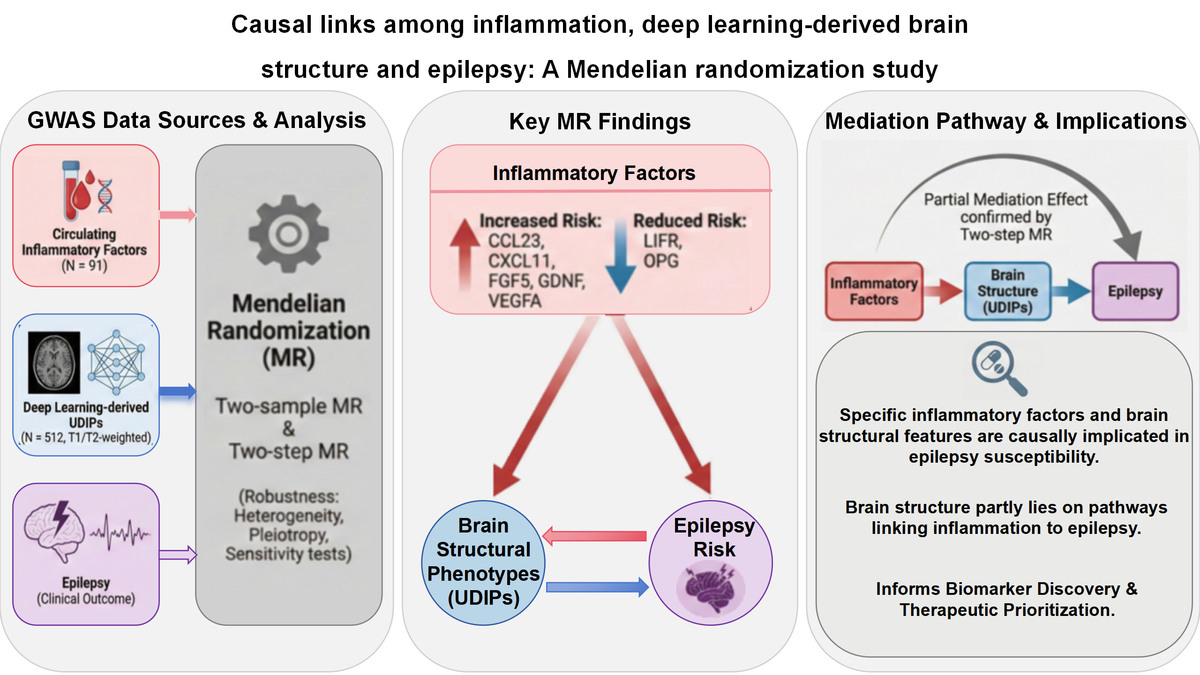
We used genome-wide association study (GWAS) summary statistics for 512 UDIPs derived from whole-brain MRI, 91 circulating inflammatory factors, and epilepsy. Two-sample MR was used to systematically estimate: (i) the effects of inflammatory factors on epilepsy, (ii) the effects of inflammatory factors on UDIPs, and (iii) the effects of UDIPs on epilepsy. We further applied two-step MR to explore whether UDIPs may mediate the associations between inflammatory factors and epilepsy. Robustness was assessed using heterogeneity tests, pleiotropy evaluation, and sensitivity analyses.
Results:
Several inflammatory factors showed significant associations with epilepsy risk. Genetically predicted higher levels of CCL23, CXCL11, FGF5, GDNF, and VEGFA were associated with increased epilepsy risk, whereas higher levels of LIFR and OPG were associated with reduced risk. MR analyses also identified multiple T1- and T2-weighted UDIP dimensions associated with epilepsy in opposite directions, indicating heterogeneous structural signatures linked to epilepsy liability (e.g., T1 dimension 76 showed a positive association, while other dimensions were inversely associated). Two-step MR suggested that, for selected pathways, UDIPs may partly explain the associations between inflammatory factors and epilepsy, consistent with partial mediation. These findings were broadly consistent across heterogeneity, pleiotropy, and sensitivity analyses.
Conclusions:
These findings implicate specific inflammatory factors and MRI-derived structural phenotypes in epilepsy susceptibility and suggest that brain structural features may partly lie on pathways linking inflammation to epilepsy, providing potential insights for biomarker discovery and therapeutic prioritization.
REFERENCES (50)
1.
Kanner AM, Bicchi MM. Antiseizure medications for adults with epilepsy: a review. JAMA 2022; 327: 1269-81.
2.
Christensen J, Trabjerg BB, Wagner RG, et al. Prevalence of epilepsy: a population-based cohort study in Denmark with comparison to Global Burden of Disease (GBD) prevalence estimates. J Neurol Neurosurg Psychiatry 2025; 96: 480-8.
3.
Lattanzi S, Trinka E, Striano P, et al. Highly purified cannabidiol for epilepsy treatment: a systematic review of epileptic conditions beyond Dravet syndrome and Lennox-Gastaut syndrome. CNS Drugs 2021; 35: 265-81.
4.
García-Ramó KB, Sanchez-Catasus CA, Winston GP. Deep learning in neuroimaging of epilepsy. Clin Neurol Neurosurg 2023; 232: 107879.
5.
Duncan JS, Trimmel K. Advanced neuroimaging techniques in epilepsy. Curr Opin Neurol 2022; 35: 189-95.
6.
Lucas A, Revell A, Davis KA. Artificial intelligence in epilepsy – applications and pathways to the clinic. Nat Rev Neurol 2024; 20: 319-36.
7.
Löscher W, Potschka H, Sisodiya SM, Vezzani A. Drug resistance in epilepsy: clinical impact, potential mechanisms, and new innovative treatment options. Pharmacol Rev 2020; 72: 606-38.
8.
Marta B, Białecka M, Machoy-Mokrzyńska A, Malinowski D, Rać M. The importance of TNF- signaling – potential risk factor in neurodegenerative and cardiovascular diseases. Arch Med Sci 2026; 22: 27-44.
9.
Zhang L, Li J, Zhang Y, Zhang H. Sanguiin inhibits cerebral hemorrhage in rats by protecting the blood-brain barrier. Arch Med Sci 2024; 20: 1345-8.
10.
Zabrodskaya Y, Paramonova N, Litovchenko A, et al. Neuroinflammatory dysfunction of the blood-brain barrier and basement membrane dysplasia play a role in the development of drug-resistant epilepsy. Int J Mol Sci 2023; 24: 12689.
11.
Zhu X, Liu J, Chen O, et al. Neuroprotective and anti-inflammatory effects of isoliquiritigenin in kainic acid-induced epileptic rats via the TLR4/MYD88 signaling pathway. Inflammopharmacology 2019; 27: 1143-53.
12.
Lange C, Storkebaum E, de Almodóvar CR, Dewerchin M, Carmeliet P. Vascular endothelial growth factor: a neurovascular target in neurological diseases. Nat Rev Neurol 2016; 12: 439-54.
13.
Guo D, Zhang B, Han L, Rensing NR, Wong M. Cerebral vascular and blood brain-barrier abnormalities in a mouse model of epilepsy and tuberous sclerosis complex. Epilepsia 2024; 65: 483-96.
14.
Rüber T, David B, Elger CE. MRI in epilepsy: clinical standard and evolution. Curr Opin Neurol 2018; 31: 223-31.
15.
Xiao F, Caciagli L, Wandschneider B, et al. Identification of different MRI atrophy progression trajectories in epilepsy by subtype and stage inference. Brain 2023; 146: 4702-16.
16.
Chen J, Ragab AAY, Doyle MF, et al. Inflammatory protein associations with brain MRI measures: Framingham Offspring Cohort. Alzheimers Dement 2024; 20: 7465-78.
17.
Patel K, Xie Z, Yuan H, et al. Unsupervised deep representation learning enables phenotype discovery for genetic association studies of brain imaging. Commun Biol 2024; 7: 414.
18.
Zhao JH, Stacey D, Eriksson N, et al. Genetics of circulating inflammatory proteins identifies drivers of immune-mediated disease risk and therapeutic targets. Nat Immunol 2023; 24: 1540-51.
19.
Palmer TM, Lawlor DA, Harbord RM, et al. Using multiple genetic variants as instrumental variables for modifiable risk factors. Stat Methods Med Res 2012; 21: 223-42.
20.
Lawlor DA, Harbord RM, Sterne JA, Timpson N, Davey Smith G. Mendelian randomization: using genes as instruments for making causal inferences in epidemiology. Stat Med 2008; 27: 1133-63.
21.
Bowden J, Davey Smith G, Haycock PC, Burgess S. Consistent estimation in mendelian randomization with some invalid instruments using a weighted median estimator. Genet Epidemiol 2016; 40: 304-14.
22.
Bowden J, Davey Smith G, Burgess S. Mendelian randomization with invalid instruments: effect estimation and bias detection through Egger regression. Int J Epidemiol 2015; 44: 512-25.
23.
Egger M, Smith GD, Phillips AN. Meta-analysis: principles and procedures. BMJ 1997; 315: 1533-7.
24.
Verbanck M, Chen CY, Neale B, Do R. Publisher Correction: detection of widespread horizontal pleiotropy in causal relationships inferred from Mendelian randomization between complex traits and diseases. Nat Genet 2018; 50: 1196.
25.
Austin GI, Pe’er I, Korem T. Distributional bias compromises leave-one-out cross-validation. Sci Adv 2025; 11: eadx6976.
26.
Yuan J, Xiong X, Zhang B, et al. Genetically predicted C-reactive protein mediates the association between rheumatoid arthritis and atlantoaxial subluxation. Front Endocrinol 2022; 13: 1054206.
27.
Li Z, Wei H, Tang X, Liu T, Li S, Wang X. Blood metabolites mediate the impact of lifestyle factors on the risk of urolithiasis: a multivariate, mediation Mendelian randomization study. Urolithiasis 2024; 52: 44.
28.
Li F, Zhao Q, Tang T, et al. Brain imaging derived phenotypes: a biomarker for the onset of inflammatory bowel disease and a potential mediator of mental complications. Front Immunol 2024; 15: 1359540.
29.
Dong X, Fan J, Lin D, et al. Captopril alleviates epilepsy and cognitive impairment by attenuation of C3-mediated inflammation and synaptic phagocytosis. J Neuroinflammation 2022; 19: 226..
30.
Terrone G, Balosso S, Pauletti A, Ravizza T, Vezzani A. Inflammation and reactive oxygen species as disease modifiers in epilepsy. Neuropharmacology 2020; 167: 107742.
31.
Purnell BS, Alves M, Boison D. Astrocyte-neuron circuits in epilepsy. Neurobiol Dis 2023; 179: 106058.
32.
Meng S, Cao H, Huang Y, et al. ASK1-K716R reduces neuroinflammation and white matter injury via preserving blood-brain barrier integrity after traumatic brain injury. J Neuroinflammation 2023; 20: 244.
33.
Liu C, Zhao XM, Wang Q, et al. Astrocyte-derived SerpinA3N promotes neuroinflammation and epileptic seizures by activating the NF-κB signaling pathway in mice with temporal lobe epilepsy. J Neuroinflammation 2023; 20: 161.
34.
Castañeda-Cabral JL, Colunga-Durán A, Ureña-Guerrero ME, et al. Expression of VEGF- and tight junction-related proteins in the neocortical microvasculature of patients with drug-resistant temporal lobe epilepsy. Microvasc Res 2020; 132: 104059.
35.
Jeong KH, Cho KO, Lee MY, Kim SY, Kim WJ. Vascular endothelial growth factor receptor-3 regulates astroglial glutamate transporter-1 expression via mTOR activation in reactive astrocytes following pilocarpine-induced status epilepticus. Glia 2021; 69: 296-309.
36.
Du X, Li F, Zhang C, et al. Eosinophil-derived chemokine (hCCL15/23, mCCL6) interacts with CCR1 to promote eosinophilic airway inflammation. Signal Transduct Target Ther 2021; 6: 91.
37.
Li Y, Han S, Wu B, et al. CXCL11 correlates with immune infiltration and impacts patient immunotherapy efficacy: a pan-cancer analysis. Front Immunol 2022; 13: 951247.
38.
Zhao Y, Li T, Jiang Z, et al. The miR-9-5p/CXCL11 pathway is a key target of hydrogen sulfide-mediated inhibition of neuroinflammation in hypoxic ischemic brain injury. Neural Regen Res 2024; 19: 1084-94.
39.
Gupta S, Viotti A, Eichwald T, et al. Navigating the blurred path of mixed neuroimmune signaling. J Allergy Clin Immunol 2024; 153: 924-38.
40.
Cerri C, Caleo M, Bozzi Y. Chemokines as new inflammatory players in the pathogenesis of epilepsy. Epilepsy Res 2017; 136: 77-83.
41.
Wu Q, Wang H, Liu X, Zhao Y, Su P. Microglial activation and over pruning involved in developmental epilepsy. J Neuropathol Exp Neurol 2023; 82: 150-9.
42.
Parthasarathy G, Pattison MB, Midkiff CC. The FGF/FGFR system in the microglial neuroinflammation with Borrelia burgdorferi: likely intersectionality with other neurological conditions. J Neuroinflammation 2023; 20: 10.
43.
Fei J, Chen S, Song X, et al. Exogenous GDNF promotes peripheral facial nerve regeneration in rats through the PI3K/AKT/mTOR signaling pathway. FASEB J 2024; 38: e23340.
44.
Eggers R, de Winter F, Tannemaat MR, Malessy MJA, Verhaagen J. GDNF gene therapy to repair the injured peripheral nerve. Front Bioeng Biotechnol 2020; 8: 583184.
45.
Shpak AA, Rider FK, Druzhkova TA, et al. Reduced levels of lacrimal glial cell line-derived neurotrophic factor (GDNF) in patients with focal epilepsy and focal epilepsy with comorbid depression: a biomarker candidate. Int.
47.
Liu L, Wang W, Huang L, et al. Injectable pathological microenvironment-responsive anti-inflammatory hydrogels for ameliorating intervertebral disc degeneration. Biomaterials 2024; 306: 122509.
48.
An W, Xing M, Fan W, Zheng K, Xu X. The ketogenic diet alleviates neuronal ferroptosis in epilepsy via HDAC4/TFRC signalling. Arch Med Sci 2026; 22: 290-300.
49.
Alyu F, Dikmen M. Inflammatory aspects of epileptogenesis: contribution of molecular inflammatory mechanisms. Acta Neuropsychiatr 2017; 29: 1-16.
50.
Hayek D, Ziegler G, Kleineidam L, et al. Different inflammatory signatures based on CSF biomarkers relate to preserved or diminished brain structure and cognition. Mol Psychiatry 2024; 29: 992-1004.
Share
RELATED ARTICLE
| eISSN: | 1896-9151 |
| ISSN: | 1734-1922 |

We process personal data collected when visiting the website. The function of obtaining information about users and their behavior is carried out by voluntarily entered information in forms and saving cookies in end devices. Data, including cookies, are used to provide services, improve the user experience and to analyze the traffic in accordance with the Privacy policy. Data are also collected and processed by Google Analytics tool (more).
You can change cookies settings in your browser. Restricted use of cookies in the browser configuration may affect some functionalities of the website.
You can change cookies settings in your browser. Restricted use of cookies in the browser configuration may affect some functionalities of the website.