Current issue
Archive
Manuscripts accepted
About the Journal
Editorial office
Editorial board
Section Editors
Abstracting and indexing
Subscription
Contact
Ethical standards and procedures
Most read articles
Instructions for authors
Article Processing Charge (APC)
Regulations of paying article processing charge (APC)


LIPID DISORDERS / CLINICAL RESEARCH
The LEASH trial: rationale and study design for early rosuvastatin-ezetimibe combination compared with stepwise rosuvastatin in high/very-high cardiovascular risk
1
Department of Vascular Diseases, University Medical Centre Ljubljana, Slovenia
2
Department of Internal Medicine, Faculty of Medicine, University of Ljubljana, Slovenia
3
Center of Preventive Cardiology, Yerevan, Armenia
4
Department of Metabolic Diseases, University Hospital Centre Zagreb, Croatia
5
Department of Cardiology and Intensive Care Medicine, Asklepios Klinik Altona, Hamburg, Germany
6
Clinic of Cardiology, University Clinical Center of Serbia, Belgrade, Serbia
7
Bekes County Central Hospital Pandy Kalman Branch, Gyula, Hungary
8
Department of Preventive Cardiology and Lipidology, Medical University of Lodz, Poland
Submission date: 2026-10-02
Acceptance date: 2026-10-02
Online publication date: 2026-10-03
Corresponding author
Borut Jug
Department of Vascular Diseases University Medical Centre Ljubljana Faculty of Medicine University of Ljubljana Zaloska 7/VI SI-1000 Ljubljana, Slovenia
Department of Vascular Diseases University Medical Centre Ljubljana Faculty of Medicine University of Ljubljana Zaloska 7/VI SI-1000 Ljubljana, Slovenia
Maciej Banach
MD, PhD, FESC, FAHA FILEP, FNLA Department of Preventive Cardiology and Lipidology Medical University of Lodz Rzgowska 281/289 93-338 Lodz, Poland
MD, PhD, FESC, FAHA FILEP, FNLA Department of Preventive Cardiology and Lipidology Medical University of Lodz Rzgowska 281/289 93-338 Lodz, Poland
KEYWORDS
dyslipidaemiarosuvastatinezetimibecombination therapylow-density lipoprotein cholesterolcardiovascular risk
TOPICS
ABSTRACT
Introduction:
Contemporary guidelines recommend early achievement of stringent low-density lipoprotein cholesterol (LDL-C) goals in patients at high or very high cardiovascular risk. The LEASH trial evaluates upfront rosuvastatin/ezetimibe combination therapy with a conventional stepwise intensification strategy in treatment-naïve patients.
Material and methods:
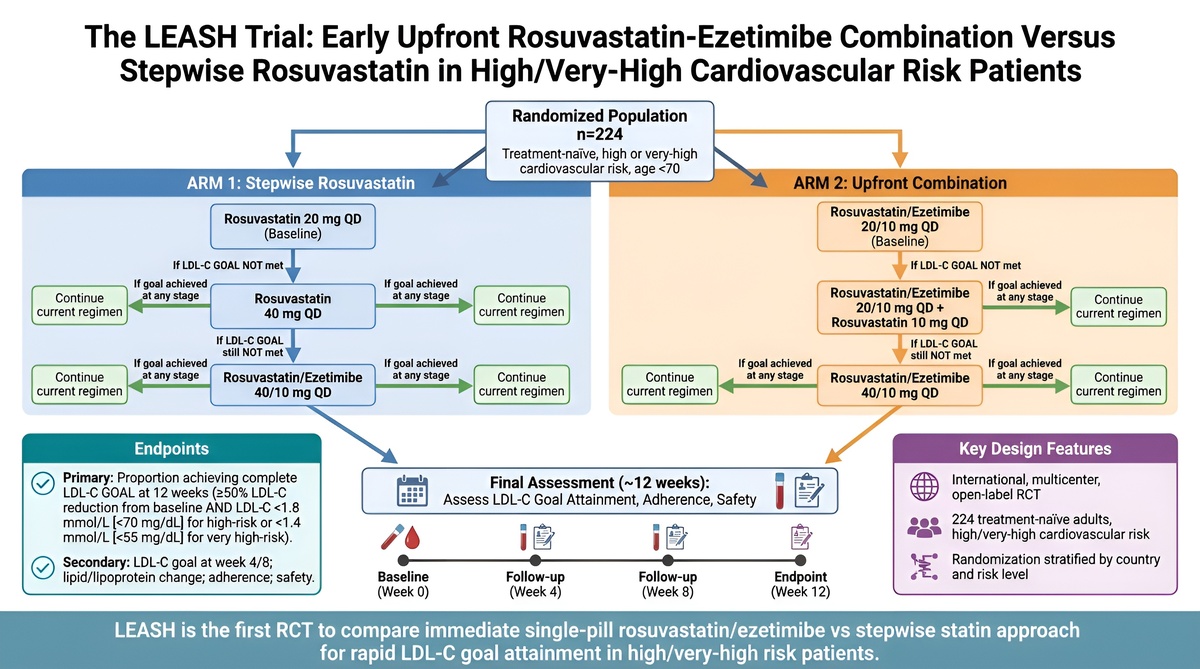
LEASH is an international, prospective, multicentre, randomised, open-label trial. Treatment-naïve adults aged < 70 years are randomised 1 : 1 within country and risk strata. Arm 1 starts with rosuvastatin 20 mg/day with protocol-directed stepwise escalation; Arm 2 starts with rosuvastatin/ezetimibe 20/10 mg/day (single-pill combination, SPC) with subsequent intensification. Treatment is reassessed at 4, 8, and 12 weeks. The primary endpoint is proportion of patients achieving complete LDL-C goal at week 12, defined as ≥ 50% reduction from baseline plus LDL-C < 1.8 mmol/l (< 70 mg/dl) for high-risk or < 1.4 mmol/l (< 55 mg/dl) for very-high-risk patients. Secondary endpoints include early goal attainment at week 4 and 8, lipoprotein changes, adherence, between-arm differences, and safety. A full analysis set of 224 patients is planned. The trial is registered as EU CT 2023-504914-31-00.
Results:
The LEASH trial is the first randomised controlled trial (RCT) to evaluate the early (4–12 weeks) efficacy and safety of an upfront SPC (rosuvastatin/ezetimibe) for LDL C reduction and goal attainment in high and very high cardiovascular risk patients. The results will inform not just whether combination therapy is effective in this population, but – critically – whether earlier initiation shortens the time to LDL C goal attainment and, consequently, reduces the risk of first and subsequent cardiovascular events.
Conclusions:
LEASH will assess whether upfront rosuvastatin/ezetimibe SPC therapy differs from conventional stepwise statin based lipid lowering intensification (with addition of ezetimibe as needed) in early (by 12 weeks) LDL C reduction and goal achievement. Therapy adherence and early safety differences between the two approaches will also be assessed.
Contemporary guidelines recommend early achievement of stringent low-density lipoprotein cholesterol (LDL-C) goals in patients at high or very high cardiovascular risk. The LEASH trial evaluates upfront rosuvastatin/ezetimibe combination therapy with a conventional stepwise intensification strategy in treatment-naïve patients.
Material and methods:
LEASH is an international, prospective, multicentre, randomised, open-label trial. Treatment-naïve adults aged < 70 years are randomised 1 : 1 within country and risk strata. Arm 1 starts with rosuvastatin 20 mg/day with protocol-directed stepwise escalation; Arm 2 starts with rosuvastatin/ezetimibe 20/10 mg/day (single-pill combination, SPC) with subsequent intensification. Treatment is reassessed at 4, 8, and 12 weeks. The primary endpoint is proportion of patients achieving complete LDL-C goal at week 12, defined as ≥ 50% reduction from baseline plus LDL-C < 1.8 mmol/l (< 70 mg/dl) for high-risk or < 1.4 mmol/l (< 55 mg/dl) for very-high-risk patients. Secondary endpoints include early goal attainment at week 4 and 8, lipoprotein changes, adherence, between-arm differences, and safety. A full analysis set of 224 patients is planned. The trial is registered as EU CT 2023-504914-31-00.
Results:
The LEASH trial is the first randomised controlled trial (RCT) to evaluate the early (4–12 weeks) efficacy and safety of an upfront SPC (rosuvastatin/ezetimibe) for LDL C reduction and goal attainment in high and very high cardiovascular risk patients. The results will inform not just whether combination therapy is effective in this population, but – critically – whether earlier initiation shortens the time to LDL C goal attainment and, consequently, reduces the risk of first and subsequent cardiovascular events.
Conclusions:
LEASH will assess whether upfront rosuvastatin/ezetimibe SPC therapy differs from conventional stepwise statin based lipid lowering intensification (with addition of ezetimibe as needed) in early (by 12 weeks) LDL C reduction and goal achievement. Therapy adherence and early safety differences between the two approaches will also be assessed.
REFERENCES (28)
1.
GBD 2023 LDL Cholesterol Collaborators; Razo C, DeCleene NK, Johnson CO, et al. Global burden of elevated LDL-C: findings From the Global Burden of Disease Study 2023. JAMA 2026; 336: 673-98. Erratum in: JAMA 2026; 336: 1072.
2.
Global Burden of Cardiovascular Diseases and Risks 2023 Collaborators. Global, regional, and national burden of cardiovascular diseases and risk factors in 204 countries and territories, 1990-2023. J Am Coll Cardiol 2025; 86: 2167-243.
3.
Ference BA, Braunwald E, Catapano AL. The LDL cumulative exposure hypothesis: evidence and practical applications. Nat Rev Cardiol 2024; 21: 701-16.
4.
Sethi Y, Mahajan K, Banach M. Global lipid guidelines: more aligned than they appear. Glob Heart 2026; 21: 41.
5.
Mach F, Baigent C, Catapano AL, et al. 2019 ESC/EAS Guidelines for the management of dyslipidaemias: lipid modification to reduce cardiovascular risk. Eur Heart J 2020; 41: 111-88.
6.
Visseren FLJ, Mach F, Smulders YM, et al. 2021 ESC-Guidelines on cardiovascular disease prevention in clinical practice. Eur Heart J 2021; 42: 3227-337.
7.
Blumenthal RS, Morris PB, Gaudino M, et al. 2026 ACC/AHA/AACVPR/ABC/ACPM/ADA/AGS/APhA/ASPC/NLA/PCNA Guideline on the Management of Dyslipidemia: A Report of the American College of Cardiology/American Heart Association Joint Committee on Clinical Practice Guidelines. Circulation 2026; 153: e1154-276.
8.
Banach M, Penson PE, Vrablik M, et al. Optimal use of lipid-lowering therapy after acute coronary syndromes: a position paper endorsed by the International Lipid Expert Panel (ILEP). Pharmacol Res 2021; 166: 105499.
9.
Ray KK, Reeskamp LF, Laufs U, et al. Combination lipid-lowering therapy as first-line strategy in very high-risk patients. Eur Heart J 2022; 43: 830-3.
10.
De Backer G, Jankowski P, Kotseva K, et al. Management of dyslipidaemia in patients with coronary heart disease: results from the ESC-EORP EUROASPIRE V survey in 27 countries. Atherosclerosis 2019; 285: 135-46.
11.
Ray KK, Molemans B, Schoonen WM, et al. EU-wide cross-sectional observational study of lipid-modifying therapy use in secondary and primary care: the DA VINCI study. Eur J Prev Cardiol 2021; 28: 1279-89.
12.
Ray KK, Haq I, Bilitou A, et al. Treatment gaps in the implementation of LDL cholesterol control among high- and very high-risk patients in Europe between 2020 and 2021: the multinational observational SANTORINI study. Lancet Reg Health Eur 2023; 29: 100624.
13.
Šabović M, Pejkov H, Caraus A, et al. Suboptimal management of hypercholesterolemia in countries with high or very high cardiovascular risk: findings from the international DISCOVERY study. Front Cardiovasc Med 2025; 12: 1665059.
14.
Banach M, Surma S, Guzik TJ, et al. Upfront lipid-lowering combination therapy in high cardiovascular risk patients: a route to effective atherosclerotic cardiovascular disease prevention. Cardiovasc Res 2025; 121: 851-9.
15.
Mach F, Koskinas KC, Roeters van Lennep JE, et al. 2025 focused update of the 2019 ESC/EAS guidelines for the management of dyslipidaemias. Eur Heart J 2025; 46(42): 4359-78.
16.
Averna M, Banach M, Bruckert E, et al. Practical guidance for combination lipid-modifying therapy in high- and very-high-risk patients: a statement from a European Atherosclerosis Society Task Force. Atherosclerosis 2021; 325: 99-109.
17.
Banach M, Reiner Ž, Surma S, et al. 2024 Recommendations on the optimal use of lipid-lowering therapy in established atherosclerotic cardiovascular disease and following acute coronary syndromes: a position paper of the International Lipid Expert Panel (ILEP). Drugs 2024; 84: 1541-77.
18.
Parhofer KG, Aguiar C, Banach M, et al. Expert opinion on the integration of combination therapy into the treatment algorithm for the management of dyslipidaemia: the integration of ezetimibe and bempedoic acid may enhance goal attainment. Eur Heart J Cardiovasc Pharmacother 2025; 11: 367-79.
19.
Cannon CP, Blazing MA, Giugliano RP, et al. Ezetimibe added to statin therapy after acute coronary syndromes. N Engl J Med 2015; 372: 2387-97.
20.
Kim BK, Hong SJ, Lee YJ, et al. Long-term efficacy and safety of moderate-intensity statin with ezetimibe combination therapy versus high-intensity statin monotherapy in patients with atherosclerotic cardiovascular disease (RACING): a randomised, open-label, non-inferiority trial. Lancet 2022; 400: 380-90.
21.
Jang JY, Kim S, Cho J, Chun SY, You SC, Kim JS. Comparative effectiveness of moderate-intensity statin with ezetimibe therapy versus high-intensity statin monotherapy in patients with acute coronary syndrome: a nationwide cohort study. Sci Rep 2024; 14: 838.
22.
Banach M, Jaiswal V, Ang SP, et al. Impact of lipid-lowering combination therapy with statins and ezetimibe vs statin monotherapy on the reduction of cardiovascular outcomes: a meta-analysis. Mayo Clin Proc 2025; 100: 2152-71.
23.
de Oliveira Almeida G, Balieiro C, Bertoli ED, et al. Cardiovascular benefits of statin plus ezetimibe combination therapy versus statin monotherapy in acute coronary syndrome: a meta-analysis of randomized controlled trials. Coron Artery Dis 2025; 36: 9-17.
24.
SCORE2-Diabetes Working Group and the ESC Cardiovascular Risk Collaboration. SCORE2-Diabetes: 10-year cardiovascular risk estimation in type 2 diabetes in Europe. Eur Heart J 2023; 44: 2544-56.
25.
Lewis JA. Statistical principles for clinical trials (ICH E9): an introductory note on an international guideline. Stat Med 1999; 18: 1903-42.
26.
Lewek J, Niedziela J, Desperak P, et al. Intensive statin therapy versus upfront combination therapy of statin and ezetimibe in patients with acute coronary syndrome: a propensity score matching analysis based on the PL-ACS Data. J Am Heart Assoc 2023; 12: e030414.
27.
Liu L, Deng Y, Li L, Yang X, Yin Z, Lai Y. Efficacy and safety of moderate-intensity rosuvastatin plus ezetimibe versus high-intensity rosuvastatin monotherapy in the treatment of composite cardiovascular events with hypercholesterolemia: a meta-analysis. PLoS One 2024; 19: e0310696.
28.
Marx N, Federici M, Schütt K, et al. 2023 ESC Guidelines for the management of cardiovascular disease in patients with diabetes. Eur Heart J 2023; 44: 4043-140.
Share
RELATED ARTICLE
| eISSN: | 1896-9151 |
| ISSN: | 1734-1922 |

We process personal data collected when visiting the website. The function of obtaining information about users and their behavior is carried out by voluntarily entered information in forms and saving cookies in end devices. Data, including cookies, are used to provide services, improve the user experience and to analyze the traffic in accordance with the Privacy policy. Data are also collected and processed by Google Analytics tool (more).
You can change cookies settings in your browser. Restricted use of cookies in the browser configuration may affect some functionalities of the website.
You can change cookies settings in your browser. Restricted use of cookies in the browser configuration may affect some functionalities of the website.