Introduction
Osteoporosis (OP) is a systemic skeletal disorder [1]. The clinical manifestations include fractures, pain, height reduction, kyphosis, respiratory difficulties, and gastrointestinal symptoms [2]. According to data from the U.S. Centers for Disease Control and Prevention (CDC), approximately 10.2 million U.S. adults aged ≥ 50 years have OP, with an additional 43.4 million at risk of developing the disease [3]. In particular, postmenopausal women over age 50 experience accelerated bone loss, resulting in a substantially elevated risk of osteoporotic fractures (OPFs) [4]. Evidence has highlighted that the gut microbiota (GM) influences skeletal homeostasis via multiple mechanisms, such as the modulation of host metabolism, immune function, hormone secretion, and the gut-brain axis [5]. Hathaway-Schrader et al. treated mice with broad-spectrum antibiotics (vancomycin, imipenem/cilastatin, and neomycin) to examine the impact of gut dysbiosis on bone [6]. They observed a significant increase in α-proteobacteria, reductions in Bacteroidetes and Firmicutes, enhanced RANKL-mediated osteoclastogenesis, doubled circulating levels of tumor necrosis factor α (TNF-α) and CCL3, and deteriorated trabecular microarchitecture. These findings demonstrate that intestinal dysbiosis can markedly alter bone metabolism and skeletal structure, providing evidence-based support for the association between the diversity of GM and OP [6].
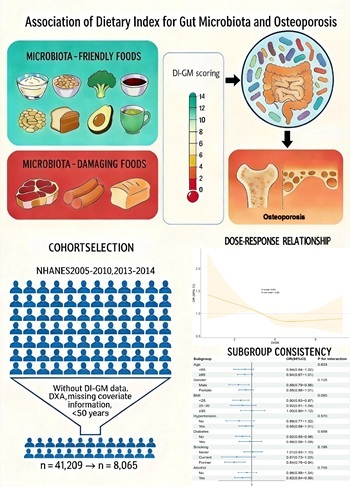
Given that diet is a primary factor modulating the GM [7], the Dietary Index for GM (DI-GM) was developed to appraise dietary patterns that influence the diversity and functionality of GM [8]. We hypothesized that the DI-GM could serve as a novel, cost-effective, and diet-modifiable biomarker for assessing the risk of OP. Therefore, based on data from the U.S. National Health and Nutrition Examination Survey (NHANES) in 2005–2010 and 2013–2014, this research assessed the association between the DI-GM and the risk of OP among individuals aged ≥ 50 years.
Material and methods
Study population and data source
This research leveraged data from the NHANES, covering four cycles from 2005 to 2010 and 2013 to 2014. The NHANES, conducted by the U.S. National Center for Health Statistics (NCHS) of the Centers for Disease Control and Prevention (CDC), was approved by the NCHS Ethics Review Board. To protect the rights of participants, informed written consent was acquired from all individuals. The NHANES uses a sophisticated, multistage, stratified probability sampling method to ensure the selection of a cohort that is demographically representative of the entire U.S. population [9]. The NHANES datasets are available at https://www.cdc.gov/nchs/nhanes/index.html.
The data collected by NHANES comprised five core components: (1) demographics included survey design variables (weights, stratification, and primary sampling units) and demographic variables; (2) information regarding participants’ nutrition consumption encompassed foods and beverages, alongside nutritional additives; (3) information on examination was gathered from physical examinations and dental check-ups; (4) laboratory data included analysis results from blood, urine, hair, air, tuberculin skin tests, and household dust and water samples; (5) questionnaire data were collected through interviews conducted at home and mobile examination centers.
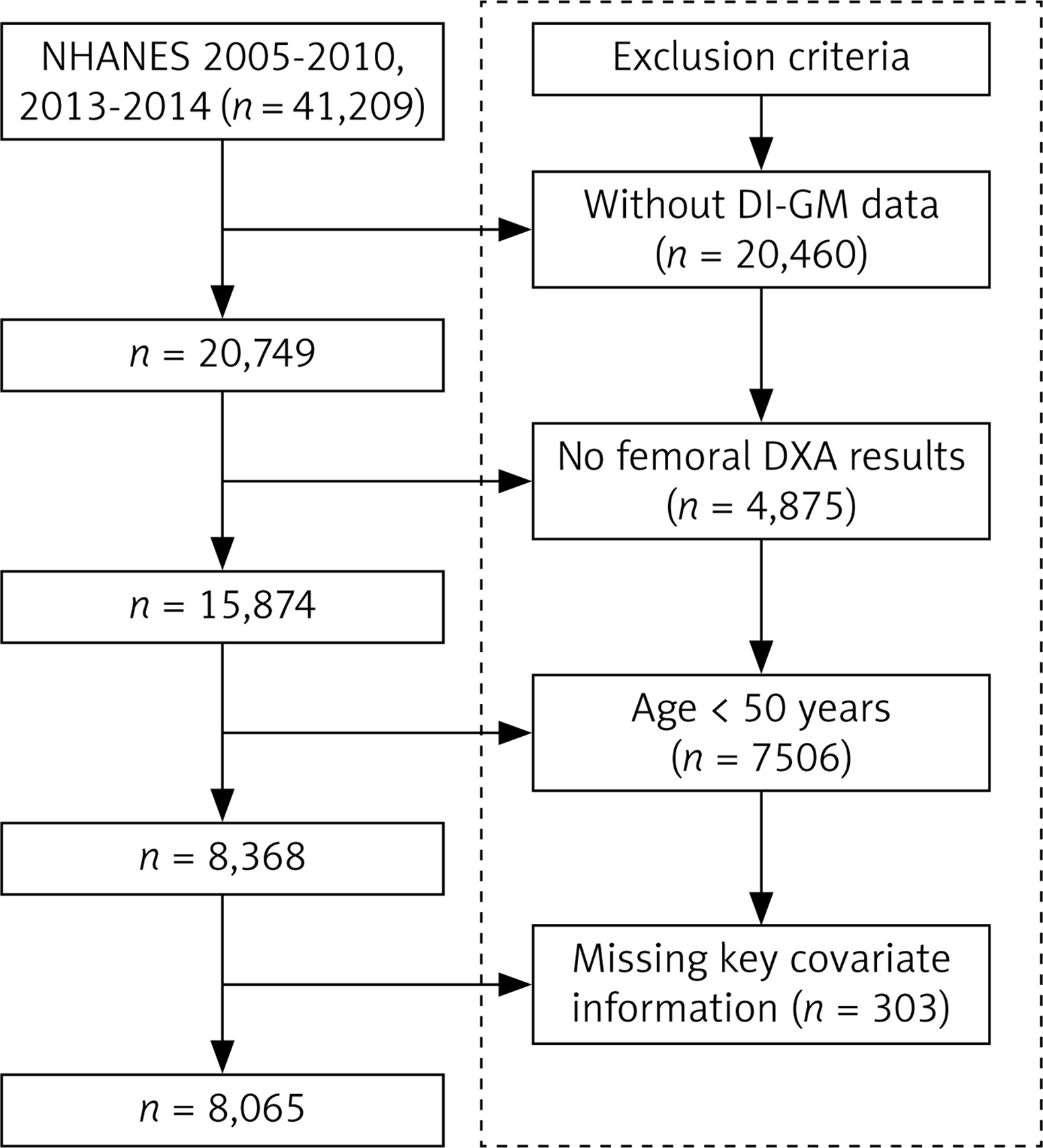
This study included 41,209 participants across four survey cycles. We excluded individuals with incomplete DI-GM data (n = 20,460), those without femoral dual-energy X-ray absorptiometry (DXA) results (n = 4,875), participants aged < 50 years (n = 7,056), and those missing covariate information (n = 303), such as demographic data, body mass index (BMI), albumin, total calcium (TC), hypertension (HTN), diabetes, smoking status (SS), and alcohol consumption (ALC). Detailed inclusion and exclusion criteria are presented in Figure 1.
Screening criteria for OP and age
Based on WHO criteria, OP in adults aged ≥ 50 years was defined as the bone mineral density (BMD) at the lumbar spine, total hip, or femoral neck (FN) ≤ 2.5 standard deviations below the average BMD of young adults of the same sex [4]. BMD values derived from NHANES DXA scans, including measurements at the FN, trochanter, intertrochanteric region, and total femur, served as the diagnostic basis, while data from participants aged 20–29 years were leveraged as the control group.
Predictive variables
The DI-GM score included 14 dietary components, comprising 10 gut-friendly foods – avocados, broccoli, chickpeas (CPs), coffee, cranberries, fermented dairy products (FDPs), DF, green tea, soy, and whole grains (WG) – and four foods harmful for gut health: red meat (RM), processed meats (PM), refined grains (RG), and high-fat diets (≥ 40% of energy from fat) [8]. Dietary components were categorized based on sex-specific median values. For beneficial components, a score of 1 was given for intake ≥ the median (0 otherwise); for harmful components, a score of 1 was given for intake < the median (0 otherwise). The aggregated DI-GM score ranged from 0 to 14, comprising health-promoting food scores (0–10) and harmful food scores (0–4). Individuals were classified into four groups based on aggregated scores – 0–3, 4, 5, and ≥ 6 points – with greater scores signifying a diet more favorable to GM health [10]. This research leveraged data on dietary intake from the first two recall interviews in the NHANES database.
Covariates
This research included various confounders, encompassing age, sex, race/ethnicity, educational level, marital status (MS), household income and poverty-to-income ratio (PIR), HTN, diabetes, SS, ALC, BMI, creatinine (Cr), TC, cholesterol, albumin, uric acid (UA), and vitamin D (VD). HTN was characterized by fulfilling any of the following criteria: (1) mean systolic blood pressure ≥ 130 mm Hg or diastolic blood pressure ≥ 80 mm Hg from three consecutive measurements [11]; (2) a physician’s diagnosis of HTN; (3) current use of antihypertensive prescription medications [11]. Diabetes was characterized by fulfilling any of the following criteria: (1) HbA1c ≥ 6.5%; (2) GLU ≥ 126 mg/dl; (2) OGTT ≥ 200 mg/dl; (4) a physician’s diagnosis of diabetes; (5) current use of antidiabetic medications or insulin [12]. SS was categorized based on lifetime cigarette consumption of ≥ 100 cigarettes. Participants who answered ‘yes’ were classified as current smokers, while those who reported having quit were classified as former smokers. All others were classified as non-smokers. Continuous variables with > 20% missing values were excluded. For continuous variables with ≤ 20% missing values, a multiple imputation random forest-based method (multiple imputation by chained equations, MICE with random forest) was applied.
Statistical analysis
The intricate sampling design of NHANES was accounted for in all data analyses. Weighted statistical methods were employed to guarantee the representativeness and reliability of the findings. Nationwide representativeness was achieved through the multistage probability sampling design of NHANES. In accordance with the NCHS, weights (WTDRD1/4), pseudo-strata, and pseudo-clusters were incorporated to capture the complexity of the design. Individuals were stratified based on OP status and further classified into four groups according to DI-GM scores [9]. Normally distributed continuous variables were compared using weighted one-way ANOVA; non-normally distributed variables were analyzed with the weighted Kruskal-Wallis test. Categorical variables were compared using the weighted χ2 test. All continuous variables in our analysis were non-normally distributed and reported as medians (Q1, Q3); categorical variables were presented as frequencies and percentages.
Three multivariable weighted logistic regression (WLR) models were constructed to estimate the relationship between DI-GM and OP. Before modeling, variance inflation factor analysis was used to evaluate multicollinearity among covariates [10]. Model 1 was unadjusted. Model 2 was adjusted for sex and age. Model 3 was further adjusted for race, educational level, MS, PIR, HTN, diabetes, SS, ALC, BMI, Cr, TC, cholesterol, albumin, UA, and VD. In the WLR analysis, DI-GM was examined as a continuous variable and by groups. The results of each model were presented as odds ratios with 95% confidence intervals (CI).
Restricted cubic splines (RCS) analysis was applied to evaluate the dose-response relationship between DI-GM and the risk of OP [10]. Subgroup analyses were performed to validate the reliability of the findings, stratified by age, sex, HTN, diabetes, SS, ALC, and BMI. All analyses were implemented using R software (version 4.4.3). A two-sided p < 0.05 signified statistical significance.
Results
Basic information
This research included 8,065 participants, of whom 48.47% (4,193) were male and 51.53% (3,872) were female. The median age was 61 years, and the prevalence of OP was 15.12% (1,285/8,065). Detailed information is shown in Supplementary Table SI. In the analysis of inter-group differences across the four DI-GM groups, the following covariates showed no significant differences: MS (p = 0.443), TC (p = 0.425), cholesterol (p = 0.124), and albumin (p = 0.117). Conversely, all other clinical characteristics exhibited significant differences, including gender (p < 0.001), age (p = 0.001), race (p < 0.001), education (p < 0.001), PIR (p < 0.001), HTN (p < 0.001), diabetes (p = 0.005), SS (p < 0.001), ALC (p < 0.001), Cr (p < 0.001), UA (p < 0.001), BMI (p < 0.001), and VD (p < 0.001). Comprehensive data are presented in Table I.
Table I
Basic characteristics of participants by DI-GM scores
[i] Continuous variables are expressed as weighted median (Q1, Q3), while categorical variables are expressed as weighted percentages. ALC – alcohol consumption, BMD – bone mineral density, BMI – body mass index, Cr – creatinine, HTN – hypertension, MS – marital status, PIR – poverty-to-income ratio, SS – smoking status, TC – total calcium, UA – uric acid, VD – vitamin D.
Association between DI-GM and OP
The WLR results indicated that both continuous and categorical analyses exhibited an association between DI-GM and the prevalence of OP (Table II). Regardless of covariate adjustments, continuous analysis revealed a marked negative association between DI-GM scores and the prevalence of OP (Model 1: OR = 0.947 [0.897, 0.999]; Model 2: OR = 0.937 [0.884, 0.993]; Model 3: OR = 0.929 [0.874, 0.988], all p < 0.05). After further adjusting for covariates in Model 3, the risk of OP was reduced by 36.1% for those with DI-GM ≥ 6 relative to those with DI-GM ≤ 5 (OR = 0.639 [0.441, 0.925], p < 0.05).
Table II
Association of Dietary Index for Gut Microbiota (DI-GM) and prevalence of osteoporosis
[i] Model 1: adjusted for gender, age. Model 2: adjusted for gender, age, race, education, hypertension, diabetes, smoking status, alcohol consumption, creatinine, total calcium, albumin. Model 3: adjusted for gender, age, race, education, marital status, poverty-to-income ratio, hypertension, diabetes, smoking status, alcohol consumption, body mass index, creatinine, total calcium, cholesterol, albumin, uric acid.
Dose-response interrelation between DI-GM and OP
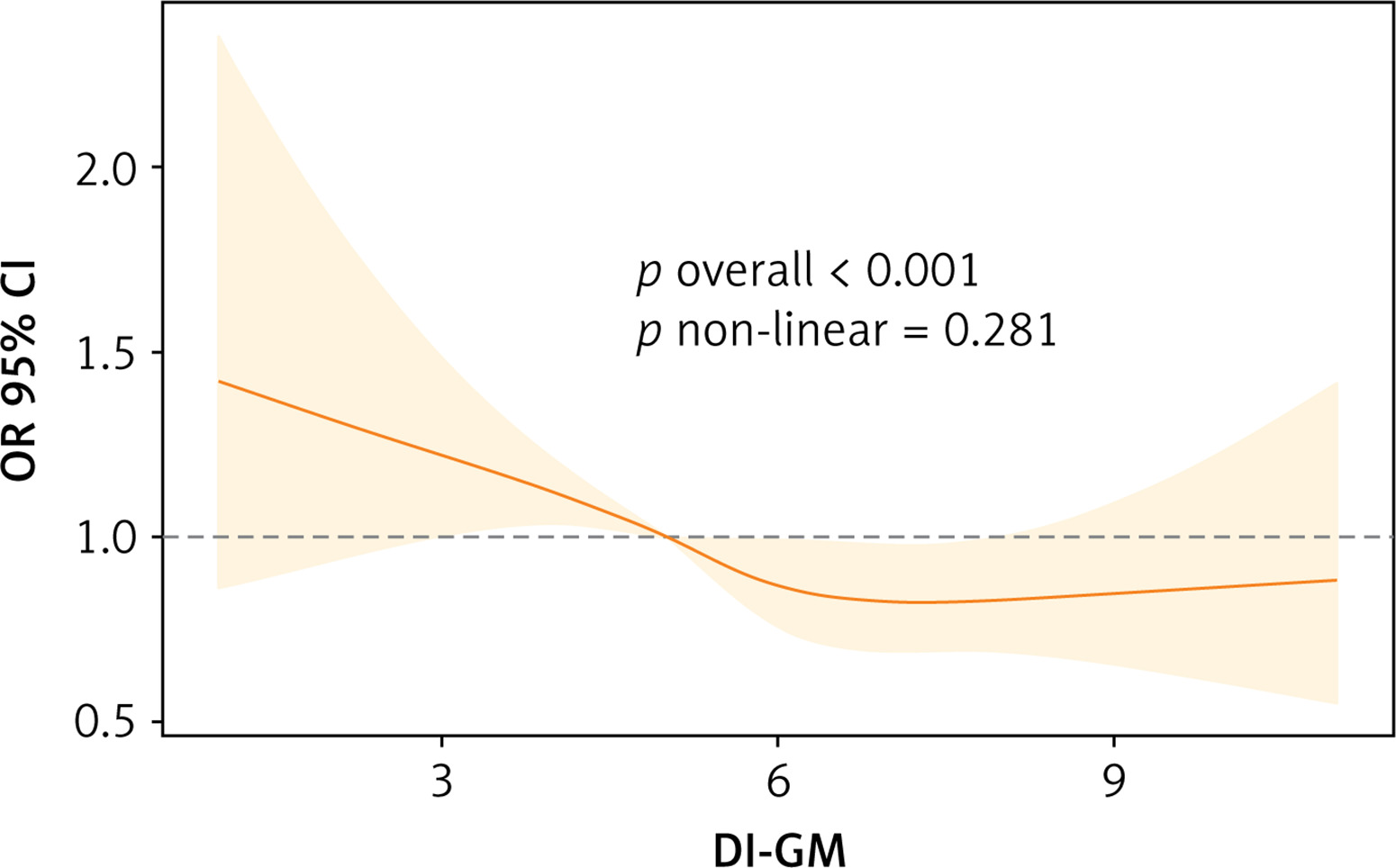
Restricted cubic splines analysis was performed to determine whether there was a dose-response relationship between DI-GM and OP (Figure 2). After adjusting for all covariates, the overall risk of OP decreased with increasing DI-GM scores (overall p < 0.05), revealing a linear association between OP and DI-GM (pnonlinear = 0.281).
Figure 2
Association between Dietary Index for Gut Microbiota (DI-GM) and OP by RCS curve. The overall risk of OP decreased significantly as DI-GM scores increased (p overall < 0.01); a further non-linearity test confirmed that the relationship between DI-GM and OP followed a linear pattern (p non-linear = 0.281), with no significant nonlinear deviation
Subgroup analysis
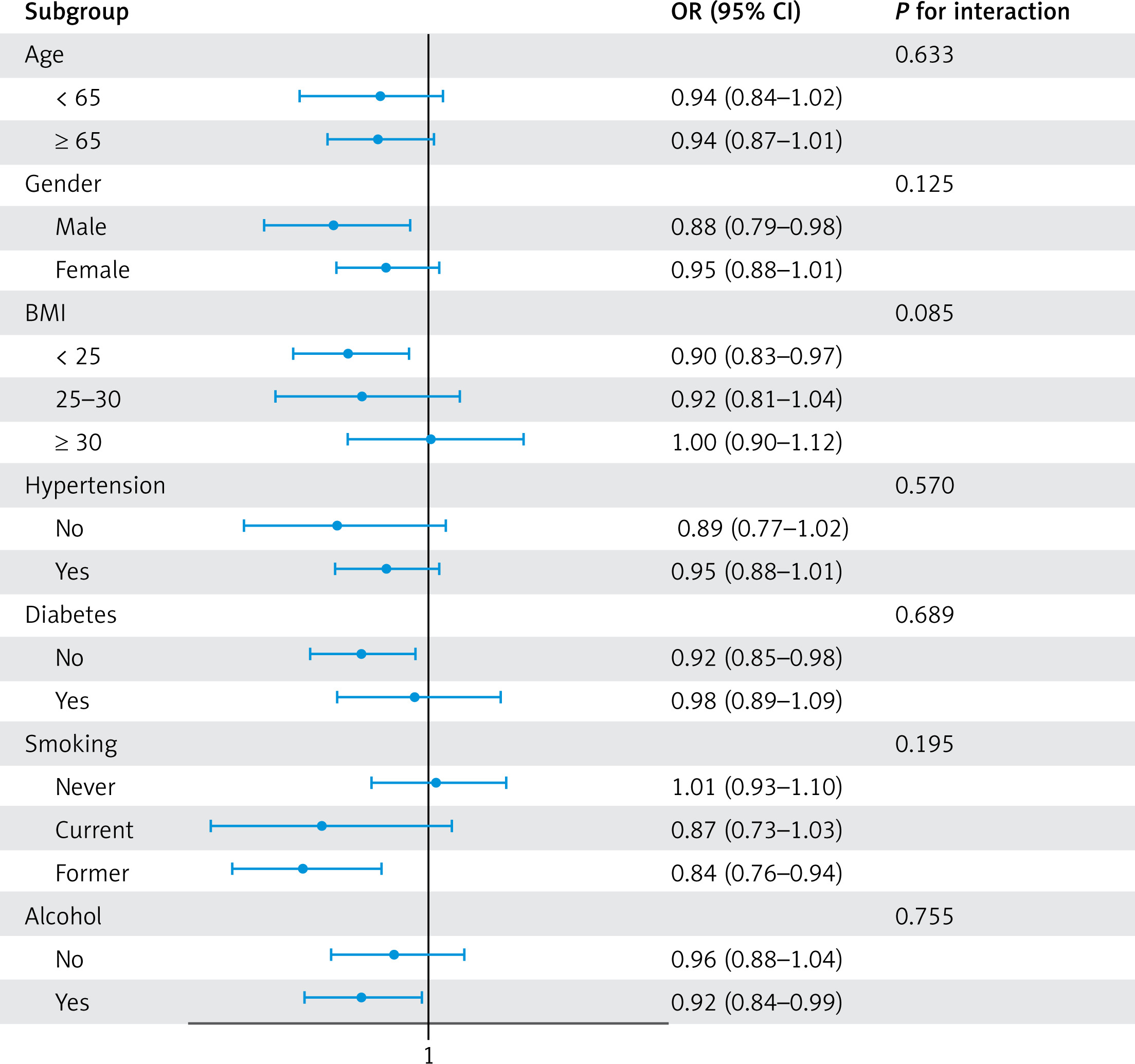
Participants were stratified based on various features. As shown in Figure 3, associations between DI-GM and OP remained significant in men (OR = 0.88, 95% CI: 0.79–0.98), individuals with BMI < 25 (OR = 0.90, 95% CI: 0.83–0.97), those without HTN (OR = 0.89, 95% CI: 0.77–1.02) or diabetes (OR = 0.92, 95% CI: 0.85–0.98), former smokers (OR = 0.84, 95% CI: 0.76–0.94), and drinkers (OR = 0.92, 95% CI: 0.84–0.99). Interaction terms were used to assess heterogeneity among subgroups. No significant differences were detected between any subgroups (all p for interaction > 0.05). The interaction tests indicated that the association was independent of age, gender, BMI, diabetes, HTN, ALC, or smoking, demonstrating its potential generalizability in diverse populations.
Discussion
This research leveraged data from the 2005–2010 and 2013-2014 U.S. NHANES to assess the association between DI-GM and the risk of OP. The findings revealed a marked linear negative relationship between DI-GM and the risk of OP. The risk of OP significantly decreased with increasing DI-GM scores. Subgroup analyses further validated the reliability of the results. The findings demonstrated that, based on the DI-GM scoring system, it is beneficial to include more gut-health-promoting foods, such as avocados, broccoli, CPs, coffee, cranberries, FDPs, DF, green tea, soy, and WG. Meanwhile, reducing the intake of foods detrimental to gut health (RM, PM, RG, and fats) can reduce the risk of OP.
Bone health is a multidimensional concept that encompasses bone mineral content, bone mass, the geometric structure of bones, and the health status of their microstructure [13]. The pathogenesis of OP is highly complex. Genetically, its occurrence and development are closely related to the abnormal expression of key regulatory genes (e.g., ADRB1, DHTKD1, GPR116, and OSTF1) [14]. However, bone health is influenced by genetic factors and closely related to lifestyle and environment (e.g., lead, cadmium exposure), with dietary nutrition playing an especially critical role in bone health [15, 16].
As a complex microbial ecosystem, GM contributes substantially to the health of the host through its diversity and function. Interventions for GM can ameliorate various immune or metabolic diseases, including type 2 diabetes, obesity, and Alzheimer’s disease [17]. Consequently, regulating the GM has become an effective approach to treating various diseases. When exploring the association between diet and bone health, we should not only focus on the direct effects of dietary components on bones but also understand the mediating role of the GM. Supplementation with fermented soy milk containing Lactobacillus paracasei JM053 alleviates dexamethasone-induced OP by modulating inflammatory indicators such as TNF-α and elevating bone formation markers such as alkaline phosphatase and osteocalcin [18]. In vivo, a high-fat beef protein diet (HFB) reduced the abundance of beneficial gut bacteria (e.g., Anaerotruncus, Butyricicoccus, and Lactobacillus) and promoted glucose metabolism impairment and insulin resistance (IR), which in turn led to significantly elevated serum levels of triglycerides, LDL-C, total cholesterol, pro-inflammatory cytokines (IL-1β, TNF-α, IL-6), and leptin, exacerbating osteoporotic bone loss in mice [19].
Kase et al. developed the DI-GM score based on a systematic review involving 106 studies, incorporating 14 dietary elements demonstrated to influence GM diversity, the generation of short-chain fatty acid (SCFA), and certain bacterial populations [8]. Relative to other dietary indices, the DI-GM score highlights the influence of individual foods on the GM, providing a solid scientific foundation and higher precision. Our analysis showed that, compared to the cohort with the lowest DI-GM, the cohort with the highest DI-GM exhibited lower levels of HTN, diabetes, BMI, Cr, and UA. We found that a high DI-GM diet did not exert anti-osteoporotic effects by directly increasing BMD. The findings revealed a negative association between DI-GM and risk of OP. The potential mechanisms may involve the following aspects: Firstly, high DI-GM diets might enhance overall metabolic health through modulating the composition and function of the GM, thereby indirectly reducing the risk of OP. High DI-GM diets are abundant in components such as DFs and polyphenols, which can promote the proliferation of beneficial microbiota (e.g., BPB), improve the function of gut barrier and immune homeostasis, reduce chronic inflammatory responses, decrease oxidative stress levels, and positively affect bone health [8, 20]. Moreover, a high DI-GM diet may enhance the diversity and functions of the GM, improving nutrient absorption and utilization efficiency. The GM is crucial in nutrient absorption, and a high DI-GM diet can release more nutrients, such as VD, which are essential for bone health [21]. Moreover, high DI-GM diets might regulate the metabolic products of the GM and diminish the occurrence of diseases, including HTN, diabetes, obesity, and hyperuricemia, thereby lowering the risk of OP indirectly. Dysbiosis of the microbiota leads to a deficiency of SCFAs, such as propionate, acetate, and butyrate. This deficiency can trigger IR, inflammation, and metabolic changes, thereby contributing to the onset of HTN, obesity, diabetes, and hyperuricemia [22–24]. These metabolic disorders subsequently impair skeletal health through multiple mechanisms, including chronic inflammation, abnormal bone metabolism, and deterioration of bone microstructure [25, 26].
This research has numerous strengths. Firstly, it is pioneering in ascertaining the significant association between DI-GM and OP after controlling for confounders. Also, it demonstrates that elevated DI-GM is progressively associated with a diminished risk of OP. Additionally, this research established a linear dose-response relationship between DI-GM and risk of OP, indicating that DI-GM has sustained protective effects on the progression of OP. Our findings suggest that enhancing DI-GM through dietary adjustments could potentially mitigate the risk of OP.
Nevertheless, this research has several limitations. Firstly, though the NHANES data are nationally representative of the United States, the findings might not be generalizable to populations from other nations or ethnic groups with distinct dietary structures and GM compositions. Furthermore, although a validated dietary recall method was employed, data on self-reported dietary intake remain subject to potential measurement bias. Moreover, the cross-sectional design precludes causal inferences and impedes assessment of the temporal relationship between DI-GM and OP. Finally, this study did not account for unmeasured confounders such as genetic predisposition, antibiotic use, probiotic supplementation, and dietary patterns not captured by the DI-GM, all of which could potentially affect the results.
This study identified a significant linear relationship between the DI-GM and OP, indicating that a diet promoting gut microbiota diversity may lower the risk of OP. These results highlight the utility of the DI-GM as a tool for evaluating dietary impacts on bone health, laying a scientific foundation for preventive nutritional strategies.