Current issue
Archive
Manuscripts accepted
About the Journal
Editorial office
Editorial board
Section Editors
Abstracting and indexing
Subscription
Contact
Ethical standards and procedures
Most read articles
Instructions for authors
Article Processing Charge (APC)
Regulations of paying article processing charge (APC)


GASTROENTEROLOGY / CLINICAL RESEARCH
Association of insulin resistance with chronic diarrhea: a study based on the NHANES database 2005–2010
1
Department of Endocrine, Jinhua Hospital of Traditional Chinese Medicine, China
2
Department of Spleen and Stomach Diseases, Jinhua Hospital of Traditional Chinese Medicine, China
These authors had equal contribution to this work
Submission date: 2025-12-02
Final revision date: 2026-02-04
Acceptance date: 2026-02-17
Online publication date: 2026-06-04
Corresponding author
Xue Huang
Department of Spleen and Stomach Diseases Jinhua Hospital of Traditional Chinese Medicine, China
Department of Spleen and Stomach Diseases Jinhua Hospital of Traditional Chinese Medicine, China
KEYWORDS
TOPICS
ABSTRACT
Introduction:
Evidence regarding the association of insulin resistance (IR) with chronic diarrhea (CD) remains scarce, especially in the absence of robust epidemiological support from large-scale population cohorts. We aimed to explore the association of IR with CD using a cross-sectional analysis of data from the National Health and Nutrition Examination Survey (NHANES) from 2005 to 2010.
Material and methods:
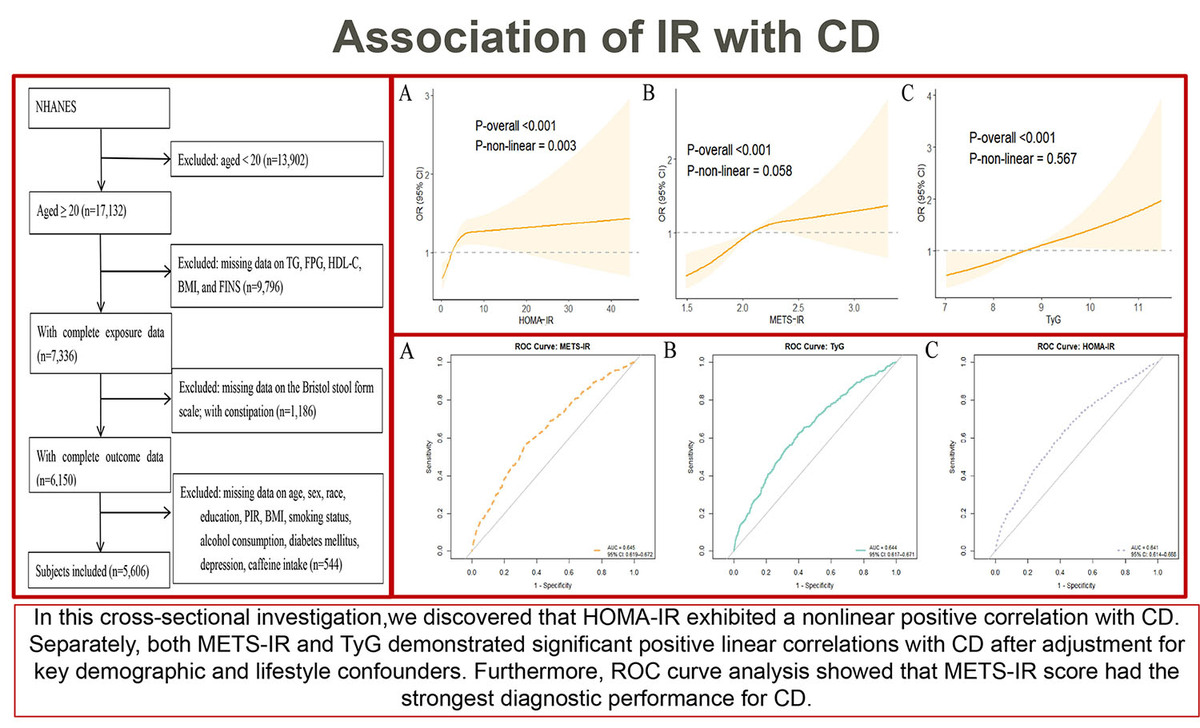
Multiple logistic regression models combined with subgroup analyses were leveraged to explore the association of IR (triglyceride-glucose [TyG] index, metabolic score for insulin resistance [METS-IR], and homeostasis model assessment of insulin resistance [HOMA-IR]) with the prevalence of CD. Nonlinear associations were assessed using restricted cubic spline (RCS) curves. Finally, the discriminative performance of these indicators was assessed using receiver operating characteristic (ROC) curves and the area under the curve (AUC).
Results:
After full adjustment for covariates (e.g., sex, age, race, education, poverty-to-income ratio (PIR), body mass index (BMI), smoking status), the TyG index (OR = 1.35, 95% CI: 1.12–1.63), METS-IR (OR = 2.00, 95% CI: 1.31–3.06), and HOMA-IR (OR = 1.02, 95% CI: 1.00–1.03) showed positive associations with the prevalence of CD. The RCS curve analysis showed a non-linear association between HOMA-IR and CD (p-non-linear = 0.003), with an inflection point at 2.423. METS-IR and TyG showed a significant positive linear association with CD (both p-non-linear > 0.05). The ROC curve analysis identified METS-IR as the best-discriminating indicator for CD (AUC = 0.645, 95% CI: 0.619–0.672).
Conclusions:
The present research identified a significant positive association between IR and CD among a demographically representative cohort of US adults. Elevated IR scores are significantly associated with the prevalence of CD.
REFERENCES (38)
1.
Xu F, Dai N. Long-term symptom development of functional bowel disease and the effects of lactose-restricted diet on the symptoms. Chin J Digestion 2017; 37: 673-8.
2.
Wang C, Wang JA. Internal Medicine. 3 edn. People’s Medical Publishing House; Beijing 2015; 509-14.
3.
Schiller LR, Pardi DS, Sellin JH. Chronic diarrhea: diagnosis and management. Clin Gastroenterol Hepatol 2017; 15: 182-93.e183.
4.
Jiang WL, Wang HR. Effect of berberine hydrochloride tablets combined with metformin on blood glucose control and quality of life in patients with type 2 diabetes mellitus. Chronic Pathematol J 2019; 8: 1228-9, 32.
5.
Yarandi SS, Srinivasan S. Diabetic gastrointestinal motility disorders and the role of enteric nervous system: current status and future directions. Neurogastroenterol Motil 2014; 26: 611-24.
6.
Wang XQ, Hu MM, Wang W, et al. Research progress in pathogenesis of diabetic gastrointestinal dysfunction. World Chin J Digestol 2016; 24: 2682-7.
7.
Duan XJ. Clinical study on Yiqi Yangyin Hewei Decoction in treating type 2 diabetic gastroenteropathy. Acta Chin Med 2015; 5: 647-9.
8.
Saad MJ, Santos A, Prada PO. Linking gut microbiota and inflammation to obesity and insulin resistance. Physiology 2016; 31: 283-93.
9.
Han X, Yao Z, Li JY, Lu H. Research progress on intestinal immunity-chronic inflammation, insulin resistance and traditional Chinese medicine treatment. China J Trad Chin Med Pharm 2019; 34: 2620-3.
10.
Sommers T, Mitsuhashi S, Singh P, et al. Prevalence of chronic constipation and chronic diarrhea in diabetic individuals in the United States. Am J Gastroenterol 2019; 114: 135-42.
11.
Salgaço MK, Oliveira LGS, Costa GN, et al. Relationship between gut microbiota, probiotics, and type 2 diabetes mellitus. Appl Microbiol Biotechnol 2019; 103: 9229-38.
12.
Lee CJ, Sears CL, Maruthur N. Gut microbiome and its role in obesity and insulin resistance. Ann N Y Acad Sci 2020; 1461: 37-52.
13.
Singh P, Mitsuhashi S, Ballou S, et al. Demographic and dietary associations of chronic diarrhea in a representative sample of adults in the United States. Am J Gastroenterol 2018; 113: 593-600.
14.
Abdullah M, Firmansyah MA. Clinical approach and management of chronic diarrhea. Acta Med Indones 2013; 45: 157-65.
15.
Wallace TM, Levy JC, Matthews DR. Use and abuse of HOMA modeling. Diabetes Care 2004; 27: 1487-95.
16.
Tahapary DL, Pratisthita LB, Fitri NA, et al. Challenges in the diagnosis of insulin resistance: focusing on the role of HOMA-IR and tryglyceride/glucose index. Diabetes Metab Syndr 2022; 16: 102581.
17.
Shen X, Chen Y, Chen Y, et al. Is the METS-IR index a potential new biomarker for kidney stone development? Front Endocrinol 2022; 13: 914812.
18.
Cui C, Liu L, Zhang T, et al. Triglyceride-glucose index, renal function and cardiovascular disease: a national cohort study. Cardiovasc Diabetol 2023; 22: 325.
19.
Li Y, Zheng R, Li S, et al. Association between four anthropometric indexes and metabolic syndrome in US Adults. Front Endocrinol 2022; 13: 889785.
20.
Liu N, Liu C, Qu Z, Tan J. Association between the triglyceride-glucose index and chronic kidney disease in adults. Int Urol Nephrol 2023; 55: 1279-89.
21.
Liu Q, Bai B, Liu F, et al. Long-term trends in risk factor management in respondents with chronic kidney disease in the USA. Am J Nephrol 2022; 53: 614-23.
22.
Simental-Mendía LE, Rodríguez-Morán M, Guerrero-Romero F. The product of fasting glucose and triglycerides as surrogate for identifying insulin resistance in apparently healthy subjects. Metab Syndr Relat Disord 2008; 6: 299-304.
23.
Zheng Y, Wang HH, Chen BW. Relationship analysis of gastrointestinal symptoms and diabetes. Chin J Med Guide 2003; 5: 82-4.
24.
Farup CE, Leidy NK, Murray M, Williams GR, Helbers L, Quigley EM. Effect of domperidone on the health-related quality of life of patients with symptoms of diabetic gastroparesis. Diabetes Care 1998; 21: 1699-706.
25.
Zhao H, Xu H, Chen S, He J, Zhou Y, Nie Y. Systematic review and meta-analysis of the role of Faecalibacterium prausnitzii alteration in inflammatory bowel disease. J Gastroenterol Hepatol 2021; 36: 320-8.
26.
Zhang M, Liu B, Zhang Y, Wei H, Lei Y, Zhao L. Structural shifts of mucosa-associated lactobacilli and Clostridium leptum subgroup in patients with ulcerative colitis. J Clin Microbiol 2007; 45: 496-500.
27.
Li Q, Hosaka T, Shikama Y, et al. Heparin-binding EGF-like growth factor (HB-EGF) mediates 5-HT-induced insulin resistance through activation of EGF receptor-ERK1/2-mTOR pathway. Endocrinology 2012; 153: 56-68.
28.
Martin-Gallausiaux C, Marinelli L, Blottière HM, Larraufie P, Lapaque N. SCFA: mechanisms and functional importance in the gut. Proc Nutr Soc 2021; 80: 37-49.
29.
Cai J, Rimal B, Jiang C, Chiang JYL, Patterson AD. Bile acid metabolism and signaling, the microbiota, and metabolic disease. Pharmacol Ther 2022; 237: 108238.
30.
Ning Y, Xu F, Xin R, Yao F. Palmatine regulates bile acid cycle metabolism and maintains intestinal flora balance to maintain stable intestinal barrier. Life Sci 2020; 262: 118405.
31.
Wu R, Ding Y, Zhou Q, et al. Relation of plasma galectin-3 level with parameters of chronic inflammation and insulin resistance in the patients with polycystic ovary syndrome. Chin J Endocrinol Metabol 2018; 34: 578-82.
32.
Takemura A, Egawa T, Tanaka T, Kuramoto T, Hayashi T, Ishihara A. Effects of exposure to mild hyperbaric oxygen on DSS-induced colonic inflammation and diarrhea in rats. J Inflamm Res 2019; 12: 293-9.
33.
Rawat M, Nighot M, Al-Sadi R, et al. IL1B increases intestinal tight junction permeability by up-regulation of MIR200C-3p, which degrades occludin mRNA. Gastroenterology 2020; 159: 1375-89.
34.
Wald A, Van Thiel DH, Hoechstetter L, et al. Gastrointestinal transit: the effect of the menstrual cycle. Gastroenterology 1981; 80: 1497-500.
35.
Nishizawa S, Benkelfat C, Young SN, et al. Differences between males and females in rates of serotonin synthesis in human brain. Proc Natl Acad Sci USA 1997; 94: 5308-13.
36.
Yao PP, Han YH, Jiang Y, Zhang J, Zhang YH. Research progress on effect of intestinal microflora on insulin resistance in polycystic ovarian syndrome and its treatment. J Liaoning Univ Trad Chin Med 2025; 27: 89-94.
37.
Chen JJ, Wang R, Li XF, Wang RL. Bifidobacterium longum supplementation improved high-fat-fed-induced metabolic syndrome and promoted intestinal Reg I gene expression. Exp Biol Med 2011; 236: 823-31.
38.
Cani PD, Amar J, Iglesias MA, et al. Metabolic endotoxemia initiates obesity and insulin resistance. Diabetes 2007; 56: 1761-72.
Share
RELATED ARTICLE
| eISSN: | 1896-9151 |
| ISSN: | 1734-1922 |

We process personal data collected when visiting the website. The function of obtaining information about users and their behavior is carried out by voluntarily entered information in forms and saving cookies in end devices. Data, including cookies, are used to provide services, improve the user experience and to analyze the traffic in accordance with the Privacy policy. Data are also collected and processed by Google Analytics tool (more).
You can change cookies settings in your browser. Restricted use of cookies in the browser configuration may affect some functionalities of the website.
You can change cookies settings in your browser. Restricted use of cookies in the browser configuration may affect some functionalities of the website.