Current issue
Archive
Manuscripts accepted
About the Journal
Editorial office
Editorial board
Section Editors
Abstracting and indexing
Subscription
Contact
Ethical standards and procedures
Most read articles
Instructions for authors
Article Processing Charge (APC)
Regulations of paying article processing charge (APC)


CLINICAL RESEARCH
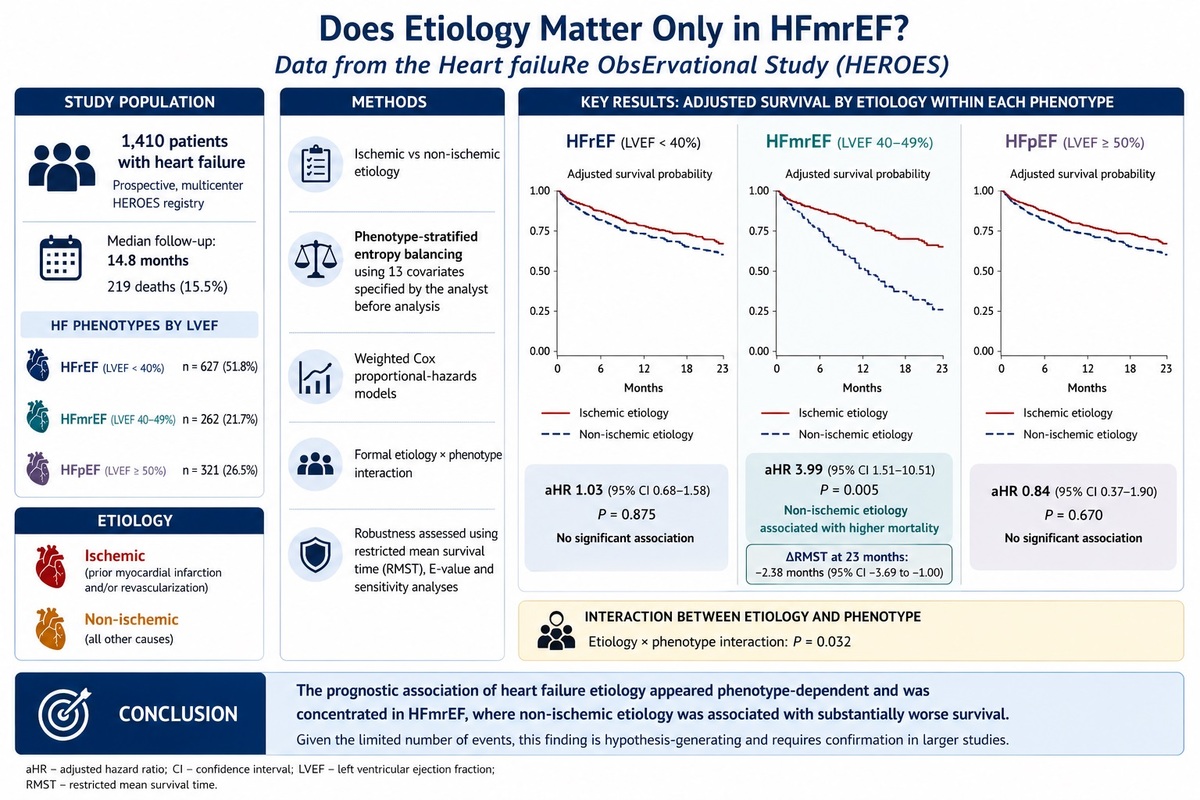
Does etiology matter only in HFmrEF? Data from the HEart failuRe ObsErvational Study (HEROES)
1
Department of Cardiology, Holy Spirit Specialist Hospital, Sandomierz, Poland
2
Department of Psychiatry, Swietokrzyskie Psychiatry Center, Morawica, Poland
3
Department of Emergency Medicine and Disaster Medicine, Medical University of Lodz, Poland
4
Department of Cardiology and Internal Diseases, Military Institute of Medicine, Warsaw, Poland
5
Heart Failure, Mechanical Circulatory Support and Transplant Department, National Institute of Cardiology, Warsaw, Poland
6
2nd Department of Cardiology, Medical University of Lodz, Poland
7
First Department of Cardiology, Medical University of Warsaw, Poland
8
Department of Hypertension and Diabetology, Faculty of Medicine, Medical University of Gdansk, Poland
9
Collegium Medicum, Jan Kochanowski University, Kielce, Poland
Submission date: 2026-06-29
Final revision date: 2026-08-29
Acceptance date: 2026-09-15
Online publication date: 2026-10-12
Corresponding author
KEYWORDS
prognosisheart failureall-cause mortalityheart failure with mildly reduced ejection fractionmildly reduced ejection fractionischemic etiologyentropy balancingrestricted mean survival time
TOPICS
ABSTRACT
Introduction:
Heart failure (HF) with mildly reduced ejection fraction (HFmrEF) is a heterogeneous phenotype, and whether the prognostic weight of ischemic versus non-ischemic etiology differs across left ventricular ejection fraction (LVEF) categories remains uncertain. We examined whether the association between etiology and long-term all-cause mortality is modified by HF phenotype.
Material and methods:
Within the prospective multicenter HEROES registry, 1,410 patients with HF were classified as having ischemic or non-ischemic etiology and categorized by LVEF. All-cause mortality was obtained through national administrative linkage with complete follow-up. Entropy balancing (13 covariates) and weighted Cox models were applied within each phenotype, with formal testing for etiology-by-phenotype interaction. Robustness was evaluated using restricted mean survival time (RMST), the E-value, and sensitivity analyses.
Results:
Over a median follow-up of 14.8 months, 219 (15.5%) deaths occurred. Crude mortality was identical between etiologies (15.5% vs. 15.5%; p = 0.93). After balancing, no difference was observed in HFrEF (adjusted hazard ratio [aHR] 1.03, 95% CI: 0.68–1.58) or HFpEF (aHR = 0.84, 95% CI: 0.37–1.90), whereas non-ischemic etiology was associated with higher mortality in HFmrEF (aHR = 3.99, 95% CI: 1.51–10.51; p = 0.005). The etiology-by-phenotype interaction was significant (p = 0.032). In HFmrEF, the RMST difference at 23 months was −2.38 months (95% CI: −3.69 to −1.00), with an E-value of 4.55 (lower confidence limit 1.99); findings were consistent across sensitivity analyses.
Conclusions:
The prognostic impact of HF etiology appears phenotype-dependent, concentrated within HFmrEF, where non-ischemic etiology substantially worse survival. Given the limited number of events, this phenotype-specific signal is hypothesis-generating and warrants confirmation.
Heart failure (HF) with mildly reduced ejection fraction (HFmrEF) is a heterogeneous phenotype, and whether the prognostic weight of ischemic versus non-ischemic etiology differs across left ventricular ejection fraction (LVEF) categories remains uncertain. We examined whether the association between etiology and long-term all-cause mortality is modified by HF phenotype.
Material and methods:
Within the prospective multicenter HEROES registry, 1,410 patients with HF were classified as having ischemic or non-ischemic etiology and categorized by LVEF. All-cause mortality was obtained through national administrative linkage with complete follow-up. Entropy balancing (13 covariates) and weighted Cox models were applied within each phenotype, with formal testing for etiology-by-phenotype interaction. Robustness was evaluated using restricted mean survival time (RMST), the E-value, and sensitivity analyses.
Results:
Over a median follow-up of 14.8 months, 219 (15.5%) deaths occurred. Crude mortality was identical between etiologies (15.5% vs. 15.5%; p = 0.93). After balancing, no difference was observed in HFrEF (adjusted hazard ratio [aHR] 1.03, 95% CI: 0.68–1.58) or HFpEF (aHR = 0.84, 95% CI: 0.37–1.90), whereas non-ischemic etiology was associated with higher mortality in HFmrEF (aHR = 3.99, 95% CI: 1.51–10.51; p = 0.005). The etiology-by-phenotype interaction was significant (p = 0.032). In HFmrEF, the RMST difference at 23 months was −2.38 months (95% CI: −3.69 to −1.00), with an E-value of 4.55 (lower confidence limit 1.99); findings were consistent across sensitivity analyses.
Conclusions:
The prognostic impact of HF etiology appears phenotype-dependent, concentrated within HFmrEF, where non-ischemic etiology substantially worse survival. Given the limited number of events, this phenotype-specific signal is hypothesis-generating and warrants confirmation.
REFERENCES (30)
1.
Brouwers FP, de Boer RA, van der Harst P, et al. Incidence and epidemiology of new onset heart failure with preserved vs reduced ejection fraction in a community-based cohort: 11-year follow-up of PREVEND. Eur Heart J 2013; 34: 1424-31.
2.
McDonagh TA, Metra M, Adamo M, et al. 2021 ESC Guidelines for the diagnosis and treatment of acute and chronic heart failure. Eur Heart J 2021; 42: 3599-726.
3.
Liu B, Zhong Y, Yin X, et al. The impact of comorbidity patterns on clinical outcomes in heart failure: a machine learning-based cluster analysis. Am J Cardiol 2026; 259: 88-96.
4.
Ma L, Ding L, Xing Z, et al. Causal relationship between inflammatory bowel disease and cardiovascular disease: a two-sample Mendelian randomized study. Arch Med Sci 2025; 21: 1811-20.
5.
Tara S, Tsukada YT, Nishino T, et al. Sex differences in the burden of multiple long-term conditions among Japanese individuals with heart failure. Open Heart 2025; 12: e003643.
6.
Esteban-Fernández A, Bonilla-Palomas JL, Muñiz J, et al. Age-based analysis of the SEC-Excelente-HF registry. Eur Geriatr Med 2026; 17: 273-81.
7.
McDonagh TA, Metra M, Adamo M, et al. 2023 Focused update of the 2021 ESC Guidelines for heart failure. Eur Heart J 2023; 44: 3627-39.
8.
Kamsani S, Sanders P. The fraction we know: heart failure phenotypes and their clinical outcomes. Pol Arch Intern Med 2023; 133(12).
9.
Khan MA, Hashim MJ, Mustafa H, et al. Global epidemiology of ischemic heart disease: results from the Global Burden of Disease Study. Cureus 2020; 12: e9349.
10.
Ceasovschih A, Banjanin N, Bednarek A, et al. Atherosclerotic features in patients with heart failure. Arch Med Sci 2025; 21: 1107-29.
11.
Pecini R, Møller DV, Torp-Pedersen C, Hassager C, Køber L. Heart failure etiology impacts survival of patients with heart failure. Int J Cardiol 2011; 149: 211-5.
12.
Balmforth C, Simpson J, Shen L, et al. Outcomes and effect of treatment according to etiology in HFrEF: analysis of PARADIGM-HF. JACC Heart Fail 2019; 7: 457-65.
13.
Wu L, Rizwan A, Rodriguez M, et al. Heart failure with mildly reduced ejection fraction: a call for a precision medicine approach. JACC Adv 2026; 5: 102476.
14.
Bozkurt B, Coats AJS, Tsutsui H, et al. Universal definition and classification of heart failure. Eur J Heart Fail 2021; 23: 352-80.
15.
Lam CSP, Voors AA, Ponikowski P, McMurray JJV, Solomon SD. Time to rename the middle child of heart failure: heart failure with mildly reduced ejection fraction. Eur Heart J 2020; 41: 2353-5.
16.
Desai N, Olewinska E, Famulska A, Remuzat C, Francois C, Folkerts K. Heart failure with mildly reduced and preserved ejection fraction: a review of disease burden and remaining unmet medical needs within a new treatment landscape. Heart Fail Rev 2024; 29: 631-62.
17.
Tymińska A, Ozierański K, Balsam P, et al. Ischemic cardiomyopathy versus non-ischemic dilated cardiomyopathy in patients with reduced ejection fraction. Biology 2022; 11: 341.
18.
Zhang ZH, Meng FQ, Hou XF, et al. Clinical characteristics and long-term prognosis of ischemic and non-ischemic cardiomyopathy. Indian Heart J 2020; 72: 93-100.
19.
Drożdż J, Morawiec R, Drozd M, et al. Rationale, objectives, and design of the HEart failuRe ObsErvational Study of the Polish Cardiac Society (HEROES). Pol Heart J 2025; 83: 321-4.
20.
Savarese G, Becher PM, Lund LH, et al. Global burden of heart failure: a comprehensive and updated review of epidemiology. Cardiovasc Res 2023; 119: 327-43.
21.
Stolfo D, Uijl A, Vedin O, et al. Contemporary epidemiology of heart failure with mildly reduced ejection fraction. Eur J Heart Fail 2023; 25: 1143-54.
22.
Butler J, Anker SD, Filippatos G. Heart failure with mildly reduced ejection fraction: characterization and future directions. Nat Rev Cardiol 2024; 21: 89-103.
23.
Burgos LM, Carosella LM, Baro Vila RC, De Bortoli MA, Malano DJ, Diez M. Small left ventricle identifies a high-risk phenotype in patients hospitalized for heart failure with preserved or mildly reduced ejection fraction. Curr Probl Cardiol 2026; 51: 103268.
24.
Vedin O, Lam CSP, Koh AS, et al. Significance of ischemic heart disease in heart failure with mildly reduced ejection fraction. Eur J Heart Fail 2022; 24: 1872-82.
25.
Greene SJ, Butler J, Vaduganathan M. Heart failure with mildly reduced ejection fraction: emerging concepts and future directions. Circulation 2024; 149: 1740-54.
26.
Chioncel O, Lainscak M, Seferovic PM, et al. Epidemiology and one-year outcomes in patients with chronic heart failure and preserved, mid-range and reduced ejection fraction: an analysis of the ESC Heart Failure Long-Term Registry. Eur J Heart Fail 2017; 19: 1574-85.
27.
Savarese G, Stolfo D, Sinagra G, Lund LH. Heart failure with mid-range or mildly reduced ejection fraction. Nat Rev Cardiol 2022; 19: 100-16.
28.
Hernán MA, Hernández-Díaz S, Robins JM. A structural approach to selection bias. Epidemiology 2004; 15: 615-25.
29.
Firth D. Bias reduction of maximum likelihood estimates. Biometrika 1993; 80: 27-38.
30.
Heinze G, Schemper M. A solution to the problem of monotone likelihood in Cox regression. Biometrics 2001; 57: 114-9.
Share
RELATED ARTICLE
| eISSN: | 1896-9151 |
| ISSN: | 1734-1922 |

We process personal data collected when visiting the website. The function of obtaining information about users and their behavior is carried out by voluntarily entered information in forms and saving cookies in end devices. Data, including cookies, are used to provide services, improve the user experience and to analyze the traffic in accordance with the Privacy policy. Data are also collected and processed by Google Analytics tool (more).
You can change cookies settings in your browser. Restricted use of cookies in the browser configuration may affect some functionalities of the website.
You can change cookies settings in your browser. Restricted use of cookies in the browser configuration may affect some functionalities of the website.