Current issue
Archive
Manuscripts accepted
About the Journal
Editorial office
Editorial board
Section Editors
Abstracting and indexing
Subscription
Contact
Ethical standards and procedures
Most read articles
Instructions for authors
Article Processing Charge (APC)
Regulations of paying article processing charge (APC)


HEMATOLOGY / CLINICAL RESEARCH
Expression and clinical significance of SENP1 in patients with acute myeloid leukemia
1
Xianyang Central Hospital, China
Submission date: 2025-04-28
Final revision date: 2025-06-24
Acceptance date: 2025-09-12
Online publication date: 2026-02-08
KEYWORDS
TOPICS
ABSTRACT
Introduction:
The study aimed to investigate the expression of SUMO1/sentrin-specific peptidase 1 (SENPl) in patients with acute myeloid leukemia (AML) and its significance in the development of AML.
Material and methods:
Patients with AML, hematological malignancies, and non-neoplastic hematological diseases were selected as the experimental subjects, and they were divided into the initial diagnosis group (n = 32), the relapse group (n = 8), and the remission group (n = 22) according to their disease status. Meanwhile, patients with non-neoplastic hematological diseases were selected as the controls (n = 30). The expression of SENP1 mRNA and protein in bone marrow samples from the different groups was detected. The effects of SENP1 silencing on cell multiplication and the cell cycle were observed.
Results:
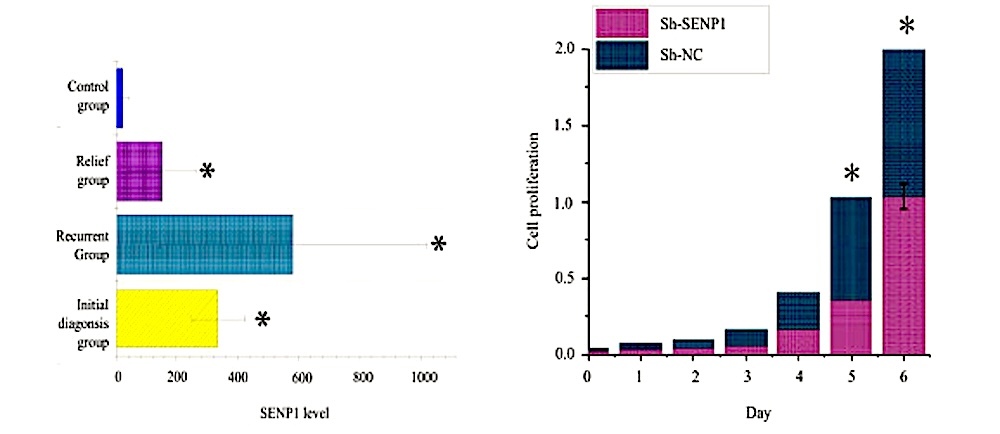
The expression of SENP1 from low to high was observed in the controls, initial diagnosis, remission, and relapse groups. The incidence of adverse conditions was the lowest in the initial diagnosis group, followed by the remission group and the relapse group. The proliferation of U937 decreased after SENP1 knockdown, suggesting that SENP1 has a major role in AML cell multiplication. In addition, the apoptosis rate of U937 was increased after SENP1 knockdown. The overall survival (OS) and disease-free survival (DFS) were ranked as follows: relapsed < initial diagnosis < remission < controls.
Conclusions:
This article preliminarily demonstrated the high expression of the biomarker SENP1 in AML patients, and found that it was related to the clinical characteristics and prognosis of AML patients.
REFERENCES (32)
1.
Pelcovits A, Niroula R. Acute myeloid leukemia: a review. R I Med J 2020; 103: 38-40.
2.
Montesinos P, Recher C, Vives S, et al. Ivosidenib and azacitidine in IDH1-mutated acute myeloid leukemia. N Engl J Med 2022; 386: 1519-31.
3.
Goyal S, Tisdale J, Schmidt M, et al. Acute myeloid leukemia case after gene therapy for sickle cell disease. N Engl J Med 2022; 386: 138-47.
4.
Carter JL, Hege K, Yang J, et al. Targeting multiple signaling pathways: the new approach to acute myeloid leukemia therapy. Signal Transduct Target Ther 2020; 5: 288.
5.
Cui XM, Gao W, He JJ, Zhang B. Screening and clinical testing of key differentially expressed genes in childhood acute myeloid leukemia. J Henan Univ 2023; 42: 23-7.
6.
Niu SQ, Zhao LM. Metagenomic next-generation sequencing clinches the diagnosis of Legionella pneumonia in a patient with acute myeloid leukemia: a case report and literature review. Front Cell Infect Microbiol 2022; 12: 924597.
7.
Mhina CJ, Cole AC, Adapa K, Bryant AL, Wood A, Richardson DR. Either go through chemotherapy or go through dying: a qualitative study of the experiences of treatment decision-making among older newly-diagnosed adults with acute myeloid leukemia. J Clin Oncol 2022; 40 (28 Suppl): 253.
8.
Sun HJ, Du CK, Li H, Liu M, Zhang H. Diagnostic significance of cytogenetic testing methods for acute leukemia in children with MLL gene abnormalities. J Lab Med 2022; 37: 1196-9.
9.
Liu LN, Li T, Ge HY, Chen ZG, Yu J, Zheng XQ. Association between MTHFR C677T gene polymorphism and liver dysfunction after high-dose methotrexate treatment in children with acute lymphoblastic leukemia. J Wenzhou Med Univ 2020; 50: 753-7.
10.
Liang YQ, Duan T, Xu QQ. Research progress on the correlation between SENP1 and malignant tumors. Chongqing Med J 2023; 52: 776-81.
11.
Qin X, Chen X, Liu J, Zeng Y, Guo L, Liu WJ. Paeoniflorin inhibits the SENP1/c-Myc signaling pathway and induces apoptosis and cell cycle arrest in acute B lymphoblastic leukemia cells. Chin J Traditional Chin Med 2022; 47: 3312-9.
12.
Song JP, Shu P, Ma JL, Wang B, Chen B. Expression of ribosomal protein S9 in multiple myeloma and its impact on its cellular biological function. J Chin Acad Med Sci 2019; 41: 175-82.
13.
Li Y, Li X, Chen Z. Research progress of SHP2 and its allosteric inhibitors in tumor targeted therapy. Pharm Res 2023; 42: 48-53, 67.
14.
Qian X, Deng YQ, Zhong N, et al. Study on the reversal of epileptic drug resistance by tetramethylpyrazine in combination with carbamazepine through modulation of P-Glycoprotein expression in rat brain microvessel endothelial cell. Cell Mol Biol 2023; 69: 254-9.
15.
You M, Yang L. Study on the regulatory effect of Gong’s brain on the spinal MAPKs signaling pathway in a bone cancer pain model rat. J Liaoning Univ Traditional Chin Med 2023; 25: 24-8.
16.
Wu J, Yang Z, Yang B, Huang H. The application of organoids in the research of skeletal diseases: current status and prospects. Stud Health Technol Inform 2023; 308: 597-604.
17.
Xie J, Qi J. In vitro culture and identification of PEX gene transfected human umbilical cord mesenchymal stem cells. Med Inform 2023; 36: 88-92, 97.
18.
Yu WH, Kang XH. The effect of LINC01410 on the proliferation, invasion, and migration of lung cancer cell A549. Chin J Gerontol 2023; 43: 5317-21.
19.
Xuan CR. The effect and mechanism of CKLF1 overexpression on the proliferation, migration, and invasion ability of renal cancer cells. J Nankai Univ 2023; 56: 35-9.
20.
Lin XT, Zhang J, Xie CM. An optimized protocol to detect protein ubiquitination and activation by ubiquitination assay in vivo and CCK-8 assay. STAR Protoc 2023; 4: 102199.
21.
Yang LQ, Wang L, Wu JT, Wang YQ. Circ_0000069 contributes to the growth, metastasis and glutamine metabolism in renal cell carcinoma (RCC) via regulating miR-125a-5p-dependent SLC1A5 expression. Transpl Immunol 2022; 77: 101764.
22.
Peng XR, Cheng J. Research progress on chimeric antigen receptor modified NK cells in the treatment of acute myeloid leukemia. Chin J Exp Hematol 2023; 31 :1905-9.
23.
Zhang YR, Shen YJ, Wei WQ, et al. Dysregulation of SIRT3 SUMOylation confers AML chemoresistance via controlling HES1-dependent fatty acid oxidation. Int J Mol Sci 2022; 23: 8282.
24.
Tao Y, Wei L, You H. Ferroptosis-related gene signature predicts the clinical outcome in pediatric acute myeloid leukemia patients and refines the 2017 ELN classification system. Front Mol Biosci 2022; 9: 954524.
25.
Li DT, Ai H, Huang SJ. Research progress of SUMO modification in breast cancer. J Qiqihar Med Coll 2023; 44: 563-8.
26.
Xu CM, Wang CH, Ding YM. Research progress on the role of ubiquitin specific protease 1 in tumors. Chin J Pract Diagn Treat 2022; 36: 753-6.
27.
Song KP, Shu P, Ma JL, Wang B, Chen B. Ribosomal protein S9 expression in multiple myeloma and its effect on cell biological function. Zhongguo Yi Xue Ke Xue Yuan Xue Bao 2019; 41: 175-82.
28.
Mrózek K. Prognostic importance of the fusion partners and measurable residual disease in patients with acute myeloid leukemia who harbor 11q23/KMT2A alterations. Transl Pediatr 2023; 12: 1920-5.
29.
Isidori A, Visani G, Ferrara F. Fms-like tyrosine kinase 3 positive acute myeloid leukemia. Curr Opin Oncol 2023; 35: 589-93.
30.
Sun XX, Chen Y, Su Y, et al. SUMO protease SENP1 deSUMOylates and stabilizes c-Myc. Proc Natl Acad Sci USA 2018; 115: 10983-8.
31.
Gao Q, Wang S, Zhang Z. E3 ubiquitin ligase SMURF2 prevents colorectal cancer by reducing the stability of the YY1 protein and inhibiting the SENP1/c-myc axis. Gene Ther 2023; 30: 51-63.
32.
Xianjun F, Xirui X, Jie T, et al. Momordin Ic induces G0/1 phase arrest and apoptosis in colon cancer cells by suppressing SENP1/c-MYC signaling pathway. J Pharmacol Sci 2021; 146: 249-58.
Share
RELATED ARTICLE
| eISSN: | 1896-9151 |
| ISSN: | 1734-1922 |

We process personal data collected when visiting the website. The function of obtaining information about users and their behavior is carried out by voluntarily entered information in forms and saving cookies in end devices. Data, including cookies, are used to provide services, improve the user experience and to analyze the traffic in accordance with the Privacy policy. Data are also collected and processed by Google Analytics tool (more).
You can change cookies settings in your browser. Restricted use of cookies in the browser configuration may affect some functionalities of the website.
You can change cookies settings in your browser. Restricted use of cookies in the browser configuration may affect some functionalities of the website.