Current issue
Archive
Manuscripts accepted
About the Journal
Editorial office
Editorial board
Section Editors
Abstracting and indexing
Subscription
Contact
Ethical standards and procedures
Most read articles
Instructions for authors
Article Processing Charge (APC)
Regulations of paying article processing charge (APC)


OSTEOPOROSIS / CLINICAL RESEARCH
Genetic associations between common medication use and osteoporosis-related outcomes: a Mendelian randomization study
1
Department of Orthopaedics, Deyang People’s Hospital, Deyang City, Sichuan Province, China
These authors had equal contribution to this work
Submission date: 2025-11-03
Final revision date: 2026-02-09
Acceptance date: 2026-02-25
Online publication date: 2026-06-04
Corresponding author
Xi Chen
Department of Orthopaedics Deyang People’s Hospital Deyang City Sichuan Province 618000, China Phone: +86 13881082380
Department of Orthopaedics Deyang People’s Hospital Deyang City Sichuan Province 618000, China Phone: +86 13881082380
KEYWORDS
Mendelian randomization analysisosteoporosisdrug-related side effects and adverse reactionsanilidesthyroid hormonesantidiabetic agentsgenetic associationpharmacologymanagement
TOPICS
ABSTRACT
Introduction:
Osteoporosis pathogenesis involves a complex interplay of genetic predisposition and medication exposure. Although long-term medication use contributes to bone fragility, which is distinct from osteomalacia, genetic evidence linking common medication-use traits to osteoporosis remains limited.
Material and methods:
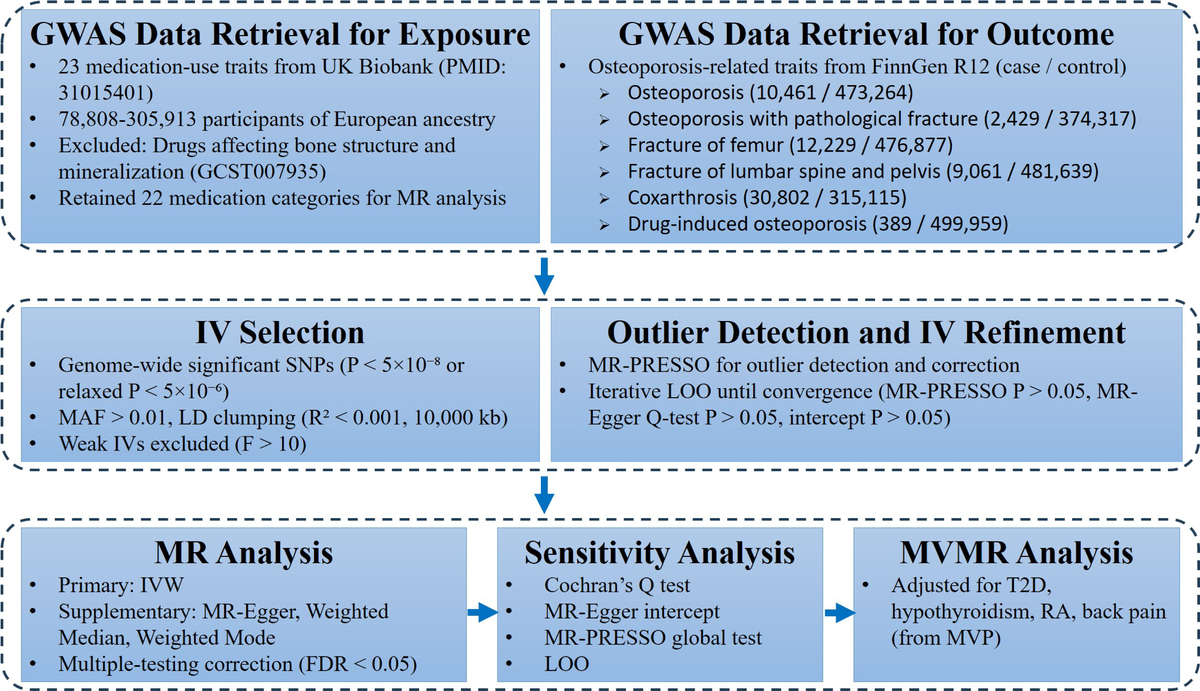
Two-sample Mendelian randomization (MR) analyses utilized GWAS data for 22 medication-use traits (UK Biobank) and osteoporosis outcomes (FinnGen R12). Multivariable MR (MVMR) was employed to adjust for confounding by underlying disease indications. Primary estimates were derived using the inverse variance–weighted (IVW) method, supported by comprehensive sensitivity analyses including MR-Egger, weighted median, and MR-PRESSO to evaluate heterogeneity and pleiotropy.
Results:
Univariable MR identified seven significant associations: anilide use with higher odds of osteoporosis (OR = 1.25, FDR = 0.0201); immunosuppressant use with higher odds of osteoporosis with pathological fracture (OR = 1.16, FDR = 0.0074) and drug-induced osteoporosis (OR = 1.36, FDR = 0.0168); thyroid preparations with increased odds of osteoporosis (OR = 1.08, FDR = 0.0016), drug-induced osteoporosis, and osteoporosis with pathological fracture; and an inverse association between antidiabetic drug use and osteoporosis (OR = 0.88, FDR = 0.0002). In MVMR, associations for anilide and thyroid preparation use remained significant after adjusting for back pain and hypothyroidism, respectively. However, the antidiabetic association reversed after adjustment for type 2 diabetes, suggesting that the inverse association may reflect the underlying metabolic condition rather than a direct pharmacological effect.
Conclusions:
Genetic evidence suggests that anilide and thyroid hormone use may independently increase osteoporosis risk, while the inverse association between antidiabetic drug use and osteoporosis may be confounded by diabetes status. Medication-related osteoporosis should be considered in long-term pharmacologic management.
REFERENCES (43)
1.
Zhang L, Cheng J, Su H, Wang Z, Dai W. Diagnostic value of circulating bone turnover markers osteocalcin, cathepsin K, and osteoprotegerin for osteoporosis in middle-aged and elderly postmenopausal women. Arch Med Sci 2024; 20: 1727-30.
2.
Khan AA, Slart R, Ali DS, et al. Osteoporotic fractures: diagnosis, evaluation, and significance from the international working group on DXA best practices. Mayo Clin Proc 2024; 99: 1127-41.
3.
Zhu Z, Yu P, Wu Y, et al. Sex specific global burden of osteoporosis in 204 countries and territories, from 1990 to 2030: an age-period-cohort modeling study. J Nutr Health Aging 2023; 27: 767-74.
4.
Hayes KN, Baschant U, Hauser B, Burden AM, Winter EM. When to start and stop bone-protecting medication for preventing glucocorticoid-induced osteoporosis. Front Endocrinol 2021; 12: 782118.
5.
Ena G, Soyfoo M. Postmenopausal osteoporosis: from molecular pathways to therapeutic targets-a mechanism-to-practice framework integrating pharmacotherapy, fall prevention, and adherence into patient-centered care. J Clin Med 2025; 15: 102.
6.
Batteux B, Bennis Y, Bodeau S, et al. Associations between osteoporosis and drug exposure: a post-marketing study of the World Health Organization pharmacovigilance database (VigiBase(R)). Bone 2021; 153: 116137.
7.
Rahman A, Haider MF. A comprehensive review on glucocorticoids induced osteoporosis: a medication caused disease. Steroids 2024; 207: 109440.
8.
Ilias I, Milionis C, Zoumakis E. An overview of glucocorticoid-induced osteoporosis. In: Endotext. Feingold KR, Ahmed SF, Anawalt B, et al. (eds.). South Dartmouth (MA)2000.
9.
Li X, Zhang T, Zhang H, Liu S, Tian L. Effects of levothyroxine therapy on bone and mineral metabolism in hypothyroidism: a systematic review and meta-analysis. BMC Endocr Disord 2025; 25: 11.
10.
Zhao G, Wang Q, Duan N, et al. Potential drug targets for osteoporosis identified: a Mendelian randomization study. Heliyon 2024; 10: e36566.
11.
de Ruiter SC, Tschiderer L, Grobbee DE, et al. Mendelian randomisation: concepts, opportunities, challenges, and future directions. Global Heart 2025; 20: 54.
12.
Huang X, Zhang T, Guo P, et al. Association of antihypertensive drugs with fracture and bone mineral density: a comprehensive drug-target Mendelian randomization study. Front Endocrinol 2023; 14: 1164387.
13.
Li XH, Pang WW, Zhang Y, et al. A Mendelian randomization study for drug repurposing reveals bezafibrate and fenofibric acid as potential osteoporosis treatments. Front Pharmacol 2023; 14: 1211302.
14.
Liu QP. Application of Mendelian randomization analysis to explore causal associations of aspirin use with bone mineral density and risk of fracture. Hereditas 2025; 162: 3.
15.
Zhang R, Zhao J. Exploring causal correlations between inflammatory response-related genes and osteoporosis: a Multi-Omics Mendelian Randomization Study. Arch Med Sci 2025; 21: 1332-44.
16.
Deng G, Wu L, Xiong S, Zhou J, Li Z. The role of antidiabetic drugs in bone health: assessing the risk of osteoporosis subtypes and fractures using mendelian randomization. Orthop Res Rev 2025; 17: 129-45.
17.
Skrivankova VW, Richmond RC, Woolf BA, et al. Strengthening the reporting of observational studies in epidemiology using Mendelian randomization: the STROBE-MR statement. JAMA 2021; 326: 1614-21.
18.
Davies NM, Holmes MV, Smith GD. Reading Mendelian randomisation studies: a guide, glossary, and checklist for clinicians. BMJ 2018; 362: k601.
19.
Wu Y, Byrne EM, Zheng Z, et al. Genome-wide association study of medication-use and associated disease in the UK Biobank. Nat Commun 2019; 10: 1891.
20.
Cui K, Song N, Fan Y, et al. A two-sample Mendelian randomization analysis: causal association between chemokines and pan-carcinoma. Front Genet 2023; 14: 1285274.
21.
Garfield V, Salzmann A, Burgess S, Chaturvedi N. A guide for selection of genetic instruments in Mendelian randomization studies of type 2 diabetes and Hba1C: toward an integrated approach. Diabetes 2023; 72:175-83.
22.
Verbanck M, Chen CY, Neale B, Do R. Detection of widespread horizontal pleiotropy in causal relationships inferred from Mendelian randomization between complex traits and diseases. Nat Genet 2018; 50: 693-8.
23.
Burgess S, Bowden J, Fall T, Ingelsson E, Thompson SG. Sensitivity analyses for robust causal inference from Mendelian randomization analyses with multiple genetic variants. Epidemiology 2017; 28: 30-42.
24.
Bowden J, Davey Smith G, Burgess S. Mendelian randomization with invalid instruments: effect estimation and bias detection through Egger regression. Int J Epidemiol 2015; 44: 512-25.
25.
Spiller W, Bowden J, Sanderson E. Estimating and visualising multivariable Mendelian randomization analyses within a radial framework. PLoS Genet 2024; 20: e1011506.
26.
Grant AJ, Burgess S. Pleiotropy robust methods for multivariable Mendelian randomization. Stat Med 2021; 40: 5813-30.
27.
Munoz M, Robinson K, Shibli-Rahhal A. Bone health and osteoporosis prevention and treatment. Clin Obstet Gynecol 2020; 63: 770-87.
28.
Eastell R, O’Neill TW, Hofbauer LC, et al. Postmenopausal osteoporosis. Nat Rev Dis Primers 2016; 2: 16069.
29.
Williams LJ, Pasco JA, Henry MJ, et al. Paracetamol (acetaminophen) use, fracture and bone mineral density. Bone 2011; 48: 1277-81.
30.
Delitala AP, Scuteri A, Doria C. Thyroid hormone diseases and osteoporosis. J Clin Med 2020; 9: 1034.
31.
Wei YK, Chen PB, Ju LL, Deng GH. Causal association of metformin and osteoporosis: a 2-sample Mendelian randomization study. Medicine 2023; 102: e35191.
32.
Maeda K, Yoshida K, Nishizawa T, et al. Inflammation and bone metabolism in rheumatoid arthritis: molecular mechanisms of joint destruction and pharmacological treatments. Int J Mol Sci 2022; 23: 2871.
33.
Sanderson E. Multivariable mendelian randomization and mediation. Cold Spring Harb Perspect Med 2021; 11: a038984.
34.
Tsuchiya H, Mizogami M. Old and new analgesic acetaminophen: pharmacological mechanisms compared with non-steroidal anti-inflammatory drugs. Future Pharmacol 2025; 5: 40.
35.
Kim W, Tokuda H, Tanabe K, et al. Acetaminophen reduces osteoprotegerin synthesis stimulated by PGE2 and PGF2 in osteoblasts: attenuation of SAPK/JNK but not p38 MAPK or p44/p42 MAPK. Biomed Res 2021; 42: 77-84.
36.
Hadjicharalambous C, Alpantaki K, Chatzinikolaidou M. Effects of NSAIDs on pre-osteoblast viability and osteogenic differentiation. Exp Ther Med 2021; 22: 740.
37.
Lademann F, Rijntjes E, Köhrle J, Tsourdi E, Hofbauer LC, Rauner M. Hyperthyroidism-driven bone loss depends on BMP receptor Bmpr1a expression in osteoblasts. Commun Biol 2024; 7: 548.
38.
Svensson J, Ohlsson C, Karlsson MK, et al. Higher serum free thyroxine levels are associated with increased risk of hip fractures in older men. J Bone Mineral Res 2024; 39: 50-8.
39.
Jiating L, Buyun J, Yinchang Z. Role of metformin on osteoblast differentiation in type 2 diabetes. Biomed Res Int 2019; 2019: 9203934.
40.
Dong B, Lv R, Wang J, et al. The extraglycemic effect of SGLT-2is on mineral and bone metabolism and bone fracture. Front Endocrinol 2022; 13: 918350.
41.
Ock M, Lee S, Kim H. Osteoporosis or fracture risk associated with thiazolidinedione and proton pump inhibitor co-administration in patients with type 2 diabetes mellitus. J Clin Pharm Ther 2022; 47: 1028-35.
42.
Zou W, Fang Y, Xu D, Zhu Y. Increasing global burden of rheumatoid arthritis: an epidemiological analysis from 1990 to 2019. Arch Med Sci 2023; 19: 1037-48.
43.
Wu D, Luo Y, Li T, et al. Systemic complications of rheumatoid arthritis: focus on pathogenesis and treatment. Front Immunol 2022; 13: 1051082.
Share
RELATED ARTICLE
| eISSN: | 1896-9151 |
| ISSN: | 1734-1922 |

We process personal data collected when visiting the website. The function of obtaining information about users and their behavior is carried out by voluntarily entered information in forms and saving cookies in end devices. Data, including cookies, are used to provide services, improve the user experience and to analyze the traffic in accordance with the Privacy policy. Data are also collected and processed by Google Analytics tool (more).
You can change cookies settings in your browser. Restricted use of cookies in the browser configuration may affect some functionalities of the website.
You can change cookies settings in your browser. Restricted use of cookies in the browser configuration may affect some functionalities of the website.