Introduction
Colorectal cancer (CRC) is one of the most common malignancies in the digestive system. According to global cancer statistics, CRC is the third most common cancer and the second leading cause of cancer-related deaths, with over 1.9 million new cases and approximately 935,000 deaths reported in 2020 [1]. Although the efficacy of CRC treatment has improved to some extent with surgery-based comprehensive treatment, the overall efficacy for CRC patients has not fundamentally improved. The treatment landscape for CRC has shifted significantly in recent years. Initially, the focus was on radical tumor resection combined with postoperative adjuvant radiotherapy and chemotherapy. This has gradually evolved into a comprehensive treatment model that includes surgical resection following neoadjuvant therapy or conversion therapy. Moreover, there has been a transition from traditional systemic chemotherapy to precision therapy, using biological targeted drugs or immunotherapy, based on molecular biomarkers. Furthermore, the emergence of multidisciplinary treatment models has significantly extended the survival of CRC patients and improved their quality of life [2].
Many factors influence the incidence of CRC and patient survival [3]. Research has shown that appendectomy can lead to gut microbiota dysbiosis and impaired gut barrier function, increasing the risk of CRC [4]. The appendix contains a high density of gut-associated lymphoid tissue, which plays an important role in gut immune regulation and microbial composition in synergy with the gut microbiome [5, 6]. The appendix is often considered a vestigial organ that can be removed without significant consequences. However, recent studies have found a rich presence of immune cells in the appendix, including various innate immune cells such as natural killer cells and intraepithelial CD8+ T cells [7]. Furthermore, although studies have shown that patients who have undergone appendectomy have a significantly reduced severity of colitis, transcriptomic analysis and animal experiments have suggested that the presence of the appendix may confer protective T cell immunity, potentially involving protection against tumor initiation rather than tumor progression [8]. Additionally, appendectomy has been closely associated with the occurrence of various diseases, including CRC, in the long term [9–12].
Mendelian randomization (MR) is a method that uses genetic variants, such as single nucleotide polymorphisms (SNPs), as instrumental variables (IVs) to assess potential causal relationships between exposures and outcomes [13]. Since associations between exposures and outcomes may be attributed to unmeasured confounders and reverse causality, using genetic determinants of exposure as IVs allows for the estimation of the causal component of these observed associations under specific assumptions. Additionally, IVs must satisfy three criteria: 1) they must be associated with the exposure, 2) they must be independent of confounders of the exposure-outcome association, and 3) they must influence the outcome only through the exposure (i.e., satisfy the exclusion restriction assumption) [14]. The advantage of MR analysis lies in its ability to reduce bias from certain confounding factors, providing additional evidence for etiological research. This method has been widely used to explore potential causal relationships between biological or medical variables [15–17]. However, the use of MR to study the potential causal relationship between appendectomy and CRC has yet to be explored.
In this study, we used data from genome-wide association studies (GWAS) and public datasets to explore the causal relationship between appendectomy and CRC risk using two-sample bidirectional MR. We employed two-step MR to identify metabolites and inflammatory proteins that may mediate the impact of appendectomy on CRC risk. Additionally, using SNPs significantly associated with CRC risk following appendectomy, we identified the five nearest genes from the FinnGen study and employed transcriptomic analysis to further investigate the impact of these related genes on the survival prognosis of CRC patients.
Material and methods
Study design
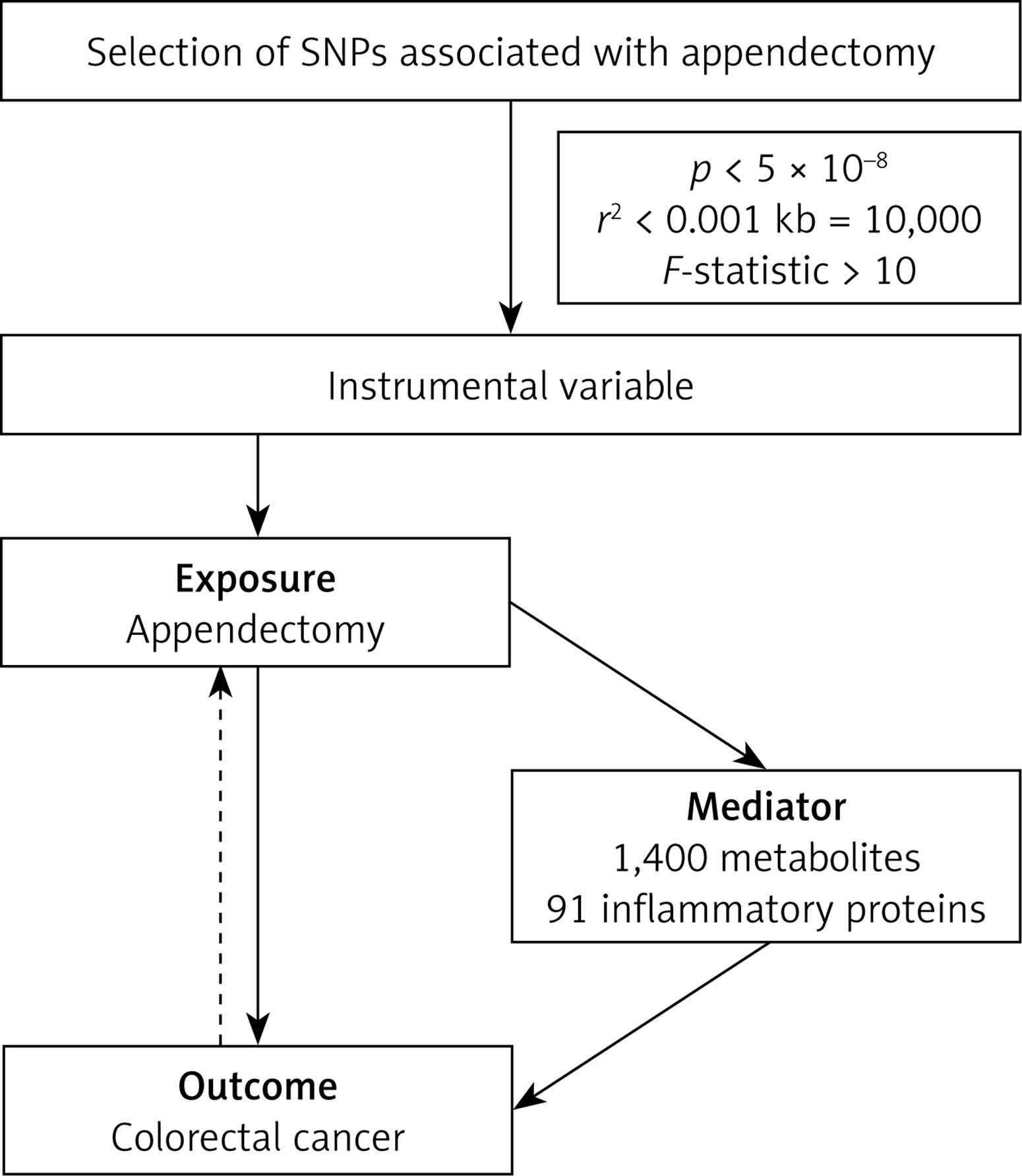
To comprehensively explore the causal relationship between appendectomy and CRC risk and potential mediating effects, we conducted an in-depth MR analysis. This approach used summary statistics from published GWAS. The MR framework employs SNPs as instrumental variables to estimate the potential causal effect of an exposure on an outcome. The MR design adheres to three fundamental assumptions: (1) relevance assumption: SNPs are associated with the exposure; (2) independence assumption: SNPs are independent of confounding factors; and (3) exclusion restriction assumption: SNPs influence the outcome only through the exposure. The second and third assumptions are related to confounding and horizontal pleiotropy, respectively, and violations of these assumptions can be assessed using a series of statistical methods. Our study design is summarized in the Figure 1.
Data source
In this study, summary data on appendectomy were obtained from the FinnGen database (https://r10.finngen.fi/pheno/K11_APPENDECTOMY), including 28,601 cases and 383,580 controls. The summary data for CRC were obtained from the study by Huyghe et al. [18], which included 19,948 CRC patients, 12,124 healthy individuals, and 38,356,021 SNPs. These data are accessible at (https://gwas.mrcieu.ac.uk/datasets/ebi-a-GCST012879/). The summary data for 1,400 metabolites were sourced from the study by Chen et al. [19]. The data can be obtained from the GWAS Catalog database (GWAS Catalog) with accession numbers GCST90199621-GCST90201020. The summary data for 91 inflammatory proteins were derived from the study by Zhao et al. [20]. The GWAS Catalog accession numbers are GCST90274758-GCST90274848. Transcriptome sequencing data used to validate the nearest genes to SNPs and assess their associations with CRC patient prognosis were obtained from the TCGA database (https://portal.gdc.cancer.gov/) and the GEO database (https://www.ncbi.nlm.nih.gov/geo/) with data summarized by Marisa et al. [21].
Instrumental variable selection
In our MR analysis, we used SNPs as IVs to study the potential causal relationship between exposure and outcome at the genetic level. Significant SNPs for appendectomy, CRC, 1400 metabolites, and 91 inflammatory proteins were selected using a uniform criterion of p < 5.0 × 10⁻⁸. However, due to the limited availability of genome-wide significant SNPs for metabolites, we adopted a more lenient threshold for metabolites in the MR analysis, specifically p < 1 × 10⁻⁵ [22]. This adjustment allowed us to obtain a broader range of SNPs associated with metabolites and CRC.
Simultaneously, we used an r2 threshold of < 0.001 and a clumping window of 10,000 kb to select independent SNPs and exclude those in linkage disequilibrium (LD) with lead SNPs [23]. This strategy allowed us to exclude SNPs that were correlated due to LD. Additionally, to minimize bias from weak instruments, we calculated the F-statistic for each SNP. SNPs with an F-statistic < 10 were considered weak instruments [24]. SNPs displaying palindromic alleles or ambiguous strand orientation were systematically excluded from the IVs used in the MR analysis [25].
MR analysis
We conducted a comprehensive two-sample bidirectional MR analysis using inverse variance weighted (IVW), MR-Egger, weighted median, weighted mode, and simple mode methods to explore the potential causal relationship between appendectomy and the outcome of CRC. IVW is one of the primary methods in MR studies, aggregating the Wald ratios of each SNP for a summary estimate [26]. The IVW method assumes that the genetic variants included in the analysis are valid instrumental variables. Due to its high statistical power and widespread use in MR analyses, the IVW method was chosen as the main analytical approach, with the other four methods serving as supplementary analyses [27, 28]. When the direction of the causal relationship remains consistent across these five methods, it is considered to provide stronger evidence supporting a potential causal relationship. According to the results of the MR analysis, a p-value < 0.05 indicates statistically significant evidence for an association between the genetically predicted exposure and the outcome under the MR assumptions [29]. To assess the robustness and validity of the results, we conducted sensitivity analyses using Cochran’s Q statistic to evaluate heterogeneity among the IVs, and Mendelian randomization pleiotropy residual sum and outlier (MR-PRESSO) to test for pleiotropy, with a p-value < 0.05 indicating significant heterogeneity and pleiotropy [30, 31]. The MR-PRESSO method can not only detect horizontal pleiotropic outliers but also identify and exclude outlier genetic variants and provide corrected causal effect estimates. Additionally, it evaluates whether there is a difference between the results before and after correction [32]. The “leave-one-out” approach is used to detect whether any instrumental variables disproportionately influence the causal effect estimate. This involves sequentially removing individual SNPs and calculating the meta-effect of the remaining SNPs. We assessed whether the results changed after removing each SNP to determine whether the outcome was influenced by any specific SNP [33]. Horizontal pleiotropy was assessed using the MR-Egger intercept, and if the p-value was > 0.05, it was considered that there was no statistically significant evidence of directional horizontal pleiotropy [34]. Furthermore, we used two-step MR analysis to identify potential mediating variables of metabolites and inflammatory proteins in the association between appendectomy and CRC. In the two-step MR analysis, we calculated the causal effect estimate of appendectomy on the mediator and the causal effect of the mediator on CRC. We then used the delta method to estimate the significance of the mediated effect and the proportion of the mediated effect in the total effect [35].
Transcriptomic analysis
Based on the SNPs identified in the MR analysis as being associated with the potential causal relationship between appendectomy and CRC, we further explored the association between the expression of the nearest genes, identified using the FinnGen database, and survival of CRC patients. Survival analysis was conducted using the “survival” package in R, based on transcriptomic data from TCGA and GEO (GSE39582). A p-value < 0.05 was considered statistically significant for differences in survival.
Results
MR analysis revealed a potential positive causal relationship between appendectomy and CRC
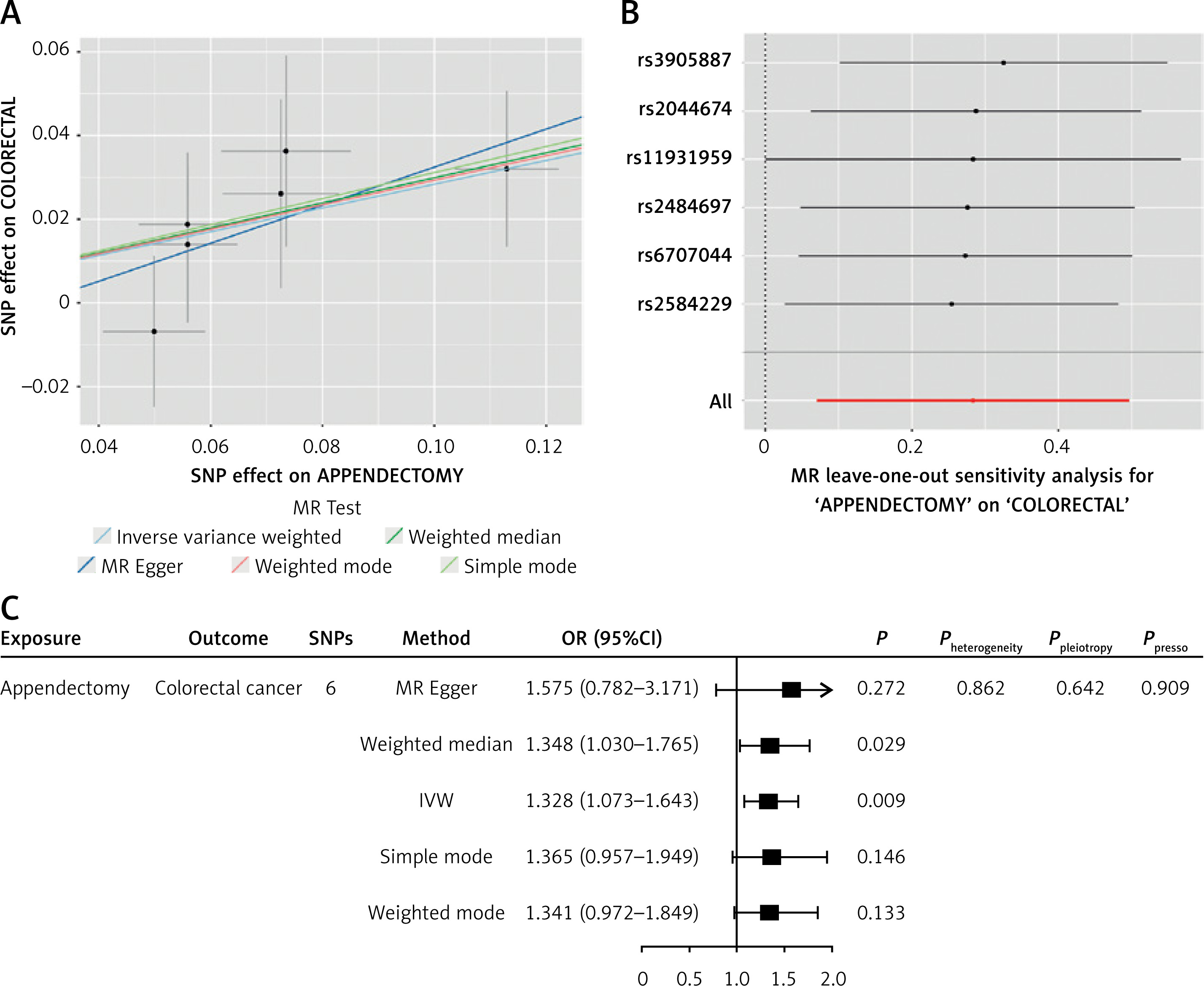
In the two-sample MR analysis, SNPs were used as IVs, with appendectomy as the exposure and CRC as the outcome. GWAS data for appendectomy were used as the summary association statistics for the exposure, and GWAS data for CRC were used as the summary association statistics for the outcome. Using the extracted 6 SNPs for appendectomy that met the selection criteria, we found evidence supporting a potential positive causal relationship between appendectomy and CRC risk (Table I). Since the IVW method has high statistical power, it was used as the main analysis method. The IVW analysis showed evidence supporting a potential causal relationship between appendectomy and an increased risk of CRC (OR = 1.328, 95% CI: 1.073–1.643, p = 0.009). Although the results of MR-Egger (OR = 1.575, 95% CI: 0.782–3.171, p = 0.272), simple mode (OR = 1.365, 95% CI: 0.957–1.949, p = 0.146), and weighted mode (OR = 1.341, 95% CI: 0.972–1.849, p = 0.133) did not reach statistical significance, the effect estimates from the other MR methods were directionally consistent with those of the IVW analysis. As shown in the scatter plot and leave-one-out plot (Figure 2), no individual SNP appeared to disproportionately influence the overall causal effect estimate. Furthermore, heterogeneity assessment showed little evidence of heterogeneity in the association (pheterogeneity = 0.862). Additionally, the MR-Egger intercept and MR-PRESSO analyses showed little evidence of horizontal pleiotropy (ppleiotropy = 0.642, ppresso = 0.909). The reverse MR analysis (Supplementary Table SI) showed no evidence supporting a potential causal relationship between genetic susceptibility to CRC and appendectomy (OR = 0.957, 95% CI: 0.898–1.020, pIVW = 0.179). This provides additional support for the robustness of the findings.
Table I
Six genome-wide significantly related SNPs were used as IVs to study the potential causal relationship between appendectomy and colorectal cancer
Figure 2
Mendelian randomization analyses showing evidence supporting a potential causal relationship between appendectomy and colorectal cancer. A – Scatter plots and causal effect estimates for five different methods. B – Leave-one-out plot of SNPs associated with appendectomy and colorectal cancer. C – IVW estimates of the association between appendectomy and colorectal cancer
SNP – single nucleotide polymorphism, IVW – inverse variance weight, OR – odds ratio, CI – confidence interval.
To conclude, our study results provide evidence supporting a potential positive causal relationship between appendectomy and the risk of CRC, suggesting that appendectomy may be associated with an increased risk of CRC.
Mediation analyses of potential metabolites and inflammatory proteins
To explore the potential mechanisms underlying the association between appendectomy and CRC, we conducted two-step MR analyses with 1,400 metabolites and 91 inflammatory proteins as potential mediators. First, in the MR analysis of 1,400 metabolites on CRC risk, based on pIVW < 0.05, consistent OR values across five methods, and satisfying the requirements of the MR-PRESSO method [32] (excluding metabolites with fewer than 3 SNPs), we identified 82 metabolites associated with CRC risk (Supplementary Tables SII and SIII). Some evidence of heterogeneity in SNP effects was observed (Supplementary Table SIV), but the leave-one-out analysis did not indicate that the causal estimate was driven by specific SNPs (Supplementary Figure S1). Next, the MR-PRESSO method was used to test for horizontal pleiotropy among these 82 metabolites, and 14 metabolites were found to exhibit evidence of horizontal pleiotropy (ppleiotropy < 0.05) (Supplementary Table SIII). After re-analyzing the metabolites showing evidence of horizontal pleiotropy using MR-PRESSO to exclude outlier SNPs and obtain corrected causal effect estimates, 5 metabolites had pIVW < 0.05 and consistent OR values across all testing methods. In summary, 73 metabolites were identified as potentially causally associated with CRC risk (Figure 3). Subsequently, MR analysis was performed between appendectomy and the 73 metabolites, and the results showed that carnitine levels (GCST90199621) may partially mediate the association between appendectomy and CRC, with a proportion mediated of 4.47% (95% CI: –9.73–18.7%).
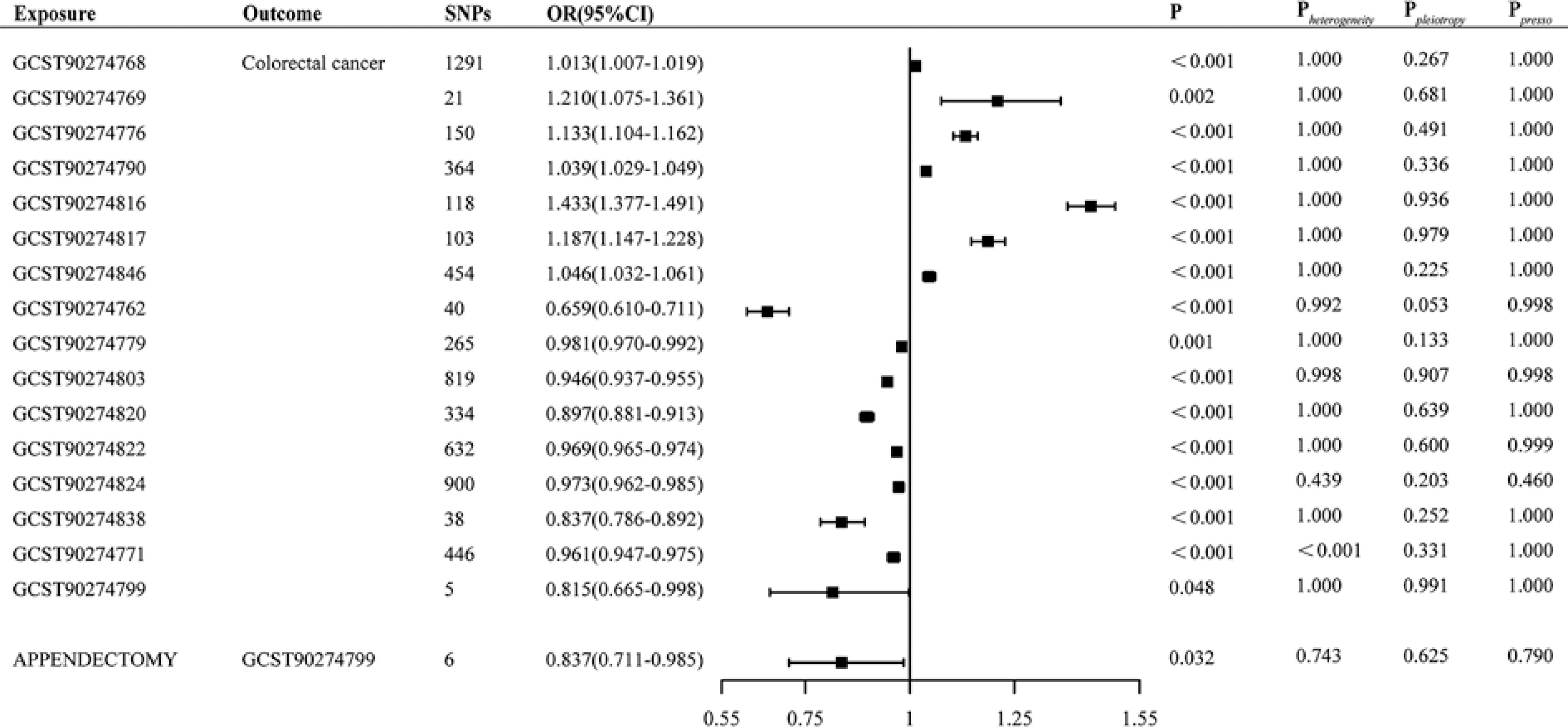
Similarly, using the same method, we analyzed the potential mediating roles of 91 inflammatory proteins in the association between appendectomy and CRC risk. We identified 18 inflammatory proteins associated with CRC risk (Supplementary Tables SV and SVI), with some SNPs showing heterogeneity (Supplementary Table SVII). However, the leave-one-out analysis indicated that no single SNP drove the causal estimate (Supplementary Figure S2). The MR-PRESSO test for horizontal pleiotropy identified 3 inflammatory proteins with evidence of horizontal pleiotropy (ppleiotropy < 0.001) (Supplementary Table SVI). After re-analyzing these 3 proteins with MR-PRESSO to exclude outlier SNPs and obtain corrected causal effect estimates, 1 inflammatory protein had pIVW< 0.05 with consistent OR values across all testing methods. Therefore, we identified 16 inflammatory proteins potentially causally associated with CRC risk (Figure 4). Performing MR analysis with these 16 inflammatory proteins as outcomes and appendectomy as the exposure, we found that interleukin-13 (IL-13,GCST90274799) may partially mediate the association between appendectomy and CRC, with a proportion mediated of 12.8% (95% CI: –2.76–28.4%).
Figure 3
Two-step Mendelian randomization analysis showing evidence supporting a potential causal relationship between metabolites and colorectal cancer, and between appendectomy and GCST90199621
SNP – single nucleotide polymorphism, IVW – inverse variance weight, OR – odds ratio, CI – confidence interval.
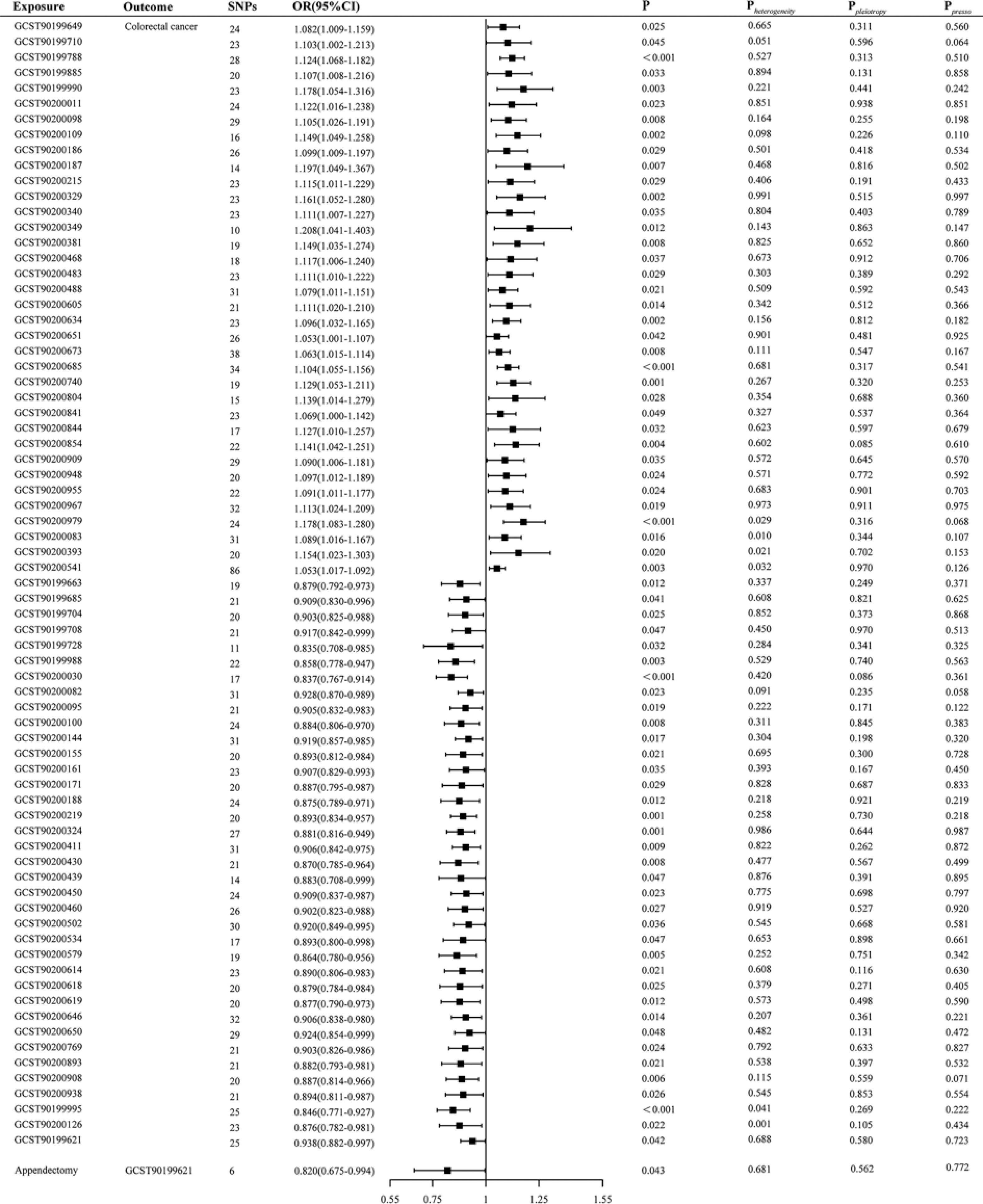
Figure 4
Two-step Mendelian randomization analysis showing evidence supporting a potential causal relationship between inflammatory proteins and colorectal cancer, and between appendectomy and GCST90274799
SNP – single nucleotide polymorphism, IVW – inverse variance weight, OR – odds ratio, CI – confidence interval.
Taken together, our study results suggest that alterations in carnitine and IL-13 levels may partially mediate the association between appendectomy and CRC.
Appendectomy may influence CRC risk through genes located near the associated SNPs
To explore whether appendectomy may be associated with CRC risk at the genetic level, we identified the nearest genes to the 6 significant SNPs associated with the potential causal relationship between appendectomy and CRC risk using the FinnGen database. The genes identified were HLX, OSR1, PITX2, C4orf32, and NR2F2, indicating that these genes are located near SNPs associated with the potential relationship between appendectomy and CRC.
To further investigate the potential relevance of HLX, OSR1, PITX2, C4orf32, and NR2F2 in CRC, we conducted survival analyses using transcriptomic sequencing data from CRC patients in the TCGA and GEO databases. The results showed that high expression of HLX and OSR1 was positively correlated with poor prognosis in CRC patients in both TCGA and GSE39582 datasets (Supplementary Figure S3). In summary, these findings suggest that HLX and OSR1 may represent candidate genes warranting further investigation in the association between appendectomy and CRC, although the present analyses do not establish that appendectomy affects their expression or influences CRC prognosis through these genes.
Discussion
In this MR study, we explored the potential causal relationship between appendectomy and the risk of developing CRC. By using genetic variants as IVs for appendectomy, our analysis provided evidence supporting a potential positive causal relationship between appendectomy and the risk of CRC. Additionally, we found that carnitine and IL-13 may act as potential mediators of this relationship.
Appendectomy, a common surgical procedure, is primarily used to treat acute appendicitis [36]. The appendix is rich in lymphoid tissue and is a major producer of IgA in the large intestine [37, 38]. Appendectomy may impair gut immunity, leading to decreased surveillance and reduced ability to identify and kill tumor cells. The appendix’s rich biofilm and secluded anatomical location make it a reservoir for gut microbiota; its removal may alter the composition of the gut microbiota [39, 40], which may contribute to the development of CRC. Past studies have suggested a possible link between appendectomy and an increased risk of CRC [4], but the exact mechanisms of this relationship remain unclear. Our Mendelian randomization study provides further evidence supporting a potential positive causal relationship between appendectomy and an increased risk of CRC.
MR is an analytical method used to assess the potential causal relationship between exposures and clinically relevant outcomes [41]. As an emerging epidemiological method for causal research, MR complements traditional epidemiological studies by helping to identify potential causal risk factors for diseases [42]. In our study, genetic variants were used as instrumental variables for appendectomy, which helped to reduce the impact of confounding factors and strengthened causal inferences. Through this approach, we found evidence supporting a significant positive potential causal relationship between appendectomy and the risk of CRC. This finding is consistent with some previous epidemiological studies that also reported an association between appendectomy and an increased risk of CRC [43–47].
Furthermore, our study identified carnitine and IL-13 as potential mediators in the association between appendectomy and CRC risk. These findings suggest that metabolic pathways and inflammatory responses may contribute to the association between appendectomy and CRC. Specifically, our two-step MR analysis suggested that carnitine may partially mediate this association. Additionally, IL-13 was identified as another potential mediator, suggesting that inflammatory pathways may also be involved.
Emerging evidence reveals a sophisticated immunomodulatory network involving vitamin D homeostasis, Th17 cell dynamics, the IL-31/IL-33 signaling axis, and gut microbial ecology in regulating immune-mediated inflammatory responses. Th17 cells – a proinflammatory CD4+ T-cell subset – are pivotal drivers of chronic inflammatory processes [48]. The alarmin cytokine IL-33 mediates dual activation of innate and adaptive immunity through ST2 receptor signaling, inducing Th2-polarized cytokine production (IL-5, IL-13) [49]. Murdaca et al. demonstrated that vitamin D insufficiency correlates with alterations in the IL-31/IL-33 signaling pathway, disrupting the Th1/Th17–Treg equilibrium and potentially facilitating bacterial translocation, thereby exacerbating intestinal immune dysfunction [50, 51]. Conversely, vitamin D sufficiency has been associated with a reduced risk of colorectal carcinogenesis in some clinical studies [52]. The gut microbiome’s compositional diversity is fundamental to immune homeostasis, aligning with the hygiene hypothesis. Physiological microbial colonization orchestrates the differentiation of Th1/Th2/Th17/Treg lineages, while commensal-derived metabolites expand peripheral Treg populations to maintain mucosal immune tolerance [53]. Based on these findings, we hypothesize that appendectomy-related immunological alterations, including changes in microbial composition and immune signaling pathways, may contribute to the observed association between appendectomy and CRC risk. Surgical removal of the appendix may influence mucosal immune regulation, microbial ecology, and metabolic pathways, including carnitine metabolism, although these mechanisms require further investigation.
Despite our study providing evidence supporting a potential causal relationship between appendectomy and an increased risk of CRC, there are some limitations to consider. First, MR studies rely on genetic variants as IVs, and their results may be affected by violations of MR assumptions, including genetic heterogeneity and pleiotropy. Second, our analysis is based on specific genetic variations and may not cover all relevant biological pathways. Therefore, future research should aim to further explore the mechanisms underlying this association and validate our findings, considering more genetic variations and biomarkers, as well as factors such as individuals’ genetic backgrounds and lifestyles, to better reveal the complex interactions between appendectomy and CRC.
In conclusion, our study provides evidence supporting an association between appendectomy and CRC risk, and identifies metabolites and inflammatory proteins as potential mediators requiring further investigation. These findings may help improve prevention strategies and risk assessment methods for CRC, thereby reducing its incidence and related mortality.