Introduction
Cardiovascular disease (CVD) is a major public health concern worldwide, accounted for approximately 17.9 million deaths, 396 million years of life lost (YLLs) and contributing an extra 44.9 million years lived with disability (YLDs) in 2022 [1]. In China, CVD remains the leading cause of mortality, responsible for 48.98% and 47.35% in rural and urban populations, respectively [2]. With accelerating population aging and socioeconomic development, a 14.65% increase in CVD prevalence was observed during 1990-2016, accompanied by a 33.7% absolute increase in the disease burden [3]. The financial impact of CVD is expected to rise significantly, with expenditures projected to increase by an average of 9.6% annually, reaching 23.4% of current health expenditures by 2036, thereby imposing a considerable burden on society and families [4]. Furthermore, CVD burden may be further intensified by shifts in lifestyle factors, nutrition transition, and other modifiable CVD risk factors. Therefore, analyzing the evolving patterns of CVD is essential for forecasting its future impact and developing preventative measures.
A recent study, using historical data from the Global Burden of Disease (GBD) 2019 study, projected that, between 2025 and 2050, CVD prevalence would increase by 90.0%, with corresponding increases of 73.4% and 54.7% in crude mortality and DALYs [5]. GBD 2021 analysis demonstrated that CVD remains a pressing public health issue, which resulted in 6 million deaths and 125 million DALYs in the Western Pacific region, constituting 39.4% of all-cause mortality and 22.5% of total DALYs [6]. Previous GBD-based studies have provided valuable descriptions of CVD burden at national or global levels [7]. However, evidence from comprehensive analysis of the CVD burden in China, including comparison with the global profile, is limited. Moreover, most studies have overlooked the consequences of demographic and epidemiological shifts for the burden of CVD. Studies have indicated that elderly people are at a much higher risk of developing CVD, with a prevalence of atherosclerosis as high as 87% in people aged 60 to 69 years [8]. The increase in CVD mortality was higher in men than in women [9]. This raises the need for targeted and effective interventions tailored to different demographic groups. However, the current lack of analyses examining CVD burden and trends by age and sex in China and globally may hinder the development of future interventions and policies.
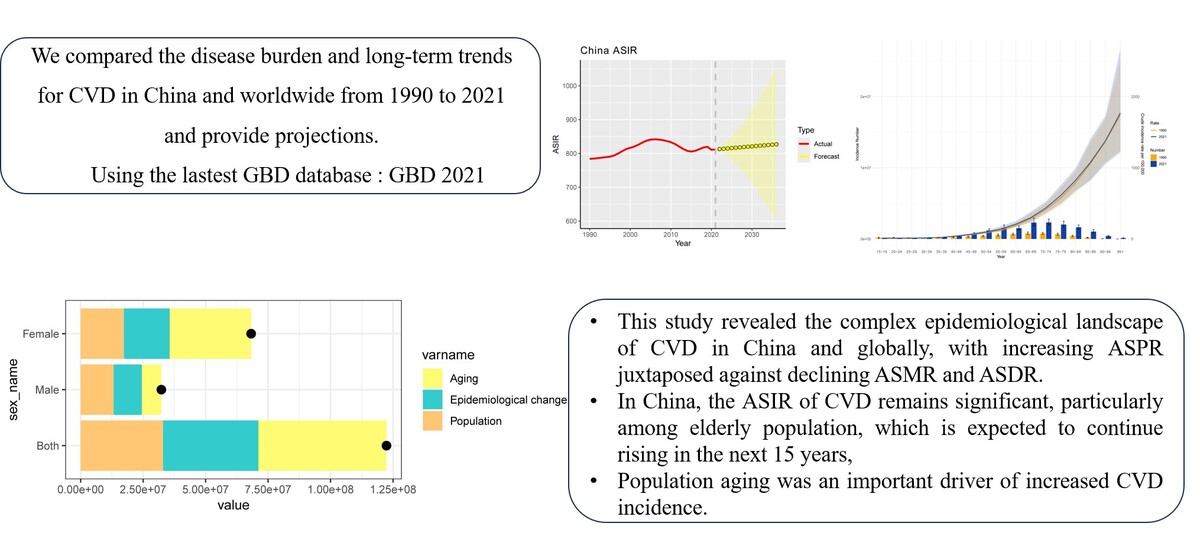
The GBD database represents a large-scale observational epidemiological initiative with worldwide coverage, designed to systematically quantify health loss from major diseases through metrics such as incidence, prevalence, mortality, and DALY rates, categorized by age, sex, region, and period [6]. In this study, we aimed to provide a focused comparative perspective on the burden and long-term trends of CVD in China and worldwide from 1990 to 2021. Additionally, an autoregressive integrated moving average (ARIMA) model was employed to forecast trends until 2036, and decomposition analysis was applied to assess the contributions of aging, epidemiological transitions, and population growth to the CVD burden. By integrated analysis of long-term trends, drivers, and future projections, the findings will not only deepen our comprehension of CVD’s epidemiological patterns but also offer valuable insights for prioritizing prevention and management approaches.
Material and methods
Data sources
A secondary analysis was carried out using data from GBD 2021. This iteration of the GBD study was the first to include global health burden estimates resulting from the COVID-19 pandemic, quantifying 371 diseases and injuries along with 88 risk factors across 204 countries and regions. The assessment relied on modeling techniques including CODEm, STGPR, and DisMod-MR to evaluate key health metrics [10, 11]. GBD estimates the burden of disease indices at regional, national, and global levels, including prevalence, incidence, mortality, and DALYs. Detailed methodology has been published elsewhere [12, 13]. In this study, we retrieved data on crude rates and age-standardized rate for incidence (ASIR), prevalence (ASPR), mortality (ASMR), and DALYs (ASDR) of total CVD in China and globally from 1990 to 2021, accompanied by 95% uncertainty intervals (UIs), categorized by sex and age groups. In the GBD, total CVD included rheumatic heart disease, ischemic heart disease, hypertensive heart disease, stroke, non-rheumatic valvular heart disease, pulmonary arterial hypertension, cardiomyopathy and myocarditis, atrial fibrillation and flutter, lower extremity peripheral arterial disease, aortic aneurysm, endocarditis, and other cardiovascular and circulatory diseases. All GBD 2021 health estimates are available at https://vizhub.healthdata.org/gbd-results/. This study was conducted in accordance with the Guidelines for Accurate and Transparent Health Estimates Reporting (GATHER), to ensure full transparency and replicability [14].
Joinpoint regression analysis
We selected the Joinpoint regression model, which can objectively identify the inflection points of temporal trends, to analyze long-term trends of age-standardized CVD metrics in China and globally from 1990 to 2021, and the annual percentage change (APC) and average annual percentage change (AAPC) as well as their 95% confidence intervals (95% CIs) were calculated. We assumed a natural logarithm of age-standardized rates to fit a linear regression model: Y = β0 + β1year + ε, where Y is equal to the natural logarithm of age-standardized rates, β0 is the constant, β1 indicates the positive or negative changing trends, year stands for the calendar year, and ε is the error term, assumed to be independently and identically distributed with constant variance. The optimal number and locations of joinpoints were determined by an iterative algorithm that minimizes the Bayesian Information Criterion (BIC), with the statistical significance evaluated using a Monte Carlo permutation test (4,999 permutations, α = 0.05), from 0 up to a maximum of 5 joinpoints. For each segment, the APC was calculated as 100 × (exp(β1) – 1), with its 95% CI derived from the CI of β1. AAPC can be calculated based on the following equation: 100 × (exp(βavg) – 1), where βavg is the length-weighted average slope, with its 95% CI calculated accordingly. An upward trend was considered statistically significant if both the AAPC estimate and the lower bound of its 95% CI were greater than zero. Conversely, a downward trend was considered statistically significant when both the AAPC and the upper bound of the 95% CI were less than zero.
Decomposition analysis
Decomposition analysis was used to investigate the impact of population growth, demographic aging, and epidemiological trends on CVD burden in China and globally. This decomposition method developed by Das Gupta uses mathematical techniques of additivity and the absence of interaction effects to break down overall changes into components to identify the specific contributions of each part, and it is independent of the order in which the components are entered, thereby ensuring the robustness of the estimates and the uniqueness of the interpretation [15, 16]. The total change in CVD metrics (∆Total) is defined as the difference between the end and start years: ∆Total = Σ (Ri2 × Pi2) – Σ (Ri1 × Pi1), where i denotes the i-th age group, R is the age-specific rate, and P is the corresponding population size. Using Das Gupta’s iterative averaging algorithm, ∆Total was decomposed into three additive components: (1) Rate Effect: change due to variations in age-specific rates, holding population constant, (2) Age Structure Effect: change due to shifts in the proportion of the population in each age group, holding rates and total population constant, (3) Population Growth Effect: change due to the increase in total population size, holding rates and age structure constant.
Model prediction
Projections of CVD burden were extended to the year 2036. This horizon was selected to align with the midterm evaluation timeline of major health initiatives (the WHO Global Action Plan on NCDs and China’s “Healthy China 2030” strategy) and to balance longterm planning relevance with reasonable forecast precision. We employed the autoregressive integrated moving average (ARIMA) model, a widely used time series analysis method, integrating autoregression (AR), integration (I), and moving average (MA) components, which is essential for capturing the complex, inertia-driven epidemiology of CVD burden over time. This provides a more rigorous foundation for forecasting compared to simple linear extrapolation [17]. The ARIMA (p, d, q) modeling approach, where p, d, and q signify the orders of autoregression, differencing, and moving average, was implemented to capture trends and cyclical patterns for prediction. The initial time series was differenced (d) to achieve stationarity, verified using the KPSS test. After comparing candidate models using Akaike information criterion (AIC) and Bayesian information criterion (BIC) criteria, the optimal model was selected. Model validity was subsequently assessed by confirming that residuals followed a normal distribution (using Q-Q plots) and exhibited white noise characteristics (using the Ljung-Box test), indicating adequate model fit. The accuracy of forecasts was quantified and reported using standard metrics: mean absolute error (MAE) and mean absolute percentage error (MAPE). The primary output of our analysis is the long-term trend trajectory with 95% prediction intervals. These intervals are calculated from the model’s residual variance and define the range where future values are expected with 95% probability, with narrower intervals indicating higher precision.
Results
Description of the CVD burden in China and globally
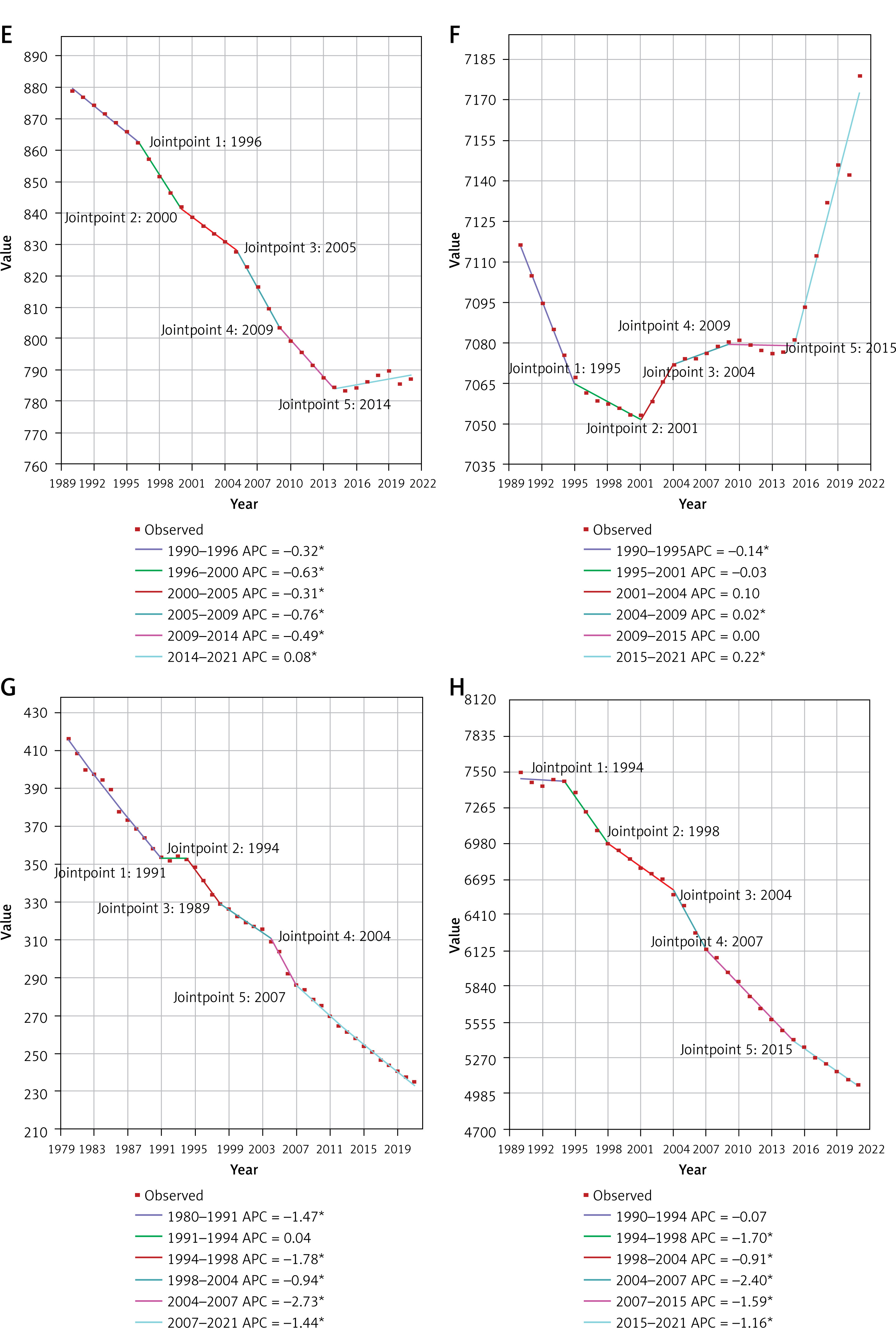
In China, ASIR increased from 783.897 (95% UI: 718.421, 857.63) per 100,000 people in 1990 to 811.813 (95% UI: 736.137, 892.008) per 100,000 in 2021, while globally it decreased from 878.787 (95% UI: 808.166, 959.896) per 100,000 to 787.04 (95% UI: 719.74, 859.695) per 100,000. From 1990 to 2021, the AAPC of ASIR increased by 0.105% (95% CI: 0.067%, 0.144%), while it decreased by 0.353% (95% CI: –0.404%, –0.301%) globally. For ASPR, China and globally saw an increase trend, with AAPC values of 0.290% (95% CI: 0.273%, 0.308%) and 0.027% (95% CI: 0.015%, 0.038%), respectively. Overall, the trends of ASMR and ASDR for CVD in China and globally were similar over the past three decades, showing a significant downward trend (Table I).
Table I
Number of CVD cases, age-standardized incidence, prevalence, mortality, and DALY rates, and corresponding AAPC in China and globally in 1990 and 2021
Long-term trends of CVD burden in China and globally
Figure 1 presents the APC of ASIR, ASPR, ASMR, and ASDR of CVD in China and globally. In China, ASIR of CVD showed an upward trend, with the largest increase from 1995 to 2005 (APC = 0.642%, 95% CI: 0.613%, 0.672%), and ASPR showed the largest increase from 2001 to 2004 (APC = 0.895%, 95% CI: 0.729%, 1.061%). Meanwhile, ASMR exhibited an overall downward trend, with an intervening period of increase from 1998 to 2004 (APC = 1.669%, 95% CI: 1.199%, 2.141%). ASDR mainly decreased from 2004 to 2007 (APC = –4.267%, 95% CI: –5.006%, –3.523%), but increased again from 1998 to 2004, with an APC of 1.669%. Globally, ASIR, ASMR and ASDR of CVD generally displayed a downward trend, while ASPR showed an upward trend with fluctuations. The increase in ASPR was mainly concentrated between 2015 and 2021 (APC = 0.219%, 95% CI: 0.187%, 0.252%).
Figure 1
The APC of ASIR, ASPR, ASMR, and ASDR of CVD in China (A–D) and globally (E–H) from 1990 to 2021 (*p < 0.05, statistically significant). A – ASIR in China; B – ASPR in China; C – ASMR in China; D – ASDR in China The APC of ASIR, ASPR, ASMR, and ASDR of CVD in China (A–D) and globally (E–H) from 1990 to 2021 (*p < 0.05, statistically significant). E – ASIR globally; F – ASPR globally; G – ASMR globally; H – ASDR globally
Age and sex difference of CVD burden in China and globally
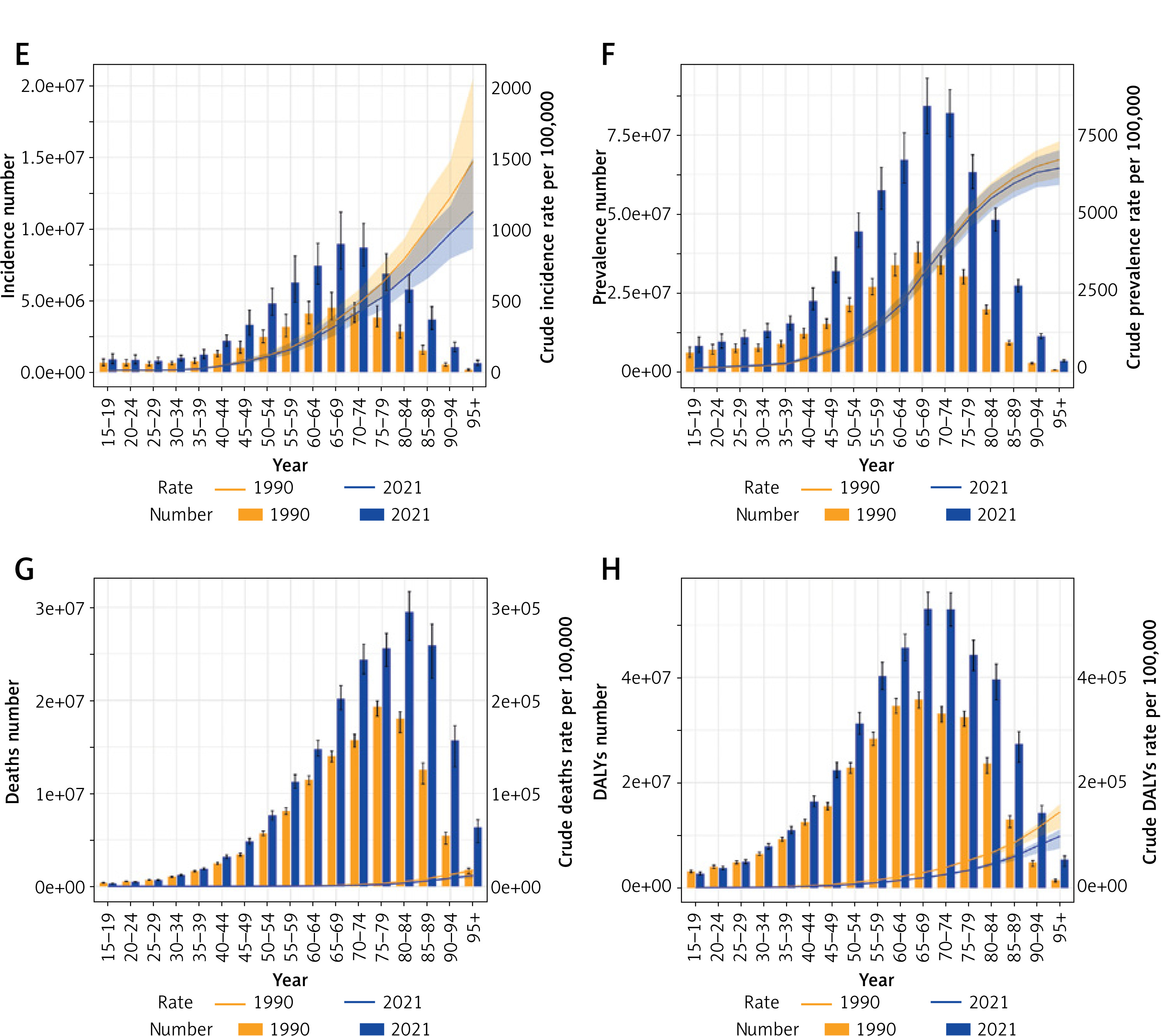
Figure 2 compares the crude incidence, prevalence, mortality, and DALY rates of CVD between China and the global level for 1990 and 2021. The corresponding absolute numbers are also presented. In both 1990 and 2021, all crude CVD rates were observed to be low among individuals under 40 years of age, after which they exhibited a consistent rise. The absolute number of corresponding CVD metrics in 2021was higher than that in 1990. Globally, in 2021, the number of incident CVD cases peaked in the 65–69 age group (8941141.59, 95% UI: 7176764.19, 11181053.52), while deaths were greatest in the 80–84 age group (2949194.02, 95% UI: 2644216.89, 3166494.84). The peak DALYs occurred in the 70–74 age group. In addition, in 2021, we observed that the number of male incident CVD cases was higher than that of females before the age of 80 years, and the number of deaths and DALYs in males were higher than those in females, except in individuals aged ≥ 90 years, in China. In terms of prevalence results, the number of females was higher than that of males after 55 years old. Globally, the number of male incident CVD cases was higher than that of females in the age range of 25–74 years, and the number of deaths and DALYs in males were higher than those in females before the age of 80 years (Supplementary Figures S1 and S2).
Figure 2
Age-specific distribution of crude CVD rates and absolute numbers of cases, deaths, and DALYs in China and globally in 1990 and 2021. The black line and shaded area represent the 95% uncertainty interval (UI). A – Incident cases and crude incidence rates in China. B – Prevalent cases and crude prevalence rates in China. C – Deaths and crude mortality rates in China. D – DALYs and crude DALY rates in China. E – Incident cases and crude incidence rates globally. F – Prevalent cases and crude prevalence rates globally. G – Deaths and crude mortality rates globally. H – DALYs and crude DALY rates globally. Bar charts represent counts; lines represent crude rates
Decomposition analysis
Drivers of changes in CVD burden varied from 1990 to 2021 (Figure 3). The results revealed that in China the increase in CVD incidence is primarily driven by population aging (total population: 41.88%, male: 24.17%, female: 47.81%); however, it negatively affected the increase in CVD prevalence (total population: –59.31%, male: –43.97%, female: –64.00%). Population growth contributed positively to the increase in CVD incidence, prevalence, mortality, and DALY rates, while epidemiological trends had a negative contribution to CVD mortality, and DALY rates in China. Globally, changes in epidemiological trends also have a negative contribution to the CVD incidence, prevalence, mortality, and DALY rates, although this does not alter the overall trend. We observed that population growth and aging had a positive contribution to CVD incidence, mortality, and DALY rates in China and globally (Table II).
Figure 3
Decomposition analysis of CVD from 1990 to 2021 in China and globally. A – Incidence in China; B – prevalence in China; C – mortality in China; D – DALYs in China; E – incidence globally; F – prevalence globally; G – mortality globally; H – DALYs globally
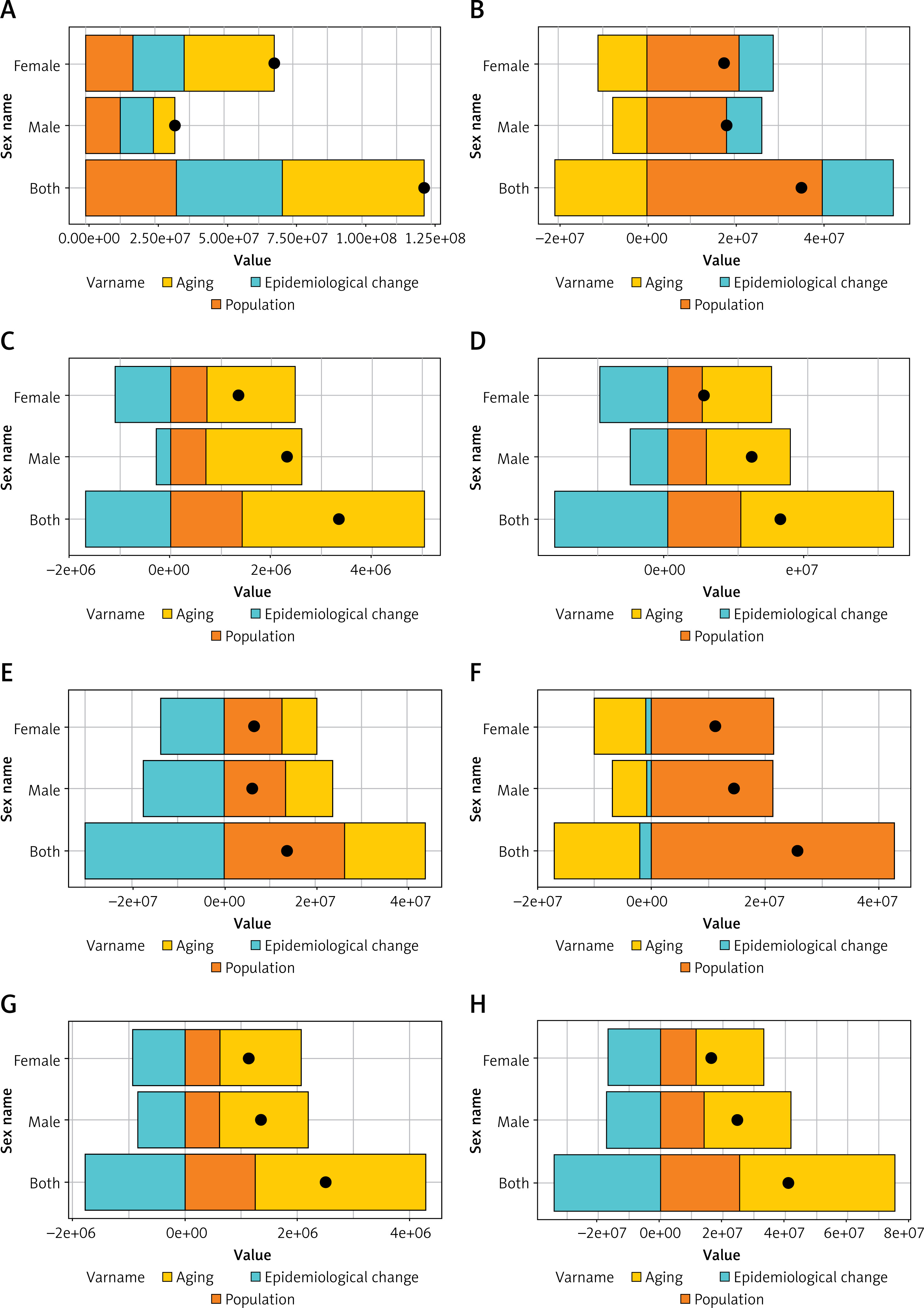
Table II
The impact of aging, population growth, and epidemiological trends on changes in CVD incidence, prevalence, mortality, and DALY rates in China and globally, 1990–2021
Projections of CVD burden for the next 15 years in China and globally
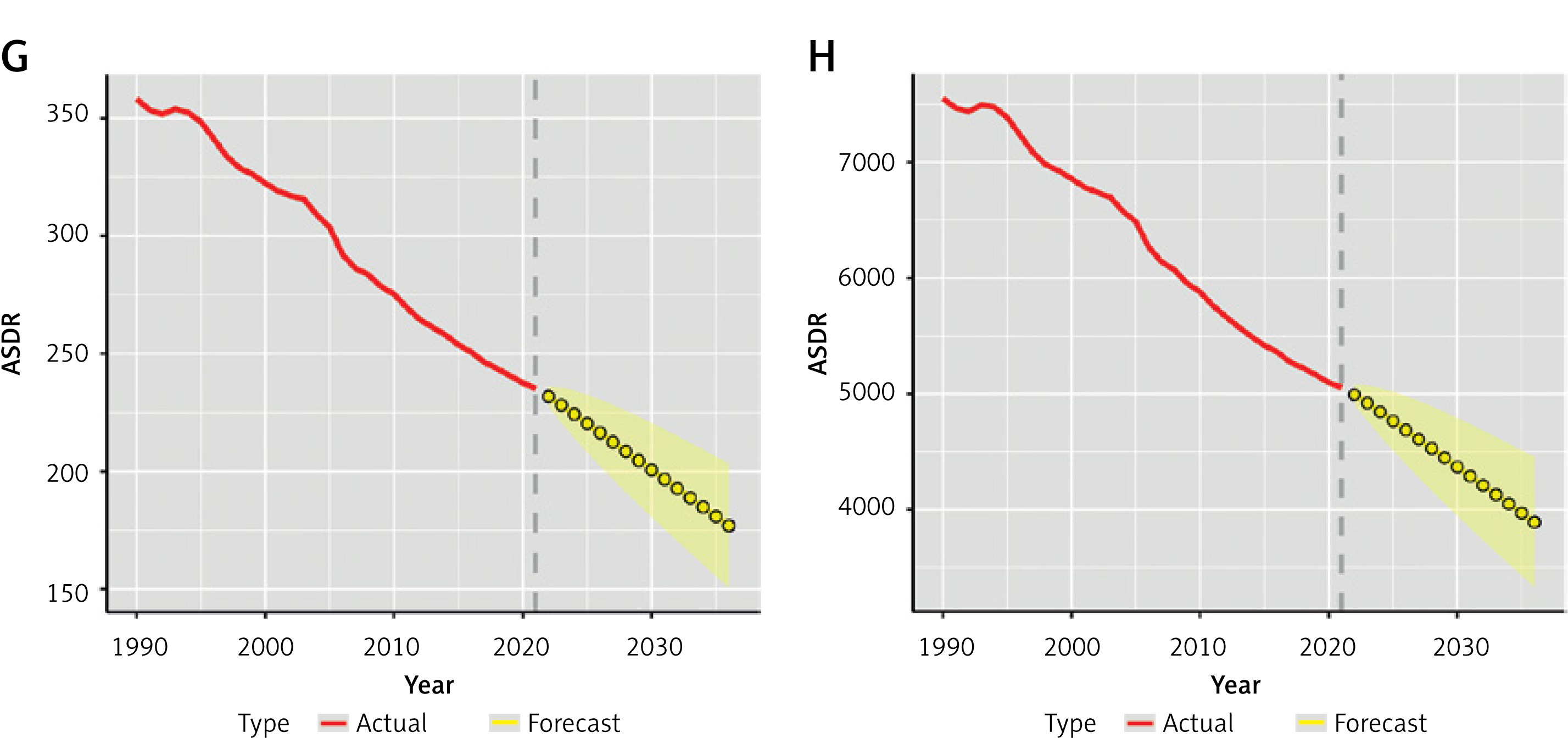
To project future trends, we applied the auto.arima() function to 1990–2021 data, generating optimal ARIMA models for the ASIR, ASPR, ASMR, and ASDR of CVD in China and globally for the next 15-year forecast. According to the ARIMA model results, the ASIR and ASPR of CVD in China are projected to continue rising. By 2036, the ASIR and ASPR of CVD are projected to increase to 825.94 per 100,000 (95% CI: 621.05, 1030.82) and 7056.84 per 100,000 (95% CI: 6727.62, 7386.06) in the total population. However, the ASMR and ASDR will decline, the ASMR and ASDR for the total population in China are projected to decline to 222.03 per 100,000 (95% CI: 149.78, 294.27) and 3797.22 per 100,000 (95% CI: 2763.56, 4830.87). At the global level, ASIR and ASPR of CVD are projected to increase to 807.96 per 100,000 (95% CI: 698.01,917.91) and 7457.46 per 100,000 (95% CI: 7204.51, 7710.41) in 2036 in the total population (Table III, Figure 4). The sex-specific prediction results showed that the ASIR of CVD for females initially rose then declined, while a declining trend among males is projected in the next 15 years in China. Globally, the ASIR of CVD for females will continue to increase in the future, while that of men will decline. China’s ASPR of CVD is projected to continue rising in the future, while the global ASPR among females is projected to rise initially and then decline. For ASMR and ASDR, both males and females are projected to show a downward trend in the next 15 years in China and globally (Supplementary Figures S3–S6).
Table III
Optimal ARIMA models and 2036 forecast values for ASIR, ASPR, ASMR, and ASDR of CVD in China and globally
Figure 4
Projected trends in ASIR, ASPR, ASMR, and ASDR of CVD in China and globally from 2021 to 2036. A – ASIR in China; B – ASPR in China; C – ASMR in China; D – ASDR in China; E – ASIR globally; F – ASPR globally; yellow dotted lines and shaded regions represent the predicted trend and its 95% CI. G – ASMR globally; H – ASDR globally; yellow dotted lines and shaded regions represent the predicted trend and its 95% CI
Discussion
This study undertakes a systematic comparison of CVD trends between China and the global average from 1990 to 2021, yielding insights into the evolving burden and epidemiological distribution of the disease. The results indicated that ASIR and ASPR of CVD in China showed significant upward trends, while ASMR and ASDR showed decreasing trends. This is consistent with the latest research from countries of the Association of Southeast Asian Nations; compared to 1990, the number of people suffering from CVD has increased by 148.1%, and ASPR has risen by 2.5% [18]. Globally, except for ASPR, other CVD metrics showed declining trends over the past three decades. The upward trends in ASIR and ASPR are plausibly explained by concurrent improvements in diagnostic capabilities and public health awareness, leading to earlier and more frequent detection of cases. In addition, over the past three decades, China has experienced a period of rapid economic development, and changes in lifestyle, such as the adoption of western dietary patterns and physical inactivity, have led to the increase of CVD risk factors, resulting in increased CVD incidence [19]. Additionally, phases of economic growth are frequently accompanied by the intensification of environmental pollution, such as air pollution and climate change, both of which are closely linked to higher CVD risk [20, 21]. It is worth noting that China is facing the challenge of an aging population, and an increasing proportion of the elderly population may lead to an increase in CVD incidence [22]. The reduction of ASMR and ASDR of CVD may be attributed to earlier screening, identification, and diagnosis of CVD by medical technology, allowing for timely interventions that effectively mitigate the progression of adverse events [23]. This difference is also explained by our decomposition analysis: the rise in ASIR and ASPR stems from unfavorable changes in the “epidemiological rate” component, reflecting increased population exposure to key behavioral and metabolic risk factors. Moreover, the introduction of new medications, such as statins and antihypertensive drugs, along with interventional therapies such as stent implantation and coronary artery bypass surgery, has significantly improved the prognosis of patients [24–26].
We observed divergent trends in the ASIR of CVD between China and global estimates, possibly due to several factors. First, many high-income countries have successfully controlled CVD risk factors and the incidence has entered a declining phase, whereas China remains in a transitional stage characterized by persistent exposure to increasing risk factors [27]. Second, China’s health policy has focused on reducing CVD mortality in the past few decades (such as promoting thrombolysis, interventional therapy, and improving the first aid system), and policy resources have been directed more toward treatment than primary prevention [28]. The implementation and coverage of primary prevention policies such as hypertension, obesity and smoking are still insufficient. Third, China has experienced one of the most rapid and substantial processes of population aging globally, resulting in a sharp increase in the absolute number of older adults. Therefore, even a modest increase in the age-standardized rate may translate into a substantial increase in new cases, while the global average aging rate is slower than that of China. Thus, compared with global patterns, China’s unusually rapid and compressed epidemiological transition (which occurred in just a few decades, in contrast to the century-long transitions observed in other countries) has shaped a distinct CVD trajectory. Hence, China should adopt a two-track strategy: strengthening primary prevention of CVD, while adapting the health policy to meet the dramatic increase in demand associated with population aging.
Findings from the current study showed that both in 1990 and 2021, the crude incidence, prevalence, mortality, and DALY rates of CVD were low under the age of 40 years and then increased with age. The absolute number of corresponding CVD metrics was substantial among the elderly. Age is a well-established risk factor for CVD due to physiological changes that occur with aging, such as arterial stiffening, increased blood pressure, and cholesterol accumulation in the arteries. In addition, older adults are more likely to have other CVD metabolic risk factors, such as diabetes and hypertension, which further increase CVD risk [29, 30]. We also observed a significant sex disparity, with males experiencing higher incidence, mortality, and DALYs compared to females. Possible reasons were that physiological factors such as lower estrogen levels and higher prevalence of abdominal obesity in men increase the CVD risk [31]. Additionally, behavioral factors, including higher rates of smoking, alcohol consumption, and less frequent healthcare engagement for males, further contribute to this disparity [32]. For example, based on the 2010 Chronic Disease Risk Factor Surveillance Survey, the smoking rate among individuals aged 60 and over was 22.4%, with the rate being substantially higher in elderly men (41.5%) than elderly women (4.3%) [33]. Smoking remains the leading risk factor for cardiovascular disease (CVD) and the leading cause of death globally, so promoting smoking cessation is critical [34]. These findings underscore the urgent need for targeted public health interventions and preventive strategies to address the growing burden of CVD in China, particularly in high-risk male elderly populations.
Decomposition analysis revealed that in China the increase in CVD incidence was primarily driven by population aging, whereas changes in age-specific rates contributed negatively to CVD mortality and DALY rates. China has taken a variety of measures to prevent CVD, such as public health promotion, smoking cessation programs, healthy diet advocacy, and regular health examinations, which have alleviated the rising incidence of CVD to a certain extent [35, 36]. However, due to the rapid aging process and large population base, these gains have not reversed the rising incidence of CVD [37]. At the global level, observed shifts in epidemiological trends exerted a moderating effect on the rates of CVD incidence, prevalence, mortality, and DALYs, albeit insufficient to reverse the overarching upward trend. These findings indicate that despite favorable shifts in some CVD risk factors, a substantial gap persists between the current levels of these indicators and their guideline-recommended targets. Projections to 2036 further suggest that the ASIR and ASPR of CVD in the total population in China will continue to rise, while the ASMR and ASDR will decline. This showed that the continuous improvement of healthcare systems and breakthroughs in therapeutic medicine have made real progress in improving CVD mortality and DALYs; however, increased ageing has led to an increase in incidence and prevalence. Accordingly, addressing the impact of population ageing must be a paramount consideration in the health planning agendas of all countries. Healthy China 2030 proposed that the rising trend of CVD incidence and risk factors should be effectively controlled, and the mortality rate should be reduced to less than 190.7 per 100,000 by 2030 [38]. Therefore, enhancing primary prevention through better control of CVD risk factors, improving access to early screening and diagnosis for timely treatment, especially prioritizing the distinct requirements of an ageing populace, and strengthening healthcare capacity, particularly in primary healthcare services, are essential steps for CVD prevention. In addition, we used ARIMA models, a well-established forecasting tool, to predict trends in the CVD burden through 2036. The strategic application of forecasting provides critical data to inform proactive health planning for future CVD trends.
The innovation of this study is the creation of a unified analytical pipeline that benchmarks China’s progress against global targets, providing a replicable template for other countries. However, this study has several limitations that should be considered. First, the heterogeneity in data quality across regions – especially the lower completeness and reliability of health records in underdeveloped areas – may introduce potential inconsistencies, as the analysis relies on secondary data from the GBD database. Moreover, variations in diagnostic standards and detection technologies over time between countries may contribute to heterogeneity in the estimates. Second, the trend analysis considered only time as an independent variable, while the decomposition and forecasting models did not incorporate potential confounding factors, such as socioeconomic status, healthcare access, and lifestyle, which are important drivers of CVD. Their absence means that our analysis may not fully disentangle the contribution of social determinants to CVD trends. Furthermore, the predictive models assume that that historical patterns will continue into the future, which may limit their ability to accurately capture future changes in CVD burden. Third, the time series ARIMA model relies on extrapolation methods and mechanical principles, generating predictions based on past trends without considering causal factors, contemporaneous predictor variables, or potential future policy changes. Its accuracy is entirely dependent on the quality and stability of the historical GBD input data, and cannot take into account unexpected events such as pandemics; and as the prediction time range increases, the uncertainty of the prediction significantly increases. Finally, the absence of provincial-level data limited the granularity of our analysis, precluding a subnational examination of the CVD burden across China. Future studies should seek to incorporate more granular, region-specific data to enhance the resolution of CVD trend analyses and identify important local disparities.
In conclusion, this study revealed the complex epidemiological landscape of CVD in China and globally, with increasing ASPR juxtaposed against declining ASMR and ASDR. In China, the rising incidence of CVD has placed a heavy burden on healthcare systems, particularly among the male elderly population, and is expected to continue over the next 15 years. The CVD burden increased with age, and sex differences were observed. Population aging is an important driver of increased CVD incidence. Therefore, it is crucial to develop differentiated screening and treatment strategies for specific age and sex groups, with the dual objectives of enhancing healthcare access and implementing effective interventions to reduce the CVD burden.