Introduction
Pain is a significant adverse event caused by external trauma [1, 2]. Non-steroidal anti-inflammatory drugs (NSAIDs) are a safe and effective treatment for pain in the paediatric population with only minor adverse reactions [3]. Orthopaedic hip surgery may cause severe pain in paediatric patients because of the large incisions and the performance of an osteotomy that is required during surgery, and because of the required immobilisation of the lower limbs after the surgery.
Tumour necrosis factor-α (TNF-α) is a multipotent pro-inflammatory cytokine, a sensitive early indicator of tissue injury, and a significant mediator of postoperative pain [4]. Substance P transmits and regulates pain and is closely correlated with chronic pain in disease [5]. It has also been suggested that substance P is a key effecter in analgesia in cancer pain [6]. TNF-α and substance P are acute reactive proteins, and their levels increase in tissues stimulated by injury. Prostaglandins (PGs) are pain-causing factors in trauma events and are inhibited by NSAIDs, thus alleviating the pain. Excessive inflammatory cytokine reactions persist for several days after surgery and can hinder patient recovery [7].
Having found no published studies on the use of NSAIDs in the treatment of acute pain in infants and children after paediatric orthopaedic hip surgery, we undertook the present study. These paediatric patients were treated post-operatively with one of three NSAIDs. The present study analyses the efficacy of NSAIDs on TNF-α and substance P and provides guidance for medical staff in clinical treatment and treating minor adverse effects.
Material and methods
General material
The subjects were selected from patients visiting our hospital’s paediatric orthopaedic department between September 2016 and September 2018. The patient inclusion criteria were children between 1.5 and 3.0 years old; body weight from 9.7 to 20.0 kg; American Society of Anaesthesiologists (ASA) class I; no previous analgesic pump therapy; no history of chronic pain and/or administration of opioids; and X-ray findings of complete hip dislocation with unilateral iliopsoas adductor muscle release, joint debridement, joint capsule repair, femoral head reduction, iliopsoas lengthening, femoral rotation osteotomy, and a hip spica cast. The patient exclusion criteria were untreated severe congenital heart disease, a known allergy to opioids or NSAIDs, obstructive sleep apnoea syndrome, neuropsychological dysfunction, unfavourable family communication, abnormalities in the patient’s ability to express emotions, or a provider directive against clinical research. Ninety-four eligible children were selected for the present study. Four children left the study, and 90 children were eventually enrolled and randomised into three groups (A, B, and C) of 30 patients each. The present study was approved by the institutional review board of the Second Hospital of Shanxi Medical University. Before the study was initiated, consent was obtained from the guardian of each patient, and this informed consent was signed by the patient’s parents.
Methods
During the operation, a trained anaesthesiologist administered general anaesthesia and local ropivacaine. After the operation, the patients received one of three NSAIDs, administered according to the study protocol:
Group A: ketorolac tromethamine injection (Shandong New Era Pharmaceutical Co., Ltd.); specifications: 30 mg/dose, 0.5 mg/kg [8], twice daily, intravenous drip;
Group B: ibuprofen suspension (Shanghai Johnson & Johnson Pharmaceutical Co., Ltd.); specifications: 100 ml/bottle, 4–5 ml/time, orally, reusable every 4 to 6 h, not more than four times every 24 h [9]. Although ibuprofen suspension has a sweet taste and is suitable for most paediatric patients, it can be rejected by some, resulting in an inaccurate dosage.
Group C: acetaminophen rectal suppository (Guangzhou Baiyunshan Pharmaceutical Co., Ltd.); specification: first dose of 40 mg/kg, and subsequent doses of 20 mg/kg rectal suppository given every 6 h, with daily doses not exceeding 60 mg/kg [10].
To ensure timely administration and accurate evaluation, the dosage regimens were administered by our group’s medical staff or the patient’s parents.
The concentrations of TNF-α and substance P in venous blood were determined by enzyme-linked immunosorbent assay (ELISA) according to the manufacturer’s instructions (Bioswamp, Wuhan, China).
Observation index
Analgesic score
Pain was scored post-operatively using the Children’s Hospital of Eastern Ontario Pain Scale (CHEOPS) at 30 min and at 1, 2, 3, 6, 12, and 24 h. CHEOPS consists of six factors, i.e. cry, facial, verbal, torso, touch, and legs, and scores of each factors range from 4 (least pain) to 13 (severe pain); a score > 5 requires the addition of analgesic drugs [11]. The scale has good reliability and validity for children from 0 to 7 years old [12], and scores were recorded by the hospital’s medical staff or the parents or guardians of the patients.
Sedation score
The sedation level of patients was evaluated using the Ramsay sedation scale, based on the 1 to 6 principle: 0 points, awake and restless; 1 point, awake and quiet, but cooperative; 2 points, sleepy and responds only to instructions; 3 points, falls asleep, but can quickly respond to calls; 4 points, sleeping and slow response to calls; and 5 points, difficult to wake up [13].
Biochemical assay
The serum levels of TNF-α and substance P were determined by ELISA before, immediately after, and 24 h after the operation.
Safety criteria
Adverse reactions were recorded such as nausea, vomiting, respiratory depression, abnormal behaviour, itching, urinary retention, and sleepiness after awakening.
Statistical analysis
SPSS 20.0 statistical software was applied for analysis. Data were expressed as mean ± standard deviation (x ± SD) and compared by a χ2-test or Fisher’s exact test. T-test, one-way ANOVA, or rank-sum test was used for comparisons among the three groups. The pain and sedation scores and the concentrations of TNF-α and substance P at different time points were compared using variance analysis with a repeated measurement design.
Results
Comparison of the baseline characteristics
There was no significant difference in baseline characteristics among the three groups (p > 0.05), as seen in Table I.
Table I
Comparison of baseline characteristics among the three groups
Comparison of the analgesic effects of the three NSAIDs
Patients in all groups demonstrated analgesic effects at each time point, but there was no statistical significance among these groups (p > 0.05), as shown in Table II.
Table II
CHEOPS analgesia score at different time points among the three groups (point,
Comparison of serum TNF-α and substance P levels
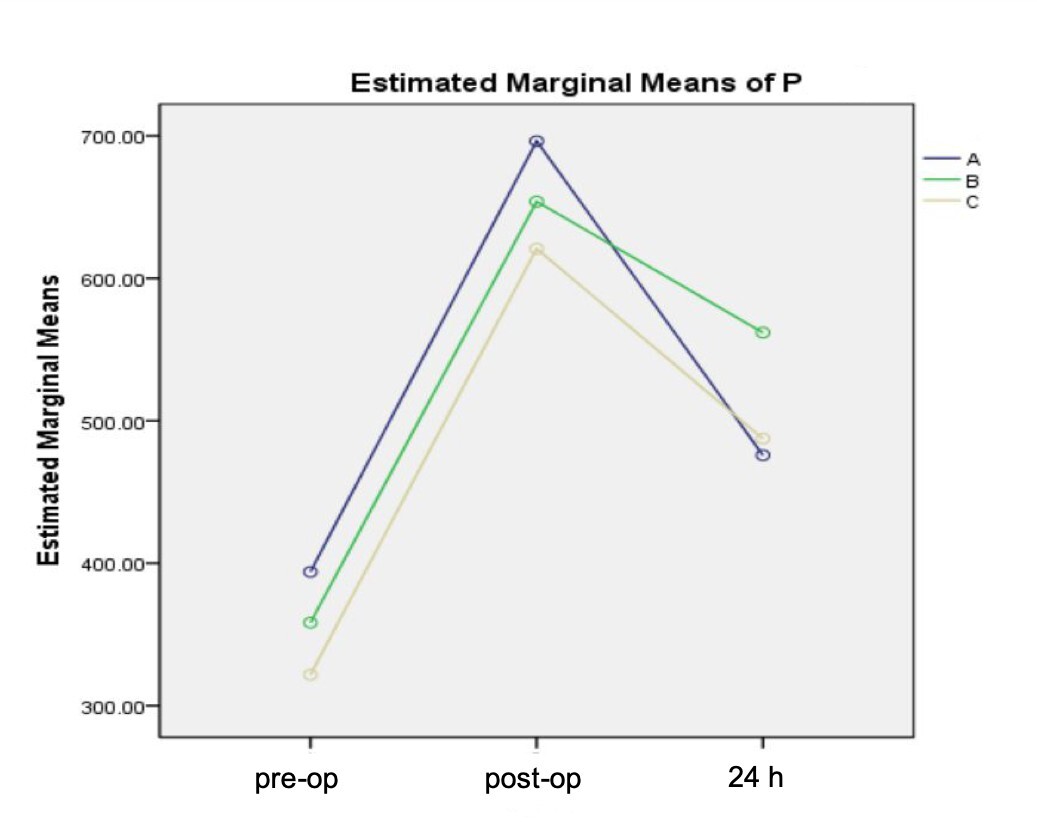
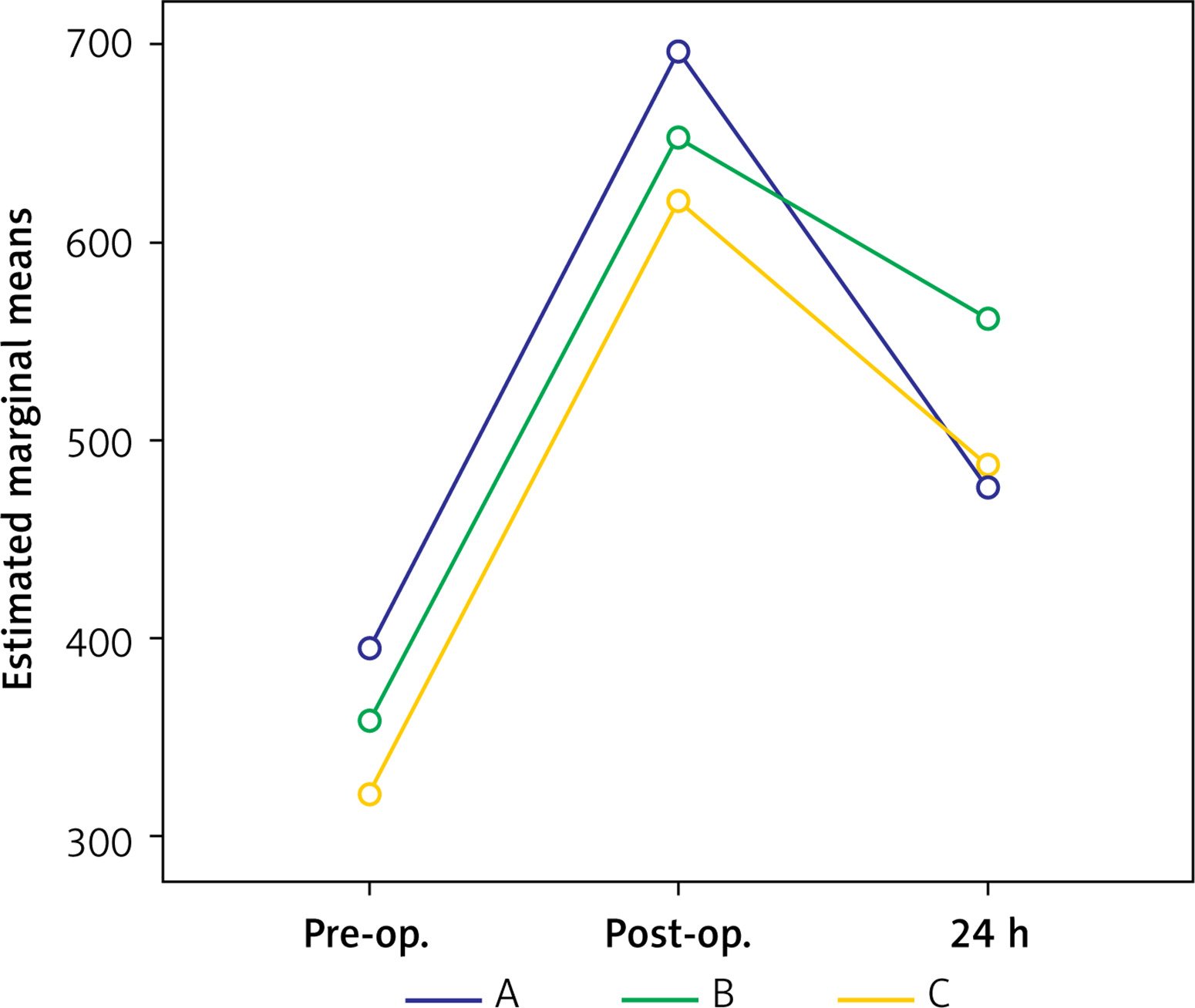
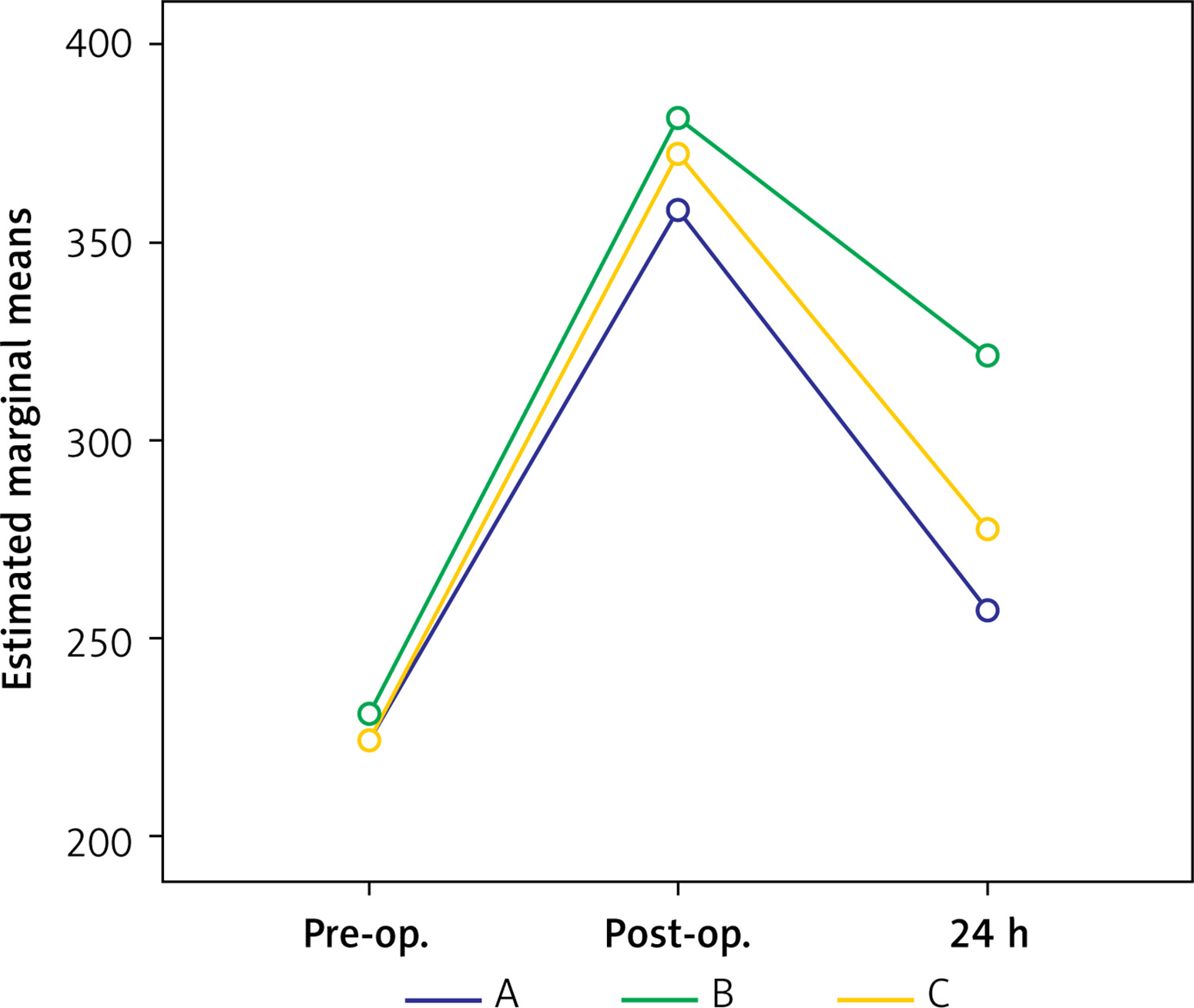
Levels of the two inflammatory factors differed depending on the patient group and time of blood sample collection. The venous blood levels of TNF-α and substance P in all groups increased after the operation but decreased after 24 h, and the difference was statistically significant (p < 0.05). These levels significantly decreased in group A, the ketorolac tromethamine group, when compared to groups B and C, but this was not statistically significant (p > 0.05) (Tables III and IV; Figures 1 and 2).
Table III
Variation of substance P at different time points among the three groups (pg/ml,
| Group | N | Pre-operation | The moment of the operation ends | 24 h post-operation |
|---|---|---|---|---|
| Group A | 30 | 393.91 ±229.38 | 696.23 ±431.53a | 475.76 ±251.68a |
| Group B | 30 | 358.28 ±271.54b | 653.82 ±438.52ab | 561.87 ±391.76ab |
| Group C | 30 | 321.76 ±188.89c | 620.72 ±291.83ac | 487.44 ±195.92ac |
Table IV
Variation of TNF-α at different time points among the three groups (pg/ml,
| Group | N | Pre-operation | The moment of the operation ends | 24 h post-operation |
|---|---|---|---|---|
| Group A | 30 | 224.57 ±129.46 | 358.74 ±251.54a | 257.53 ±131.01a |
| Group B | 30 | 231.02 ±120.68b | 381.63 ±192.30ab | 322.01 ±149.65ab |
| Group C | 30 | 224.86 ±80.49c | 372.93 ±135.05ac | 278.12 ±82.83ac |
Comparison of adverse reactions of the three NSAIDs
The incidence of adverse reactions in group C, the acetaminophen group, was lower than those in group A and group B, and the difference was statistically significant (p < 0.05, Table V).
Discussion
NSAIDs exert analgesic and anti-inflammatory effects by inhibiting cyclooxygenase (COX) and reducing the conversion of arachidonic acid to PG and thromboxane [14]. NSAIDs have been recognised as the preferred analgesic drug for children due to their safety and precise analgesic effect [3], and they are widely used for postoperative analgesia in this patient population.
In the present study, one of three NSAIDs was administered post-operatively to each paediatric patient, and the CHEOPS pain scale measured pain at 30 min and at 1, 2, 3, 6, 12, and 24 h. Patients from groups A, B, and C had significant analgesic effects at each time point, but there was no statistical difference among the groups (p > 0.05). This indicates that NSAIDs are a suitable treatment for moderate postoperative pain and could be used as a first-line drug for most pain therapies, consistent with the study conducted by Smith [15].
There was no statistical difference in the serum levels of TNF-α and substance P among groups A, B, and C before, during, and after the operation (p > 0.05). Peripheral nerve stimulation and the body stress response to surgical trauma resulted in a significant increase in inflammatory factors and increased postoperative pain. In the present study, TNF-α and substance P significantly increased when the patients regained consciousness after the operation and decreased after administering analgesics, and this was statistically significant (p < 0.05). However, these results were significantly higher than those before the operation, suggesting that there was a recovery trend and indicating that the analgesic effects of the three different administration modes were similar, consistent with the results reported by Gupta [16]. The present study suggests that the use of NSAIDs immediately after surgery could effectively reduce the inflammatory reaction.
All three drugs had adverse reactions, and the difference among them was statistically significant (p < 0.05). Patients in all three groups had nausea and vomiting: 1 patient in group A, 3 in B, and 1 in C. This might be correlated with the adverse drug reactions after general anaesthesia. The study conducted by Ferrer [17] indicates that the gastrointestinal reaction was higher with ketorolac tromethamine (group A). The symptom of vomiting in the patient in group A was relieved after omeprazole was administered to protect the gastric mucosa. The symptom of vomiting in patients in group B was spontaneously relieved without any intervention, which might be correlated to adverse drug reactions or the unwillingness to take oral drugs. The symptoms in patients in group C were also relieved without any treatment, which was consistent with the results in the study conducted by Liang et al. [18, 19].
Adverse reactions, such as nausea and vomiting, may occur during COX-1 inhibition. Acetaminophen exerts an analgesic effect by inhibiting the activity of COX-2 and COX-3 in paediatric patients. Compared with ibuprofen, the use of acetaminophen may allow the adverse reaction caused by COX-1 inhibition at the time of PG inhibition to be avoided.
Additional adverse effects included 2 cases of somnolence in group A, which might be correlated to poor drug tolerance in the youngest patients, and obvious side effects. The symptoms were relieved in these 2 patients after the drug dosage could be reduced while maintaining pain-relieving effects. In their pharmacokinetic research, Eljezi et al. showed that the difference in the drug clearance rate and clearance half-life among paediatric patients was greater than that of adult patients [20], and the interval of administration should be shortened to maintain a comprehensive analgesic effect. Thus, a reduced dosage in group A continued to relieve symptoms. Finally, the hepatic toxicity of acetaminophen is much higher compared to ibuprofen or ketorolac tromethamine.
For pain management, external humanistic factors are also crucial. Because the patients are small children, we should provide a pleasant environment for them. Reducing the children’s fear and establishing a cry-free ward is especially important for controlling children’s pain and avoiding significant use of narcotics. Because there is no pain before the operation in paediatric patients undergoing orthopaedic hip surgery, the pain after the major surgical trauma would be perceived as more severe.
Due to the morbidity, the sample size of the present study was relatively small, and there were more female than male patients, which might have offset the results. In addition, there were no controls, so we did not know the values of substance P and TNF in the absence of the NSAIDs. Further studies should increase the sample size and length of observation of the indicators and include a control group to further explore the differences between the efficacy of these three NSAID treatment modalities.
In conclusion, NSAIDs are effective for analgesic use after orthopaedic hip surgery in children who are 1 to 3 years old. However, ketorolac tromethamine is preferred because it can significantly and effectively reduce serum levels of TNF-α and substance P in patient serum and has few adverse reactions.