
Introduction
Despite improvement in the medical treatment of peptic ulcer disease through the use of proton pump inhibitors (PPIs), the incidence of upper gastrointestinal (GI) bleeding remains high. Estimates of the incidence of upper GI bleeding range between 50 and 150 cases per 100,000 citizens annually, depending on geographic localization [1]. Moreover, the number of patients requiring anticoagulant and anti-platelet medications due to cardiac or vascular comorbidity continues to rise [2, 3]. These patients are also more commonly treated for concomitant diseases such as diabetes or chronic renal insufficiency, which may worsen the overall prognosis. The overall mortality related to upper GI bleeding varies between 2 and 2.5% [4, 5].
In order to select high-risk patients, many prognostic scales have been invented. Among them, Rockall, Glasgow-Blatchford and AIMS65 scales were considered the most useful. The Rockall score assesses patient age, symptoms of shock, concomitant diseases and endoscopic findings [4], whereas the Glasgow-Blatchford scale is based on hemodynamic parameters, hemoglobin count, symptoms of GI tract bleeding and presence of cardiac and hepatic diseases [6]. A recently introduced score called AIMS65 takes into consideration albumin level, INR, blood pressure, mental status and age [7]. However, despite their value, none of these scales are widely used in clinical practice. There is a lack of data on which scale offers the most accurate risk stratification in patients with acute upper GI bleeding. Therefore, we designed a study comparing all three scales.
The aim of the study was to compare different scoring systems (Rockall score, Glasgow-Blatchford, AIMS65) as tools for mortality prediction in patients with non-variceal upper GI bleeding.
Material and methods
Patients with non-variceal upper GI tract bleeding, treated between January 2017 and December 2018 in the 2nd Department of General Surgery of the Jagiellonian University, were retrospectively enrolled in the study.
Patients presenting with symptoms of GI bleeding, such as hematemesis, melena, coffee ground vomiting or blood in the nasogastric tube, were considered for endoscopic examination. The Forrest scale was used to classify severity of bleeding [8]. In case of active bleeding, injection of adrenaline with 10% saline solution was used to achieve hemostasis. Forrest Ia bleeding and Forrest IIa ulcers were additionally secured by an endoclip. Every patient has had constant 8 mg/h PPI infusion. All patients had basic biochemistry, CBC and vital parameters assessed. Blood transfusion was indicated when the hemoglobin count dropped below 7 g/dl, or the hematocrit level was below 21%, or signs of hemodynamic instability were present, despite fluid injection. Fresh frozen plasma was transfused in case of coagulation disorders (INR > 1.3, APTT > 36 s). Every patient had a clinical Rockall, Glasgow-Blatchford and AIMS65 score calculated retrospectively. Data on hospitalization – blood transfusions, length of hospital stay, rebleeding, intensive care unit (ICU) admission, mortality – were included in the database. The primary endpoint was in-hospital mortality. Secondary endpoints were bleeding recurrence, need for blood and fresh frozen plasma transfusion.
All procedures were performed in accordance with the ethical standards of the 1964 Declaration of Helsinki and its later amendments (Fortaleza 2013). The study was approved by the Local Ethics Committee of the Jagiellonian University Medical College (KBN no 122.6120.36.2016).
Statistical analysis
All data were analyzed with Statistica version 13.0 PL (StatSoft Inc., Tulsa, OK, USA). The results are presented as mean standard deviation (mean ± SD), median, and interquartile range (IQR). The study of categorical variables used the χ2 test of independence. The Shapiro-Wilk test was used to check for normal distribution of data and the Student t test was used for normally distributed quantitative data. For non-normally distributed quantitative variables, the Mann-Whitney U test was used. A p-value < 0.05 was considered statistically significant. All considerable patient- and treatment-related factors were analyzed in univariate logistic regression models, then significant factors were analyzed in the multiple logistic regression model in search of independent risk factors for blood and fresh frozen plasma transfusion and rebleeding or in-hospital mortality. The results are presented as the odds ratio (OR) and confidence interval (CI). Receiver operating characteristic curves with area under curve (AUC) calculation were used to compare the scoring systems in terms of sensitivity and specificity. The Youden index was used to select cut-off points.
Results
137 patients were included in the analysis. Mean age was 64.13 ±16.04.
The median AIMS65 score was 1 (IQR: 1–2). There were 15 patients (10.95%) with high risk of in-hospital mortality. 118 (86.13%) patients had a Glasgow-Blatchford score > 6, which stratifies the risk of needing an intervention as > 50%. The median Glasgow-Blatchford score was 10 (IQR: 8–13). The median Rockall score was 5 (IQR: 3–6). There were 6 (4.38%) patients with high risk of mortality. The summary is included in Table I. Six (4.38%) patients died during hospitalization. Univariate logistic regression revealed that only the AIMS65 scale was a prognostic factor for in-hospital mortality (OR = 11.028; 95% CI: 2.271–53.563, p = 0.001).
Table I
Analysis of gastrointestinal bleeding assessment scales in study group
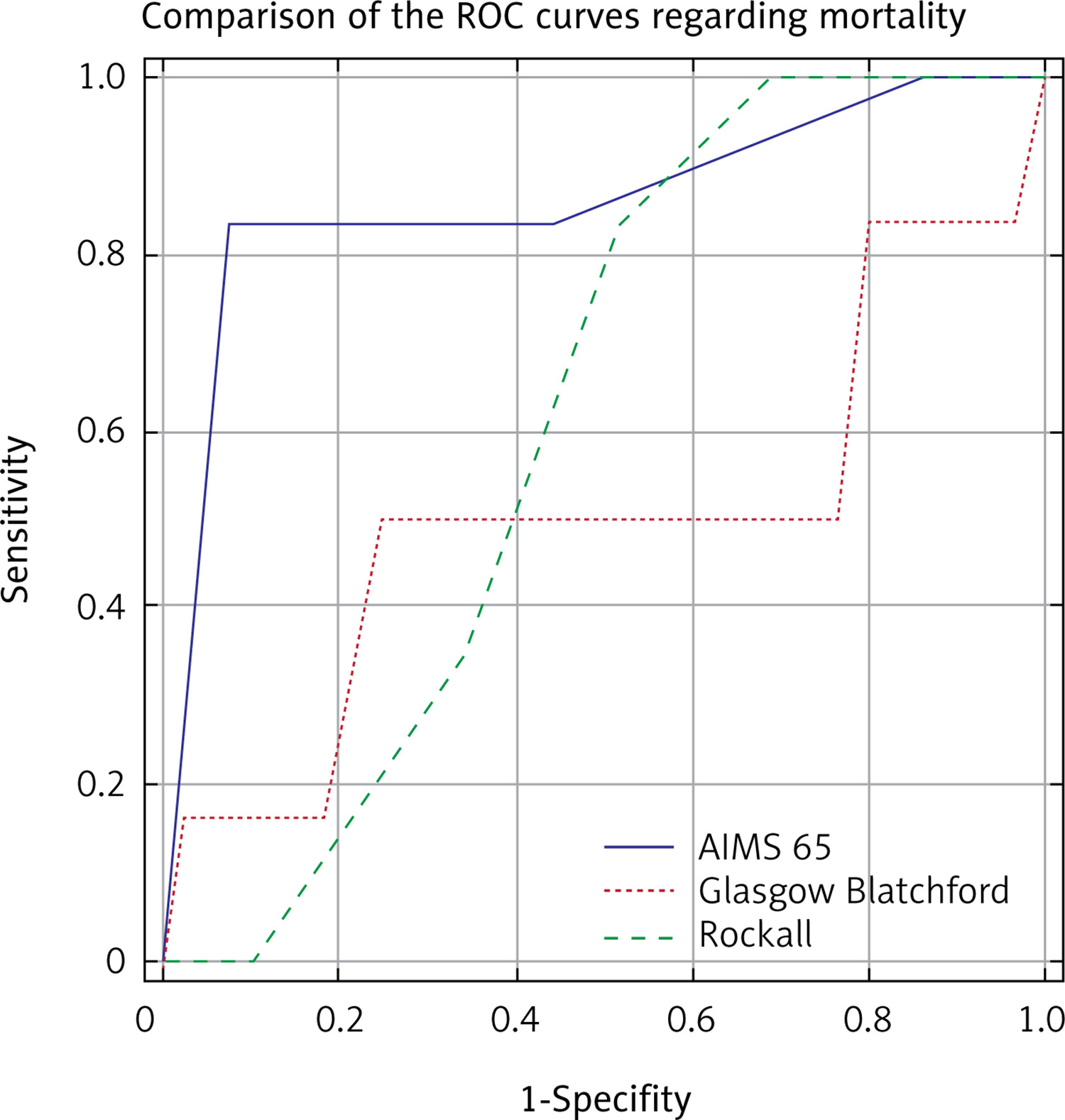
The results of univariate logistic regression are shown in Table II. The area under the curve (AUC) in the ROC analysis revealed that the AIMS65 scale was the most accurate in mortality prediction (AUC = 0.859, p = 0.002), whereas Rockall and Glasgow-Blatchford scores were not significant (AUC = 0.614, p = 0.093 and AUC = 0.504, p = 0.97, respectively) (Figures 1, 2).
Table II
Risk factors for need of transfusion > 4 units of PRBC v1.0
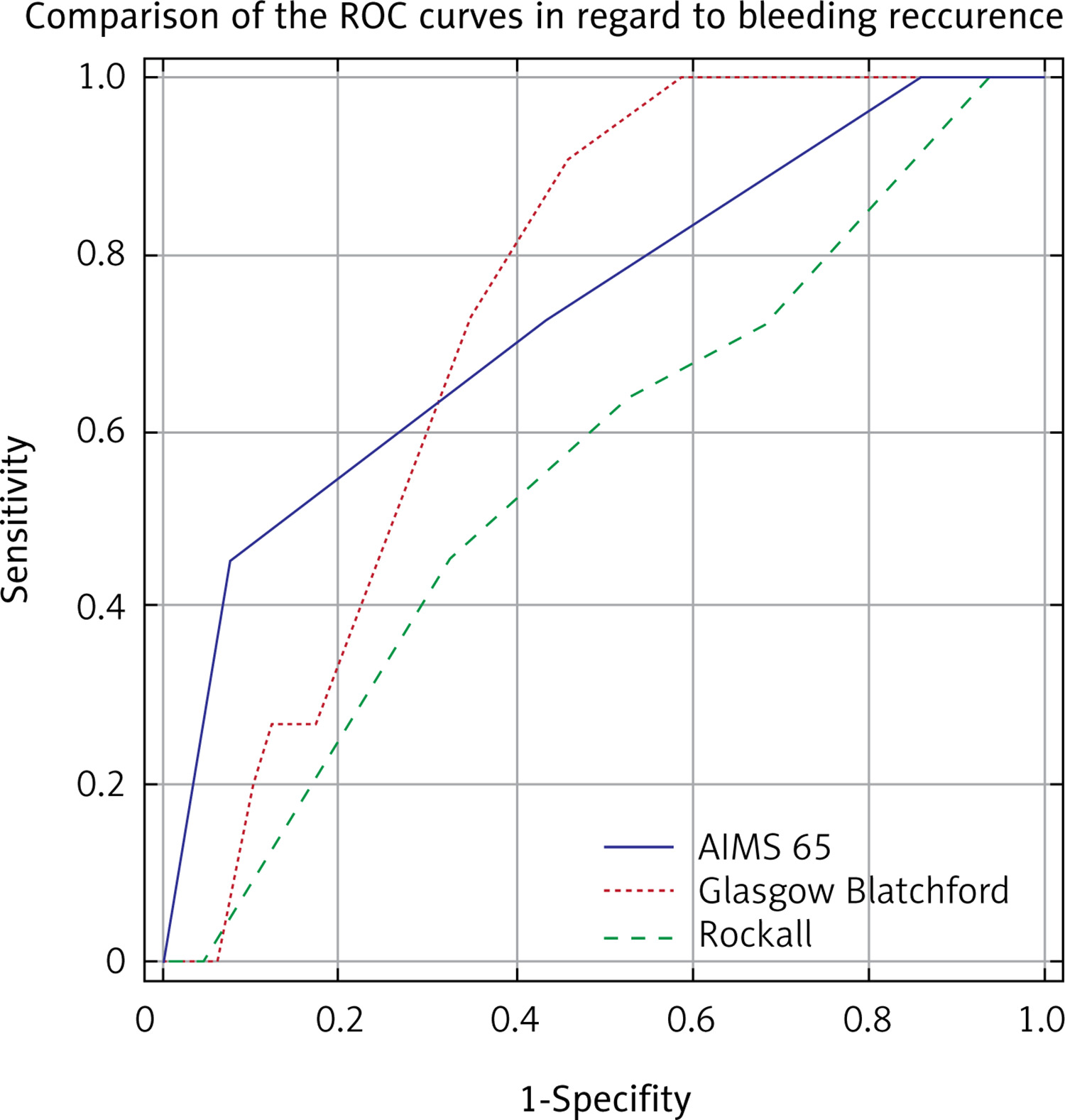
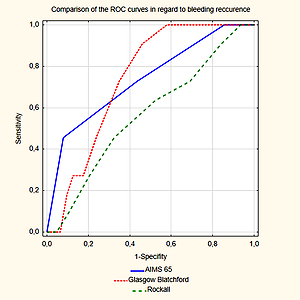
There were 11 patients with bleeding recurrence during their hospitalization. ROC analysis revealed that the AIMS65 and Glasgow-Blatchford score were comparable in rebleeding prediction (AUC = 0.735; p = 0.004 and AUC = 0.737; p = 0.001 respectively). The Rockall score had lower accuracy (AUC = 0.56; p = 0.451).
102 patients required blood transfusions during hospitalization and 29 patients required more than 4 units of packed red blood cells. 51 patients required fresh frozen plasma transfusions. The data are summarized in Table III.
Table III
Baseline characteristics of study group
The AIMS65 score > 2 was the only factor predicting the need of >4 blood units transfusion during hospitalization (OR = 3.977; 95% CI: 1.305–12.122, p = 0.015), whereas Glasgow-Blatchford scale > 5 was the only risk factor for the need of fresh frozen plasma transfusion (OR = 3.657; 95% CI: 1.010–13.242, p = 0.048). The results are summarized in Table IV.
Table IV
Risk factors for need of transfusion FFP v1.0
Discussion
This study has demonstrated the value of the AIMS65 scoring system, which proved to be most accurate in mortality prediction and need of blood transfusion in patients with upper GI tract bleeding.
The AIMS65 scoring system’s main objective is to stratify patients with a high risk of in-hospital mortality [7]. In our study, it was the only scoring system that helped to accurately predict in-hospital death [8]. It is in line with the study by Robertson et al., who showed superiority of this scoring system in comparison to Glasgow-Blatchford and Rockall scales [9]. A Japanese study also revealed superiority of the AIMS65 score [10]. In addition to its high accuracy, the AIMS65 system is simple and based on basic parameters [11]. In contrast, Choe et al. suggested that both Rockall and Glasgow-Blatchford scales are more accurate in predicting the need of blood transfusion and endoscopic intervention [12]. Stanley et al., using data from six hospitals in Europe, North America, Asia and Oceania, found superiority of AIMS65 for mortality prediction, but the authors still recommended the Glasgow-Blatchford scale as most accurate in general risk stratification [13]. Shafaghi et al. proposed a modified Glasgow-Blatchford scoring system, taking the albumin level into account, as more accurate in the Central European population [14].
AIMS65 and Glasgow-Blatchford scales were comparable in prediction of rebleeding. The same findings were revealed in a study by Rout et al. [15]. However, as the author pointed out, the AIMS65 scale was originally invented for risk stratification of non-variceal upper GI bleeding [16].
In our study, the AIMS65 score was also superior to the others in predicting the need for blood transfusion. Conversely, Hyett et al. underlined the superiority of the Glasgow-Blatchford scale [11]. One possible explanation for this discrepancy is the frequent use of oral anticoagulants in central Europe, which elevates the INR level, one of the components of the AIMS65 scale. However, in our study the Glasgow-Blatchford scale was the only one that helped with predicting the need for plasma transfusion.
Our study has some limitations, which may affect the final results. First, the study is designed as a retrospective analysis of data, and therefore some important data might have been missed in the medical records. Secondly, the study group is middle-sized, which may have an impact on the final results. Lastly, we did not perform a multivariate-analysis of logistic regression, because in all cases there was only one significant factor in the univariate analysis.
In conclusion, we recommend using the AIMS65 scoring system. It is simple and requires few parameters to be counted. Also, it proved to be the most efficient in predicting in-hospital mortality.