Current issue
Archive
Manuscripts accepted
About the Journal
Editorial office
Editorial board
Section Editors
Abstracting and indexing
Subscription
Contact
Ethical standards and procedures
Most read articles
Instructions for authors
Article Processing Charge (APC)
Regulations of paying article processing charge (APC)


Editor's Choice
SMOKING / RESEARCH PAPER
Prevalence and Patterns of E-Cigarette Use Among U.S. Adults: A Repeated Cross-Sectional Analysis of the All of Us Research Program, 2017–2023
1
Johns Hopkins University, United States
2
Department of Medicine, Rutgers New Jersey Medical School, United States
3
Department of Population Health, New York University School of Medicine, United States
4
Cardiovascular Medicine, Boston Medical Center, Boston University Chobanian and Avedisian School of Medicine, United States
5
University of Louisville School of Medicine, United States
6
Department of Epidemiology, Boston University School of Public Health, United States
Submission date: 2026-04-16
Final revision date: 2026-08-07
Acceptance date: 2026-09-03
Online publication date: 2026-09-03
KEYWORDS
observational studyprevalenceyoung adultssurveillancenicotine dependenceelectronic nicotine delivery systemshealth disparitiestobacco usee-cigarettesAll of Us Research Program
TOPICS
ABSTRACT
Introduction:
Large-scale, ongoing cohort studies may offer a complementary approach for monitoring population patterns of e-cigarette use alongside established national surveillance systems. This study assessed the prevalence and patterns of current and daily e-cigarette use among adults in the All of Us Research Program from 2017 to 2023 and compared observed patterns with those from established national surveys.
Material and methods:
This repeated cross-sectional analysis included adults aged 18 years or older who completed the All of Us Lifestyle Survey between 2017 and 2023. Current and daily e-cigarette use were ascertained through self-reported survey items. The analytic cohort was sex-balanced through random subsampling of female participants (1:1 ratio), and overall prevalence estimates were age-standardized to the 2020 U.S. Census adult age distribution. All analyses were descriptive.
Results:
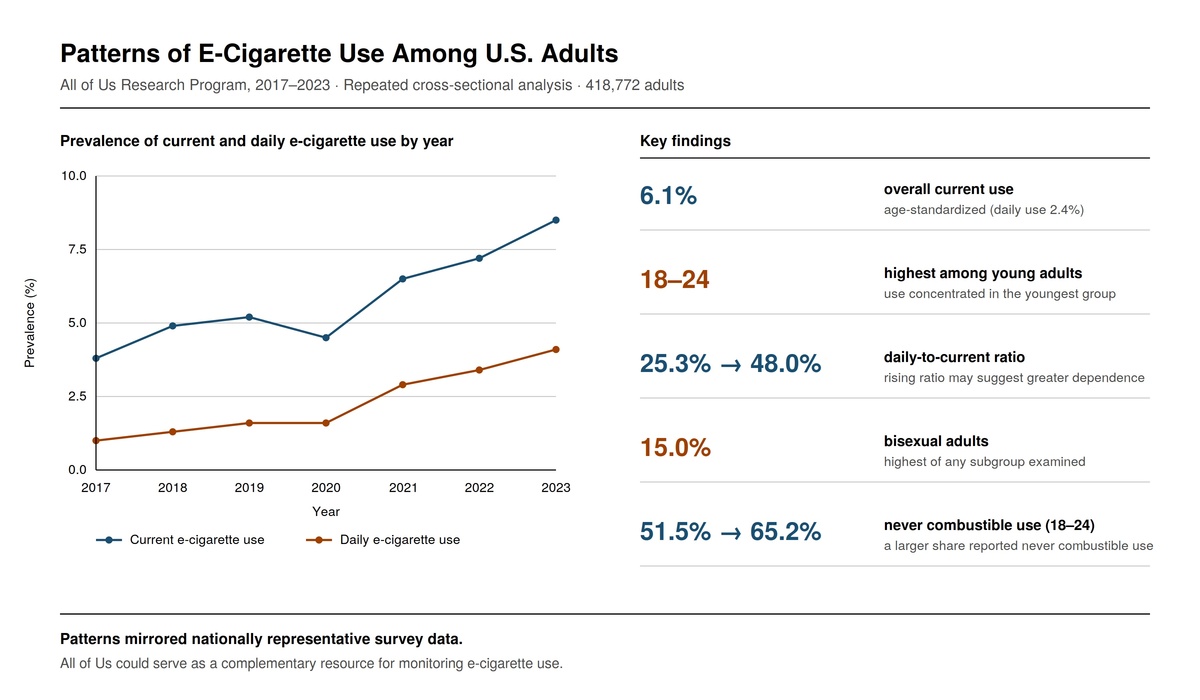
The analytic sample included 418,772 participants. Age-standardized prevalence of current e-cigarette use was 6.1% (95% CI: 6.0–6.2), and daily use was 2.4% (95% CI: 2.3–2.4). Prevalence was highest among adults aged 18–24 years (13.3%), male participants (7.0%), and those with depression (7.5%). Annual current use prevalence rose from 3.8% in 2017 to 8.5% in 2023, with a dip to 4.5% in 2020. Among young adults reporting current e-cigarette use, the proportion reporting never combustible cigarette use grew from 51.5% in 2017 to 65.2% in 2023.
Conclusions:
E-cigarette use was most common among young adults, with patterns consistent with nationally representative datasets. These findings support the potential of the All of Us Research Program as a complementary resource for monitoring e-cigarette use.
Large-scale, ongoing cohort studies may offer a complementary approach for monitoring population patterns of e-cigarette use alongside established national surveillance systems. This study assessed the prevalence and patterns of current and daily e-cigarette use among adults in the All of Us Research Program from 2017 to 2023 and compared observed patterns with those from established national surveys.
Material and methods:
This repeated cross-sectional analysis included adults aged 18 years or older who completed the All of Us Lifestyle Survey between 2017 and 2023. Current and daily e-cigarette use were ascertained through self-reported survey items. The analytic cohort was sex-balanced through random subsampling of female participants (1:1 ratio), and overall prevalence estimates were age-standardized to the 2020 U.S. Census adult age distribution. All analyses were descriptive.
Results:
The analytic sample included 418,772 participants. Age-standardized prevalence of current e-cigarette use was 6.1% (95% CI: 6.0–6.2), and daily use was 2.4% (95% CI: 2.3–2.4). Prevalence was highest among adults aged 18–24 years (13.3%), male participants (7.0%), and those with depression (7.5%). Annual current use prevalence rose from 3.8% in 2017 to 8.5% in 2023, with a dip to 4.5% in 2020. Among young adults reporting current e-cigarette use, the proportion reporting never combustible cigarette use grew from 51.5% in 2017 to 65.2% in 2023.
Conclusions:
E-cigarette use was most common among young adults, with patterns consistent with nationally representative datasets. These findings support the potential of the All of Us Research Program as a complementary resource for monitoring e-cigarette use.
REFERENCES (31)
1.
Brown CJ, Cheng JM. Electronic cigarettes: product characterisation and design considerations. Tob Control 2014; 23 Suppl 2: ii4-10.
2.
Pinto MI, Thissen J, Hermes N, et al. Chemical characterisation of the vapour emitted by an e-cigarette using a ceramic wick-based technology. Sci Rep 2022; 12: 16773.
3.
Cornelius M, Loretan C, Wang T, Jamal A, Homa D. Tobacco product use among adults – United States, 2020. MMWR Morb Mortal Wkly Rep 2022; 71: 397-405.
4.
Cornelius M, Wang T, Jamal A, Loretan C, Neff L. Tobacco product use among adults – United States, 2019. MMWR Morb Mortal Wkly Rep 2020; 69: 1736-42.
5.
Boakye E, Osuji N, Erhabor J, et al. Assessment of patterns in e-cigarette use among adults in the US, 2017-2020. JAMA Netw Open 2022; 5: e2223266.
6.
Erhabor J, Boakye E, Obisesan O, et al. E-cigarette use among US adults in the 2021 Behavioral Risk Factor Surveillance System Survey. JAMA Netw Open 2023; 6: e2340859.
7.
Obisesan O, Osei A, Uddin S, et al. Trends in e-cigarette use in adults in the United States, 2016-2018. JAMA Intern Med 2020; 180: 1394-8.
8.
Centers for Disease Control and Prevention. Health effects of vaping. https://www.cdc.gov/tobacco/e-... (accessed 10 Jan 2026).
9.
Drummond MB, Upson D. Electronic cigarettes: potential harms and benefits. Ann Am Thorac Soc 2014; 11: 236-42.
10.
Travis N, Knoll M, Cadham CJ, et al. Health effects of electronic cigarettes: an umbrella review and methodological considerations. Int J Environ Res Public Health 2022; 19: 9054.
11.
Yao Z, Tasdighi E, Dardari ZA, et al. Use of e-cigarettes, traditional combustible cigarettes, and high sensitivity C-reactive protein: the Cross Cohort Collaboration. Am Heart J 2025; 280: 1-6.
12.
Ali FRM, Seidenberg AB, Crane E, et al. E-cigarette unit sales by product and flavor type, and top-selling brands, United States, 2020-2022. MMWR Morb Mortal Wkly Rep 2023; 72: 672-7.
13.
Boakye E, Erhabor J, Obisesan O, et al. Comprehensive review of the national surveys that assess e-cigarette use domains among youth and adults in the United States. Lancet Reg Health Am 2023; 23: 100528.
14.
Rodu B, Plurphanswat N. E-cigarette use among US adults: Population Assessment of Tobacco and Health (PATH) Study. Nicotine Tob Res 2018; 20: 940-8.
15.
Levy DT, Yuan Z, Li Y, et al. An examination of the variation in estimates of e-cigarette prevalence among U.S. adults. Int J Environ Res Public Health 2019; 16: 3164.
16.
Pacek L, Sawdey M, Gross A, et al. Nicotine-containing electronic nicotine delivery systems (ENDS) use in the United States, stratified by age, National Survey on Drug Use and Health, 2021. Subst Use Misuse 2025; 60: 342-50.
17.
Center for Behavioral Health Statistics and Quality. 2023 National Survey on Drug Use and Health (NSDUH): Methodological Summary and Definitions. Rockville, MD: SAMHSA; 2024.
18.
Dai H, Leventhal A. Changes in electronic cigarette use among U.S. adults by cigarette smoking status, sociodemographics, and subjective depression, 2019-2020. Prev Med Rep 2022; 30: 102048.
19.
Dai H, Leventhal A. Prevalence of e-cigarette use among adults in the United States, 2014-2018. JAMA 2019; 322: 1824-7.
20.
Denny J, Rutter J, Goldstein D, et al. The “All of Us” Research Program. N Engl J Med 2019; 381: 668-76.
21.
National Institutes of Health. All of Us Research Program Protocol. https://allofus.nih.gov/articl... (accessed 11 Jan 2026).
22.
Cronin R, Jerome R, Mapes B, et al. Development of the initial surveys for the All of Us Research Program. Epidemiology 2019; 30: 597-608.
23.
Mayo KR, Basford MA, Carroll RJ, et al. The All of Us Data and Research Center: creating a secure, scalable, and sustainable ecosystem for biomedical research. Annu Rev Biomed Data Sci 2023; 6: 443-71.
24.
Ramirez AH, Sulieman L, Schlueter DJ, et al. The All of Us Research Program: data quality, utility, and diversity. Patterns 2022; 3: 100570.
25.
U.S. Census Bureau. 2020 Census: Redistricting File (Public Law 94-171) Dataset. Washington, DC: U.S. Census Bureau; 2021.
26.
Centers for Disease Control and Prevention. Tobacco product use among adults – United States, 2022: 2022 NHIS Highlights. 2024.
27.
Centers for Disease Control and Prevention. QuickStats: percentage distribution of cigarette smoking status among current adult e-cigarette users, by age group – NHIS, United States, 2021. MMWR Morb Mortal Wkly Rep 2023; 72: 270.
28.
Kreslake JM, O’Connor KM, Liu M, Vallone DM, Hair E. A resurgence of e-cigarette use among adolescents and young adults late in the COVID-19 pandemic. PLoS One 2023; 18: e0282894.
29.
Struble CA, Bauer SJ, Lundahl LH, et al. Electronic cigarette use among sexual minority and heterosexual young adults in a U.S. national sample: exploring the modifying effects of advertisement exposure. Prev Med 2022; 155: 106926.
30.
Al Rifai M, Mirbolouk M, Jia X, et al. E-cigarette use and risk behaviors among lesbian, gay, bisexual, and transgender adults: the Behavioral Risk Factor Surveillance System (BRFSS) Survey. Kans J Med 2020; 13: 318-21.
31.
Romm KF, Cohn AM, Wang Y, et al. Disparities in trajectories of cigarette and e-cigarette use across sexual orientation groups of young adult men and women in the US. Addict Behav 2023; 145: 107763.
Share
RELATED ARTICLE
| eISSN: | 1896-9151 |
| ISSN: | 1734-1922 |

We process personal data collected when visiting the website. The function of obtaining information about users and their behavior is carried out by voluntarily entered information in forms and saving cookies in end devices. Data, including cookies, are used to provide services, improve the user experience and to analyze the traffic in accordance with the Privacy policy. Data are also collected and processed by Google Analytics tool (more).
You can change cookies settings in your browser. Restricted use of cookies in the browser configuration may affect some functionalities of the website.
You can change cookies settings in your browser. Restricted use of cookies in the browser configuration may affect some functionalities of the website.