Introduction
Gestational diabetes mellitus (GDM) is a form of diabetes that first appears during pregnancy, which occurs in approximately 14% of pregnancies worldwide, representing a significant health concern that requires targeted prevention and management strategies [1]. GDM often presents with subtle or no noticeable clinical symptoms in many cases, so screening tests are needed [2]. GDM has profound implications for both maternal and fetal health, leading to increased risk of cesarean section, macrosomia in infants, and the development of type 2 diabetes (T2DM) in the mother postpartum. These complications are primarily closely related to insulin resistance during pregnancy, fetal hyperinsulinemia, and metabolic abnormalities in the mother [3]. GDM typically resolves shortly after childbirth due to the rapid decrease in pregnancy-related hormones and insulin resistance. However, this condition may have other long-term implications. Women with a history of GDM are at an increased risk of developing T2DM later in life, with up to 50% developing the condition within 5 years of giving birth. Additionally, postpartum weight changes can significantly impact metabolic health [4]. Moreover, children born to mothers with GDM are at a higher risk of obesity and metabolic disorders in their lifetime, potentially due to fetal exposure to hyperglycemia, which may lead to epigenetic modifications, altered fetal programming, and persistent metabolic dysregulation [3, 5]. Overweight and obesity in mothers, advanced maternal age, a prior episode of GDM, a family history of type 2 diabetes, serum vitamin D deficiency, and certain ethnic backgrounds are identified as key risk factors for the development of GDM [6].
Endocrine factors, particularly thyroid function, are crucial for maintaining metabolic balance and optimal fetal development during pregnancy [7]. Thyroid function, such as thyroid-stimulating hormone (TSH) and thyroid hormones (T3 and T4), is essential for regulating metabolism, growth, and development. Both hyperthyroidism and hypothyroidism have been linked to diabetes risk [8]. Recent studies show that elevated free thyroxine (FT4) levels are negatively associated with gestational diabetes mellitus (GDM) risk [9]. Another study showed that elevated TSH levels (> 4 mIU/l) are associated with increased risks of prematurity and respiratory distress syndrome in offspring [10]. Although some associations remain non-significant, these findings highlight the importance of thyroid function screening in pregnant women.[11]. Consequently, it is imperative to investigate further the correlation between thyroid function disturbance and the development of GDM to enhance our understanding and potentially inform preventive strategies.
Mendelian randomization (MR) is an epidemiological technique using genetic variants as instrumental variables (IVs) to investigate causal relationships between risk factors and disease outcomes [12]. This approach capitalizes on the random assortment of genes from parents to offspring during reproduction, assuming that these genetic variants are not confounded by lifestyle or environmental factors, thus providing a robust method to infer causality in observational studies [13]. Despite numerous studies on the association between thyroid function disturbance and GDM, there is a scarcity of MR research in this area.
To address the knowledge gap regarding the relationship between thyroid function disturbance and GDM using MR methods, this study selected appropriate genetic markers as IVs and applied robust statistical analyses. It aimed to provide a definitive understanding of their causal relationship, informing clinical prevention and intervention strategies for GDM.
Material and methods
Study design
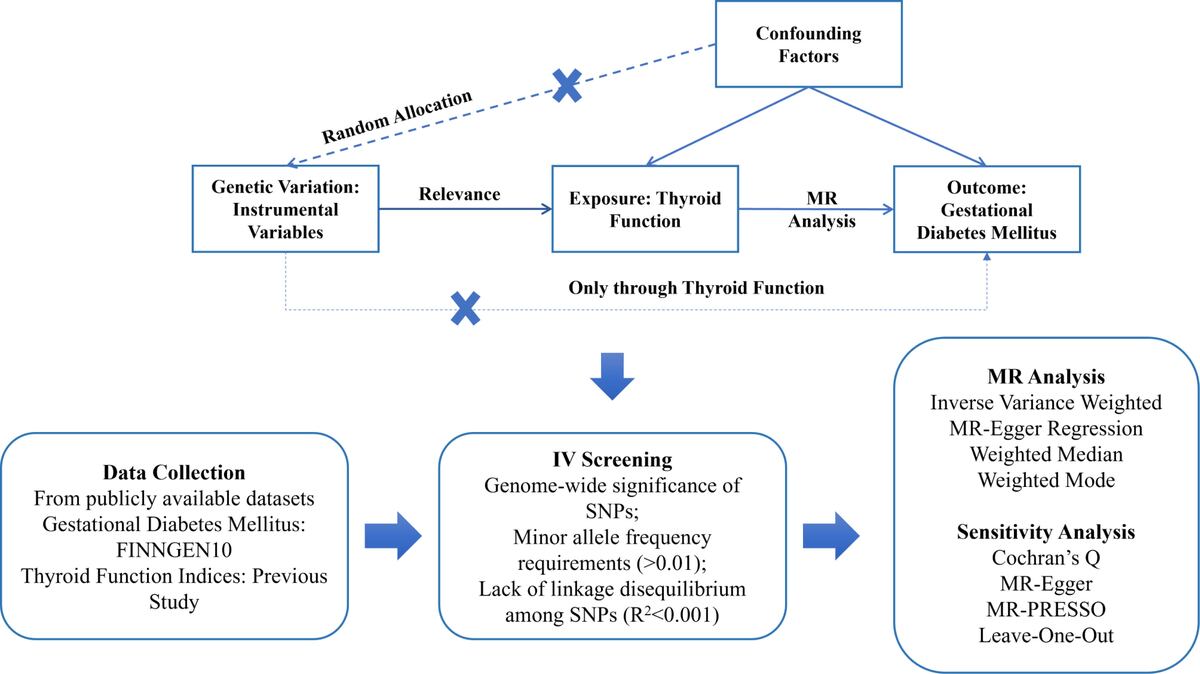
Our writing adheres to the MR-STROBE guidelines, ensuring the transparent and accurate reporting of MR studies [14]. MR studies are predicated on three fundamental assumptions [12]: 1) Random allocation: Genetic variants are inherently randomly distributed at conception, separate from other elements that may impact both the exposure and the disease outcome. This presupposes that these genetic variants are unaffected by confounding influences. 2) Relevance: The genetic variants exhibit a robust correlation with the exposure of interest – in this study, thyroid function-related indices. It is imperative that these variants significantly influence the levels of the exposure. 3) Instrumental validity: The genetic variants exert an impact on the disease outcome (GDM), solely through their influence on the exposure. This assumption is critical in confirming that any observed relationship between the exposure and the disease outcome is not confounded by extraneous factors.
Source of data
The data for this study were derived from publicly available datasets, thereby eliminating the need for ethical approval. The data sources used in this study exclusively comprised European populations. This approach ensures homogeneity in genetic background and reduces potential biases associated with population stratification.
The GWAS data for GDM were obtained from the analysis of the large-scale FINN cohort in the IEU database (https://storage.googleapis.com/finngen-public-data-r10/summary_stats/finngen_R10_GEST_DIABETES.gz). Among the participants, a total of 14,718 cases of GDM were identified, contrasted with 215,592 control cases, respectively.
The GWAS for thyroid function-related indices was obtained from the literature of previous studies [15]. The research performed GWAS meta-analyses in 18,297 individuals for thyroid peroxidase antibody (TPOAb) positivity (1769 TPOAb-positive and 16,528 TPOAb-negative individuals) and in 12,353 individuals for TPOAb serum levels, with replication in 8,990 individuals. For the Graves’ disease analyses, cases were recruited from the United Kingdom Graves’ disease cohort and controls from the British 1958 Birth Cohort. Thyroid cancer cases and controls were recruited from the Nijmegen and Ohio thyroid cancer cohorts.
The main data analyzed include free thyroxine (or tetraiodothyronine) (FT4), total triiodothyronine (TT3), free triiodothyronine (FT3), thyroid-stimulating hormone (TSH), and FT3/FT4.
Selection of instrumental variables
In the study, the selection of IVs was conducted with meticulous adherence to a set of rigorous standards to ensure their validity and relevance. Initially, we identified single nucleotide polymorphisms (SNPs) with genome-wide significant associations with thyroid function indices using a stringent significance threshold of p < 5 × 10⁻⁸. For the selection of SNPs based on total triiodothyronine (TT3) as the exposure, the threshold was adjusted to p < 5 × 10⁻⁶ due to the limited number of available SNPs for this specific trait. Only SNPs with a minor allele frequency greater than 0.01 were included in the analysis [16]. To address the potential confounding effects of linkage disequilibrium (LD) among SNPs, a filter was applied based on R2 < 0.001 within a 10,000 kb window, effectively eliminating SNPs with LD effects [17]. In cases where the selected IVs were absent in the outcome’s summary data, proxy SNPs exhibiting a high degree of LD (R2 > 0.8) were identified to serve as substitutes [18]. Furthermore, the strength of the IVs was evaluated by calculating the F-statistic for each SNP within the IVs to avoid the bias associated with weak instrument effects. The calculation was performed using the formula F = R2 × (N – 2)/(1 – R2), where R2 denotes the proportion of the exposure’s variance explained by the SNP. It was essential that the F-statistic exceeded a value of 10, thereby confirming the robustness of the IVs in relation to the thyroid function indices [19].
MR analysis
In this analysis, the primary method applied was the inverse variance weighted (IVW) approach, a cornerstone for interpreting MR outcomes, which calculates the weighted average of effect sizes, each weighted by the inverse of its variance [20]. This approach facilitated the estimation of the odds ratio (OR) with the 95% confidence interval (CI), assessing the causal relationship between exposure and outcome risk. To address potential pleiotropy bias, the MR-Egger intercept was used, providing a robust estimation of the causal effect despite the presence of such biases [21]. Additionally, the weighted median method was employed under the assumption of half of the IVs being effective, further examining the causal association. The weighted mode method was also applied to bolster the results’ validity [22]. All analyses were performed using the TwoSampleMR package in R version 4.0.5, a specialized tool for MR studies. The visualization of results through forest plots, scatter plots, and funnel plots offered a graphical interpretation of the data, enhancing the findings’ interpretability. This comprehensive approach ensures a rigorous and dependable evaluation of the causal associations within the study.
Sensitivity analysis
The heterogeneity across the IVs was evaluated using Cochran’s Q test, where a p-value exceeding 0.05 signified a low degree of heterogeneity [23]. This suggested that the variance in estimations among the IVs was random and had a negligible effect on the IVW results. To mitigate the impact of genetic pleiotropy on the estimated association effects, the MR-Egger regression method was applied [24]. A non-significant intercept in the MR-Egger regression, close to zero, indicated that pleiotropy was not present, thus supporting the validity of the causal estimates. Additionally, the MR Pleiotropy RESidual Sum and Outlier (MR-PRESSO) was used to detect outliers, identified by a p-value less than 0.05, and to correct for horizontal pleiotropy by excluding these outliers and re-estimating the causal relationships [25]. Complementing these approaches, a leave-one-out sensitivity analysis was performed to assess the robustness and consistency of the findings [26]. By sequentially omitting each IV and recalculating the estimates, this method ensured that no single IV disproportionately influenced the results, thereby validating the reliability of the conclusions derived from the MR analysis.
Results
Instrumental variables and methodological approaches
In this comprehensive MR study, we identified a total of 266 IVs relevant to thyroid function disturbance, ensuring a robust genetic representation of the exposure variables (Supplementary Table SI). The mean F-statistic value for these IVs was 123.94, with a minimum of 20.85 and a maximum of 1479.73. These values indicate a strong instrument effect across the selected variables, thereby minimizing the potential for weak instrument bias and enhancing the reliability of our MR analysis.
When GDM was considered as the outcome, we encountered missing information for several SNPs in the summary data. To address this limitation and ensure the continuity of our analysis, we employed proxy SNPs as substitutes for the missing ones. Specifically, the following substitutions were made: rs11626350 was replaced by rs8015085, rs11860343 by rs4401038, rs75705948 by rs10946313, rs2810494 by rs467317, rs17450274 by rs36067198, rs1129735 by rs41315758, and rs554833 by rs576123. These substitutions ensured the integrity of our MR study findings by maintaining the genetic linkage disequilibrium and preserving the statistical power of our analyses.
Causal effects of thyroid function indices on GDM
As illustrated in Table I, the results from the IVW method for all thyroid function disturbance showed no statistically significant association with GDM. For instance, FT4: OR = 0.99, 95% CI: 0.88–1.11, p = 0.84; TT3: OR = 1.10, 95% CI: 0.98–1.24, p = 0.12; FT3: OR = 1.16, 95% CI: 0.96–1.40, p = 0.13; TSH: OR = 1.01, 95% CI: 0.94–1.08, p = 0.83; FT3/FT4: OR = 1.05, 95% CI: 0.58–1.91, p = 0.87. These results collectively indicate a lack of significant causal effect of thyroid function indices on GDM. The results of the other methods are mostly consistent with IVW.
Table I
Causal association between thyroid function and gestational diabetes mellitus
However, a notable discrepancy was observed for TT3 when using the weighted median method. This method yielded a positive result with an OR of 1.177 (95% CI: 1.013–1.368, p = 0.033), which contrasts with the IVW result. This inconsistency suggests that other confounding factors or pleiotropic effects may influence the relationship between TT3 and GDM, warranting further investigation.
Assessment of pleiotropy and heterogeneity
As shown in Table II, the MR Egger regression intercept results indicated no significant horizontal pleiotropy across all thyroid function disturbance (p-values were non-significant). This finding supports the validity of our MR assumptions and reinforces the robustness of our primary IVW analysis. The funnel plots in Supplementary Figure S1 illustrate the heterogeneity assessment, revealing significant heterogeneity for FT4 (p < 0.05) and TSH (p < 0.05) in the IVW analysis. Given the presence of heterogeneity, we employed a random effects model in our primary IVW analysis, which inherently accommodates a degree of heterogeneity and enhances the robustness of our findings.
Sensitivity analyses and outlier detection
Table III presents the results of the MR-PRESSO analysis, which identified one outlier (rs12036629) in the analysis of FT4 as the exposure for GDM. After excluding this outlier, the results remained negative, with an OR of 1.0159 (95% CI: 0.9317–1.1078, p = 0.7215). Similarly, for TSH as the exposure, two outliers were identified (rs10123643 and rs700750). Even after correcting for these outliers, the results continued to show no significant association, with an OR of 1.0137 (95% CI: 0.9558–1.0751, p = 0.651). The observed heterogeneity in FT4 and TSH may be attributed to the presence of outliers; however, the consistency of negative results after outlier exclusion further strengthens the robustness and reliability of our overall findings.
Table III
MR-PRESSO results
Additionally, the leave-one-out sensitivity analysis results (Supplementary Figure S2) demonstrated the stability of our findings across different IVs, further confirming that our negative results are not driven by any single genetic instrument. This comprehensive approach to sensitivity analysis ensures that our conclusions are reliable and minimizes the potential for bias or spurious associations.
Discussion
This study contributes valuable insights to the field by employing a MR approach to investigate the hypothesized causal relationship between thyroid function disturbance and GDM. The principal findings, derived from the IVW method, reveal no statistically significant association between various thyroid function disturbance and the risk of GDM, suggesting a negative outcome. This outcome implies that the genetic predispositions to thyroid function, as captured by our selected IVs, do not appear to exert a direct causal influence on the development of GDM, challenging some previously held assumptions and warranting further exploration into the complex interplay of factors contributing to this condition.
Previous studies have extensively explored the relationship between thyroid function disturbance and GDM, yielding a variety of findings that contribute to the understanding of this complex association. The study by Sert et al. underscores the significance of TSH, T4, and T3 levels in the first trimester, along with anti-thyroid peroxidase (anti-TPO) and anti-thyroglobulin (anti-TG) antibodies, and renal iodine excretion (RIE) in predicting the risk of GDM [27]. The results showed that the elevated TSH levels and positive anti-TPO and anti-TG antibody rates were more frequent among patients with GDM, suggesting that thyroid function tests may be instrumental in identifying women at increased risk of GDM. Similarly, the research by Chen et al. in China highlights an inverse association between higher serum concentrations of FT4 and the risk of GDM [9]. However, no significant associations were observed for TSH concentration, thyroid function subtypes, or anti-TPO positivity with GDM risk. The study by Chen et al. explored the combined effects of maternal FT4 levels and triglyceride (TG) responses on the prevalence of GDM [28]. The findings revealed an L-shaped association between maternal FT4 levels and GDM, with the highest risk for GDM observed among women with lower FT4 and the highest TG concentrations. This study provides new insights into the complex relationship between thyroid function disturbance and GDM risk. The prospective cohort study by Huang et al. from Beijing Obstetrics and Gynecology Hospital further supports the association between elevated TSH levels and the risk of GDM [29]. The study’s robust design and large sample size lend credibility to the finding that even TSH levels within the normal range may be a risk factor for GDM, particularly when pre-pregnancy BMI is considered. However, the present study yielded negative results, indicating no significant causal association between thyroid function disturbance and the risk of GDM, which contrasts with some previous findings. Several factors might account for the inconsistency between the results of this study and those reported in the literature. Differences in study design, such as the timing of thyroid function measurements during pregnancy, the specific population studied, and the criteria used for GDM diagnosis, could influence the outcomes [30]. Genetic predispositions and ethnic variations in thyroid function disturbance and GDM susceptibility might not be uniformly distributed across populations, leading to varying results in different studies [31]. Unmeasured or inadequately controlled confounding factors, such as diet, physical activity, or obesity, could influence both thyroid function disturbance and the risk of GDM, potentially masking a true association [32]. Variability in the assays used to measure thyroid function across different studies could lead to discrepancies in the reported associations [33]. The definition of thyroid dysfunction and the thresholds for thyroid hormone levels used to categorize women into different groups might differ between studies, affecting the comparability of results [33]. Understanding these discrepancies is crucial for the development of more targeted and effective preventive and treatment strategies for GDM. Future research should consider these factors to ensure a more accurate assessment of the relationship between thyroid function disturbance and GDM risk. This could involve exploring different populations and settings to account for genetic, environmental, and lifestyle factors.
Another point worth mentioning is that the role of thyroid autoimmunity, indicated by anti-TPO antibodies, may not have been fully captured in this study, as some studies suggest that autoimmune thyroid disorders are more prevalent in women with GDM. For instance, in the cohort study by Wang et al., the presence of thyroid autoantibodies appeared to modify the association between thyroid dysfunction and the risk of GDM and pre-eclampsia, suggesting that autoimmune processes may play a role in the pathophysiology of these pregnancy complications [34]. Safian et al.’s study adds to this by highlighting the increased prevalence of subclinical hypothyroidism and thyroid autoimmunity in pregnant women with GDM [35]. The higher frequency of anti-TPO antibodies in women with GDM compared to healthy pregnant women underscores the potential influence of thyroid autoimmunity on glucose metabolism during pregnancy. Li X et al.’s research specifically addresses the context of assisted pregnancies, identifying a significant association between anti-TPO positivity and an increased risk of GDM [36]. Furthermore, the study indicates that higher TSH or lower FT4 levels, in conjunction with anti-TPO positivity, are associated with a greater risk of GDM in assisted pregnancies. Overall, the collective evidence from these studies reinforces the intricate connection between thyroid function, autoimmunity, and the risk of adverse pregnancy outcomes. Further research is warranted to explore the underlying mechanisms and to develop effective strategies for prevention and management of GDM in women with thyroid dysfunction. Specifically, investigating molecular pathways and genetic factors could provide deeper insights into how thyroid disorders affect pregnancy health.
This study benefits from a large sample size and a rigorous application of MR methods, providing robust evidence for the investigation of the causal relationship between thyroid function disturbance and GDM. However, several limitations are worth noting. Firstly, the study may be subject to residual confounding factors that were not measured, which could influence both thyroid function disturbance and the risk of GDM. Secondly, the generalizability of the findings may be limited due to the specific demographic characteristics of the study population. Additionally, this study did not measure other potential factors that could impact thyroid function. Lastly, while this study provides insights into the relationship between thyroid function disturbance and GDM, it does not elucidate the underlying biological mechanisms. Future research should aim to develop effective strategies for the prevention and management of GDM in women with thyroid dysfunction. This includes longitudinal studies to monitor changes over time and intervention trials to test potential therapies.
In conclusion, this study, employing robust MR methods, found no statistically significant association between thyroid function disturbance and the risk of GDM. The results, which contrast with some previous findings, highlight the complexity of this relationship. This underscores the need for further research into potential confounders and biological mechanisms linking thyroid function disturbance and GDM. It also emphasizes the importance of considering the multifaceted nature of pregnancy physiology when interpreting such associations. As our understanding of these relationships evolves, so too must the approach to managing thyroid function in pregnancy to optimize maternal and fetal health.